
Building EU-India Synergy: Allying sustainable modernisation and strategic autonomy
Télécharger la versoin pdf
Strategic convergences mean that EU-India partnerships have the potential to be a vector of change for both actors and to offer new prospects for policy dialogue, as well as shared technical, industrial, and economic development. However, their differences of approach should be better understood and points of contention should also be further analysed so as to ultimately be addressed in a transparent manner.
Introduction
In recent years, the European Union (EU) and India have become increasingly active partners, while closely cooperating in:
- green sectoral areas: climate change mitigation and adaptation, but also the circular economy and better management of transport, water and urbanisation;
- the area known as the ‘Indo-Pacific’: a geopolitical stage stretching from the North West Indian Ocean (NWIO) to the Pacific that produces two-thirds of global Gross Domestic Product (GDP) and acts as a conduit of the majority of global trade.
This current strategic convergence means that the EU-India Partnership has the potential to be a vector of change for both actors and to offer new prospects for policy dialogue, as well as shared technical, industrial, and economic development. However, not only should their differences – or possible divergences – of approach be better understood, but the tensions surrounding their various shared objectives should also be further analysed so as to ultimately be addressed in a transparent manner.
Two such objectives have been ‘sustainable development’ and ‘strategic autonomy’. In 2018, the EU’s Joint Communication and 2020-2025 Roadmap described ‘an enhanced EU-India partnership on sustainable modernisation’ as being central to the EU’s India strategy. ‘Strategic autonomy’ has always been a key element of independent India’s foreign policy; and, despite the fact that it has been part of the discourse of EU Member States for decades (although not always used in a positive manner), it has more recently also become commonplace in the vocabulary of the EU institutions in the context of a rapidly changing geopolitical landscape. In India’s case, ‘strategic autonomy’ has been the most constant objective of its foreign policy, while the question of sustainable development is a major issue at the intersection of both its domestic and external policies.
In addition to these shared interests, new global trends and their repercussions make EU-India collaboration even more urgent. First, in a more uncertain world, rising tensions with China and Russia provide an additional reason for cooperation on combining green goals with security objectives: in particular, the invasion of Ukraine raises the challenge of how to manage supply chain disruptions, while maintaining an adequate degree of strategic autonomy and commitment to climate-related objectives. Second, overlaps between the matters of strategic autonomy and sustainable modernisation are becoming increasingly complex. This complexity, in turn, requires innovative solutions that need to be addressed at all policy levels, including bilateral partnerships. On the EU side, for example, there have been recent efforts to increase its semiconductor industrial capabilities and decrease its energy dependence on Russia. In their Joint Communication of March 2021,(x) several EU institutions stated that the green and digital transformations of Europe should (inter alia) increase security standards and actively contribute to economy-wide decarbonisation efforts over the next decade. However, the European Chips Act, a 43-billion-euro plan proposed by the Commission in February 2022 to boost the semiconductor industry within the EU, makes little direct mention of climate targets beyond its overall stated goal of ensuring there is no slowdown in the EU’s ‘digital and green transition’.(x) Tellingly, the Chips Act’s rhetoric focuses on digital sovereignty without addressing the potential dichotomy between its general decarbonisation goal and the environmental damage emanating from the energy and water uses of the semiconductor industry, as well as the resulting hazardous waste.(x)
This study identifies and examines ways in which the two objectives of sustainable modernisation and strategic autonomy intersect for the EU and India; a process which is leading to both tensions and potential synergies in policymaking. It is based on a corpus of official documents, interviews carried out with policymakers and experts in Europe (Paris and Brussels) and in India (New Delhi), as well as secondary literature. How have the concepts of ‘sustainable modernisation’ and ‘strategic autonomy’ been defined and understood in the EU and India? What are the convergences and divergences regarding the perspectives of the partners on these concepts and objectives? The study thus focuses on three specific policy areas: security, sustainable development and climate, and trade and investment. In a final section, this study offers recommendations about how to increase synergies between sustainable modernisation and strategic autonomy within the context of the EU-India Strategic Partnership.
I. Defining the Two Goals
Sustainable Modernisation and Strategic Autonomy
For the EU
The EU and India understand ’sustainable modernisation’ as a cross-cutting term under which to develop strategies that combine social, planetary and economic interests.(x) This alignment theoretically results in the simultaneous advancing of multiple Sustainable Development Goals (SDGs) while better taking into account negative externalities.
The concept itself is not well defined, something which enables governments to craft their own strategies when synthesising common objectives with regard to improving societal wellbeing, protecting natural habitats and unlocking growth potential. The relationship with the concept of strategic autonomy is mainly addressed through efforts to increase resource efficiency and reduce dependency on foreign sources of materials (ores, fertilisers, commodities) or energy (oil, gas, coal, uranium).
On the European side, the December 2019 European Green Deal,(x) from which the institutional conceptualisation of sustainable modernisation partly emanates, envisages investments in a systemic decarbonisation of energy systems, infrastructure, transport, industrial processes, agriculture and land use as key components of a sustainable future. Internally, the EU has historically used its regulatory powers to advance some of these objectives across Member States by amending existing sectoral pieces of legislation.(x) It has, for instance, adopted measures dedicated to meeting greenhouse gas (GHG) emissions targets, such as those on the regulation of the carbon removal industry or on the use of land and forests.(x) The Commission has used the Recovery Plan for Europe, a stimulus bill aimed at restoring economic growth following the Covid-19-induced crisis, to formulate economy-wide pieces of legislation, expanding the use of innovative financial instruments and vastly increasing the dedicated budget.(x) Moreover, Directive 2021/1119 enshrined into law a framework for achieving climate neutrality. This directive, dubbed the European Climate Law, focuses on climate mitigation, but also contains adaptation and resilience components.(x) In this document, the EU also states that the low-carbon transition will have to be cost-effective, just and socially inclusive.
Sustainable modernisation has been explicitly identified as a prominent component of various EU-India development partnerships, recognising the recent shift in India’s stance and bringing sustainability to the forefront of policymaking. The recently launched ‘Global Gateway’ strategy (December 2021),(x) which coordinates financial flows from the EU and its Member States and their respective financial and development institutions, identifies digitalisation, climate and energy, transport, health, education and research as the cornerstones of its foreign policy. The Global Gateway aims to build on connectivity partnerships, including the one with India, to boost the EU’s geopolitical influence, thereby maximising impact with limited resources and ensuring buy-in from Member States at the same time. Through the Global Gateway, the Union states that it ‘aims to mobilise up to €300 billion in investments between 2021 and 2027 to underpin a lasting global recovery, taking into account our partners needs and EU’s own interests.’ The term ‘connectivity’ encompasses a broad range of potential actions and is viewed in parallel to ‘sustainable modernisation’ as a capable means of strengthening EU-India relations on theoretical and practical grounds.
For India
India has published a Nationally Determined Contribution (NDC) to the Paris Agreement and joined international alliances and coalitions to promote the circular economy and protect biodiversity.(x) While it does not have comparable climate laws, it has identified renewable energy, water supplies and the circular economy as ‘national missions’. These combine the twin objectives of making the country a leading destination for foreign direct investment (FDI) and addressing environmental concerns. Diversification related to imported fossil fuels, fertilisers, food and vegetable oils is also of crucial strategic importance to India, which is still highly dependent on hydrocarbon imports in particular – the prices of which can weaken the Indian rupee, deepen its trade deficit and potentially become a major electoral issue. Furthermore, incremental climate mitigation and adaptation through a strategic focus on issues including clean energy,(x) sustainable urbanisation, transport and water management(x) would enable India to achieve its NDC goal and meet other international commitments.
‘Sustainable modernisation’ is largely absent from India’s vocabulary with regard to its foreign policy strategy. There are, however, close equivalents, which may allow for a greater understanding of India’s strategic orientation. In particular, External Affairs Minister Subrahmanyam Jaishankar’s formulation of the ‘India way’ in foreign policy is structured largely around the notion of ‘diplomacy for development’. This is meant to apply not just to India but refers to the broader ‘Global South’ – particularly Africa, and South and South-East Asia.
This approach was summarised by Dr Jaishankar in his 2021 BRICS Academic Forum speech in New Delhi on how ‘human-centric globalisation’ is the hallmark of the post-pandemic world order. There, he stated: “India is a constructive contributor to the efforts to create such an international order by sharing developmental experience with partner countries in the Global South; undertaking humanitarian assistance and disaster relief operations, particularly during the pandemic; through initiatives such as the International Solar Alliance and the Coalition for Disaster Resilient Infrastructure (CDRI); and by acting as a first responder and net security provider in its diplomatic environment.”(x)
The notions of ‘diplomacy for development’ and ‘human-centric globalisation’ are often read as an Indian response to what New Delhi perceives as Beijing’s attempt to create a new geo-economic order in the Indo-Pacific centred on the People’s Republic of China (PRC) through the Belt and Road Initiative (BRI). Significantly, the EU’s Global Gateway project seems to potentially represent an alternative funding source to the BRI (as well as the US’ own version, ‘Build Back Better World’). The President of the European Commission, Ursula von der Leyen,(x) has described it as way of fostering “partnerships with countries around the world, for investments in quality infrastructure, connecting goods, people and services.” She also stated that “We will take a values-based approach, offering transparency and good governance to our partners. We want to create links and not dependencies.”
Thus, India’s diplomatic engagement is defined by its current administration as a means to construct a new, reformed global order. The specific examples provided are revealing, in that they clearly indicate that leadership in creating global networks for resilience and on climate change are central to India’s efforts to foster a form of development-focused globalisation.
Comparisons/Differences
While the EU has been more explicit in legislative terms, the roles of climate and energy in India’s vision are also clear; Minister of External Affairs Jaishankar has, for instance, described climate change as an “opportunity”,(x) while senior officials of the Ministry of External Affairs (MEA), in conversation with the authors, have described “green growth” and investment as central to the creation of new structures of cooperation in foreign policy. Prime Minister Narendra Modi, for his part, has sought to frame India’s mitigation efforts not just in an international context by repeatedly pointing out that India is the G20 country most committed to meeting its Paris Agreement targets, but has also claimed that carbon mitigation is inspired by a “thousands of years old Indian tradition”.(x)
The differences between India’s climate focus in its external diplomacy and the wider arc of the EU’s Green Deal diplomacy are equally revealing. The EU’s stated claims are more comprehensive but also more diffuse: the Union’s proposed actions seek to address challenges to all nine of what the Stockholm Resilience Centre calls ‘planetary boundaries’, including ocean acidification and land-system change, for instance.(x) On the other hand, both the circular economy and biodiversity missions of the Indian government have been presented by senior officials in mainly domestic terms. While presenting the 2022 Union Budget, for example, Indian Finance Minister Nirmala Sitharaman argued that “the Circular Economy transition is expected to help in productivity enhancement, as well as creating large opportunities for new businesses and jobs.” Elsewhere, the government has touted the Circular Economy as ‘Our ability to maximise our resource efficiency, minimise the consumption of finite resources as well as the impetus to the emergence of new business models and entrepreneurial ventures will spur our transition towards self-reliance.’(x) Unlike in the EU, there is no explicitly geo-economic or strategic context contained within this policy – or not yet at least.(x)
Strategic Autonomy: Definitions and Policies
For the EU
There is no unique and singular definition of the concept of ‘strategic autonomy’ in the EU context; neither from the Union itself nor from Member States. Its meaning has been debated and contested, with a study from the Council of the EU General Secretariat stating that ‘EU leaders have generally preferred to avoid linguistic and definitional questions, and tried to focus instead on the ‘substance’ of ‘strategic autonomy.’(x) The term is thus part of a larger semantic field including other overlapping expressions such as ‘strategic ‘sovereignty’,(x) and ‘open’ strategic autonomy in the context of EU trade policy.(x)
Yet the term ‘strategic’, and with it, ‘strategic autonomy’, have increasingly appeared in key EU documents. Most recently, the April 2021 Council Conclusions on an EU Strategy for Cooperation in the Indo-Pacific state that ‘The EU’s [strategic] engagement should contribute to enhancing its strategic autonomy and ability to cooperate with partners in order to safeguard its values and interests.’(x) While the EU Strategy itself (released in September 2021 as a Joint Communication) does not use the expression, it notes that this ‘engagement should contribute to strengthening Europe’s strategic reach and security and to securing the resilience of its supply chains’.(x) From another perspective, the EU Trade Review and the Communication on the European Green Deal note that, as regards the ‘environmental ambition’ of the proposal, the ‘EU will continue to lead international efforts and wants to build alliances with the like-minded.’(x) Without mentioning strategic autonomy explicitly, these documents also contribute to emphasising the critical importance of supply issues in conjunction with the EU’s desire to develop a cooperative approach to address its foreign policy challenges.
The EU’s understanding of ‘open’ strategic autonomy is specifically applied to trade policy in that it accepts the inevitability of economic interdependence and sets out principles that can manage it to the benefit of EU interests and values.(x) This delicately-balanced trade strategy imagines an EU that is open to trade and investment; competitive and connected; focused on sustainability and responsibility; ready to lead while seeking co-operation; and assertive when dealing with unfair practices. It should also be noted, however, that the concept of open strategy autonomy is not shared by all in the EU: some states, and indeed even EU bodies, disagree with the emphasis on ‘open’.
These multiple objectives illustrate how the definition of ‘strategic autonomy’ has widened and become multi-dimensional as the EU developed its ability to act globally in the late 2010s. Following a 1998 Franco-British summit and the subsequent Saint Malo Declaration on European Defence, the objective was for the EU to ‘have the capacity for autonomous action, backed up by credible military forces, the means to decide to use them, and a readiness to do so, in order to respond to international crises.’(x) The 2016 EU Global Strategy (EUGS) continued to frame its ambition primarily through a security lens, albeit in a wider sense – mentioning the objective of ‘[enhancing] … efforts on defence, cyber, counterterrorism, energy and strategic communications.’(x) In contrast, newer publications, such as the EU Indo-Pacific Strategy, show that the concept of ‘strategic autonomy’ has since evolved from a mainly security-driven approach. Its definition now goes beyond a strict application in the field of security and defence and now applies to other policy areas such as trade. The Council noted, for instance, that ‘the EU should reinforce its strategic focus, presence and actions in the Indo-Pacific with the aim of contributing to the stability, security, prosperity and sustainable development of the region, based on the promotion of democracy, rule of law, human rights and international law.’(x) Concretely, for example, this now may include the imposition of requirements for extra-territorial corporate due diligence with regard to the environment and human rights.(x) This shift became clearer after the Covid-19 crisis of 2020-21: by that point, EU Member States had fully understood that they needed to adopt a more global understanding of strategic autonomy, beyond the hitherto limited security-focused definition of the Union as an ally of the United States through the North Atlantic Treaty Organisation (NATO).(x) As a result, the notion of strategic autonomy is relevant today across a range of EU policies, including the Green Deal and sustainable modernisation.
The EUGS had, however, already partially illustrated this when stating that ‘[we] will keep deepening the transatlantic bond and our partnership with NATO, while we will also connect to new players and explore new formats.’(x) More recent public interventions, notably by French President Emmanuel Macron, indicate an effort to transcend the binary discourse on NATO by stressing a greater awareness of “common threats and common goals” shared by Europeans.(x) This new approach, which to a large extent results from an acknowledgement of the changing geopolitical context, was echoed by a high-ranking French diplomat interviewed for this study; according to him, strategic autonomy means that the EU “sometimes has its own interests and approach. These may not fully coincide with those of the US, but [European efforts] should try to be complementary…and reinforce the transatlantic alliance.” As an example, he noted that “we should speak and cooperate together for a stable Indo-Pacific based on the rule of law.” Moreover “India’s example shows that there is great similarity between France and India [but] that does not prevent India from cooperating with the Quad”, a grouping that does not include France or any other EU Member State. From this perspective, the EU’s Indo-Pacific Strategy provides a good illustration of strategic autonomy.(x) In a similar vein, one expert on the Indo-Pacific region defined strategic autonomy as the ongoing “possibility to choose your partners and to consider new fields of cooperation with them, in a symmetry of relation, with a notion of respect.”(x) This additional definition seems to refer not only to the transatlantic alliance, but also to China.
That said, the EU’s understanding of strategic autonomy is not exclusively framed in relation to China or in the context of China’s rise. This is partly explained by the fact that the EU has hitherto sought to find a political middle ground and its own position distinct from a binary discourse of US-China competition. The EU remains cautious in how it labels its approach towards China, and it insists on inclusive cooperation in the Indo-Pacific region. One expert noted that “there is a kind of vigilance not to present the EU as part of a bloc” and highlighted that the EU “does not want to […] have to take a side.”(x) However, another French diplomat stressed during an interview that, in substance, the US has the same broad approach as the EU, only with the additional element of strategic competition.(x) In this sense, the EU remains far closer to the US than to China, and is therefore not fully equidistant to the two biggest powers in the region (this strategy seems to be playing out through its cooperation with the Quad, for example).
At the same time, the Covid-19 crisis in 2020 made Member States realise how dependent they were on supply chains linked to China and the EU’s ‘fragility’ when it comes to protecting its citizens. In this context, the use of the concept of strategic autonomy can be seen as “another way to involve the China factor, which is a security one.”(x) This complex positioning towards China is encapsulated by the EU’s varied descriptions of Beijing as a ‘cooperation partner’, a ‘negotiation partner’, an ‘economic competitor’ and a ‘systemic rival’, depending on the policy area considered.(x)
Overall, the increasing use of the concept of strategic autonomy and its related definitions signal that the EU has upped its ambitions as a strategic global actor, in particular with the team led by Ursula von der Leyen and Josep Borrell in the European Commission, and against the backdrop of the war in Ukraine. This evolution has been signalled by Ursula von der Leyen’s speech in November 2019, when she stressed her desire to create a “geopolitical Commission”.(x) From this perspective, in view of the evolution of this concept beyond a military understanding, strategic autonomy has both an external and a domestic dimension: externally, it notably involves forging a third way in the Indo-Pacific available to other regional states; domestically, it involves ensuring European sovereignty through its international action.
Emerging crises may yet lead (or force) the EU to act more swiftly: the war in Ukraine, which has important implications for the Union’s border security, may have irrevocably altered internal EU dynamics and positioning and transformed the long-term broader debate on the nature of strategic autonomy for Europe (including in the Indo-Pacific). However, a European-wide understanding of the term is still under construction, with multiple visions of strategic autonomy coexisting within the EU.(x) The ‘Strategic Compass’ arguably contributes to ensuring European sovereignty (or independence) through the stated concept of ‘its ability to work with partners to safeguard its values and interests’ in a number of fields, including geo-spatial intelligence.(x) Yet, a full agreement on the meaning of strategic autonomy within the EU, as well as on its concrete policy implications, will remain a challenge in the foreseeable future. What can be said is that the Union’s understanding of the term is nevertheless, arguably, more absolute than relative.
For India
India also lacks a unique definition of strategic autonomy despite the fact that it is a central concept of its foreign policy. As Indian diplomat Shyam Saran put it, ‘strategic autonomy refers to the capacity of the state to make some independent choices on particular critical issues; in fact this sets apart a great power from the rest’.(x) However, in India’s foreign policy vocabulary, the concept of strategic autonomy is a function of the prevalent structure of the international order, which makes it a more relative concept than an absolute one. It revolves around one primary practical question: autonomy from whom? In today’s fast-changing geopolitical context, with heightened risks of conflicts in the Asia-Pacific region, India aims to carve out its own niche to further its economic and diplomatic relations with other actors. Securing its strategic autonomy is, in part, about coping with the challenges posed by Beijing to its territorial integrity, sovereignty and capacity to act. In this context, Jaishankar wrote in 2020 that the time had come for his country’s diplomacy to ‘get involved alongside the United States, to manage [the relationship] with China, to cultivate [ties] with Europe, to reassure Russia, to include Japan and our neighbours [in this diplomatic game], while widening the traditional space of our supporters.’(x) From that perspective, strategic autonomy involves promoting a multipolar order and strengthening India’s capabilities through partnerships, in particular the US but also France, Japan and Australia.
For some analysts interviewed in New Delhi, the concept of strategic autonomy should be clearly distinguished from the doctrine of non-alignment. To them, non-alignment was an absolute, voluntary and prescriptive policy which suggested equidistance between two competing superpowers, or at least put ex ante limits on cooperation with either. For other analysts, strategic autonomy is the successor to non-alignment: it is a form of the doctrine adapted to a time in which a rising China has effectively pushed India closer to Washington. In a seminar organised by the Institute for Defence Studies and Analyses (IDSA) in New Delhi, it was argued that strategic autonomy is “a mutation of realism and India’s traditional non-aligned posture” and can be described as a “dependence control strategy aimed at safeguarding its independence in both foreign policy decision-making and protecting strategic assets against American pressure.”(x) Former Indian Foreign Secretary Vijay Gokhale meanwhile drew a more nuanced distinction between strategic autonomy and non-alignment by arguing that India is now aligned ‘but the alignment is issue-based […] It is not ideological. That gives us the capacity to be flexible, gives us the capacity to maintain our decisional autonomy.’(x)
In May 2020, the Indian government introduced the concept of ‘atmanirbhar Bharat’ or a ‘self-reliant India’, as a post-pandemic policy orientation across multiple sectors. In June 2021, Indian Foreign Secretary Harsh Vardhan Shringla then included the need for strategic autonomy or of being atmanirbhar as one of the five strands of Indian diplomacy.(x) It may be argued that the geo-economic signals emanating from the Indian government in the atmanirbhar period are contradictory. On the one hand, the head of Niti Aayog (the public policy think tank of the Indian government) has argued that the purpose of ‘self-reliance’ is to increase the global competitiveness of Indian companies. On the other hand, trade measures in recent years have been protectionist in nature rather than competitiveness-enhancing. There remains a degree of uncertainty about what ‘self-reliance’ means for a globalised economy, which is closely linked to ambiguity concerning the meaning of strategic autonomy for a country openly seeking new partnerships. What is certain is that, in the atmanirbhar era, India’s strategic autonomy centres around the reconfiguration and renewal of global geo-economic networks. Recently, Jaishankar remarked that in a post-pandemic world, conversations around strategic autonomy are going to increasingly revolve around resilience, reliability and de-risking the world. If this is the case, India looks more inclined towards pursuing a more decentralised form of globalisation, setting up different centres of production.(x)
Comparisons/Differences
The contrast between ‘self-reliance’ as the guidepost for Indian policy and as its equivalent of ‘open’ or selective ‘strategic autonomy’ for the European Union goes beyond mere emphasis. India’s traditional desire to have room to manoeuvre between independent power blocs has been enhanced by a concern about the decay of multilateralism, including the global trading system. In this context, Indian policymakers have chosen to rely on the sheer size of India’s economy and its internal market to provide some insulation from geo-economic risk, and to achieve its sustainability and growth targets. It is worth noting, however, that the EU has also chosen in some cases to use its economic size to achieve other targets – through, for example, the proposed Carbon Border Adjustment Mechanism.
What is certain is that India now has become increasingly vocal of its strategic autonomy being threatened or put at risk by China – not unlike the EU, energy security was also pushed to the fore in response to Russian aggression in Ukraine.(x) In the context of the Indo-Pacific, India views strategic autonomy as means of gaining leverage towards China, which is to be facilitated through new partnerships with other powers in the region and thereby offering a new set of options and alternatives to New Delhi’s geostrategic and geopolitical challenges.(x) The Russian invasion of Ukraine – which is seen in New Delhi as being both destabilising and having the tacit backing of Beijing – further complicates Indian efforts to achieve autonomy. It is a very valid possibility that, rather than simply pushing India closer to the Quad, this could create new opportunities for EU-India partnerships.
Tensions and Synergies
For the EU
The real and potential sources of tensions between the goals of sustainable modernisation and strategic autonomy can be identified at several levels.
The concept of strategic autonomy has the potential to link the different existing policy areas of EU action with a larger, overarching framework that allows for greater coherence and synergies. However, the concept of strategic autonomy is not yet fully operationalised (or operationalisable) across all policy sectors and with regard to the EU’s relations to its partners. This seems partly due to the fact that the policy goals are not yet articulated enough in relation to the concept of strategic autonomy to create synergies between different objectives. Thus, the EU Strategy for Cooperation in the Indo-Pacific illustrates that while European strategic autonomy aims at furthering other policy goals (in the fields of climate change, the environment, supply chains and other economic interests), there is not yet a clear level of integration between them. To operationalise strategic autonomy may require a further division of this concept into sub-principles and concretely identifiable sub-objectives that can be systematically applied to different policy areas and the ability to set standards and norms in accordance with EU preferences.
An alternative view would posit that the tangible economic and political dividends for the EU (and India) in being more strategic in the selection of partnerships remains uncertain. And it is this uncertainty that leads some actors to prioritise opportunistic rather than strategic partnerships. If so, it might therefore be more effective if the idea of longer-term economic relationships were piloted in specific economic sectors consistent with the broader shared goals of sustainable modernisation. These sectors might include, for example, mobility or eco-smart agriculture, and would demonstrate the possibility and profitability of ‘going green together’ through a shared approach to green finance and technology co-development. At a more abstract level, the relationship between the goals of strategic autonomy and sustainable modernisation depends on the coherence of the long-term development view advocated by the EU. Yet tensions between the goal of strategic autonomy and sustainable modernisation also have a financial dimension. Promoting sustainable modernisation goals within EU programmes with third countries through a mechanism of conditionality involves fulfilling criteria that require the adapting/adopting of legislation and/or economic structures. These changes entail additional costs – requiring funding in a context of competing financial requirements.
Lastly, at an organisational level, the long-standing compartmentalisation of EU external action can undermine the coherence of its own policies, which, in turn, can have a negative impact on its ability to create synergies between the goals of sustainable modernisation and strategic autonomy. According to an official from the European Commission interviewed in January 2022, there is still a pronounced level of insularity between the European External Action Service (EEAS) and Commission Directorate-Generals (DGs), which leads to siloed thinking on diplomacy, trade, industry, environment, climate change, and innovation; all of which limits the integration/coherence of different policies. Moreover, as the EU is not a ‘state’ itself, strategic autonomy is not simply about a disagreement over terminology, but rather a more deep-seated issue stemming from the fact that the Union is composed of institutions and sovereign states. This issue is, however, due to be partially addressed by the European Commission, which, under the new seven-year budget cycle (2021-2017), is to reorganise its foreign policy activities to enhance their overall coherence and its budget management regarding country partnerships.
For India
When taken together, the notions of sustainable modernisation and strategic autonomy have several possible areas of tensions and synergies that can influence policymaking. These can be identified at two different levels.
At a conceptual level
Historically, particularly in the age of non-alignment, India’s development-focused diplomacy and its search for strategic autonomy evolved so as to be compatible with each other. Non-alignment allowed for the creation of development-focused partnerships internationally across various ideological barriers; and each partnership could be designed to increase the freedom of manoeuvre available to New Delhi and thus its degree of autonomy. More recently, however, with India’s emergence as a middle-income nation and an expansion of the scope of its economic diplomacy, tensions have indeed grown between these two imperatives. The concept ‘Diplomacy for Development’, for example, continues to drive the urge to forge partnerships and express ‘solidarity’ with countries that also self-define as developing nations. This is visible also in its development assistance efforts, which have been defined as the ‘repurposing of aid in such a manner that it serves its public diplomacy ambitions while simultaneously achieving development goals’.(x) Yet strategic autonomy, given the increasingly tense geopolitical and geo-economic environment in the Indo-Pacific, no longer allows space for the emergence of organic solidarity among developing countries. Unlike in the age of non-alignment, competing countries are not defined by levels of development distinct from those of developing countries. Development-focused partnerships and choices have therefore become increasingly constrained by geopolitical concerns.
Over the past few years, New Delhi has responded to this shift by gradually altering the nature of its drive for development-focused diplomacy. Earlier calls for inclusive globalisation have been replaced by calls for ‘decentred’ globalisation, especially in the manufacturing, food and health sectors.(x) Minister of External Affairs Jaishankar has separately argued that ‘decentred’ globalisation was relevant to connectivity with Association of Southeast Asian Nations (ASEAN) and to relationships between India and the countries of the African continent. ‘Decentred’ globalisation as a goal of development-focused diplomacy tacitly accepts that the centres of growth and value addition in the age of globalisation are no longer only to be found in what was formerly deemed the developed world. In this context, mere ‘inclusion’ is insufficient. What is essential is that the new global order that is being built does not merely replace one economic core (currently located in the Atlantic sphere) with another – presumably centred around the PRC. The redefinition of the target for human-centred globalisation from ‘inclusion’ (which may disproportionately help China) to ‘decentring’ (which may help Africa, South and South-East Asia) is a clear attempt to conceptually realign the mandates of strategic autonomy and of the Indian version of sustainable modernisation.
At the level of implementation
In practice, a realignment of the mandates of development-focused diplomacy and strategic autonomy in the Indian policymaking establishment has focused on ensuring economic security and steering the Indo-Pacific away from a Beijing-led economic architecture. India and several of its partners in the Indo-Pacific are working towards disengaging in terms of trade from mainland China, as well as identifying alternative sources of financing for large-scale investments, especially in strategically important sectors like infrastructure, energy and the digital economy. As part of the Quad grouping, India is trying to create a new area for cooperation and collaboration, all the while maintaining its strategic autonomy in the region. This collaboration does not conflict with development-focused diplomacy since it is accompanied by increasing scepticism that a manufacturing superpower can also be called a developing nation. India is also collaborating with Japan and Australia in the region by promoting the resilient supply chain initiative (RSCI) in order to reshore production away from China.(x) In fact, the deterioration of diplomatic relations in the neighbourhood is increasingly forcing New Delhi to shape its geopolitical choices to maximise its strategic autonomy. Interviews with experts suggest that India’s desire for strategic autonomy is now balanced against the need to discover alignments that can maintain the country’s security.
Crucially, New Delhi has identified climate leadership as the area where its development paradigm requirements most closely align with both its foreign policy incentives and its geopolitical imperatives. India is not just on the front line in terms of the effects of climate change, but it also sees the green transformation as an engine of growth and renewal for its economy; a source of global legitimacy; and a prime example of its leadership of the emerging world. Given that climate action is also a priority for India’s geopolitical partners, it is natural that Indian policymakers, including those interviewed for the purpose of this study, seek to emphasise the possibility that shared priorities on climate action can both reinvigorate India’s modernisation project and enhance its ability to construct partnerships that preserve its strategic autonomy.
Towards a Shared Conceptual Perspective
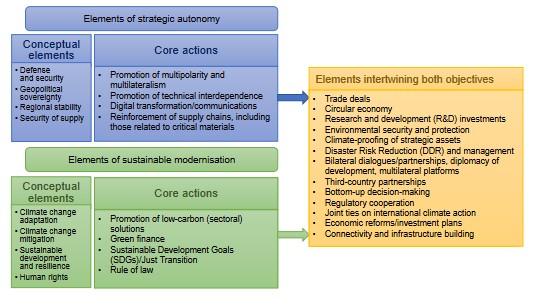
Figure 1 provides a graphical illustration of the distinctions and overlaps between the various elements that constitute the concepts of strategic autonomy and sustainable modernisation. As can be seen, creating a shared conceptual perceptive can aid in the identification of policy actions that incorporate both objectives.
Figure 1
Schematic of the Conceptual Relationship between Strategic Autonomy and Sustainable Modernisation as viewed by the EU and India
Source: Authors’ compilation.
II. Analysis: Seeking Convergences
This section will use the conceptual and implementation strategies for strategic autonomy and sustainable modernisation to examine areas of convergence that can be utilised and to clearly identify possible divergences that will need to be managed. This exercise will be conducted along three lines: first, regarding strategic autonomy; then, under the sustainable modernisation category, for sustainability and development issues (including finance); and finally, also under the sustainable modernisation category, for trade and investment.
On Strategic Autonomy
Both the EU and India’s notion of strategic autonomy have evolved over the past years, leading to a greater convergence in their respective understanding of this concept. Both partners have used the term to signal their preference for multipolarity and their desire to steer away from the possibility of unipolarity or binary competition in the Indo-Pacific region. They both also see themselves as potentially offering a rules-based alternative to the region and are looking to reduce dependencies on China and foster linkages and partnerships with other regional actors. This convergence creates new scope for cooperation to jointly develop an alternative to bipolarity and existing infrastructure projects in the region, notably the BRI.
The Indian foreign policy establishment has traditionally avoided framing its actions around universal values other than decolonisation, sovereignty and the right to development; the EU has consciously designed its outreach to promote values that it sees as universal or reciprocal. In recent years, New Delhi has grown more comfortable with choosing ‘like-mindedness’ and ‘shared values’ as a structure with which to manage bilateral relationships. Both the EU and Indian approaches are closer to each other, in stressing balanced and mutually beneficial partnerships within a framework of rules-based multilateralism, than the Chinese or US approaches.
However, the EU and the Indian understandings of strategic autonomy differ regarding their individual relationships to the US and China in particular.
- Regarding the US: official documents signal that the EU shares more with the US than with China in terms of vision and principles. India maintains a slightly different position: while the US has noted its appreciation of India’s growing importance in the region,(x) India tends to signal to Western partners, especially in Washington, that they should not expect full political alignment in the future. In recent times, this has sometimes become a point of contention, particularly due to New Delhi’s clear unwillingness to follow the Western lead in isolating Moscow following Russia’s invasion of Ukraine.
- Regarding China: although the relationship with and views of China differ, neither India nor the EU wish to adopt a confrontational approach. However, increasing Sino-Indian tensions over their contested border since 2020 and the ensuing deterioration of the bilateral relationship has led India to perceptibly change its posture. New Delhi has become more openly vocal about what it perceives as China’s growing aggression in the Indo-Pacific. This evolution is also reflected in the fact that India is actively increasing its outreach vis-à-vis ASEAN and partners on the African continent.
- Regarding multipolarity: both the EU and India share an idea of strategic autonomy that underscores the importance of multipolarity and of maintaining and protecting their strategic interests. However, the emphasis put on building strategic ‘alliances and coalitions to advance [European] values’ by the European Commission,(x) differs slightly from New Delhi’s emphasis on being self-reliant by pushing for issue-based alignments.
On Sustainable Development
One major area of convergence is that both India and the EU have placed green issues at the centre of their modernisation/development/growth strategies. For India, the focus so far has been on energy and mobility transition; the EU, as argued previously, has adopted a wider approach via the European Green Deal that incorporates agricultural transition and biodiversity protection, among others.
As it stands, however, the partnership on climate and energy is a key aspect of the overall EU-India relationship, as stated in multiple Joint Declarations. It is also a major component of New Delhi’s bilateral relationships with EU Member States, illustrated most vividly by the Green Strategic Partnership between Denmark and India. By centring its climate action leadership in its diplomatic outreach, India seeks to ensure that it can create a sustainable growth model that removes some of the obstacles that it faces in replicating the resource-heavy growth that enabled development in certain other countries in the Indo-Pacific.
Divergences in their approaches to sustainable development can be detected in open questions about the applicability of the ‘common but differentiated responsibility’ criterion in climate action. Burden-sharing when it comes to the costs of adaptation and mitigation will continue to be a source of potential contention, emanating from differing views of how a shared commitment to sustainability in growth can be implemented in practice. Broadly, India seeks a reliable flow of investment and technology as part of its development plans. Yet its outreach to create new partnership structures to enable such investments is constrained by its own choices on autonomy. Its traditional association with multilateralism means in practice that it prefers traditional multilateral structures and is relatively unwilling to invest in new and untested ones. Both India and the EU also value regulatory autonomy and independence, which leads in both cases to policymaking in isolation.
Gender is another cross-cutting issue that represents a convergence between recent actions and statements in India and the EU on sustainability and development. Both agree that gender equality and the empowerment of women are essential for socio-economic development and an increase in global scientific capacity; both sides have taken actions at different levels to stimulate the participation of women in sciences, for instance. Joint international research efforts and the exchange of best practices should help speed up the realisation of women’s full economic, social and scientific potential.(x) This is of particular importance in the post-pandemic era, given the increasing pressure on women due to the loss of revenues and increasing gender inequality.(x) The shared priority of gender-based issues should therefore be recognised when formulating future collaboration efforts.
On Trade and Investment
On both sides, the imperatives of strategic autonomy and sustainable modernisation align in their approaches to seeking new and more resilient trading networks. For India, this is epitomised in the idea of ‘decentred globalisation’, in which neither financial superpowers nor manufacturing superpowers should entirely dominate the flows of trade or investment. Both India and the EU also share the notion that resilience also requires the diversification of trading partners, as well as new directions for investment flows.
In particular, the Indian discourse on digital trade and regulation shares some features with that of the EU. Both realise that they are not the location of the largest concentrations of economic power in the digital world; they are primarily sources and providers of data and markets rather than innovators, processors of data and owners of rights. Reorienting the gains from digital trade, innovation and production is a crucial common strand of their domestic policies and their approach to geo-economic questions at the multilateral level.
On the latter, the EU works to continually reiterate and integrate existing multilateral and bilateral commitments in its agreements. China is the EU’s largest trade partner (India, however, is a distant 10th),51.and Beijing is also India’s largest trade partner – one driver, for both India and the EU, towards concluding a bilateral Free Trade Agreement (FTA). Trade and investment can therefore act as a lever for strategic autonomy when understood through the prism of ‘healthy economic interdependence and diversified global supply chains.’(x)
Divergences that must be managed are, however, also present in this field. For one, questions about gains from innovation are conflated with complex existing positions about intellectual property (IP) protection; India has traditionally seen stringent IP protection as a barrier to sustainable modernisation efforts and requires technology transfer as a pre-requisite for meeting its climate and SDG commitments. The EU, meanwhile, seeks to protect its private sector’s gains stemming from innovation. Future partnerships in the technology and innovation fields will need to ensure that this divergence does not grow or intensify. One way might be to ensure that EU-India business partnerships to remain safe and fair – in other words, mutually profitable, sharing both the risks and the benefits in a transparent and enforceable manner. Mechanisms to enable the co-development and co-ownership of crucial technologies would also go a long way in managing this divergence.
That the EU’s approach to environmental issues and sustainability is broader than India’s current choices is also a possible source of future divergences. The 2020 EU Biodiversity Strategy for 2030 emphasised the ‘full implementation and enforcement of the biodiversity provisions in all trade agreements, including through the EU Chief Trade Enforcement Officer. The Commission will better assess the impact of trade agreements on biodiversity, with follow-up action to strengthen the biodiversity provisions of existing and new agreements, if relevant’. Ex ante considerations on the potential (positive and negative) impacts and means of implementation should therefore take place on both sides. Similarly, as negotiations in mid-2022 continue on a global, legally-binding agreement towards ending plastic pollution, both the EU and India need to be in a position to assess and balance whether and how such an agreement would impact their trade and manufacturing potential – not only in plastics, but with regard to the alternative products designed to replace them.
Such possible differences reflect a broader divergence on how the interaction between trade architecture and development requirements is perceived by the two partners. India positions itself as one of the developing countries at global climate summits, for example. The EU views India more as a powerful, if emerging, G20 country. India also continues to see ‘sustainability’ and ‘trade’ discussions as being distinct, born of a long period in which restrictions on imports due to environmental or labour regulations were viewed as essentially mercantilist and protectionist in nature. While until now this has only caused tensions over the trade and investment framework and at the multilateral level, it may also cause disagreement in the future on sustainability and climate unless it is addressed early on. Developing mutual understanding and hammering out of differences in perception, appropriate wording and ‘positioning’ are crucial to any successful negotiations.
III. Synthesis and recommendations
This study identifies several possible ways forward to enhance EU-India cooperation in the fields of security; sustainable development (especially climate change); and trade and investment, by developing synergies between the goals of strategic autonomy and of sustainable modernisation.
Security
On the European side, synergies between defence and climate risks have been identified since the 2020 Climate Change & Defence Roadmap, but are yet to be actively implemented;(x) as one French diplomat emphasised, “security will be the last area in which we will work on green transition”.(x) However, a distinction should be made between hard security, an area in which integrating green objectives and the objective of strategic autonomy is not obvious, and soft security, which is more suitable to such integration. With this in mind, several actions could be considered:
- Focusing on the integration of green objectives in the sub-fields of 1) Maritime Domain Awareness (MDA), 2) Humanitarian Assistance Disaster Relief (HADR) operations and risk management, 3) Green innovation, 4) Environmental security.(x) From the interviews carried out in Europe and in India, increased cooperation between the partners was envisioned in the fields of maritime security (such as anti-piracy missions off the coast of Somalia and the Common Security and Defence Policy (CSDP) operation EUNAVFOR), in the framework of the CDRI, launched by Prime Minister Modi in 2019, and in the framework of the EU Critical Maritime Routes (CMR) programme, in particular CRIMARIO II. The latter project could be used for information exchange for HADR exercises, for instance.(x) Increasing cooperation in this area is even more pressing given the increase in extreme climatic events in the Indo-Pacific.
- Focusing on diversification: India’s National Hydrogen Mission clearly positions the country as a possible innovator in, and eventual exporter of, green hydrogen. This dovetails neatly with ongoing efforts in the EU (and elsewhere) to diversify energy supply chains – efforts that have been given a clear security imperative in the context of Moscow’s invasion of Ukraine and the need to reduce dependence on Russian hydrocarbons.
- Focusing on using multilateral platforms and enhancing multilateralism in the Indo-Pacific region as a way to jointly promote green objectives. Here, the Indian Ocean Rim Association (IORA), the French-India Maritime Security dialogue and other similar minilateral regional forums are platforms that could be enhanced to promote regional stability or aid in humanitarian assistance and disaster relief efforts. Interviewees also stressed that the EU could become an observer of IORA for HADR operations. India is generally more comfortable with regional platforms rather than global ones that risk being dominated by superpower rivalry. More broadly, in a Covid-19 context where multilateralism is facing severe criticism, strengthening EU-India multilateral cooperation could become an important engine to promote the protection of global public goods and security.
- Focusing on investing in preparedness, pre-emptive planning and threshold stocks and funds for emergency situations such as pandemics and climate-related disasters. One interviewee from the European Commission stressed that the EU intends “to be serious” in its involvement in the New Delhi-based CDRI, for instance.(x) This is seen by the Commission as a simple show of good faith to support India’s agenda and subsequently help deepen the broader climate partnership.
Sustainable Development and Climate
A shared climate focus is at the heart of the convergence between India and the EU on sustainable development and growth. This study consequently examined specific implementation issues in this field with a view to minimising EU-India divergences and incorporating shared insights into the benefits of strategic autonomy.
A focus on three particular areas within the climate and sustainability field are essential to ‘green’ the Strategic Partnership between India and the EU. First, greater work on a common approach to basic decarbonisation strategies is needed so as to minimise future divergences caused by differences over the application of the common but differentiated responsibility principle. Second, climate finance is central to ensuring a proper green transition in India and is something in which the European Union has considerable expertise. And third, attention must be paid to cooperation on the circular economy that blends concerns about both sustainability and autonomy, expanding efforts well beyond climate mitigation. This notably encompasses adaptation and other environmental issues such as biodiversity loss – linked in part to the current agricultural model that is, in parallel, highly dependent on imports of a range of chemicals, including fertilisers from Russia and Ukraine.
Climate-related partnerships should be framed in the context of just transition, achieving greater resilience and the desire to meet SDG targets – with a short-term focus on the adverse effects of the Covid-19 pandemic and ensuing economic crisis for the populations most at risk. To boost local mitigation policies and their social acceptance, strategies promoting local joint initiatives should be identified and promoted, using the growing evidence on the economic and health benefits of certain comprehensive policy sets.(x) The current context of normative discussions on air pollution standards taking place in New Delhi provides an opportunity to draw inspiration from the EU’s success in reducing air pollution and think about how best to comprehensively tackle the issue, as well as greenhouse gas emissions more broadly. The nexus between climate (adaptation) efforts in the agriculture sector on the one side, and food and water security on the other, is another key area worth exploring.
A focus on fair transitions both globally and locally would also ensure that mitigation and adaptation efforts would be more closely linked. Currently, this effort mostly involves technical and strategic dialogues, in particular joint efforts on water management and innovative technology. The EU and India are aware that coherence between climate response actions should be achieved with regard to biodiversity, deforestation and sustainable mobility, too. According to an official from the EU Commission’s DG for the Environment, the Union could add further expertise by using its extensive experience on legislation to protect water basins. Meanwhile, India has set a net-zero goal for 2070, and the pace of existing decarbonisation efforts, especially in the energy sector, offer glimpses of hope that a substantial shorter-term pathway is being followed.(x) Assistance for both India’s 2070 and newer 2030 goals on climate action must be a priority if this momentum is not to be lost.
The energy transition offers an opportunity to both integrate economic bases and to ensure greater autonomy for both partners. With the REPowerEU plan initiating a broad update of the bloc’s energy policy, the EU is already pushing for increased international cooperation on energy in general and on solar in particular, and singles out India as a partner to whom it seeks to offer more technical support and business ties.(x) Offshore wind and nuclear energy are domains where the EU has considerable technological capital to share with India (and the Indo-Pacific region more broadly). Hydrogen power is also seen as essential to the longer-term future of both economies with the potential to green heavy industry’s energy needs, storage and perhaps even long-haul transport. However, policies on climate change that endanger existing jobs, particular interests and industries have been socially and politically contentious in India, as well as in many EU countries. The specific constraints faced by EU Member States when it comes to reducing fossil fuel dependencies in the context of the Ukraine war may also have an effect on any future partnership.
India is unabashedly pro-nuclear power at the federal level. But the EU’s position on nuclear power was greatly influenced by the decision to classify nuclear power as a green technology in the forthcoming Taxonomy Regulation, for which a final proposal by the European Commission was submitted in February 2022.(x) The EU and India signed an agreement in 2020 to strengthen their cooperation on research and development on nuclear power.(x) Further to this, the EU could help create capacity for nuclear power in India through financing and technical collaboration to both expand the partnership and accelerate India’s energy transition. Although uncertainties surrounding future costs and risks remain, additional nuclear capacity might pave the way for an alternative decarbonisation pathway that could broaden options for green hydrogen production, and even alleviate part of the demand for critical materials that a full transition to renewables and battery-powered vehicles would require.
Reducing dependencies on fuel imports is a major strategic goal of both partners; this requires not only transition in terms of energy generation but also significant changes in energy use. Here, the mobility transition is of vital importance. Existing cooperation has traditionally directed an important share of EU investments towards urban public transport projects. These will continue to be high-stakes collaborative projects and must be observed and expanded where possible. Local health and socioeconomic co-benefits should be stressed and grassroots people-to-people contacts should ensure the momentum of this transition, as will be explored.(x)
The Indian discourse at the COP26 climate change conference in Glasgow tied progress on climate change to the availability of finance and investment from developed countries, which has consistently fallen short of previous commitments. As a result, finance has become the core of all discussions regarding sustainable modernisation. Even though the EU took a step forward to ‘come clean on falling short’ on its climate finance pledge, it produced a delivery plan in Glasgow and committed to become a donor on adaptation finance. However, India’s share of public finance might not be sufficient in relation to the sheer size of its economy. The role of private finance therefore becomes crucial. Some action is already visible on this front: in May 2021, a new 100-million-euro private sector climate action initiative was launched jointly by the European Investment Bank (EIB) and the State Bank of India; the ‘Neev II’ project will provide equity funds to small and medium-sized enterprises (SMEs) providing innovative solutions mitigating climate risks. Yet these steps are small when compared to the potential, the needs and Indian expectations.
India and the EU already collaborate on sustainable finance through the International Platform on Sustainable Finance, which was launched by the latter in 2019.(x) What is required, however, are more bilateral exchanges between regulators and other stakeholders on finance, which thus far have not materialised. Furthermore, the EU’s green taxonomy for financial instruments has been presented, but India’s equivalent taxonomy is being developed in relative isolation. It is essential that the drafting process for India’s taxonomy is not completely isolated from the process underway in the European Union and vice versa, as there are major strategic and climate-related benefits to the two structures having common norms. The EU’s decision-makers cannot also operate in a vacuum and need to be sensitised to how aspects of the EU taxonomy may be counter-productive for mitigation efforts if they reduce the flow of sustainable finance from the EU to India. Such mutual understanding requires politically-backed, structurally sound, and periodic, bilateral dialogue between regulatory decision-makers.
The COP27 climate change conference in Sharm El-Sheikh represents a chance for India to renew its position on international climate finance, albeit in a situation vastly different from the post-Covid context of COP26. While India has shown its willingness to advance its carbon pricing mechanisms through a newly-approved bill, the reinforcement of its domestic market might create a dearth of carbon credits for international buyers, including the EU.(x) Moreover, the global food and energy crisis induced by the war in Ukraine is putting a strain on the countries that should lead the diplomatic talks. The extent to which India, the EU, US and China can actually be considered ‘like-minded’ from a ‘sustainable modernisation and multilateralism’ perspective goes beyond the scope of this study, but there will be a need for them to keep cooperating on climate and sustainability goals in the future, regardless of geopolitical tensions.
Grassroots climate action
Greater contact at a people-to-people level, involving Member States, subnational entities in India and corporations from both sides is an essential (missing) piece to developing a shared approach to climate action.
This effort could also involve conversations at the corporate level – Indian companies are increasingly using the Corporate Responsibility clause of the 2013 Companies Act (section 135, amended in 2019) that requires most companies to spend 2% of their average net profits (made over a period of three years) on social projects as a mechanism for climate and sustainability action. The EU and India could work together to study the role and impact of climate education and devise bottom-up efforts for effective implementation of climate and sustainable policies. Cooperation programmes at the local or municipal level (possibly through the EU-centred Global Covenant of Mayors or the more global C40) and encouraging the twinning of tier-two or tier-three cities might be a practical way to increase enthusiasm and rigorously test the effectiveness of a policy before it is implemented on a larger scale.
Circular economy
While tensions between the EU and India were exposed at the 2021 COP26 over the pace of, and pathways to, of economy-wide decarbonisation, there seems to be consensus on the promotion of the circular economy. The concept, according to which production and consumption feed each other by reusing resources instead of generating waste, enables the partners to reap a range of benefits, as well as reduce GHG emissions: it can enhance security of supply, help transform and boost the industrial sector and reduce environmental costs associated with waste production. It can also be applied to a wide range of products, including plastics, textiles, construction and electronics. India and the EU seem well aligned to promote a circular economy in a range of sectors, including aluminium, and a number of working groups are functioning with the help of EU Member State actors such as the Deutsche Gesellschaft für Internationale Zusammenarbeit (GIZ), the main German development agency. The concepts of circular economy, security of supply and resilience are found in a range of recently-published documents; notably the atmanirbhar doctrine referenced earlier, the EU Circular Economy’s Action Plan (CEAP) and the Roadmap to a Resource Efficient Europe. The EU-India Partnership on Resource Efficiency and Circular Economy notably calls for increased collaboration on research and sharing of best practices, with a particular focus on the automotive sector, renewable energy sources and waste streams.(x)
Overall, the EU and India should invest in securing new, diverse and alternative supply chains, especially in relation to rare earth metals, silicon and hydrogen batteries. Furthermore, the narrative promoting a circular economy should be streamlined further into institutional thinking and into private sector actions by explicitly recognising the combined potential for combatting GHG emissions, enhancing security of supply and boosting local economic benefits. It is crucial that EU outreach on the circular economy stresses both the livelihood and strategic benefits alongside its environmental utility.
Circularity and diversity of sourcing share the strategic autonomy imperative, but the first may have specific climate-related benefits. Poorly managed attempts at both – for example, forcing investment for diversification of supply chains to flow solely to local sources and not to sources in partner countries – will set back bilateral relations, modernisation and efforts to combat climate change.
Trade and Investment
There is a common desire to ensure supply chain ‘resilience’ as a pre-requisite for ‘decentred globalisation’ on the Indian side or ‘open strategic autonomy’ on the EU side. Yet there are some outstanding supply chain-related issues, as well as one area that will have to be managed in the coming years if it is not to derail a promising partnership on both climate and trade: the Carbon Border Adjustment Mechanism (CBAM).
The diversification of supply chains should contribute to economic resilience, especially for the most sensitive industrial ecosystems, and to the reduction of strategic dependencies on critical raw materials. The synergy of energy security and decarbonisation goals is vital for both the EU and India, which import most of their carbon-intensive energy sources. The current Ukraine crisis is a particularly poignant illustration of this synergy, and is being used by political leaders in Member States and the EU in their efforts to lay out an energy strategy that is resilient without greatly compromising the decarbonisation pathway. The EU External Energy Strategy expresses the bloc’s willingness to diversify its supply and support its international partners, including India, rather than isolate itself, with a particular emphasis on critical raw materials.(x) European partners, including in the United Kingdom, are making similar efforts. In the US, the recently-released Biden-Harris Plan on American Manufacturing and Securing of Critical Supply Chains provides a telling example of how that administration is trying to align economic, climate and geopolitical interests through a renewed focus on critical materials.(x) These efforts must be closely aligned with the needs of emerging economies, including India. As argued previously, poorly managed attempts at creating secure supply chains that force investment into specific geographical locations, and not a large set of partner countries, will be counterproductive.
A recent International Energy Agency (IEA) report on critical minerals clearly emphasised the importance of recycling and diversifying the sources of supply in critical minerals when it comes to energy transition and security. Both India and the EU have a common interest in reinforcing cooperation in developing global standards on the supply, durability, collection, waste-mining, recyclability and overall sustainability of critical minerals.(x) Enhancing recycling rates would also reduce the political backlash associated with the opening of new mines, with so-called NIMBY (‘not in my backyard’) movements increasingly organised in multiple European countries.(x)
The EU and India officially acknowledge the fragility of their supply chains on lithium, cobalt and rare earths, and the need to integrate supply chain issues into the broader management of the energy transition. In that regard, the blocs could upgrade their current circular economy dialogue that is focused on plastics, industrial processes in established industries, and expand it to include recent interests in green hydrogen. Moreover, the issue of supply chains could be integrated by exploring avenues for cooperation on the recycling of critical minerals. In particular, ensuring a sustainable supply of rare earth minerals is essential to a range of low-carbon technologies: the EU and India are currently heavily reliant on China’s rare earth industry, and neither seem able to overcome their dependency on a timescale consistent with their desired decarbonisation pathways.
Both sides emphasise the potential of collaboration on biotic resources and on the opportunity to foster a ‘global circular economy.’(x) However, while the EU and India should explore how to expand this partnership beyond the mere exchange of good practices, interviews held for this study exposed persisting tensions within the EU over the adequate level of integration into the global supply chain.(x)
The Carbon Border Adjustment Mechanism and Trade Negotiations(x)
Interviews(x) with officials in the EU suggest a trade deal with India continues to be essential for fostering greater cooperation in the field of trade and environment, promoting shared values and strengthening multilateral systems. India and the EU both recognise the great benefits that could flow from the harmonisation of regulations and norms, in particular such agreements’ ability to catalyse private finance into frontier and strategic sectors.
Yet the CBAM, which is sought to be enshrined into EU legislation by the end of 2022, has the potential to slow the implementation of any trade deal and narrow its scope. From a theoretical perspective, CBAM is an attempt for the EU to enhance competitiveness, introduce a higher carbon price and potentially boost fiscal revenue.(x) In India, CBAM continues to widely be seen as a deterrent to trade cooperation between the two partners. Yet some interviewees suggested that CBAM could also promote greater cooperation and convergence: there would be an extended transition period to allow for adjustments, and internal modelling does not show India being extensively or adversely affected.(x) CBAM is product-specific and not country specific – thereby allowing individual exporters from India to continue exporting to the EU as long as they meet the CBAM specifications.
The general Indian perspective on CBAM is that it is a means of shifting the responsibility for minimising carbon intensity of production onto developing nations, as well as being too paperwork-intensive and constructed unilaterally without considering the needs of either strategic partners or developing nations. This strengthens two forces in Indian policy thought that serve to drive a wedge between India and the EU. First, it encourages India to identify as a wronged developing nation rather than as a partner in the search for strategic autonomy and sustainable modernisation. Second, it triggers long-standing Indian concerns that climate and other perspectives are interfering with trading relationships defined at the multilateral level. In the absence of clear bilateral outreach identifying possible shared benefits from CBAM, this will continue to be New Delhi’s view, poisoning all future co-operation on sustainable modernisation.
From a European perspective, trade in climate-related products will face the same hurdles as trade in non-climate goods: liberalising market access and public procurement at the state and federal level in India is thus of foremost importance. That said, there is growing awareness on both sides about the strategic importance of the FTA across the geo-political, economic and sustainability sectors. India’s new trade agreement with the United Arab Emirates (UAE) demonstrates that New Delhi is now willing to move forward on pending trade issues, with bilateral trade negotiations having gained momentum thanks to greater exchange and high-level dialogue at a ministerial level. Expanding the level of contacts to include actors from regulatory bodies, academics, business and civil society will be essential to push any comprehensive trade agreement over the line.
Other Recommendations
Development cooperation
Cooperation on sustainable development in the broader Indo-Pacific, in support of shared values and the rules-based order, is another potentially fruitful avenue for the India-EU relationship. India’s model for development partnerships focuses on demand-based solutions identified by partner countries: ‘India provides solutions to developing countries which are mostly welcomed from all quarters’, said Ambassador Navdeep Suri recently.(x) Given its own experience of being a developing country, it offers a low-cost, recipient-driven development cooperation model as compared to the EU. For its part, the EU has made explicit its support for cooperation with third countries in bilateral and triangular cooperation since 2015. Closer cooperation in this field could lead to a harmonised approach to the financing and support of sustainable modernisation-related projects in the Indo-Pacific. The EU has general experience through the DG for International Partnerships’ (INTPA) European Fund for Sustainable Development (EFSD) Guarantee Fund, although that does not operate in the Indo-Pacific. A recent independent evaluation commissioned by the DG noted that the EFSD fund ‘enables the EU to do two things that are difficult to do with other EU instruments: (1) engage much more broadly in support of private sector development and sub-sovereign investments, and (2) support broad innovation.’(x)
India’s specific advantages stem from its approach which centres development in its foreign policy; which is, as described above, its version of sustainable modernisation. It also has experience not just with the Solar Alliance but also the CDRI when it comes to dealing with climate-related investment and protection. Indian administrative bottlenecks regarding financial and state capacity could be tackled through increased exchange with and understanding of the EFSD and the DG-INTPA more broadly. Geopolitical and sustainability concerns could thus be merged by developing a shared approach with India’s Development Partnership Association to sustainable modernisation in the Indo-Pacific.
This kind of collaboration could bring important benefits to multilateral foreign policy and create new markets for SMEs, especially in Africa. There is also the clear possibility, if cooperation on frontier industries relevant to sustainable modernisation materialises, that this could energise triangular partnerships. Co-developed and co-owned technologies and businesses could supply green and affordable solutions to other emerging countries, for example.
However, the merging of India-EU development cooperation initiatives in third countries adds a further layer of complexity to the relationship. Considering the intricate bureaucratic structure of the EU, it is quite natural that any results of changes to the policy model are delayed. However, a fundamental gap exists that needs to be bridged between an Indian model that is recipient-driven and protective on market attribution and an EU model that is prescriptive.
Connectivity and ‘Bubbles of Trust’
As EU Ambassador to India Ugo Astuto phrased it, cooperation is key in an increasingly erratic world.(x) The need to develop ‘connectivity’ seems to be recognised by commentators from both the EU and India, albeit with some definitional vagueness. The Global Gateway strategy seems able to allow for progress on that issue; but retired Indian Ambassador Bhaswati Mukherjee cautions that it must create links and not dependencies.(x) Further to this, strategic autonomy vis-à-vis the world economy should not come at the cost of strategic interdependence with regard to individual partnerships.
The Global Gateway could provide a platform to create a so-called ‘bubble of trust’, inspired by the efforts of the QUAD, notably on digitalisation and technology. ‘Bubbles of trust’ refer to alliances based on a potentially evolving combination of shared values, geopolitical interests, and complementarities in capabilities to forge a way between complete (and unattainable) technological sovereignty and a full globalisation of supply chains.(x) It has also been touted by Indian commentators in recent years as a way to counter the rise in the dominance of China. To foster such synergies, there must, however, be a shared, explicit agreement on what shared policy interests the idea of connectivity entails.
Ultimately, connectivity – as with much of the above recommendations – comes down to whether sufficient trust can be built between the institutions of the European Union, of its Member States, and of India (including at the state level). Trust will (and must) form the backbone of any common progress on strategic autonomy and towards sustainable modernisation; and this trust can only be built through the sufficient investment of time and energy by both policy establishments.
Authors
Pooja Jain-Grégoire is a Research Fellow at the Asia Centre. Her research focuses on Indian foreign policy, development partnerships, global governance, climate change and international aid.
Raphaëlle Khan is an Assistant Professor at the City College of New York, an Associate at the Harvard Asia Center, and an Research Associate at the Institute for Strategic Research (IRSEM) in Paris. Her current research focuses on the contestation of the international order and the strategic reconfiguration of the Indo-Pacific region.
Arnaud Koehl is a multi-disciplinary researcher in climate policies with a particular focus on transport and health. He is based at Imperial College London’s School of Public Health and at the London School of Economics’ Grantham Research Institute.
Swati Prabhu is Associate Fellow with the Centre for New Economic Diplomacy at the Observer Research Foundation. Her broader research interests encompass climate change and environment, sustainability, and development cooperation.
Mihir Swarup Sharma is the Director Centre for Economy and Growth Programme at the Observer Research Foundation.
John-Joseph Wilkins is an Associate Fellow at the German Council on Foreign Relations (DGAP) and an independent analyst. While he focuses on domestic and security matters in India, Pakistan, and Afghanistan, he also works on issues related to EU defence.
1. Communication from the Commission to the European Parliament, the Council, the European Economic and Social Committee and the Committee of the Regions, ‘2030 Digital Compass: the European way for the Digital Decade’, 9.3.2021 COM(2021) 118 final, 2021, https://eur-lex.europa.eu/legal-content/en/TXT/?uri=CELEX%3A52021DC0118.
2. See the EU Commission dedicated page and full text: https://digital-strategy.ec.europa.eu/en/library/european-chips-act-communication-regulation-joint-undertaking-and-recommendation. To ensure harmony with the European Green Deal, the Communication explicitly mentions that semiconductor production should take into account energy consumption and energy efficiency.
3. Semiconductors also have the potential to contribute to global warming due to their fluorinated compounds. See: https://www.epa.gov/f-gas-partnership-programs/semiconductor-industry.
4. The term ‘planetary’ is understood here as encompassing all societal events, as well as geophysical and environmental issues which have a global impact.
5. Communication from the Commission to the European Parliament, the European Council, the Council, the European Economic and Social Committee and the Committee of the Regions, ‘The European Green Deal’, COM/2019/640 final, 2021, https://eur-lex.europa.eu/legal-content/EN/TXT/?qid=1576150542719&uri=COM%3A2019%3A640%3AFIN.
6. Examples of such amended sectoral legislation include the Directive (EU) 2018/2001 on the promotion of the use of energy from renewable sources and Supplementing Regulation 2019/807 and the new Common Agricultural Policy (Regulations no 1307/2013, no 1308/2013, no 1305/2013, no 1306/2013, no 2020/2220).
7. For geological storage of carbon dioxide, see: Directive 2009/31/EC on the geological storage of carbon dioxide and amending Council Directive 85/337/EEC, European Parliament and Council Directives 2000/60/EC, 2001/80/EC, 2004/35/EC, 2006/12/EC, 2008/1/EC and Regulation (EC) No 1013/2006). For land use, see: Decision No. 529/2013/EU on accounting rules on GHG emissions and removals resulting from activities relating to LULUCF and on information concerning actions relating to those activities.
8. The Recovery Plan entered into force following the passing of Regulation 2021/241 and Council Regulation 2020/2094.
9. Other relevant aspects of the Green Deal include the ‘farm-to-fork’ initiative and decisions on biodiversity, eco-design, circularity in plastics, textile and construction, chemicals and mobility.
10. European Council, ‘Joint Communication to the European Parliament, the Council, the European Economic and Social Committee, the Committee of the Regions and the European Investment Bank, The Global Gateway,’ JOIN(2021) 30 final, 1 December 2021, https://ec.europa.eu/info/sites/default/files/joint_communication_global_gateway.pdf.
11. Government of India, ‘India’s Intended Nationally Determined Contribution’, June 2022, https://unfccc.int/sites/default/files/NDC/2022-06/INDIA%20INDC%20TO%20UNFCCC.pdf.
12. ‘India red-hot investment opportunity for its clean energy transition: John Kerry, PTI’, The Hindustan Times, 12 February 2021, https://www.hindustantimes.com/india-news/india-red-hot-investment-opportunity-for-its-clean-energy-transition-john-kerry-101613093903999.html.
13. Ministry of External Affairs, ‘Joint Statement on India-The Netherlands Virtual Summit – Towards a Strategic Partnership on Water’, 9 April 2021, https://mea.gov.in/bilateral-documents.htm?dtl/33789/Joint_Statement_on_IndiaThe_Netherlands_Virtual_Summit__Towards_a_Strategic_Partnership_on_Water.
14. Ministry of External Affairs, ‘Address by External Affairs Minister at the Inaugural Session of BRICS Academic Forum’, 3 August 2021, https://www.mea.gov.in/Speeches-Statements.htm?dtl/34093.
15. EU Commission, ‘2021 State of the Union Address’, 15 September 2021, https://ec.europa.eu/commission/presscorner/detail/ov/SPEECH_21_4701.
16. Asian News International (ANI), ‘EAM Jaishankar calls for resourcing solutions to address climate change problems’, 30 June 2021, https://www.aninews.in/news/world/asia/eam-jaishankar-calls-for-resourcing-solutions-to-address-climate-change-problems20210630155627/.
17. Ministry of External Affairs, ‘Prime Minister’s address at G20 Summit Session II: Climate Change and Environment’, 31 October 2021, http://www.mea.gov.in/Speeches-Statements.htm?dtl/34457/Prime+Ministers+address+at+G20+Summit+session+II++Climate+ Change+and+Environment.
18. See: ‘Planetary boundaries’, Stockholm Resilience Centre, https://www.stockholmresilience.org/research/planetary-boundaries.html.
19. See: Press Information Bureau, ‘Govt Driving Transition from Linear to Circular Economy’, 18 March 2021, https://pib.gov.in/PressReleasePage.aspx?PRID=1705772.
20. Similarly, the commitment to supporting ‘zero-budget’ farming and reduction of the use of chemical fertiliser is framed as a way of fulfilling government promises to double farmers’ income by reducing costs and not as a way of moderating international dependencies and geopolitical risks brought about through a reliance on imported fertiliser.
21. For more information, see: Analysis and Research Team, General Secretariat of the Council of the European Union, ‘Strategic autonomy, Strategic choices’, Issue Paper, February 2021, p.3.
22. Used, for instance, in the speech of Emmanuel Macron at a press conference on 9 December 2021, https://presidence-francaise.consilium.europa.eu/fr/actualites/discours-du-president-de-la-republique-a-la-conference-de-presse-du-9-decembre-2021/.
23. European Commission, ‘Shaping and securing the EU’s open strategicautonomy by 2040 and beyond’, 10 October 2022, https://op.europa.eu/en/publication-detail/-/publication/aea15f22-49db-11ed-92ed-01aa75ed71a1/language-en/format-RDF/source-search.
24. Council of the European Union, ‘Council conclusions on an EU Strategy for cooperation in the Indo-Pacific’, 19 April 2021, https://www.consilium.europa.eu/en/press/press-releases/2021/04/19/indo-pacific-council-adopts-conclusions-on-eu-strategy-for-cooperation/.
25. European Commission, High Representative of the Union for Foreign Affairs and Security Policy, ‘Joint Communication to the European Parliament and the Council – The EU strategy for cooperation in the Indo-Pacific’, JOIN(2021) 24 final, 16 September 2021, https://www.eeas.europa.eu/sites/default/files/jointcommunication_2021_24_1_en.pdf.
26. European Commission, ‘Communication on The European Green Deal’, 11 December 2019, https://ec.europa.eu/info/publications/communication-european-green-deal_en.
27. European Commission, ‘An Open, Sustainable and Assertive Trade Policy’, February 2021, https://trade.ec.europa.eu/doclib/html/159434.htm.
28. Joint Declaration issued at the British-French Summit, Saint-Malo, ‘Joint Declaration on European Defence’, 4 December 1998, https://www.cvce.eu/content/publication/2008/3/31/f3cd16fb-fc37-4d52-936f-c8e9bc80f24f/publishable_en.pdf.
29. European External Action Service (EEAS), ‘Shared Vision, Common Action: A Stronger Europe. A Global Strategy for the European Union’s Foreign and Security Policy’, 28 June 2016, https://eeas.europa.eu/archives/docs/top_stories/pdf/eugs_review_web.pdf.
30. General Secretariat of the Council of the European Union, ‘Council conclusions on an EU Strategy for cooperation in the Indo-Pacific’, 16 April 2021, https://data.consilium.europa.eu/doc/document/ST-7914-2021-INIT/en/pdf.
31. European Commission, ‘Just and sustainable economy: Commission lays down rules for companies to respect human rights and environment in global value chains’, 23 February 2022, https://ec.europa.eu/commission/presscorner/detail/en/ip_22_1145.
32. Interview, French policy expert on the Indo-Pacific region, 27 December 2021.
33. European External Action Service, ‘A Global Strategy for the European Union’s Foreign And Security Policy. Shared Vision, Common Action’, June 2016.
34. Quote by Emmanuel Macron from a speech on 9 December, 2021 (translated by the author), https://presidence-francaise.consilium.europa.eu/fr/actualites/discours-du-president-de-la-republique-a-laconference-de-presse-du-9-decembre-2021/.
35. Interview, French diplomat, French Ministry for Europe and Foreign Affairs, 22 December 2021.
36. Interview, French policy expert on the Indo-Pacific region, 27 December 2021.
37. Interview, French policy expert on the Indo-Pacific region, 27 December 2021.
38. Interview, French diplomat, French Ministry for Europe and Foreign Affairs, 22 December 2021.
39. Interview, French policy expert on the Indo-Pacific region, 27 December 2021.
40. European Commission, ‘EU-China Relations factsheet’, 20 June, 2020, https://eeas.europa.eu/headquarters/headquarters-homepage_en/34728/EU-China%20Relations%20factsheet.
41. European Commission, ‘Speech by President-elect von der Leyen in the European Parliament Plenary on the occasion of the presentation of her College of Commissioners and their programme’, 27 November 2019, https://ec.europa.eu/commission/presscorner/detail/en/SPEECH_19_6408.
42. While they were not necessarily antithetical, the concept of strategic autonomy described by German Defence Minister Annegret Kramo-Karrenbauer and French President Emmanuel Macron in magazines in 2020 illustrated the tensions between the different framings of the concept. See: Annegret Kramp-Karrenbauer, ‘Europe still needs America‘, Politico, 2 November 2020, https://www.politico.eu/article/europe-still-needs-america; Emmanuel Macron, Le Grand Continent, ‘La doctrine Macron: une conversation avec le Président français’, 16 November 2020, https://legrandcontinent.eu/fr/2020/11/16/macron/.
43. For further details on the Strategic Compass, see: EEAS, ‘A Strategic Compass’, https://eeas.europa.eu/headquarters/headquarters-homepage/106337/towards-strategic-compass_en.
44. Shyam Saran, ‘To expand India’s strategic autonomy, we need to get back to a high growth economy fast’, The Print, 7 October 2021, https://theprint.in/opinion/to-expand-indias-strategic-autonomy-we-need-to-get-back-to-high-growth-economy-fast/746566/.
45. Subrahmanyam Jaishankar, The Indian Way. Strategies for an Uncertain World , HarperCollins Publishers India, 2020.
46. Manohar Parrikar, ‘India’s Strategic Autonomy Dilemma and the Rapprochement with the United States’, Institute for Defence Studies and Analyses (IDSA), 20 March 2009, https://idsa.in/event/IndiavsUS_gmonsonis_200309.
47. C. Raja Mohan, ‘Raja Mandala: Alliances and strategic autonomy’, The Indian Express, 15 January 2019, https://indianexpress.com/article/opinion/columns/raja-mandala-alliances-and-strategic-autonomy-indian-foreign-policy-5538447/.
48. Vimarsh Aryan, ‘Global Rebalancing and India’s Foreign Policy’, Speech at the Vivekananda International Foundation, 30 June 2021, http://www.mea.gov.in/Speeches-Statements.htm?dtl/33965/Foreign_Secretarys_Vimarsh_Talk_on_Global_Rebalancing_and_Indias_Foreign_Policy_Vivekananda_International_Foundation_June_30_2021.
49. S Jaishankar, ‘In Conversation with Gen McMaster’, Ministry of External Affairs, 26 May 2021, https://www.mea.gov.in/interviews.htm?dtl/33878/External_Affairs_Minister_in_conversation_with_General_HR_McMaster_in_Battlegrounds_session_on_India_Opportunities_and_Challenges_for_a_Strategic_Part.
50. Ministry of External Affairs, ‘Leveraging Strategic Autonomy in a Turbulent World’, 5 November 2020, https://mea.gov.in/Speeches-statements.htm?dtl/33166/Foreign_Secretarys_Address_on_Leveraging_Strategic_Autonomy_in_a_Turbulent_World_at_the_Diamond_Jubilee_Seminar_of_the_National_Defence_College.
51. Darshana Baruah, ‘India in the Indo-Pacific: New Delhi’s Theater of Opportunity’, Carnegie Paper, Carnegie Endowment for International Peace, 30 June 2020, https://carnegieendowment.org/2020/06/30/india-in-indo-pacific-new-delhi-s-theater-of-opportunity-pub-82205.
52. The Overseas Development Institute (ODI), ‘The New Development Diplomacy in Middle-Income Countries: The Changing Role of Traditional Donors in India’, February 2020, https://cdn.odi.org/media/documents/the_new_development_v5.pdf.
53. Olivier Mongin, ‘The Decentering of the World’, Esprit, 6, 2007, pp. 54-61, https://www.cairn-int.info/article-E_ESPRI_0706_0054--the-decentering-of-the-world.htm.
54. Amitendu Palit, ‘Can India decouple from China?’, The Diplomat, 1 November 2020, https://thediplomat.com/2020/10/can-india-decouple-from-china/.
55. One significant example of this was Washington’s decision to consult New Delhi on the Indo-Pacific and Beijing’s activities in the run-up to the meeting between US President Joe Biden and Japanese Prime Minister Kishida Fumio in January 2020.
56. Speech by President-elect von der Leyen in the European Parliament Plenary on the occasion of the presentation of her College of Commissioners and their programme, 27 November 2019, https://ec.europa.eu/commission/presscorner/detail/en/SPEECH_19_6408.
57. Ministry of External Affairs, ‘India-EU Strategic Partnership: A Roadmap to 2025’, 15 July 2020, https://www.mea.gov.in/bilateral-documents.htm?dtl/32828/IndiaEU_Strategic_Partnership_A_Roadmap_to_2025.
58. Fisher, Alexandra N., and Michelle K. Ryan. ‘Gender Inequalities during COVID-19’, Group Processes & Intergroup Relations 24:2, February 2021, pp. 237–45, https://doi.org/10.1177/1368430220984248.
59. Council of the European Union’s Analysis and Research Team, ‘Strategic autonomy, strategic choices’, Issues paper, 5 February 2021, https://www.consilium.europa.eu/media/49404/strategic-autonomy-issues-paper-5-february-2021-web.pdf.
60. European External Action Service (EEAS), ‘Climate Change and Defence Roadmap’, Working Document, 6 November 2021, https://data.consilium.europa.eu/doc/document/ST-12741-2020-INIT/en/pdf.
61. Interview, French diplomat, French Ministry for Europe and Foreign Affairs, 22 December 2021.
62. Louise van Schaik and Akash Ramnath, ‘Mission Probable: the EU’s efforts to green security and defence’, Planetary Security Initiative, Policy brief, August 2021, https://www.planetarysecurityinitiative.org/sites/default/files/2021-07/PB%20Mission%20Probable_3e%20proef.pdf.
63. Interview, French policy expert on the Indo-Pacific region, 27 December 2021.
64. Interview, Official from DG INTPA, 13 January 2022.
65. Mikael Karlsson, Eva Alfredsson and Nils Westling, ‘Climate policy co-benefits: a review’, Climate Policy, 10 February 2020, pp. 292-316, https://www.tandfonline.com/doi/full/10.1080/14693062.2020.1724070.
66. Fatih Birol and Amitabh Kant, ‘On track for 2070 net zero target’, The Times of India, 9 January 2022, https://timesofindia.indiatimes.com/blogs/toi-edit-page/on-track-for-2070-net-zero-target-indias-clean-energy-transition-is-rapidly-underway-benefiting-the-entire-world/.
67. European Commission, ‘EU Solar Energy Strategy, Communication’, COM(2022)221, 18 May 2022, https://eur-lex.europa.eu/legal-content/EN/TXT/?uri=COM%3A2022%3A221%3AFIN&qid=1653034500503.
68. Directorate-General for Financial Stability, Financial Services and Capital Markets Union, ‘EU taxonomy: Commission presents Complementary Climate Delegated Act to accelerate decarbonisation’, 2 February 2022, https://ec.europa.eu/info/publications/220202-sustainable-finance-taxonomy-complementary-climate-delegated-act_en.
69. European Atomic Energy Community and Government of India, ‘Agreement between the European Atomic Energy Community and the Government of the Republic of India for research and development cooperation in the field of the peaceful uses of nuclear energy’, 30 December 2020, https://eur-lex.europa.eu/legal-content/EN/TXT/?uri=celex%3A22020A1230%2802%29.
70. Noah Scovronick, Mark Budolfson, Francis Dennig, et al., ‘The impact of human health co-benefits on evaluations of global climate policy’, Nature Communications 10, 7 May 2019, https://doi.org/10.1038/s41467-019-09499-x.
71. European Commission, ‘International Platform on Sustainable Finance’, October 2019, https://ec.europa.eu/info/business-economy-euro/banking-and-finance/sustainable-finance/international-platform-sustainable-finance_en.
72. Commonwealth Parliamentary Association, ‘From COP26 to COP27: 4 climate laws passed in the last year’, November 2022, https://www.cpahq.org/knowledge-centre/blogs/cop27-climate-laws/.
73. European Commission and Office of the Prime Minister of India, ‘EU-India Joint Declaration on Resource Efficiency and Circular Economy’, 15 July 2002, https://www.consilium.europa.eu/media/45027/joint-declaration-with-india-on-resource-efficiency-and-circular-economy.pdf.
74. European Commission, ‘EU external energy engagement in a changing world’, Joint Communication, 18 May 2022, https://eur-lex.europa.eu/legal-content/EN/TXT/?uri=JOIN%3A2022%3A23%3AFIN&qid=1653033264976.
75. See: The White House, ‘The Biden-Harris Plan to Revitalize American Manufacturing and Secure Critical Supply Chains in 2022’, 24 February 2022, https://www.whitehouse.gov/briefing-room/statements-releases/2022/02/24/the-biden-harris-plan-to-revitalize-american-manufacturing-and-secure-critical-supply-chains-in-2022/.
76. International Energy Agency (IEA), ‘The Role of Critical Minerals in Clean Energy Transitions’, Report, May 2001, https://www.iea.org/reports/the-role-of-critical-minerals-in-clean-energy-transitions.
77. Antonia Zimmermann, ‘Europe (slowly) warms up to raw material mining at home’, Politico, 28 March 2022, https://www.politico.eu/article/europe-slow-warm-up-raw-material-mining-home/; and Sanskriti Falor, ‘Explained: Why have Serbians been protesting over lithium mining?’, The Indian Express, 25 January 2022, https://indianexpress.com/article/explained/explained-why-have-serbians-been-protesting-over-lithium-mining-7738870/.
78. Delegation of the European Union to India and Bhutan, ‘EU-India: partners for circular economy & resource efficiency’, 2018, https://eeas.europa.eu/sites/default/files/rei_1.pdf.
79. Direct citations have been avoided so as to not disclose the identity of the interviewee at their request.
80. David Henig, ‘Perspectives: The EU’s conflicting trade objectives in the Indo-Pacific region’, Borderlex, 12 January 2022, https://borderlex.net/2022/01/12/perspectives-the-eus-conflicting-trade-objectives-in-the-indo-pacific-region/.
81. Interviews: policy officer and a senior expert, DG Trade section of the European Commission, 12 December 2021 and 7 January 2022.
82. Stuart Evans, Michael A. Mehling, Robert A. Ritz and Paul Sammon, ‘Border carbon adjustments and industrial competitiveness in a European Green Deal’, Climate Policy, 2001, 21:3, pp. 307-317.
83. Interview, official from the EU’s Directorate General on Climate, 17 December 2021.
84. Remarks held during a webinar on boosting EU-India strategic ties during France’s Presidency of the EU, hosted by the French Embassy in India on its Facebook page on 18 January 2022.
85. BKP Development, ‘Independent evaluation of the European Fund for Sustainable Development’, January, 2020, https://ec.europa.eu/eu-external-investment-plan/sites/default/files/efsd-implem_report-external_support_study-final.pdf.
86. Remarks held during a webinar on boosting EU-India strategic ties during France’s Presidency of the EU, hosted by the French Embassy in India on its Facebook page on 18 January 2022.
87. Ibid.
88. Nitin Pai, ‘A Bubble of Trust approach’, The Hindu, 25 October 2021, https://www.thehindu.com/opinion/op-ed/a-bubbles-of-trust-approach/article37167231.ece.
REPORT – No. 101
Building EU-India Synergy
Allying Sustainable Modernisation
and Strategic Autonomy
IRSEM, École militaire
1, place Joffre, case 38 - 75700 Paris SP 07
Strategic convergences mean that EU-India partnerships have the potential to be a vector of change for both actors and to offer new prospects for policy dialogue, as well as shared technical, industrial, and economic development. However, their overall differences of approach should be better understood and points of contention should also be further analysed so as to ultimately be addressed in a transparent manner.
Two key areas in the context of a rapidly changing geopolitical landscape have been ‘sustainable development’ and ‘strategic autonomy’. Yet overlaps between the two matters are becoming increasingly complex. This complexity, in turn, requires innovative solutions that need to be addressed at all policy levels, including bilateral partnerships.
This study identifies and examines ways in which these two objectives intersect for the EU and India; a process which is leading to both tensions and potential synergies in policymaking. How have the concepts of ‘sustainable modernisation’ and ‘strategic autonomy’ been defined and understood in the EU and India? And what are the main convergences and divergences regarding their perspectives?
Pooja Jain-Grégoire, Raphaëlle Khan,
Arnaud Koehl, Swati Prabhu, Mihir S. Sharma,
and John-Joseph Wilkins