Les États-Unis face à la recomposition des alliances dans un monde en mutation
Wednesday 25 March 2026
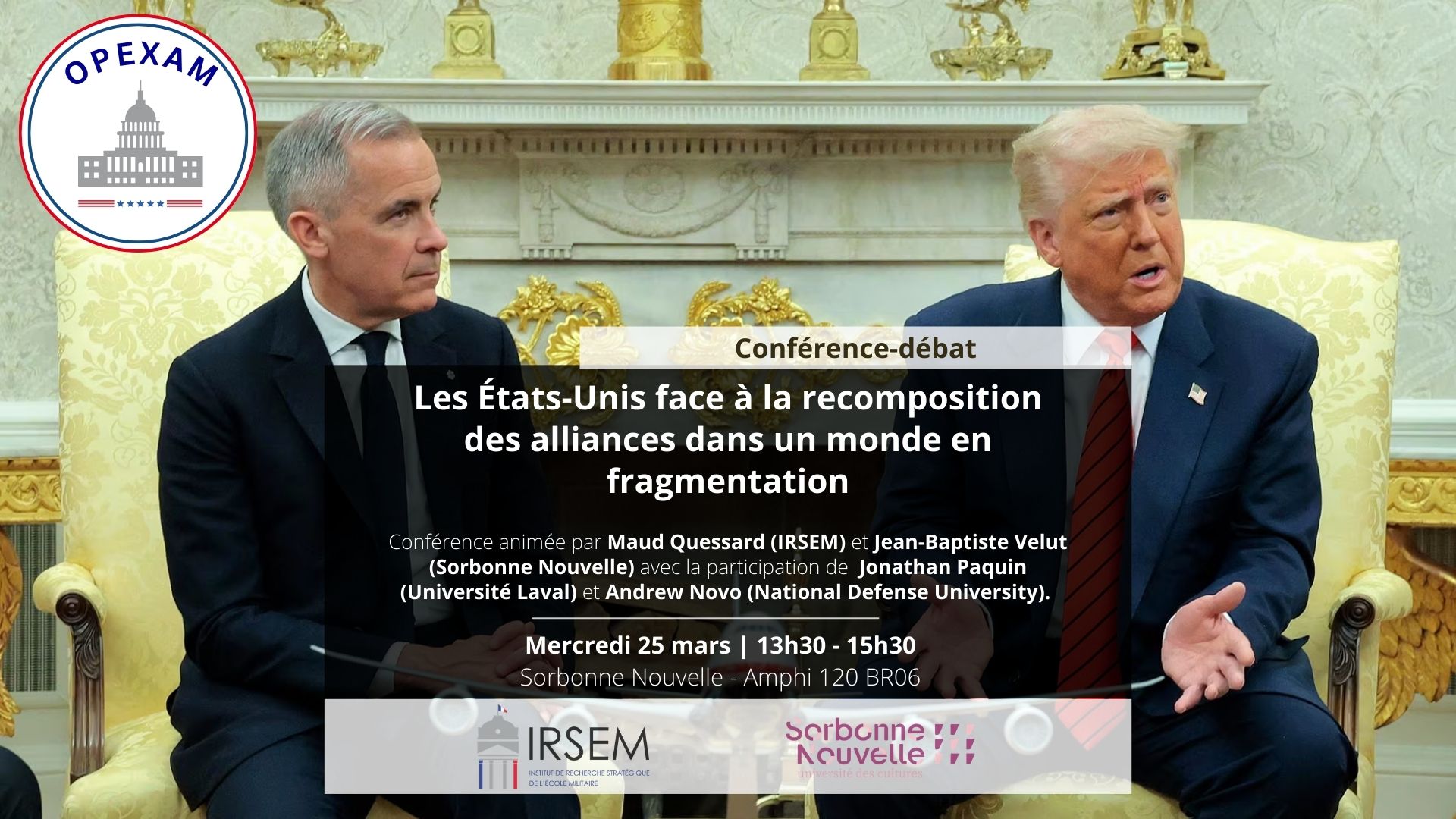
The United States and the Reconfiguration of Alliances in a Changing Global Order
Strategic Reversals, Great Power Rivalry, and the Fragmentation of International Order
In an era marked by renewed great power competition and the gradual fragmentation of the liberal international order, this conference examines the contemporary transformation of military, political, and economic alliances. Whether recent shifts in U.S. foreign policy are understood as a catalyst or a symptom of these developments, American strategic reversals over the past decade have profoundly reshaped relations with its allies.
The Atlantic alliance, weakened during Donald Trump’s first term and revitalized under the Biden administration in response to Russia’s invasion of Ukraine, is once again under strain—both strategically and economically. Complex negotiations surrounding the end of the war in Ukraine, the conclusion of asymmetrical trade agreements favoring the United States, renewed instability in Latin America, and escalating tensions in the Middle East all highlight the volatility of contemporary alliance politics.
In North America, Canada and Mexico are seeking to preserve their privileged trade status within the framework of the USMCA (ACEUM), whose scheduled 2026 review foreshadows another difficult round of negotiations. Latin America has reemerged as a central geopolitical arena, marked by naval deployments in the Caribbean, airstrikes off the Venezuelan coast, and growing tensions with traditional partners such as Colombia. In the Indo-Pacific, the logic of friendshoring appears increasingly replaced by “friendshedding,” reflecting the selective abandonment of partners in favor of transactional bilateralism. Traditional allies and emerging powers alike are adopting hedging strategies to navigate both Chinese territorial and economic pressures and American strategic unpredictability.
The Middle East and Africa are likewise shaped by alliance recomposition amid intensifying great power rivalry. Far from static frameworks, alliances today are characterized by strategic ambiguity, opportunism, and at times deliberate reversals. Unconventional alignments, partnerships among rivals, and transactional recalibrations place long-standing coalitions under mounting structural pressure.
Beyond their immediate geopolitical manifestations, these developments point to deeper structural transformations that raise fundamental questions about autonomy and dependence—military, technological, and economic—between allied or aligned powers and their leading partner.
Organized by the Observatoire de la Politique Extérieure Américaine (OPEXAM), a joint initiative of Sorbonne Nouvelle and the Institut de Recherche Stratégique de l’École Militaire (IRSEM), this conference will bring together leading Canadian and American scholars specializing in strategic alliances, international relations, and international political economy. It will convene academics, policymakers, private-sector representatives, and civil society actors to assess the tectonic shifts reshaping alliance behavior and the contemporary international order.