
The TPNW enters into force a turning point for the campaign to ban nuclear weapons ?
Download the PDF version
By entering into force on January 22, 2021, did the Treaty on the Prohibition of Nuclear Weapons (TPNW) ban nuclear weapons? From a legal perspective, the scope of the treaty does not reach beyond its members, all of whom already committed years ago not to acquire nuclear weapons, through the Treaty on the Non-Proliferation of Nuclear Weapons (NPT). Yet, the international campaign led by a group of players, the most visible undoubtedly being the International Campaign to Abolish Nuclear Weapons (ICAN), asserts that nuclear weapons are “outlawed”. In particular, ICAN builds on this development to legitimize its action and chart a course that is no doubt necessary to secure its future and improve the image of the TPNW. At the same time, this NGO is driving a strategy to delegitimize nuclear weapons and stigmatize a number of States among those that have chosen to base their security on nuclear deterrence. This study aims to examine the challenges inherent in implementing the TPNW and the mechanisms involved in its use by ICAN.
Introduction
The International Campaign for the Abolition of Nuclear Weapons (ICAN) has been quite engaged in activism in recent years: not only was it the driver behind the movement that led to the Treaty on the Prohibition of Nuclear Weapons (TPNW), but it also succeeded in obtaining the fifty ratifications necessary for the treaty to enter into force,(x) which could only occur “90 days after the fiftieth instrument of ratification, acceptance, approval or accession has been deposited.(x)” This period began on October 4, 2020 when Honduras joined the TPNW, and ended on January 22, 2021.
Several actors of the movement that led to the adoption of the TPNW welcomed this step forward. ICAN naturally marked the event on social media networks, claiming: “We did it. Nuclear weapons are illegal now”.(x) This is a mixed message. Beyond the question of the prohibition, ICAN also strengthens the identity of the group formed around this cause. The “we” is sufficiently imprecise to suggest that the group is open. This emphasis placed on the inclusive nature of ICAN’s campaign follows on from the attention paid to it by the makers of the Treaty. In fact, the TPNW would no doubt have failed to emerge without the convergence of several initiatives and the cooperation of multiple stakeholders, including states. In addition, several monographs have even highlighted the role played by certain diplomats.(x) Ray Acheson, the Director of Reaching Critical Will, one of the main NGOs working in multilateral disarmament fora,(x) welcomed “the culmination of so much courage from so many activists and diplomats.”(x) At the same time, the statement by Peter Maurer, President of the International Committee of the Red Cross (ICRC), recalled that this organization, while keen to assert its independence, has truly contributed to the “humanitarian” initiative on nuclear weapons and intends to pursue its action.(x) Furthermore, the United Nations High Representative for Disarmament Affairs has also backed the TPNW since it was concluded. On the eve of the fiftieth ratification, Izumi Nakamitsu welcomed the ratifications by Nauru and Jamaica: “there is only one more to reach 50 required for the Treaty’s entry-into-force.”(x) With the legitimacy of all this backing and the campaign led by ICAN, this support will no doubt grow and gain in strength.
The entry into force of the TPNW should be a powerful accelerator for a number of communication and advocacy actions. But is this really the “historical” moment that the TPNW’s proponents say it is? What changes can this new step in an initiative pursuing the stated aim of eliminating nuclear weapons bring at the international level? The responses to these questions will not be without consequences for the credibility and continuation of the campaign, which has an obvious interest in depicting the entry into force of the TPNW as a significant milestone.
This study aims to provide insights by focusing closely on the purpose, along two lines: first, by examining what the TPNW makes provision for after its entry into force and, second, by considering the continuation of the campaign, as presented by ICAN.(x)
The Beginnings of ICAN
When it won the Nobel Peace Prize in 2017,(x) the NGO ICAN had only been in existence for ten years. It was officially launched in 2007, first in Melbourne where its first office was based, and then internationally at the NPT Preparatory Committee meeting held in Vienna.
The story of the origins of ICAN attributes the idea for this organization to Ronald McCoy, who was one of the leaders of International Physicians for the Prevention of Nuclear War (IPPNW). IPPNW is a long-standing anti-nuclear organization which also received the Nobel Peace Prize in 1985 “for spreading authoritative information and by creating awareness of the catastrophic consequences of nuclear war”.(x)
On several occasions, particularly in interviews for the press, R. McCoy has recounted how, after the 2005 NPT review conference, he had thought about launching a “process similar to the Ottawa Process for the abolition of nuclear weapons”. This would require bringing together several organizations, seeking the support of like-minded governments and working to obtain a convention on nuclear weapons. Hence the idea of founding “the International Campaign to Abolish Nuclear Weapons, with the logo ICAN”.(x)
The Australian branch of IPPNW, the Medical Association for Prevention of War (MAPW), decided to contribute to the implementation, particularly by finding the necessary funding and providing very practical support for the start of the project.
In just a few years, ICAN has carved out a place for itself in the relatively dense landscape of nuclear-abolition NGOs working alongside official action taken by multilateral bodies addressing nuclear issues. The organization, which has gradually diversified its sources of funding,(x) gained recognition at the Oslo Conference on the Humanitarian Impacts of Nuclear Weapons (HINW), in March 2013.(x) It was tasked with preparing a major “civil society forum” by the Norwegian organizers who also enabled it to broadcast a long campaign commercial at the introduction to the Conference of States. ICAN broadly illustrated the topic of HINW and recommended banning nuclear weapons.
At the time, promoting this aim was relatively new as, until then, ICAN had campaigned for the negotiation of a convention on nuclear weapons. Several NGOs specializing in law had developed a model at the end of the 1990s and it was submitted to the United Nations General Assembly by Costa Rica in 1997. It was endorsed by Secretary-General Ban Ki-Moon who included it in his Five-Point Proposal for Nuclear Disarmament in 2008. A growing number of delegations expressed support for such a convention, but the international context made it a hopeless prospect.
After pursuing this process, ICAN therefore took a new turn in 2013. This change would have been made much earlier internally, as its leaders were quickly convinced by this option which required neither lengthy negotiations, nor the participation of nuclear-weapon states. A prohibition treaty would not directly bind the latter, but, according to its proponents, it would be a necessary first step towards fostering abolition.
I. Implementing the prohibition
The entry into force of the TPNW raises the question of how to implement the ban on nuclear weapons without the nuclear-weapon possessor states. The substance of its implementation without these states can indeed be queried. But the treaty includes a number of specific provisions that the States Parties, even if they do not possess nuclear weapons, must apply. We will examine the content of the TPNW through three themes: the scope of the ban; the implementation of the treaty; and the first meeting of the States Parties.
Scope of the ban
Nuclear weapons are prohibited for states that do not possess them
Does the entry into force of the TPNW entail the prohibition of nuclear weapons? To ICAN, the answer is yes, naturally. When the fiftieth ratification was obtained, the organization’s Executive Director, Beatrice Fihn, said for example: “This is a new chapter for nuclear disarmament. Decades of activism have achieved what many said was impossible: nuclear weapons are banned.”(x) The ICRC spoke of a “new global norm […] explicitly prohibiting nuclear weapons.”(x) While the TPNW effectively bans nuclear weapons for its members, for the moment those members are precisely non-nuclear-weapon States (NWS) within the meaning of the NPT.(x) And the prohibition does not apply to non-signatory states.
In practical terms, the scope of the prohibition is therefore limited to states that have already accepted this requirement pursuant to the NPT. On this point in particular, the TPNW does not establish any new obligation. The provisions of paragraphs a and b of Article 1 only differ very slightly to those of the NPT(x): the States Parties undertake never to “Develop, test, produce, manufacture, otherwise acquire, possess or stockpile nuclear weapons or other nuclear explosive devices” (Article 1a); transfer such weapons or control over such weapons (article 1b); receive the transfer or control over such weapons (Article 1c).
The difference lies in the addition of a prohibition on developing and testing. It seems logical for the prohibition to apply to testing, but surprisingly no mention is made of the CTBT. Without this reference, the treaty is more like a policy statement than a legal instrument aiming to ensure compliance with this ban.(x)
With regard to the safeguards given by the International Atomic Energy Agency (IAEA) concerning civil nuclear activities of non-nuclear-weapon states (NNWS), the TPNW does not create any additional obligation. These states are required to conclude a comprehensive safeguards agreement if they have not yet done so or to “at a minimum, maintain its International Atomic Energy Agency safeguards obligations in force at the time of entry into force of this Treaty.”(x) We will come back later to the question of safeguards which is clearly very important for the treaty’s credibility.
The provisions that follow are on a different level, commencing with a prohibition on using and threatening to use nuclear weapons (Article 1d) which echoes the demands habitually made by several states in multilateral fora. In particular, a connection can be established with the resolution for a convention on the prohibition of the use of nuclear weapons, presented each year by India and co-sponsored by almost all the members of the NAM.(x) This Article 1 (paragraph g) also includes a commitment to never “Allow any stationing, installation or deployment of any nuclear weapons or other nuclear explosive devices in its territory or at any place under its jurisdiction or control.” Here again, the idea of such a prohibition can be found in positions expressed by several countries such as China, Russia or Iran. NATO’s nuclear sharing arrangements are clearly targeted. Lastly, paragraphs e and f of Article 1 on encouraging and inducing others to engage in activities prohibited by the treaty and seeking assistance to engage in such activities are drafted imprecisely and will no doubt give rise to discussions between the members.
Prohibition on assistance
As it stands, the TPNW does not create any new restrictions for its members, with the exception of Kazakhstan. Attention has indeed been drawn to the fact that this country allowed Russia to carry out ballistic tests on the Sary-Shagan site located on its territory.(x) According to some experts, Sary-Shagan would be a “testing ground” for the new Treaty,(x) suggesting that the way in which the States Parties evoke this issue will reflect on the credibility of the TPNW.
In 2019, the Nuclear Weapons Ban Monitor published by the NGO Norwegian People’s Aid considered that it was a case of non-compliance with Article 1f concerning assistance with the development of nuclear weapons.(x) In the 2020 version, the document took a softer approach by first mentioning the responsibility of NWS and stressing the fact that no new “proof” had been found that any tests of missiles capable of carrying nuclear warheads had been carried out in Kazakhstan in 2020. It thus concluded that this State could be regarded as compliant with the prohibition on assistance.(x) The drafters of these paragraphs were no doubt keen to find a balance between the need to demonstrate how seriously compliance with this provision is examined and to show consideration for one of the States Parties. This likely explains why these paragraphs on assistance in developing nuclear capacities also underline the merits of Kazakhstan, presenting it as “a staunch supporter of international nuclear disarmament efforts.”(x)
The basis of a customary norm?
Beyond treaty law, there is the question of customary law and a possible new referral to the International Court of Justice (ICJ).(x) Many observers have mentioned this possibility as a logical continuation of the TPNW. In practical terms, with several NWS standing as persistent objectors to the establishment of a customary norm rooted in the TPNW, there would be a certain logic to this prospect.(x) The advisory opinion on the legality of nuclear weapons, issued in 1996, certainly left a taste of unfinished business among abolitionists and in particular the NGOs that had taken the initiative and wanted to see nuclear weapons made illegal.(x) Like Jean-Marie Collin, spokesperson for ICAN-France, we can question the added value of a new referral, given that the TPNW has entered into force: “[…] would such a legal step be worthwhile? Why should we want an opinion from the ICJ, when (once the TPNW is in force) international law will have a norm that already recognizes this illegality?”(x) However, it would no doubt be worthwhile for a campaign that is partly based on delegitimizing nuclear weapons (see below) and which faces refusal from NWS.
As several observers point out, the TPNW is not enforceable against NWS while they remain non-signatories. However, they could be under more pressure if the prohibition were regarded as belonging to the realm of customary law.(x) Nonetheless, the persistent objection of several NWS, as mentioned above, runs counter to the efforts of those that have sought to bring to light new elements likely to change the Court’s opinion.
The refusal of these states to be bound by the ban is reinforced by that of the NATO member states. When the TPNW was about to come into force, they published a statement clearly indicating their “opposition” to this treaty; they even explained the legal issue: “We do not accept any argument that the ban treaty reflects or in any way contributes to the development of customary international law. The ban treaty will not change the legal obligations of our countries with respect to nuclear weapons.”(x) The obstacle posed by the position of this group of states to the formation of a customary international prohibition norm may explain why a recent article on the topics to be discussed at the first meeting of TPNW States Parties suggests examining the legal status of the persistent objector rule itself.(x) The underlying idea seems to be that if the rule cannot be applied in a way that favors prohibition, then it should be changed.
Furthermore, some authors question how the campaign would gain from formulating another question. For instance, J.-M. Collin thinks it would be better to concentrate on “the lawfulness of nuclear weapons being hosted by “non-nuclear weapon” states within the meaning of the NPT or, due to their security alliance, those supporting a policy of deterrence.”(x) But at this stage, attention remains focused on the ban.
Implementation of the treaty
National declarations
The TPNW contains a number of provisions that the States Parties will therefore have to implement, even without the accession of NWS. First, Article 2, which provides for the communication of information about the State Party’s nuclear weapons status, is not limited to requiring them from possessor states, but from all the States Parties. Within thirty days of the entry into force of the TPNW, each State Party must therefore have sent a declaration to the United Nations Secretary-General stating whether it possessed nuclear weapons prior to the treaty’s entry into force(x) (which is the case of South Africa for example). The Secretary-General is then required to transmit these declarations to the States Parties. The treaty does not indicate whether these documents will then be distributed to the Member States or possibly made public but several declarations are already on line on the website of the UN Office for Disarmament Affairs.(x)
Transposition into domestic law
In addition, Article 5 of the TPNW provides for national “legal, administrative and other measures, including the imposition of penal sanctions, to prevent and suppress any activity prohibited […] undertaken by persons or on territory under its jurisdiction or control.”(x) The ICRC developed a model for transposing the TPNW into domestic law covering all the provisions as well as the sanctions in the event of a breach and the text’s extra-territorial application.(x) Now, the manner in which national legislations are designed and integrate the provisions of the TPNW will provide an indication of the dominant interpretations of the treaty and the materialization of the ban.(x) The States are also required to encourage non-party states to join the treaty (Article 12 “Universality”). Some NGO representatives have already started commending countries that have worked to that effect.(x)
Assistance and remediation of the environment
The entry into force of the TPNW also binds the States Parties in respect of assistance and environmental remediation that are central to the humanitarian dimension. Several activists from ICAN or affiliated organizations have spotlighted this issue, sometimes even more so than the ban itself.
Article 6, which commits States Parties to remedy the problems that concern them (providing assistance in the form of medical care, rehabilitation and psychological support, as well as social and economic inclusion to individuals under their jurisdiction and remediating areas under their jurisdiction or control), is followed by Article 7 on international cooperation and assistance. Help may be provided by other states, and by appropriate international organizations. Paragraph 6 of this article specifically refers to States Parties that have “used or tested nuclear weapons” but the situation has not yet arisen as none of the states liable to be concerned have joined the treaty so far.
First meeting of the States parties
Technical questions
The entry into force of the TPNW also means that the States Parties will hold their first meeting. In accordance with Article 8, the first meeting will be convened by the Secretary-General of the United Nations within a year, and then every two years.(x) The following meetings should then be held every six years.(x)
As expected, these meetings aim to consider the treaty’s implementation and measures concerning the “irreversible elimination of nuclear-weapon programs”. This latter point is not expected to be on the agenda of the first meeting. So what will the function of that meeting be and what expectations have already been expressed? Contrary to what we might imagine given the purpose of the treaty, this first meeting will have several topics to address despite the absence of NWS.
First of all, this meeting will have to settle a number of organizational matters such as the adoption of rules of procedure.(x) The costs will be borne not only by the participating States Parties but also by observers,(x) as underlined in particular by Alicia Sanders-Zakre, Policy and Research Coordinator for ICAN, when mentioning the case of Switzerland and Sweden: “Observer states, including signatory states, and some non-signatory states, including at least Sweden and Switzerland, will also attend and share the cost of the meeting.”(x) As observer status is not limited to states and international and regional organizations, but also includes NGOs, many such organizations may wish to attend the proceedings and maybe play an active role if the rules of procedure so permit.
Compliance
Then, attention will no doubt focus on implementation and compliance. The situation of Kazakhstan, mentioned above, may be discussed, even if it is no longer regarded as a case of non-compliance by the Nuclear Weapons Ban Monitor. Some observers also believe a standing committee will be formed to monitor compliance with the provisions on assistance and encouraging prohibited activities.(x)
Other matters that should be on the agenda despite the absence of NWS include the deadline for the elimination of nuclear weapons. According to the treaty, states possessing nuclear weapons must eliminate their nuclear weapons “as soon as possible but not later than a deadline to be determined by the first meeting of States Parties”.(x) A ten-year deadline to be renewed if necessary has been mentioned.(x) The idea of a closer date for weapons hosted by non-possessor states, “for example three years”, has been considered.(x) Again regarding elimination, TPNW implementation is awaiting membership by NWS. However, the States Parties may already designate the competent authority “to negotiate and verify the irreversible elimination of nuclear-weapons programs” (Article 4, paragraph 6).
Finally, the issue of assistance will undoubtedly focus the attention of a large number of players because it is the tangible translation of the initiative’s humanitarian dimension. However, the implementation of this provision will likely be difficult. Several publications on the subject mention principles that should guide its application, but some also appear to see how challenging it will be for the States concerned to determine which populations are indeed victims.(x)
Campaign echo chamber
Beyond these technical questions, these meetings of the States Parties will certainly be highly symbolic for them. Several proponents of the ban stressed that the adoption of a humanitarian approach to nuclear weapons had given voice to NNWS, whereas the debate had hitherto been dominated by the opinions of NWS. Will this sense of empowerment(x) come into play in this new forum? What role will observers play, particularly NGOs? Under the banner of ICAN, they will no doubt seek to organize key events on the sidelines of the official proceedings. What stands will the various players take?
And finally, without addressing the question of the intention of the TPNW negotiators,(x) the first meeting of the States Parties brings us back to the topic of the relationship between this treaty and the NPT. Hopefully the diplomats involved in this new process will be careful not to undermine the regime established by the NPT.
II. The campaign goes on
The entry into force of the TPNW does not bring ICAN’s campaign to an end, nor the other actions undertaken by various players, some of whom have been involved since the start of the movement on humanitarian consequences. In fact, ICRC President, Peter Maurer, emphasized this point in a speech following the fiftieth ratification, declaring: “So, while we celebrate the entry into force of the Treaty on the Prohibition of Nuclear Weapons, we must not forget that prohibiting nuclear weapons is the beginning – not the end – of our efforts.”(x)
Although the TPNW effectively represents a basis and a rallying point for a number of abolitionists, it is still far off the universal dimension to which it aspires. The prohibition is conceived only as one necessary but insufficient component of a strategy underpinned by the idea that a normative change will bring a change in practices. Other actions are therefore required.
Three focuses can be analytically identified: first, the reinforcement of the treaty by gaining new members; second, enhancing its image to boost its legitimacy; and third, developing a policy norm by delegitimizing and stigmatizing. The second part of this study will therefore explore the continuation of ICAN’s campaign along these three lines.
Gaining new members
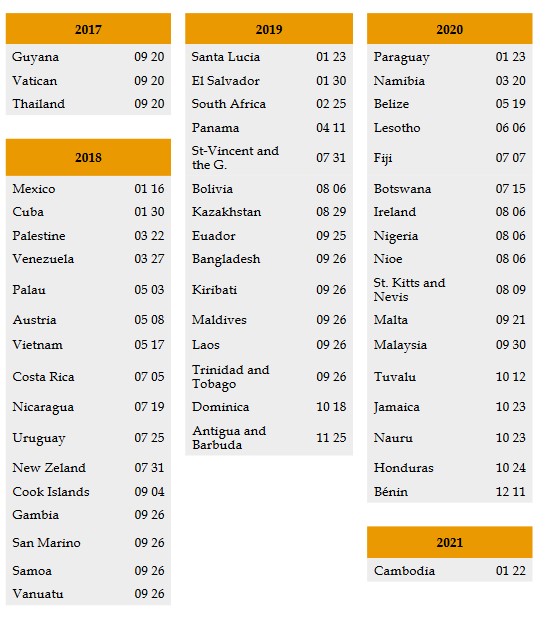
Upon its entry into force, the TPNW had 51 members, as Cambodia joined on January 22, 2021, and 33 signatories. Several states appear to have initiated a procedure to ratify the treaty and in turn become members. However, to be more convincing, the TPNW needs to recruit further.(x) The amount of support is indeed decisive for a treaty intended to found a political and moral norm. For the purposes of the campaign, ICAN, through the Nuclear Weapons Ban Monitor, proposes a typology of states based on their degree of support for the TPNW.(x) It includes: States Parties, Signatories, Other Supporters, Undecided states and those that are Opposed.
Categorization for campaigning purposes
The latter three categories (Other Supporters, Undecided and Opposed) are not defined directly according to accession to the TPNW. The definition is based on their vote in negotiations on the TPNW(x) or their position in relation to the treaty resolution, submitted each year at the United Nations General Assembly (UNGA) since its conclusion.(x) While this criterion seems relevant, it does not allow the same qualification as other factors such as the Explanations of Vote associated with this resolution or the national statements made at the First Committee of the UNGA dedicated to security and disarmament.
We will take the example of the Non-Aligned Movement (NAM), several members of which have signed or even acceded to the TPNW, including some that can be described as influential in the movement. While most NAM members vote for the TPNW resolution,(x) its support for the treaty is not very emphatic, as suggested for example by an address delivered by Indonesia on NAM’s behalf at the First Committee of the UNGA in 2020. Out of more than two pages devoted to nuclear disarmament, the only paragraph mentioning the TPNW is not overly enthusiastic: “Moreover, NAM takes note of adoption of the Treaty on the Prohibition of Nuclear Weapons on 7 July 2017. It is hoped that, when entered into force, the Treaty would contribute to furthering the agreed global objective of total elimination of nuclear weapons.”(x) The phrase “takes note” represents only one of the first degrees for marking support. Real backing could have been expressed by “welcomes with satisfaction”. Therefore, a NAM state that voted for the resolution could be counted among “Other Supporters” by ICAN even though it does not necessarily take a clear stance.
Consequently, the future evolution of these states’ position is difficult to predict. There is no certainty that the fifty or so states in this “other supporters” category will join the TPNW. The vast majority did not vote in favor of the treaty when it was adopted on July 7, 2017 and the others did not take part in the vote. Participation in the vote is not a reliable indicator of whether or not the states concerned will join the treaty. Firstly, as we have seen, forty states that voted ‘yes’ to the treaty in the negotiations have not signed it despite their apparent support, whereas others voted for it but then took a back seat – and are therefore in the Nuclear Weapons Ban Monitor “Undecided” category. Secondly, on the other hand, a small number of states that did not vote for the TPNW when it was adopted have now signed and sometimes even ratified it nonetheless.(x)
“Undecided” and “Opposed” States
Whatever the case may be, this classification by ICAN provides an indication of the priority targets of the campaign. The “Undecided” will no doubt be among them, since their hesitation could be a fulcrum for convincing them to join the treaty. Ironically, some of the “Opposed” states are asserted targets.(x) This category includes countries with diverse statuses, namely nuclear-armed states and nuclear-weapon endorsing states.
a) Nuclear-armed states encompass states recognized as possessing nuclear weapons by the NPT, those that have developed nuclear weapons without signing the NPT and finally, one state that has violated the NPT and continues to strengthen its arsenal.(x) Clearly to ICAN, the nuclear order no longer hinges on the NPT’s distinction between NWS and NNWS. The typology and terminology employed are different, implicitly ignoring the non-proliferation norm.(x) ICAN does not hope to gain the support of these states, but that of the category we will focus on in the paragraphs below.
b) States described as “endorsing” nuclear weapons are those that have chosen to seek protection from the nuclear weapons of a third country,(x) i.e., the NATO Member States, other US allies (Australia, South Korea, and Japan), and two states identified as being under the Russian umbrella (Armenia and Belarus).(x) As these latter two abstained in the vote on the TPNW resolution at the General Assembly between 2017 and 2021, they are therefore classed as “Undecided” rather than “Opposed”.
However, ICAN would appear to be centering its pressure on states “endorsing” nuclear weapons in the “Opposed” category. This is easy to comprehend in light of the Nuclear Weapons Ban Monitor’s evaluation identifying certain states as “more in internal conflict over the TPNW than others”, referring to the letter in support of the treaty published by 56 NATO key figures, Japan and South Korea in September 2020.(x) This assessment of the situation at least partly explains why the NGO hopes to win over these Opposed states. It appears to believe that the opposition is not solid enough and could crumble. Some TPNW proponents think they have already identified some “first cracks in the NATO wall.”(x)
Maximum pressure on NATO
In general, ICAN pursues the goal of “changing Europe’s calculations”.(x) NATO is therefore particularly targeted, especially by a strategy to delegitimize which we will examine further on. A growing number of publications and addresses seek to explain what these states should do, while trying to minimize the impact this could have on their security and their involvement in NATO. For example, one of the documents prepared by ICAN about NATO gives a fairly vague explanation of how the accession of a NATO member to the treaty would take place: “NATO states would need to modify some of their policies or behaviors around the nuclear dimension of the alliance, but they are free to join the treaty and continue to engage in the non-nuclear weapon elements of the military alliance.”(x) A few lines further down, the document also asserts that “For most of the NATO countries that endorse the nuclear weapon dimension of the alliance, joining the TPNW and renouncing its endorsement would not be an alliance-shattering split, but rather a weakened degree of involvement in one aspect of the alliance’s activities.” In addition, the nuclear dimension of NATO is denied as being part of its original identity,(x) although it in fact dates back to the organization’s creation.(x)
This influence strategy is implemented in many other ways, such as a suggested position at the upcoming NPT review conference (postponed due to the health crisis(x)) consisting of recognizing the TPNW’s value for nuclear disarmament, for the implementation of Article VI of the NPT and for the reinforcement of non-proliferation. Despite appearing relatively insignificant, this proposal is not neutral at all as it would lead the relevant states to support de facto the position of TPNW advocates, against that of NATO, with the risk of causing a divide within the organization. Above all, such a change in the position of certain allies would not be neutral for ICAN which could then consolidate that support around the idea that the TPNW reinforces the NPT. Now, this idea is a major factor of legitimacy for the campaign and the treaty. Although some supporters of the nuclear weapons ban seek to set aside the NPT, most, on the other hand, confirm that they wish to maintain it and implement its Article VI through the TPNW.(x) At the same time, its opponents denounce the damage that this treaty and the enterprise surrounding it have already done to the NPT and threaten to do in the future. ICAN is understandably focusing its attentions on this point, particularly as several “Undecided” states have shown that it was one of their main reservations vis-à-vis the TPNW. Communication on this issue appears to be part of a normalization effort that will be examined in further detail in the paragraphs below.
Improving the treaty’s image
In response to the criticism of the treaty’s weaknesses and shortcomings, ICAN is most certainly concerned about improving its image. For example, this is the case of the TPNW’s compatibility with the NPT as mentioned above, or the question of verification which represents a vast case study.
Communication in support of verification
In theory, the verification of a treaty aiming to abolish nuclear weapons should guarantee the disarmament of nuclear-armed states and prevent the arming or re-arming of one or more states. Given the major civil applications of nuclear energy, it cannot be banned. Therefore, as is the case with the NPT, this use of nuclear power must be permitted while ensuring that it is not diverted to military purposes and that weapons are not developed illegally. During a first phase, it will also be necessary to verify the dismantling of arsenals.(x)
Regarding non-nuclear-armed states, the TPNW is in keeping with the NPT. Article 3 of the TPNW stipulates that each NNWS “shall, at a minimum, maintain its International Atomic Energy Agency safeguards obligations in force at the time of entry into force of this Treaty, without prejudice to any additional relevant instruments that it may adopt in the future” and if it has not yet done so, shall conclude a comprehensive safeguards agreement with the IAEA.(x)
The TPNW keeps up appearances but there is clearly a problem. Had it been concluded in the 1960s like the NPT, or at least before the discovery of Iraq’s clandestine program in the early 1990s and the development of an additional protocol (AP) to the IAEA comprehensive safeguards agreements (CSA), it would have been understandable if it had not referred to it. But with knowledge of this context, the negotiators should have taken these developments into account. This serious deficiency can be explained by the opposition – political in some cases – of several states that were part of the core group(x) of supporters of the ban during the negotiation conference. Sweden and Switzerland, meanwhile, worked hard to integrate this verification standard into the treaty (CSA and AP).
Some proponents of the TPNW deplore the fact that it does not include the obligation to conclude an additional protocol.(x) Others take up defensive arguments on the question of TPNW verification or even seek to demonstrate its added value in this regard. While they might struggle to convince those who take the time to read the texts, they could no doubt delude those that do not.(x) Their argument is extremely simple: the TPNW requires states to maintain safeguards agreements already in force (proposal no. 1) so the TPNW requires states that already have an additional protocol to maintain it (proposal no. 2); however the NPT “does not legally require states to adopt or maintain the additional protocol” (proposal no. 3) so the TPNW adds an obligation compared to the NPT.(x) While the first two proposals are true, the third is questionable. The obligations of States Parties to the NPT as regards safeguards do not stop at concluding an agreement which must obviously remain in force. Therefore, the NPT requires existing safeguards to be maintained, and therefore the additional protocol. Above all, the reasoning here concerns a particular case, but in reality, any state acceding to the TPNW without an additional protocol is absolutely not required to conclude one.
ICAN’s communication on verification sometimes results in completely distorting the reality. The informational graphics posted on social media to explain what the entry into force of the TPNW will require of states is a perfect illustration. Article 3 of the treaty, titled “Safeguards”, becomes “Accepting international inspections” (a phrase that appears neither in Article 3, nor in the rest of the treaty). While this kind of communication material is designed to allow a rapid understanding, here the simplification creates a message that fits little with the treaty’s provisions. The wording suggests that the TPNW introduces such international inspections, but with no reference to the competent authority, i.e. the IAEA. In actual fact, acceptance of such “international inspections” is already given by adhering to the NPT, whose Article 3 requires the conclusion of safeguards agreements within a certain time limit.(x) Therefore, for the States Parties to the NPT, the TPNW has no added value in this regard.
ICAN’s insistence on this issue would appear to reveal its predicament and the challenge that this question represents. A certain ambivalence can be seen when the same Nuclear Weapons Ban Monitor extols the virtues of the TPNW as regards verification but suggests that the first meeting of States Parties should adopt a recommendation that they conclude an additional protocol.(x) This idea could reassure the “Undecided” states like Sweden or Switzerland that had tried to direct negotiations so as to render the treaty credible in terms of safeguards, but to no avail.
Necessary normalization
It may seem ironical to talk about normalization in connection with an organization that has positioned itself as a legitimate authority in a process of establishing norms. However, this development is easily explained by the fact that, on the one hand, the prohibition of nuclear weapons is not yet a norm and, on the other hand, existing norms, even if they have been challenged at several levels, are almost universally accepted and have structured the international and multilateral environment for several decades. In this context, “normalization” refers to all the actions aiming to enhance the legitimacy of the TPNW and durably establish it in this environment, especially multilateral.
This primarily leads to striving for legitimacy as institutional players.(x) When presenting itself, ICAN for example stresses the fact that it promotes a “United Nations” treaty. The ICRC’s support is also frequently mentioned. And this legitimacy benefitting the TPNW naturally reflects on the organization behind it. In this way, ICAN boosts the symbolic power it has already gained by winning the Nobel Peace Prize in 2017 and the legitimacy it derives not only from its NGO status but also from that of a coalition of NGOs which lends further weight to the idea that ICAN represents the voice of civil society.
The TPNW has only just come into force and although it is included in the United Nations treaty collection, its integration into the normative landscape is not established. This explains why its proponents are closely focused on seeing the next NPT review conference admit that the TPNW allows implementation of Article VI of the non-proliferation treaty. Gaining such recognition by all NPT States Parties, including NWS, is obviously of key importance for the continuation of the campaign.
The treaty’s articulation with the CTBT is also important. While the TPNW does prohibit testing, it does not compel its States Parties to join the CTBT. Therefore, it does not subject them to any system of verification unlike the CTBT which is associated with the development of a global monitoring system. ICAN appears to have realized that the TPNW’s credibility was suffering on this point. The Nuclear Weapons Ban Monitor (2020) recommends that the first meeting of the States Parties request the TPNW signatories and members to join the CTBT if this is not already the case.(x)
In addition, special efforts to position the TPNW in a long timescale and within the realms of possibility can be seen. During the campaign, several ICAN representatives complained of being seen as irrational and disconnected from reality. With the entry into force of the TPNW and the ambition to establish a norm, ICAN must definitely continue to drive home the idea that the aim of eliminating nuclear weapons is not utopic, but “an actual achievable goal” as asserted by ICRC President, Peter Maurer, who was cited by Beatrice Fihn and Daniel Hogsta in an article published shortly after the fiftieth ratification.(x) The credibility of the treaty and the expansion of support for it are at stake.
Although the weight carried by the “possibility” argument in the movement that led to the TPNW cannot be measured, it is easy to see in the rhetoric of the ban’s advocates. From this perspective, it is understandable why ICAN is keen to follow in the footsteps of previous campaigns - on the banning of landmines and then of cluster munitions – which have been a source of inspiration since the very beginning and from which it undoubtedly intends to derive some legitimacy for itself and its action (see below). For example, the drafting of a Nuclear Weapons Ban Monitor, the counterpart of the Landmine Monitor and Cluster Munitions Monitor, illustrates the desire to borrow from the proven methodology used by other campaigns but also to position itself as a reference on nuclear weapons.(x)
Finally, normalization leads, more generally, to actions aimed at responding to the presumed expectations of campaign targets. In this respect, it is of particular interest for the campaign, with a view to “converting” undecided states or those identified as opposed. Special attention is clearly paid to creating a responsible and serious image. This is particularly noticeable in how ICAN has changed its approach to disarmament verification. To begin with, the fact that the TPNW did not address this question was often justified by the idea that the involvement of NWS was needed and that actual elimination would occur in a second stage: the sequence consisted of the prohibition, followed by elimination, as two separate phases. The treaty leaves the matter in the hands of a competent international authority to be designated at a later date. However, for the first time in 2020, the Nuclear Weapons Ban Monitor proposed a detailed schedule on verification, setting out the different “missions”.(x) The presentation is only a one-page table, but this new feature no doubt points to a shift in focus by ICAN in its quest for recognition.(x)
Stigmatizing deterrence
Although it might seem contrary to the aim of improving the image of the TPNW and of ICAN, the organization is driving a strategy to delegitimize nuclear weapons and stigmatize a number of players. This is only an outward contradiction, as ICAN stands by these processes which it asserts as fully legitimate methods of action. The homepage of the NGO’s website states that “ICAN is the international campaign to stigmatize, prohibit & eliminate nuclear weapons”.(x) In several testimonies, organization leaders have explained how, based on the model of the landmines or cluster munitions campaigns, ICAN would pursue this strategy aimed at forcing NWS to justify themselves, and how the TPNW would be the turning point in it. This is very clearly explained by Beatrice Fihn in an article published before the treaty was concluded: “Stigmatizing weapons creates perceptions of unacceptability which can be incompatible with the identity a state wishes to hold in the world. A treaty prohibiting nuclear weapons will make it more difficult for nuclear-armed states to continue to justify possessing and planning to use nuclear weapons.”(x) The entry into force of the TPNW is therefore an additional asset in this campaign.
A discursive strategy
This repeated use of “delegitimization” and “stigmatization” raises the question of their application to nuclear weapons. What do these processes encompass? What precisely are their aims? Do they target weapons as an object or rather the deterrence strategy or policy choices of certain states? What goals and means of action are envisaged? In the theory of international relations, these terms echo the “constructivist project” and the idea of social construction of identities, interests and conduct.(x) However, the nuclear weapons ban is a very interesting case which questions both the possibility of using the theory for political purposes and the limits of constructivism. Several sources indeed confirm that ICAN’s strategy has been defined by players who have used the theory and tried to put it into practice. “ICAN’s leaders were aware of the constructivist, feminist and post-structuralist academic literature on the stigmatization of weapons. They self-consciously adopted a discursive strategy casting nuclear weapons (and those who defended them) as immoral pariahs.”(x)
This “discursive strategy” does not go unnoticed. The way certain words and expressions are hammered out shows a desire to change the current terminology. The words are obviously not neutral and ICAN is counting on the dissemination of this language to bring about a normative change. “The supporters of the ban are aiming to replace the NPT’s distinction between nuclear haves and have-nots with a distinction between nuclear civilizers and barbarians.”(x) In this regard, it can be noted that this change is also based on an exacerbation of the NWS/NNWS antagonism rooted in the NPT review process. One factor that explains why states have been successfully mobilized by the humanitarian initiative is the “frustration” felt by NNWS and described by several experts and observers of the NPT review process.(x) ICAN has tried to deny the importance of this factor to focus on concerns regarding the humanitarian consequences,(x) which is obviously a necessary tactical choice for the image of the NGO and the TPNW. Rather than fueling this antagonism, ICAN is gradually trying to merely stigmatize certain players, as we will see through three case studies: the NWS that ICAN stigmatizes without seeking their membership; the NATO NNWS which it aims to “convert”; and lastly the example of one “undecided” state whose signing of the TPNW would be crucial with a view to converting other states in Europe. Through these three examples, it is clear that stigmatization is not only used to shape a norm in general, but also to influence conduct and decisions, and not just indirectly.
Stigmatizing to delegitimize
Overall, the nuclear-armed states have very clearly rejected the TPNW. Therefore, ICAN will not expend energy seeking their adherence, but will focus on stigmatizing them with a view to undermining their legitimacy. This stigmatization can take various forms. Here we will look at two examples that differ greatly by the register used in the message, but are similar in the action undertaken. One seeks to be funny, the other serious, but both communications aim to depict defeated stakeholders. The first is a video posted on Twitter by Beatrice Fihn after the fiftieth ratification in which, with a triumphant face, she can be seen drinking out of a cup marked “P5 Tears”.(x) The second example is an article published in Le Monde following the announcement of the fiftieth ratification. Beatrice Fihn threatens NWS that might “believe they are above this new norm” and says that states that are not parties to the treaty will nonetheless suffer the consequences of the TPNW’s entry into force. She then adds: “politicians and diplomats will have to justify their keeping of illegal weapons and can no longer claim to comply with international law or even to be a “responsible” state”.(x) The aim is clearly to “reverse the burden of proof” mentioned in several feedback documents on the Oslo and Ottawa processes.(x) Criticizing nuclear-armed states and the P5 in particular appears to be a general immediate reaction.
However, on closer examination, an exception to the stigmatization would appear possible for China which, although it does not plan to join, keeps up a rhetoric favorable to the TPNW, to which some ICAN representatives are sensitive. One, for example, has mentioned the possibility of China playing a role in mediating future negotiations, claiming that “despite its totalitarian regime, [it] adopted a relatively open attitude towards the process that led to the adoption of the Treaty on the Prohibition of Nuclear Weapons (TPNW) ”.(x) Still, the leader of ICAN is no doubt less taken in by the rhetoric and seems to focus more on the actual development of China’s arsenal. Thus, when the Chinese mission to the United Nations welcomed the entry into force of the TPNW, repeating that its advocacy for “complete prohibition and thorough destruction of nuclear weapons” was “fundamentally in line with purposes of the TPNW”,(x) Beatrice Fihn took a firm stand: “This is great, but maybe stop modernizing your nuclear arsenals and join the treaty then!”(x) At the same time, Alicia Sanders-Zakre (ICAN), in an article for War on the Rocks, symbolically praised the Chinese tweet which she compared with that of a “US official” who called the treaty “counterproductive”.(x)
It would be interesting to understand just how the idea that China supports the TPNW influences ICAN’s action, particularly as the greater permeability to communication or influence actions of other NWS’ political systems no doubt explains the difference in treatment displayed.(x) Generally speaking, the stigmatization strategy described by ICAN is criticized due to the dead ground that non-democratic regimes represent. As George Perkovich, for example, points out in an article published in November 2020, even if this were not the intention, it is difficult to see how the strategy can avoid penalizing states that have adhered to democratic norms authorizing freedom of association and lobbying.(x)
Converting opposed NNWS
NNWS that are NATO members are seeing their security policy criticized from a moral perspective: “The TPNW exposes these states for what they are at the moment: complicit in the legitimation of the most destructive and inhumane weapon ever invented – and standing ready to participate in the annihilation of cities and mass murder of civilians.”(x) The leaders of ICAN are clearly aiming to delegitimize the governments concerned by casting doubt on the democratic nature of their policies.(x) In support of their arguments on the mismatch between these policies and the wishes of the public, they produce polls showing that the majority demands accession to the TPNW, opposes investments by banks in nuclear weapon activities and quite simply supports ICAN’s positions, thus reinforcing the legitimacy of representing civil society, to which it aspires.(x) Implicitly, it also questions the ability of these governments to decide, by regularly suggesting that their decisions are swayed by pressure from the United States or other Alliance members.(x) At the same time, in contrast with this discrediting pressure, attempts at persuasion and even seduction can be seen, to encourage states to join a movement described as being “on the right side of history”.(x)
Whatever the case, the Allies are “complicit”(x) states or “weasels”, according to another term used by some advocates of the ban in the years in which the initiative on humanitarian consequences was being rolled out. Indeed, the figure Wildfire – the former Australian diplomat Richard Lennane – used this term particularly with reference to NATO NNWS (but also other non-armed states that have opted for nuclear deterrence). Other developments came with this coining of this term, including publicity for a “recovery program”, various goodies and a cardboard statute position in different places on the sidelines of multilateral meetings. Stigmatization can also take the form of a farce. The impact of such influence operations is hard to measure. There is a significant gap between the image projected in this way and the one that states wish to maintain internationally and/or internally, but the spread of these stigmatizing representations seems quite limited for the moment. In any event, they may contribute to maintaining a certain climate in multilateral fora and creating pressure that local delegations will no doubt report back to their respective capitals.(x)
Deciding the “Undecided”
Among the “undecided” states identified by ICAN, Switzerland is a special case since it has retreated in relation to the TPNW after instigating the introduction of the “humanitarian aspect”(x) at the 2010 NPT review conference and then continuing to be a driving force for several years. After taking part in the negotiations and voting for the adoption of the treaty, it nonetheless expressed several reservations about the outcome of the negotiations, decided that a “careful assessment” of the treaty would allow it to “fully comprehend the impact and consequences of its provisions”, that it would follow closely the manner in which the treaty was interpreted and implemented and would also assess whether “it effectively complements and strengthens the nuclear disarmament and non-proliferation regime.”(x) For this purpose, a working group was set up, led by the Federal Department of Foreign Affairs. Its conclusion, in June 2018, was very clear: “for Switzerland the arguments against an accession to the TPNW outweigh the potential opportunities of an accession.”(x) However, parliament ultimately objected and asked the government to join the TPNW.(x)
Switzerland displays a “humanitarian tradition” around which the diplomacy of this neutral, NATO-partner state, is organized. The humanitarian dimension of its identity on the international stage is a natural fulcrum for a campaign like ICAN’s. Here, similar observations can be made to those established about the “Oslo process” on cluster munitions and particularly the ‘naming and shaming’ strategies when they seek to “publicly expose the contradictions between the behaviors and normative commitments of their targets.”(x) A process of “rhetorical entrapment”(x) is underway. Switzerland adheres to the humanitarian framework but not to the result of the initiative, the TPNW. It has promised to reassess its decision, in principle after the NPT review conference. Should it continue to reject the TPNW, it would struggle to show that it nonetheless adheres fully to the humanitarian framework. This position is indeed hard to explain in the context of a campaign in which the debate is binary, including from a moral standpoint.
Beyond words
Beyond words, ICAN develops several actions intended to stigmatize weapons and their environment.(x) Such actions include raising awareness of the cause and disseminating ICAN messages through its national entities, particularly through the “Cities Appeal” which was joined by two capital cities of NWS (Washington and Paris),(x) several cities in these states and fourteen others, most of which are NATO members or otherwise under the protection of US nuclear deterrence.(x) ICAN also recommends initiating debates in parliaments and in the media of non-States Parties. And it has launched an initiative targeting universities that contribute to the development of nuclear weapons. So far, it seems to be limited to the United States where it has identified “complicit” universities thus described as “Schools of Mass Destruction”.(x) The divestment campaign, “Don’t bank on the bomb”, launched several years ago, would appear to be gaining ground.(x) It aims to prompt banks and pension funds to withdraw their investments from businesses participating in nuclear armament programs. Once again, this action is the transposition to the nuclear domain of those previously launched for landmines and cluster munitions that ICAN describes as having had “quite a concrete impact in reducing companies’ willingness to be involved in these practices.”(x) Regarding cluster munitions for example, several firms did indeed gradually cease producing prohibited materials, but not immediately. Furthermore, many states are yet to sign the convention, including several producers.(x) The Cluster Munition Monitor estimates that 17 States Parties have ceased production, while the 16 states that are not party to the convention continue this activity (or have suspended it but without committing not to resume it). The report stresses the fact that Russia and China conducted R&D activities on new capacities in 2020.(x) ICAN therefore uses these examples to lend credit to its action, even though the comparison between the three processes quickly reaches its limits. By encouraging these entities to change their policies, ICAN not only attempts to hinder the development of nuclear weapons programs, but also to create another source of input to the stigmatization process.
Conclusion: What to do with the TPNW?
The TPNW is now in force. While its supporters find it worthwhile, doubts remain as to its benefits in terms of security. And some clear questions are raised about the strategic imbalance it could create if the campaigners achieved their aim, particularly as regards extended deterrence. Advocates of the TPNW claim to see a laughable contradiction between the finding that the treaty is ineffective and the assessment of the risks it entails. These two evaluations are obviously placed at different levels. So what should be done with the TPNW?
Whatever normalization efforts ICAN makes, the strengthening of its campaign and the continuation of stigmatization actions will no doubt further heighten tensions within multilateral fora and discourage opposed states from joining the initiative.
The question therefore remains unanswered. While some experts are of the opinion that the TPNW should not be ignored, current events call for progress on urgent issues such as the rebuilding of arms control or whatever will take its place, because the future may well prove those who believe that the era of formal agreements between the US and Russia is over, to be right.(x)
Lastly, the question we raise as a conclusion also requires a response from researchers. What should be done with the TPNW? By shedding light on the facts and presenting certain mechanisms, we have sought to lay the groundwork for future studies. The fact that communication and influence are so prevalent calls for further analysis of these modes of action when they are used by NGOs at international level. As some of their actions have been analyzed as diplomacy of non-state players,(x) those we have described here could no doubt gain from using concepts from public diplomacy.(x)
Annexes
List of TPNW members when the treaty entered into force (January 22, 2021)
In chronological order according to date of accession