A Foreign Policy by Proxies? The two Sides of Russia's Presence in Mali
Download the PDF version
Relations between Mali and Russia were, until recently, mostly based on defense cooperation, revived in the early 2000s on the underlying foundation of ties established during the Soviet era. However, they have gained new momentum since the two coups d’état of 2020 and 2021, and the negotiations initiated by the Malian authorities with the paramilitary organization Wagner. Already deployed in other African countries, the deployment of the Wagner Group in Mali one year ago, in December 2021, is one of the most emblematic illustrations of Moscow’s reengagement in sub-Saharan Africa initiated over the past few years. It also took place in a context of regional and international isolation of Bamako, a major political crisis between France and Mali, and the ever-deepening deterioration in relations between Russia and the West since the invasion of Ukraine on February 24, 2022.
Introduction
The deployment of the Wagner Group in Mali, which began at the end of December 2021, has opened a new stage in the development of Russia’s presence in sub-Saharan Africa. It can also be put in perspective with the broader New Scramble for Africa among the major democratic and authoritarian powers.(x) Over the past five years, Russia’s footprint in Mali has undergone major changes, particularly in qualitative terms, and is characterized by its two-faceted nature, both official and non-state. These two sides are not mutually exclusive and may even be complementary, as non-official actors most often work to serve the state’s interests. This has already been seen in Africa, namely in Sudan, the Central African Republic and Mozambique. But what about Mali?
The arrival and deployment of the Russian mercenaries in Mali took place a few months after the start of negotiations between the transitional authorities, which emerged from the coups of August 2020 and May 2021, and the Wagner Group. They also occurred in the context of a major political crisis and the growing international isolation of the military junta in power in Bamako. One of the most blatant examples is the unprecedented crisis in relations with Paris, which features a diplomatic dimension, with the expulsion of the French ambassador from Mali in January 2022 and Bamako’s referral to the UN Security Council in August to denounce French “acts of aggression”; a military dimension, with the accelerated withdrawal from the country of the Barkhane force and the departure of the last French detachment on August 15, 2022; and an information dimension, with the suspension late April in Mali of the broadcasting activities of RFI and France 24, France’s two main international media.
Beyond this local dimension, the establishment in Mali of the infamous Wagner Group is part of a regional process to reinforce Russia’s presence throughout the African continent. This process is partly institutionalized, as illustrated by the some twenty defense agreements that Moscow has signed with various African countries since 2015, and the increased attention paid by Russian international media outlets to French-speaking African countries. It is also developed by non-state actors and entities that do not officially represent the Russian institutions, but work in close cooperation, or even in symbiosis with them, according to a practice described as “influence entrepreneurship” or “adhocracy” – we will come back to these terms later. The most well-known of these non-state actors is Yevgeny Prigozhin, a tycoon who finances the Wagner Group and, among other activities, controls a vast network of entities operating in raw material extraction and information influence sectors. In this report, we refer to this network as the “Prigozhin galaxy”, in line with our previous articles on this central figure in Russia’s international non-state action.(x)
Specifically focused on the situation in Mali, this report analyzes the motives behind Russia’s influence through this double prism, official on the one hand and unofficial on the other, and suggests that, so far, the unofficial dimension has proved much more relevant to understanding the growth of Russia’s footprint in the country. Although fueled by previous fieldwork in Russia, the methodology that we use is mainly digital investigation through open sources.(x) It is based, in part, on a qualitative study of various Russian primary sources available in open access, in particular publications from the Russian Ministry of Defense, legal texts and reports from research centers affiliated with the federal authorities. Additionally, the study of Russia’s informational influence activities in Mali is based on an analysis of the content and “strategic narratives(x)” produced by its actors, notably through lexicometry and a statistical analysis of large corpuses of text.
The report is divided into three parts. The first, brief and introductory part, focuses on the history of relations between Moscow and Bamako, and more specifically on the role played by the Soviet Union from 1961 onwards, following Mali’s independence. Despite initial enthusiasm and some achievements, this cooperation turned out to be short-lived, with a major change of course in Bamako in 1968 following the fall of Modibo Keïta and the rise to power of Moussa Traoré. The Soviet-Malian friendship remains nonetheless a memory often recollected and highlighted today by Russian actors looking to build a narrative that legitimizes their current cooperation with Bamako.
The second part focuses on non-official and “adhocratic” Russian actors currently deployed in Mali. The Wagner Group is one of the most obvious examples: it has established itself in Mali – as it has in all the other African countries in which the group is present, whether in North Africa in Libya, or in sub-Saharan Africa in the Central African Republic – because of a major political or security crisis. After reviewing the circumstances of its deployment, we detail the group’s main characteristics, six months after its arrival. We then expand upon the informational component of this aspect of Russian presence in Mali, highlighting the ecosystem of influence set up by actors of the Prigozhin galaxy, who shape and fuel a narrative to justify Russia’s presence while denouncing its detractors.
The third part of the report focuses on the official channels used by Moscow to develop its presence in Mali. As with the rest of the African continent, the development of bilateral relations remains mostly based on defense cooperation, whereas results are limited in the economic sphere. This last part is based on an analysis of several Russian primary sources, such as various defense agreements signed between Moscow and Bamako, and media outlets belonging to the Russian Ministry of Defense. The media sphere also represents a fundamental dimension of Russia’s official presence in Mali. This is illustrated by the growing volume of content produced by the French-language branches of the Russian international media outlets RT and Sputnik, for which we provide a textual analysis of Malian news coverage.
I. The legacy of the Soviet presence in Mali
The 1960s, the golden age of the Soviet and Malian “people’s friendship”
The development of relations between Mali and the USSR started in the early 1960s, with the increased investment by Soviet diplomacy in newly decolonized countries. This policy was met with enthusiasm in Mali in the early years of independence, led until 1968 by Modibo Keïta, president of the Sudanese Union – African Democratic Rally, the only authorized party at the time. Both due to his socialist leanings and the young republic’s considerable needs for its development, Modibo Keïta first turned to the USSR. Diplomatic relations between the two countries were established in October 1960, barely a month after Mali’s independence was declared, following the collapse of the Mali Federation, which until then had included French Sudan (later Mali) and Senegal.
The official establishment of diplomatic relations paved the way for the signing of a series of agreements between Mali and the Soviet Union that would frame the development of bilateral relations. Along with the beginning of diplomatic relations came the signing of economic and technical aid agreements on loan grants, Soviet assistance in conducting geological prospecting and support with university education and management training. The major role played by the USSR in education and training in Mali can partly be explained by the breakdown in the ties between Mali and Senegal, the only state in the region with a university at the time.(x) Thus, from the 1960s onwards, more than 10,000 Malian students were trained in the USSR, and more than 5,000 Malian citizens learned the Russian language at the Soviet Cultural Center in Bamako.(x) Among them was Amadou Toumani Touré, President of Mali from 2002 to 2012 and an alumnus of the Ryazan Guards Higher Airborne Command School, from which he graduated in 1976.(x) The USSR also contributed to the creation of the Malian National School of Administration in 1963.
In 1961, a cultural cooperation agreement was signed, followed by another agreement establishing air connections between the two countries in 1962.(x) The Soviet Union also made a significant contribution to the development of air transport in the young Malian state, since the entire fleet of the national airline, Air Mali, was made up of Ilyushin aircraft. In the same year, the Soviet Union began providing financial and technical assistance to the Office du Niger, which was created in 1932 to develop irrigation systems in Mali’s Inner Niger Delta region. The Office du Niger, initially tasked with supervising the increase of cotton production was later reoriented to rice production. This period was also marked by the Soviet contribution to the building of major infrastructure projects. This was part of a policy of large-scale works implemented by the USSR in Third World countries, which included the construction of the Aswan Dam in Egypt during the 1960s and the Tabqa Dam on the Euphrates River in Syria between 1968 and 1973. Throughout the 1960s, Moscow thus provided assistance in constructing roads, the Gao airfield, Bamako’s stadium, and the development of the Malian cement company (SOCIMA) – the country’s first cement plant – inaugurated in 1969 in the Diamou region.(x)
It should be noted that this initial momentum, which followed the establishment of bilateral relations, was relatively short-lived. In Moscow, Soviet leaders quickly became aware of the limited prospects for cooperation with Bamako. This explains, in fact, the relatively low amount of aid granted to Mali, compared to other West African countries. Loans allocated to Bamako in 1961 – about 40 million rubles – were only a quarter of those granted to Guinea and Ghana in the same period. Furthermore, Modibo Keita’s Mali did not grant the Soviet Union any exclusivity and also turned to Maoist China in 1962. The establishment of this new partnership with Beijing accelerated Moscow’s disillusionment as to the potential for developing relations with Mali.(x)
Finally, following the 1968 coup d’état and the rise to power of Moussa Traoré whose rule lasted until 1991, the official socialist stance of Mali’s early years of independence was abandoned, causing a considerable set-back in relations with both the Soviet Union and China.
Ultimately, Mali most significantly benefited from its cooperation with Moscow in terms of military-technical aid, primarily with arms sales, which survived the enthusiasm of the early years of Modibo Keita’s regime. This arms relationship was supported by the presence of a significant number of Soviet military instructors in Mali. Their number is estimated to have been around 100 in the mid-1960s and has remained at around 50 since the 1970s.(x) In addition to supplying arms, the Soviet Union helped form the Malian air force by training pilots and modernizing several military airfields. Some of these were also used in the context of Soviet military support for the People’s Movement for the Liberation of Angola (MPLA) beginning in 1975. The relationship built between the Soviet military and the Malian Armed Forces (FAMa) during the Cold War still has strong repercussions on the representations of post-Soviet Russia in Mali today. We will see that these representations are instrumentalized and cultivated by influence actors seeking to legitimize the Russian presence there today.
The KGB’s’ “active measures” in Mali
In addition to these various fields of cooperation, Mali was also an important target of Soviet influence operations led by Moscow toward the Third World. We delve here into two “active measures” taken by Department D (and then by Service A from 1966 onwards) of the First Chief Directorate of the KGB, listed in the archives of Vassili Mitrokhin.(x) Starting at the end of the 1950s, several operations were led by the KGB to dupe Marxist or non-aligned leaders by revealing to them hostile actions carried out by Western or Chinese intelligence agencies. This was the case of operation DEFEKTOR 4, run in 1964 to deceive Modibo Keïta. In a forged document, allegedly written by the CIA and transmitted to the Malian presidency via Algerian President Ahmed Ben Bella(x), the KGB reported how Keïta’s opponents were preparing an assassination attempt against him, with the support of French intelligence. To encourage the Malian president to react quickly, the KGB suggested in the document that the conspirators were reluctant to act because of Keïta’s immense popularity among the public. A few days later, Keïta delivered a long indictment in Bamako against the imperialist conspiracies designed to hinder the advent of a socialist Mali, thereby meeting Moscow’s expectations.(x)
Mitrokhin also reports on the KGB’s efforts to weaken the Chinese presence in Mali in order to halt the rapprochement between Bamako and Beijing. Operation ALLIGATOR is said to have led to the resignation of the Malian Minister of Information, who was accused of working under the table for China. Most of the Soviet active measures taken against Beijing took the form of false documents produced to show the collusion of Maoist opponents with the People’s Republic of China or plots to overthrow the authorities in place.(x) Influence campaigns carried out today by Russian actors in Mali, and more broadly in sub-Saharan Africa, are therefore based in part on methods of operating and know-how established during the Cold War.
II. The Prigozhin Galaxy in Mali: mercenaries and influence
In contrast to the Soviet period, Russia’s current presence in Mali is mainly being developed by non-official actors, who however support Russia’s official agenda in the region at different levels. This is why we describe this network of actors as de facto “semi-state”(x) and “adhocratic”, as it is embodied by the Prigozhin galaxy and its main entity, the Wagner Group.
The Wagner Group: the main indication of Russia’s presence in Africa
Mali is the fifth African country in which the Wagner Group has positioned itself, following Libya, Sudan and the Central African Republic (CAR) in 2018 and Mozambique in 2019. As it has no established legal existence and maintains virtually organic ties with the Russian armed forces, the Wagner Group cannot, strictly speaking, be considered a formal private military company (PMC). There are about ten of these in Russia (RSB-GRYP(x) being the largest) that have been active since the end of the 2000s. They are all relatively similar to their Western counterparts in terms of organization and the services they provide.(x) Wagner therefore does not fit the classic conception of a PMC, but should not only be regarded as an instrument used by the Kremlin, for defining it as such could mask the complexity of the phenomenon. This entity should be seen more as the main powerhouse behind the lucrative logic of its “boss”, Yevgeny Prigozhin, that is able to concomitantly help implement certain Russian foreign policy objectives.
Russia’s use of private military companies
To describe the nature of the Wagner Group, we use the concepts of “adhocracy” and “influence entrepreneurship”. These concepts refer to the singularity of practices that are indeed most often in line with the interests and objectives set by the Kremlin but, for various reasons, are not implemented by Russian institutions such as the Ministry of Defense or Foreign Affairs. Thus, actors like Wagner enjoy relative autonomy and leeway, and are not constrained by institutional obstacles.
First, “contracting” with the Wagner Group can be explained by the fact that, in some instances, Moscow does not want to directly intervene for political reasons. This also helps explain why the Wagner Group has no legal existence in Russia – unlike the PMCs mentioned above – and why the Russian authorities also deny its existence. In a recently published article by the Russian International Affairs Council (RIAC) – a think tank close to the Kremlin – on the development of international standards for the PMC sector, there is not a single mention of the Wagner Group.(x)
Second, the use of this instrument may represent a less costly, more flexible and more effective means of achieving certain objectives. This is what is suggested by the neologism “adhocracy” (from ad hoc), which was coined in the 1960s in the field of management science to denote informal and “agile” practices that are alternatives to bureaucracy.(x) This concept has been echoed and applied to the Russian context by the researcher Mark Galeotti(x) to describe “adhocratic” actors who belong to the non-institutionalized partof the Russian regime and are able to bypass the existing bureaucratic constraints to respond to immediate needs. Ultimately, adhocracy allows state authorities to create plausible deniability, i.e., not to incur any direct responsibility in various operations (military, informational, etc.). More recently, Marlène Laruelle and Kevin Limonier proposed the concept of “entrepreneurs of influence” to designate these businessmen who invest their own capital in influence operations abroad in order to support the official Russian agenda and thus receive financial, symbolic or political dividends.(x)
Although Yevgeny Prigozhin is currently the main actor in this modus operandi, it is worth noting that he is not the first. During the 2010s, businessmen with close ties to the government had already made their networks available to serve some of Moscow’s foreign policy objectives. Konstantin Malofeyev, an oligarch with ultraconservative and monarchist views, thus played an important role in financing the separatist movements in Donbas starting in 2014. Owner of the Russian traditionalist TV channel Tsargrad, Malofeyev tried to further strengthen Russia’s presence in Africa by founding the International Agency for Sovereign Development (IASD) just before the Russia-Africa summit in Sochi in October 2019. According to the businessman, the organization intends to reinforce the economic sovereignty of African states by encouraging their “financial independence from the Western world.”(x) Lev Dengov, a Russian businessman present in Libya since the late 2000s, close to Ramzan Kadyrov and chairman of the Russian-Libyan Trade House, is another geopolitical entrepreneur. Among other things, Lev Dengov has contributed to reviving Russia’s presence in Libya and was particularly active in 2016-2017, that is to say, before the arrival of Wagner.
The growing role played by the Wagner Group in several countries in the Middle East and sub-Saharan Africa came in the wake of the development of private military companies in Russia in the 2000s. This phenomenon is the result of a partial emulation by Russian actors of Western practices, observed for instance during Western interventions in Afghanistan (2001), Iraq (2003) and Libya (2011). It is also closely intertwined with the growing attention paid by various figures of the Russian strategic community to the privatization of war, as shown by the reference made by Chief of the General Staff Valery Gerasimov in his 2013 article, “The Value of Science Is in the Foresight” on the role that PMCs apparently played in the Libya intervention. Gerasimov states that, “The Libya operation is a good example [of the new means of military operations] during which a maritime blockade was implemented, and private military companies were widely used in close interaction with armed formations of the opposition.”(x) Another illustration is suggested in the 2014 version of the Russian military doctrine, which unprecedentedly mentions the activity of foreign private military companies near the borders of the Russian Federation as one of the “main external military dangers” and makes “the participation in armed conflicts of irregular armed formations and private military companies” a “characteristic of contemporary armed conflicts.”(x)
In all of these countries, it was during a political or security turmoil that the services of the Wagner Group were called upon, either by the central authorities of the countries concerned or by their rival entities, such as Field Marshal Haftar’s Libyan National Army. As a matter of interest, it was during the intra-Libyan crisis, in a context marked by Marshal Haftar’s ambition to take control of Tripoli, that Wagner expanded its presence in the Benghazi region in the east of the country. Likewise, although Wagner has been present in Sudan since 2017 after an agreement between the then strongman of Khartoum and Russia, it was in 2018 that the group deepened its mark on the country alongside growing discontent with the Khartoum regime. Wagner’s arrival in the Central African Republic in the spring of 2018, following agreements between Moscow and Bangui at the end of 2017 for the courtesy delivery of a first batch of AK-47s, also came at a time of consolidation of President Touadéra’s authority throughout the country, including in rebel areas. Finally, as for Mozambique, it was to fight against Islamic State fighters in Central Africa present in the oil-rich region of Cabo Delgado that Wagner’s services were requested by President Filipe Nyusi in September 2019. The Mozambique venture is the group’s most notable setback, as it left the region less than two months after its deployment, following numerous casualties and setbacks in their fight against the Islamist group.(x)
The RIAC’s above-mentioned article on private military companies highlights this causal link between political instability in several African countries and the use of these organizations. It also confirms the participation of their members in armed operations, even though they are not supposed to take part in combat, in accordance with the principle of the Montreux Convention established by the International Committee of the Red Cross in 2008 that sets out general principles for PMC activity. This is therefore probably an implicit reference to the actions of the Wagner Group in these countries: “In a context of political and economic instability and lack of sufficient peacekeeping resources within the armed forces of the countries concerned (e.g., Mozambique, the CAR and Mali), the use of private military and security companies by legal authorities is one way to end certain conflicts. Employees of private military companies take part directly in military actions, provide technical support to local armies, including in the field of cyber operations, and organize humanitarian assistance”,(x) writes Korolkova.
Wagner in Mali: key features
In a similar way to what happed in the four above-mentioned countries, the Wagner Group has established itself in Mali in a context of major political crisis, as part of the enlargement of Moscow’s footprint in the region, and the consolidation of official relations with Bamako, particularly in the field of military cooperation. The military junta currently in power in Bamako approached Wagner amid the withdrawal of the French Operation Barkhane, the Takuba Task Force and the European Union Training Mission (EUTM), as well as the crisis triggered by the two coups d’état of 2020 and 2021, which led to the overthrow of Ibrahim Boubacar Keïta and the establishment of the ‘transitional government’ led by Assimi Goïta.(x)
In September 2021, less than four months after the second coup, Reuters revealed the imminent signing of an agreement between the junta and the Wagner Group.(x) Although Russian Foreign Minister Sergey Lavrov did not explicitly mention the Wagner Group, he did confirm that talks were under way between Bamako and a Russian PMC. He stated, at the United Nations General Assembly, that “insofar as the Malian authorities consider their capacities insufficient without external support and this external support is decreasing, they have turned to a Russian private military company.”(x)
Shortly thereafter, at a Valdai Discussion Club conference organized in Sochi in October 2021, President Putin himself tacitly admitted the presence of a Russian PMC in Mali, saying that such organizations could be present in the country to participate in operations to secure gold deposits.(x)
It was finally in December 2021 that Wagner’s presence in Mali began to take shape, with the construction of a dedicated military camp near Bamako’s Modibo Keita airport. The deployment of Wagner fighters in Mali confirms the existence of structural links, already seen in other theaters, between the Russian armed forces and the Wagner Group. Its members were indeed transported to Mali by Russian Il-76 and Antonov-124 military aircraft operated by a state airline, the 223rdFlight Unit(x), placed under the authority of the Russian Aerospace Forces and whose main mission is to carry out commercial flights for the Russian armed forces.
Although Vladimir Putin and Sergey Lavrov implicitly acknowledged the group’s arrival in Mali, as they had previously done for other countries such as Libya(x), Yevgeny Prigozhin, the founder and sponsor of Wagner, long dismissed these allegations outright.(x) After various newspapers reported the deployment of several hundred of its members in Mali in December 2021, the businessman signed a right of reply, published by the press office of one of his main companies Concord, in which he stated that, “As far as Mali is concerned, there is no evidence of the presence of Russian armed groups or Russian citizens other than those carrying out humanitarian operations or who are in charge of military-technical cooperation with Mali. Thus, to speak about the deployment of the ‘private military company Wagner’ in Mali is, to say the least, an absolute lack of professionalism.”(x)
The Malian authorities reacted in a similar way: in the official communiqué No. 004 published on December 24, 2021(x), Bamako formally denied the presence of Russian private military companies in Mali, stating that, “Russian instructors are present in the country just like the European Training Mission – as part of the operational reinforcement of national defense and security forces.” A senior official from the Russian Foreign Ministry told the TASS agency on January 12, that this is, “A private military company, which does its own business. We did not deploy them; they have a contract with their employers. In this country, there are official authorities who invite our companies, and companies from other countries. And we have no idea how many members [of this private military company] there are – one, two or three hundred, or three thousand.”(x) The main stakeholders therefore differed fundamentally in their descriptions of the Russian citizens present in Mali: according to Prigozhin, there was no evidence of their presence; according to Bamako, they were “instructors present […] in the context of the operational reinforcement of the national defense and security forces”; and according to the Russian diplomats, they were members of private military companies deployed under a private contract signed with the authorities in Bamako.
While a certain amount of open-source information does provide a fairly accurate picture of Wagner’s activities in Libya, Sudan, and the Central African Republic, the filtering of information has long appeared to be much stricter in Mali, no doubt due to a greater effort to be discreet.
There are nonetheless several elements to confirm that Wagner members deployed in Mali, headed by Ivan Maslov, a member of the company previously based in Ukraine and CAR(x), were involved in armed operations conducted jointly with the Malian armed forces. Following their arrival in Bamako in December 2021, Wagner members were deployed to the center of the country, particularly around Timbuktu. The presence of Russian instructors in this city was confirmed by a Malian government source on January 6. The first confrontations between Malian armed forces backed by Wagner members and local insurgents occurred in early January on the Bankass-Bandiagara route; however, Wagner’s involvement in operations alongside Malian armed forces was more definitively confirmed in relation to an operation that occurred between March 27 and 31, in the central Malian town of Moura, in which an estimated 300 civilians were killed.(x) According to the thirty or so accounts gathered by the teams of Human Rights Watch, around 100 Wagner members participated in this massacre. The FAMa, for their part, reported that the 200 people “neutralized” were “terrorist” fighters.(x) In their November 2022 report, the members of the “All Eyes on Wagner” project, which has monitored the Wagner Group’s activities around the world since 2021, detail some of the 23 cases of human rights abuses (killings, attacks on civilians, sexual abuses, population displacement) involving – “with a high degree of certainty – the Russian mercenaries in Mali, at the top of which is the Moura massacre”.(x)
In an interview given to the newspaper Moskovskij Komsomolec in October 2021, a former Wagner member made some comments about the type of military operations the Wagner Group would have to deal with in Mali. The ex-mercenary explained that participation in armed operations on Malian soil would be easier than in Syria or Libya, especially for experienced members of the group: “What I understand about the ongoing conflict in Mali is that it has little to do with what is going on in Syria or even Libya. The local fighters don’t have armored vehicles or unified command systems. Moreover, there are not really any densely populated urban areas. Military operations consist mainly of raids in the desert that try to scare isolated units.”(x)
According to data compiled by the U.S. NGO Armed Conflict Location & Event Data Project (ACLED) in the summer of 2022, more than 456 civilians have already lost their lives in nine different incidents involving the FAMa and Wagner members.(x) This data is consistent with a report published in May by the United Nations Multidimensional Integrated Stabilization Mission in Mali (MINUSMA), which notes that the number of human rights violations committed by the defense and security forces in Mali increased from 31 in the first quarter of 2021 to 320 in the first quarter of 2022.(x) There is a notable difference between the situations in Mali and in the Central African Republic with regard to the Praetorian guard role sometimes played by Wagner. While Russian mercenaries publicly guarantee the protection of President Touadéra in the CAR and appear in the streets of Bangui, no such phenomenon has been seen thus far with the Malian junta. Wagner’s presence remains almost invisible in Bamako. As reporter Matteo Maillard explained in an interview in September 2022, the transitional authorities rely on their own networks to ensure their security.
For the time being, Wagner’s sources of financing in Mali are still obscure. Although these are well documented in Sudan and the CAR, where the extraction of raw materials (diamonds, gold, rare wood(x)) and the protection of mining sites are a vital part of the business model developed by Prigozhin, information on Mali is limited. Two geologists sent by Wagner did carry out mineral prospecting in the gold-bearing areas of the south prior to the arrival of the Russian mercenaries(x), but little is still known about the extent of their current mining activities, although it is presumably less than in the CAR. In July 2022, the commander of the Barkhane force, General Laurent Michon, accused the Wagner Group of “predatory intentions” with the exploitation of three gold mines in the country.(x) According to the information published by Jeune Afrique in September 2022, negotiations between Wagner and the Malian authorities for the transfer of mining permits to the Russian group, which were previously held by Canadian and Australian companies, are still underway.(x) The most well-known fact, communicated publicly by an official American source at the end of 2021, mentions a contract under which authorities in Bamako apparently pay the Wagner Group a monthly fee of $10 million.(x) However, according to Jeune Afrique in June 2022, the transitional government has had great difficulty funding the Russian mercenaries, sometimes leading to a suspension of operations and looting in their deployment areas.(x)
Informational support: between legitimization and defamation
Beyond this first pillar, the model implemented by Yevgeny Prigozhin to establish the Wagner Group and its “entrepreneurs of influence” relies on another dimension, more intangible and encompassing, which is also found in Mali. Informational support for this unofficial Russian presence is rolled out to forge favorable representations of Wagner’s paramilitary, endorse its actions through media and cultural means, establish ties with potential local supporters, and on a larger scale, legitimize the Russia-Mali cooperation and discredit its critics.
We first focus on the ecosystem formed by those who have been identified and are well known for their involvement in the Prigozhin galaxy. These actors – Russian- or French-language media outlets, organization websites, false flag websites, Telegram, VK, Twitter and YouTube accounts linked to individuals or entities – publish dozens of articles, messages, and videos every day, which moreover constitute a promising database for conducting digital investigations and open-source research.(x) This content is devoted not only to local African and international current affairs, but also to the shifting Russian presence and its “instructors” (the main term used to refer to Wagner members) in sub-Saharan Africa. It should be noted that the list of actors that appears in this section is not exhaustive, as this galaxy includes other “gray” and “black” sources that were not identified or attributable at the time of writing.(x)
RIA FAN and its coverage of African news
Founded in 2014, RIA FAN [Federal’noye Agenstvo Novostey] is the flagship of Patriot Media Group, a Prigozhin-owned conglomerate. Its website is the main content production center and matrix of the Russian-language side of the ecosystem set up by the businessman(x), and attracted more than twenty million total visits in February 2022, 75% of which were from Russia (SimilarWeb). The study of this entity appears relevant as not only does RIA FAN serve as a soundbox for activities closely or remotely linked to Prigozhin’s network and the Wagner Group, but it also reveals the narratives conveyed by the latter to justify this expansion. In its articles, RIA FAN relays content produced by African media, especially when this content is favorable to greater cooperation between the transitional authorities and Russia. The website of the Central African radio station Lengo Songo, the “Russians’ radio” financed by Prigozhin’s network in the CAR(x), is one of the most revealing examples. To date, Lengo Songo’s articles have been cited nearly 160 times on Patriot’s primary website. In Mali, Mali Actu (see below) is the independent site most cited by RIA FAN with about 15 citations.
Observing RIA FAN’s media coverage of news from several African countries attests to the fact that the Prigozhin galaxy is providing informational support for the renewed engagement of Russia and its various actors in sub-Saharan Africa. Whenever the Wagner Group enters into negotiations with a government or sets up operations in a country, or when major local political events likely to interest Russian actors occur (elections, coup d’état, etc.), RIA FAN, the production center, seems to take action to justify their actions or those of their allies, and to denigrate those of their opponents.
In a study conducted by one of the authors with researcher Colin Gérard, we compared the news coverage of three countries representative of the different levels of the Wagner Group’s involvement in the region, between July 2017 and January 2022 (see Graph No. 1)(x): the CAR, where Wagner’s presence is long-standing (early 2018), large (between 1,500 and 2,000 fighters) and long-term; Mozambique, with a long-standing and limited presence, after Wagner’s heavy defeat in Cabo Delgado in late 2019 and its near-complete withdrawal a few weeks after its arrival; and finally Mali, with a recent arrival in late 2021 and a large contingent deployed in the country.
Graph No. 1
Monthly volume of articles produced by RIA FAN with the tags “CAR”, “Mozambique”, “Mali”, and “Burkina Faso” between July 2017 and January 2022
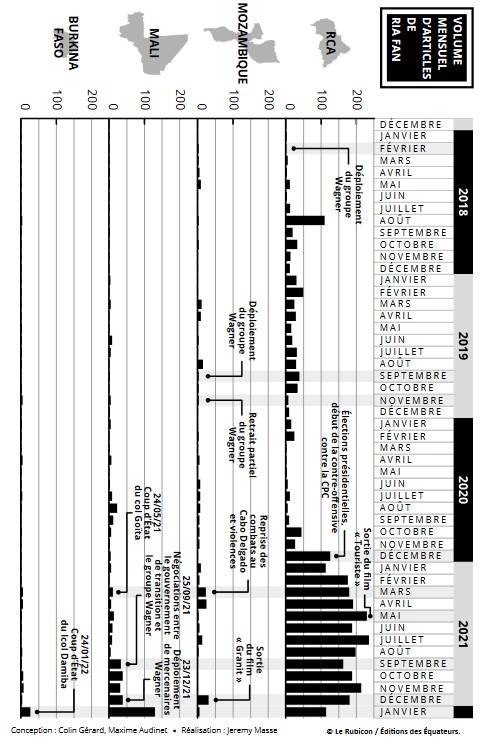
Source: M. Audinet and C. Gérard, “Les ‘libérateurs’”.
For contrast purposes, we added Burkina Faso to the analysis: the Wagner Group was not present in the country at the time of the analysis, but the January 2022 coup bringing Lieutenant Colonel Paul-Henri Sandaogo Damiba to power was welcomed by Prigozhin, while one of his lieutenants in the CAR, Alexander Ivanov, expressed his willingness to “share Russian instructors’ experience” with Burkina Faso.(x) Despite hesitations from the authorities in power, the “land of honest men” is now one of the African countries the Prigozhin galaxy has set its sights on.(x)
Of the four countries observed, RIA FAN’s coverage of CAR current affairs is clearly the most extensive. The isolated spike in August 2018 corresponds to a series of articles published after the suspicious murder in late July north of Bangui of three Russian journalists who came to investigate Wagner’s activities in the CAR. Since the December 2020 presidential elections and the counteroffensive led in the following months by the Central African Armed Forces (FACA) and Wagner’s mercenaries against the rebel groups belonging to the Coalition of Patriots for Change (CPC), there has been a marked increase in coverage.
The amount of content devoted to Mali by RIA FAN also illustrates this informational support. Production of content on Mali intensified in several waves in parallel to opportunities opened up by the overthrow of the regime of Ibrahim Boubacar Keita in August 2020 (first wave), by the second coup d’état in May 2021 (second wave), and above all, by the negotiations initiated by the putschist government of Assimi Goïta with Wagner in September 2021. Since the arrival of the Russian mercenaries at the end of December, and against the backdrop of a major diplomatic crisis between Paris and Bamako and the withdrawal of the French army from the country, RIA FAN has published several dozen articles each week about Mali.
Far from being simply factual, RIA FAN’s articles on Mali are deeply subjective, biased and editorialized. This is shown by the judgment analysis we have carried out on the 129 articles published on its website with the tag “Mali” (Table No. 1).
Table No. 1
Judgment analysis of the 129 articles published on RIA FAN with the tag “Mali” in January 2022
| Dominant theme | Number of articles | Percentage |
| News about only Malian authorities and their actions | 27 | 20,9 % |
| Meliorative articles on the transitional government and/or the FAMa | 16 | 12,40 % |
| News about France (armed forces, government, Malian diaspora, etc.) | 27 | 20,9 % |
| Pejorative articles on the French government and/or Barkhane | 18 | 13,95 % |
| News about the United States or European partners of “Takuba” | 13 | 10,1 % |
| News about Russia | 30 | 23,3 % |
| Articles favorable to the Russian presence and Russia-Mali co-operation | 22 | 17,05 % |
| Articles on French-Russian competition in Mali | 6 | 4,7 % |
| Articles about ECOWAS | 23 | 17,8 % |
| Articles critical of ECOWAS | 22 | 17,05 % |
| Other | 3 | 2,3 % |
Nearly a quarter of the articles published concern Russia’s role in the country, 22 of which are positive or even laudatory. But for a few exceptions, Wagner’s mercenaries are systematically presented as Russian “instructors” or “trainers,” according to the official terminology used by the Russian and Malian authorities. The French position dominates more than 20% of content, including 18 articles that are openly critical of the government and Operation Barkhane. Similarly, the role of the Economic Community of West African States (ECOWAS), which is behind the sanctions against Bamako and is presented as being “controlled by France,” is denounced in 17% of the articles. Finally, just over 12% of the articles published during the period offered a meliorative view of the Malian transitional government and the FAMa.
Unsurprisingly, controversial information or elements that could damage the reputation of Russian actors (mining, looting, acts of violence, etc.) are not mentioned in RIA FAN’s content. In April 2022, the massacre perpetrated by Malian soldiers and Russian mercenaries in Moura in central Mali was thus not covered by RIA FAN. Its reporting journalist, Igor Sarmatov preferred to stick to the official version from the Malian authorities, which called it an “anti-terrorist operation” that resulted only in the “elimination of 203 radicals” while accusations from the French authorities and “Western globalist media” are described as “fake news” and “provocative”.(x)
Russia’s role in influence and disinformation activities in Mali
In addition to the deployment of Russian mercenaries in Mali since the end of 2021, in recent months there has been a proliferation of disinformation content on line, most often to criticize the French presence and justify that of Russia. This was shown by Jean Le Roux from the DFR Lab, in a report published in February 2022, with the case of a coordinated network of five Facebook pages combining 140,000 followers and more than 24,000 posts on the platform.(x) But Le Roux admits that some authors of these posts are no doubt Malians who genuinely support the transition government and/or Russia. And Facebook had still not suspended some of these pages in spring 2022.(x)
In most cases, it is difficult to prove that this content comes from sources that are inauthentic (bots, fake accounts, coordinated campaigns) or external,particularly Russians or subsidized subcontractors. However, some informational practices that have long been used by actors connected with Yevgeny Prigozhin, primarily the ‘troll factories’(x) which the businessman sponsors, have been identified in recent months in Mali, and more broadly in Sub-Saharan Africa.(x) Several disinformation operations can even now be clearly attributed to the Wagner Group and Prigozhin’s network, and some have been extensively covered in the media in recent months.
One example is the macabre Gossi affair.(x) On April 22, 2022, the French Army sent aerial images filmed by drone to the press, showing a group of uniformed individuals presented as members of Wagner. The fighters were in the process of burying and filming the bodies of unknown persons, three kilometers from the military base in Gossi, ceded back to the Malian Armed Forces three days earlier by France. In another video extract provided by the French Army, the group can be seen travelling in Deng Feng vehicles, which are used by the FAMa and Wagner. On April 20, the fake account @diadiarra6(x), which pretended to be a former soldier and ‘Malian patriot’ and has since been removed by Twitter, posted a tweet accusing the French Army of “crime against the Malian people” in Gossi. The next day, the same account posted the close-up video of the mass grave corresponding to the one seen in the French aerial images. This disinformation operation by Russians, and the French Army’s immediate response to counter it, are important in two regards. First, the Gossi affair is the concrete translation of the much more offensive posture developed by the French Armed Forces in “information warfare”, following on from the new “cyber influence warfare” doctrine (Lutte informatique d’influence, L2I) adopted in October 2021.(x) After years of being relatively passive in the information arena and of definite unease with regard to conducting influence operations, the French Armed Forces are now clearly trying to move into this space to counter Russian actors in the Sahel(x), even though they are withdrawing from the ‘‘physical’ ground in Mali. Secondly, this was the first time that the French authorities attributed an ‘ informational attack’ to a foreign actor. The method used to nip the operation in the bud, i.e., declassifying military intelligence and sending it specifically to the press, particularly to French news agencies and media outlets present in Africa (AFP, France 24, TV5 Monde, RFI), also reveals a specific modus operandi, refreshed by US intelligence ahead of and since the start of Russia’s invasion of Ukraine.(x)
The response from the Prigozhin galaxy to clear the Russian paramilitaries was not long in coming after the French operation, in parallel to the accusations against the French Army from the Malian authorities. On April 22, the ‘sociologist’ Maksim Shugaley, one of the pilot-fish and a leading figure of Prigozhin’s network in Africa(x), mentioned in a post on his Telegram channel the “atrocities committed by French politicians and soldiers” in Africa, claiming that it was “obviously the French who committed these inhuman burials near their base.(x)” On April 26, at a press conference of the Rossia Segodnia federal agency (the parent company of Sputnik) reported by RIA FAN(x), Mira Terada, head of the Russian Foundation to Battle Injustice (FBI, or FBR in Russian), a Prigozhin-linked entity, said that “stating that Russian mercenaries can be seen on the images is another provocation by French propaganda.” Lastly, in a statement reported by The Guardianand in parallel to a very clear criticism of a “dying-out Western civilisation […] infected by the disease called Nazism”, Yevgeny Prigozhin reacted to the Gossi affair in person, accusing the French Army of having “mercilessly” killed Malian civilians not far from their military base.(x)
In Mali, Wagner-linked Russian actors could also reproduce practices of outsourcing other kinds of information operations already seen in the Central African Republic (like their considerable influence over the Information and Communication Bureau (BIC) linked to the Central African government)(x), by outsourcing certain influence operations to local actors. In 2020, an outgrowth of the Internet Research Agency (IRA), the famous Prigozhin-sponsored “troll factory” in Saint Petersburg, was incorporated into an NGO in the suburbs of Accra in Ghana. Its accounts targeted Afro-American populations in the lead up to the 2020 US Presidential elections.(x) The newspaper Jeune Afrique further reports that an “influence unit” attached to ambassador Igor Gromyko – the grandson of Soviet Foreign Minister Andrei Gromyko – has been at work for several months within the Russian embassy in Bamako.(x)
Furthermore, unlike Lengo Songo in the CAR, we are not yet aware of any media outlet partially or entirely funded by Prigozhin’s network in Mali. The ‘independent media outlet’ CEIBA is nonetheless suspicious in more than one respect and could resemble a false flag website.(x) Its Malian domain name, ceiba.ml, and its Facebook and Twitter accounts, were all created in early January 2022, only a few days after the Wagner Group’s arrival. Although most CEIBA content reports on Malian news, with clearly pro-junta views, a very significant part of the content focuses on Russian foreign policy. Since February 24, and the invasion of Ukraine, 57 of the 71 articles published in the “World” section of CEIBA, i.e., 80% of the content, relate to Russia and/or Ukraine, with an editorial line more favorable to the former than the latter. Several articles hostile to France’s presence are posted on the site.
Some sources, such as the pro-Mali government website MaliJet, are regularly cited by RIA FAN when their articles are in favor of Russian actors. As we have seen, this is also the case of the website Mali Actu, which has also given voice to leading figures in the Prigozhin galaxy: first, in October 2021, with an “exclusive interview” with Aleksandr Ivanov, in which this director of a Wagner-linked organization in Bangui (the Officers Union for International Security – COSI) praised the actions of “Russian specialists” in the Central African Republic, in parallel to negotiations between the PMC and the Malian government(x); and twice to Maksim Shugaley, at the time of Wagner’s arrival in Mali and just after the Gossi affair, with the publication of his declarations posted on Telegram a few days earlier.(x) Statements by Shugaley were also published by MaliJet in January 2022.(x) Every time, these Malian media present Prigozhin’s henchman by his recurring title of “Russian sociologist,” without ever mentioning his ties with Wagner. We will see how Russian media entryism in Mali also involves the action of the Russian international state media outlets, RT and Sputnik (see below).
By acting as a soundbox in Russian for this type of locally produced content, RIA FAN also makes it possible to identify relay accounts on social media networks that directly serve the interests of Russian actors. One example, regarding the Gossi affair and beyond the account @diadiarra6, is the Twitter account @MalleLuka, created in April 2022. In a tweet on May 13, 2022, cited by RIA FAN on May 20(x), the account, which describes itself in the bio as a “pan-Africanist, proud to be African [and whose] dream is an Africa free of colonialism”, broadcasts a video of demonstrators waving Russian flags and denouncing the “crimes of France.(x)”
The main strategic narratives used by the Prigozhin galaxy in Mali
All in all, from the content produced by the Prigozhin galaxy about Mali, particularly viaits media ecosystem, three main types of selective narratives, aiming either to legitimize or denigrate, can be identified.
The first stresses the beneficial nature of the cooperation between Russia and Mali and the valuable role played by “Russian instructors.” Some RIA FAN articles suggest that this renewed Russian engagement, a veritable “alternative to Western neocolonialism” (January 20, 2021), is supported by the authorities and the population (January 19 and 25). According to its journalists citing Mali Actu, the flag of the Russian Federation is a “symbol of the movement to liberate” African countries (January 27). Other Russian entities contribute to promoting this narrative, for example the Foundation for National Values Protection (FZNC), an NGO sanctioned by the U.S. government in April 2021, which is led by Maksim Shugaley and tasked with contacting or co-opting African militants. In a questionable poll published in September 2021, when negotiations between the junta and the Wagner Group began, FZNC thus suggested that 87.4% of Malians supported President Goïta’s appeal to “private military companies from Russia to help combat terrorists”, and that 83% were against the presence of the French Army in Mali.(x)
The second pejorative narrative indeed concerns France and, behind it, the main Western powers and their “neocolonial” interventionism. In a second FZNC poll published in January 2022(x), 83.3% of Malians had negative views about the French troops deployed in the country. Moreover, a Prigozhin post published just before Christmas 2021 on Concord’s Vkontakte account, just at the first Wagner mercenaries were arriving, contrasted the “glorious Russian fighters [who] save the world from violence and injustice” in Africa with “corrupt and greedy Western politicians [who] make unfounded accusations”. In its coverage of Operation Barkhane, RIA FAN underlined how the French Army was bogged down in Mali and its double-dealing vis-à-vis jihadist groups (January 23, 2022), and even reported that the reason for the intervention was to “pillage” mining resources (January 30, 2022). Obviously, Russians are not the only ones behind this anti-Western line, which many African militants have pursued for years. Some are actively relayed by Prigozhin’s ecosystem, such as the French-Beninese “ethno-differentialist” activist Kemi Seba, who claims to represent a radical fringe of Pan-Africanism(x). In an interview given in RIA FAN on March 31, after a tour in Moscow(x), Seba repeated these views hostile to the French army, denouncing its inefficiency and predation: “Yes, the Russians are much more efficient [in Mali] than France’s Operation Barkhane forces,” he concludes.
Illustration No. 1
Post of January 25, 2022 on the VK account of Concord’s press department(x)
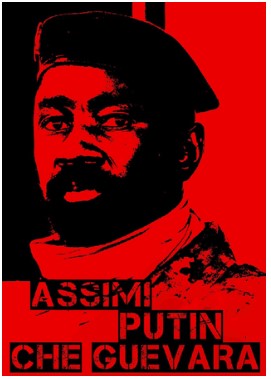
The third type of narrative is laudatory, and concerns the most recent African leaders to have come to power in the Central African Republic (Faustin-Archange Touadéra), Mali (Assimi Goïta), Burkina Faso (Paul-Henri Sandaogo Damiba in January 2022 and Ibrahim Traoré in September 2022) and Guinea (Mamadi Doumbouya), by means of a coup for the latter four. The “times of colonels” have come, and with them a “new era of decolonization”, Prigozhin claims in a Concord post on Vkontakte on January 25, 2022. Several members of Prigozhin’s network, including himself and Maksim Shugaley, refer to the Malian transition president as the “African Che Guevara”, a nickname also used in the 1980s for the President of Burkina Faso Thomas Sankara (see illustration no. 1).
In a RIA FAN article published on May 31, 2022, and featuring a visual based on the same narrative structure (see illustration No. 2), the writer “Sergei Dzerzhinsky” showers praise on the “freedom fighter” and “modern-day Che Guevara” that Assimi Goïta is, and his wish to move closer to Russia, “one of the main decisions of his political career.(x)”
Illustration No. 2
Publication in a RIA FAN article of May 31, on Assimi Goïta
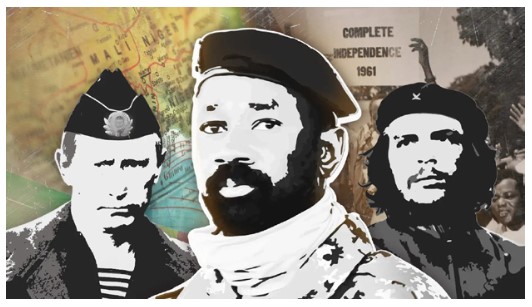
Beyond the symbol, associating the Malian president with the leader of the Cuban revolution, and behind him with the figure of Thomas Sankara, illustrates a systematic effort by these Russian actors to craft a narrative that reactivates the Soviet support for independence movements and the fight against Western imperialism during the Cold War, in the hope of arousing support among the target populations and spurring their opposition to Western “neo-colonialism”.
III. An official presence in the background
Today, Russia’s presence in Mali is dominated by the activities of the Wagner Group and the Prigozhin galaxy. However, the Russian authorities have also strengthened their ties with their Malian counterparts, mainly in the field of military-technical cooperation. Moreover, Mali is one of the Sub-Saharan countries that receives the strongest media coverage by international Russian state media outlets RT and Sputnik.
D efense cooperation – the spearhead of Moscow’s return to M ali
In the context of renewed tensions between the USSR and the West at the end of the 1970s, dubbed as the “Second Cold War” by Indian researcher Krishnaswamy Subrahmanyam(x), Moscow further developed its relations with several countries in sub-Saharan Africa, namely Mozambique, Angola and Ethiopia. However, this late move was short-lived, since the coming to power of Mikhail Gorbachev in 1984 marked the start of Soviet disengagement from the region, and more generally from Third World countries. As a result, the role of the international department of the Communist Party’s Central Committee in the planning and implementation of the Soviet Foreign policy was reduced, in favor of the Ministry of Foreign Affairs. This gradual disengagement reached its height at the time of the Soviet Union’s dissolution, with the closure of Moscow’s naval bases in Africa, such as Socotra and Aden in Yemen at the end of the 1980s, and Nokra, in Ethiopia, which was evacuated in 1991.
While Moscow’s reinvestment in sub-Saharan Africa in general, and in Mali in particular, clearly increased from the end of the 2010s onwards, relations between post-Soviet Russia and Bamako had developed in the early 1990s, based on the architecture established in the 1960s (see above). In January 1992, Bamako officially recognized Russia as the successor of the Russian Soviet Federative Socialist Republic (RSFSR), before the first visit by a Malian Foreign Minister to Russia in October of the same year. And although several cooperation agreements were signed during the 1990s, particularly in the parliamentary and academic fields, the bilateral relationship was more obviously restored in the defense sector. This renewed engagement reflected an assertion of Russian foreign policy after Vladimir Putin came to power at the end of 1999. Although post-Soviet Eurasia remained the priority for Russian diplomacy, it also sought, along the lines initiated by former Foreign Minister Yevgeny Primakov (1996-1998), to re-establish relations with the USSR’s former main partners, mainly in the Middle East and Asia, but also in sub-Saharan Africa.
In 2003, a cooperation agreement was signed between the Russian Federal Service for Military-Technical Cooperation with Foreign Countries and the Ministry of Defense of the Republic of Mali. In 2009, during the visit of Malian Foreign Minister Moctar Ouane to Moscow, defense cooperation between the two countries was taken further, with an agreement to establish a working group in the fight against terrorism. It was in September 2012 that Moscow and Bamako first signed an arms contract worth $12 million for the sale of 3,000 AK-47 assault rifles, which was completed in 2013. Contrary to what Russia now claims when it presents Moscow’s action in Mali as competing with Western countries (see below), defense cooperation between the two countries in the early 2010s was seen as complementary to the stabilization policies conducted by several states, primarily France.(x) This alleged mutual benefit for Paris and Moscow was underlined in an article published by the RIAC in 2012, on the prospects of cooperation between Russia and France.(x)
The reinforcement of Russia’s official presence in sub-Saharan Africa ties in with two trends: first, the crisis that began between Russia and Western countries in 2014, following the annexation of Crimea and the war in Donbas; second, the development of Russian presence in the Middle East following Moscow’s intervention in Syria starting in September 2015. Since 2015, Moscow’s activism in Africa has led to the signing of around twenty bilateral defense agreements, and to the organization in October 2019 in Sochi of a first summit between Russia and more than forty African nations. From Moscow’s perspective, the continent has become a new theater in its conflictual relationship with the West; Russia’s advances in the Middle East, especially in the Eastern Mediterranean countries (Syria, Egypt, and Libya), paved the way to this “extension of the battle zone” towards sub-Saharan Africa. It should also be noted that in 2014, sub-Saharan Africa was added to the portfolio of Mikhail Bogdanov, Russia’s Deputy Minister of Foreign Affairs hitherto in charge of North Africa and the Middle East. One of the key features of Moscow’s official line supporting its policy of influence in sub-Saharan Africa was precisely to underline the operational experience gained in Syria in the fight against terrorism, which Russia sought to offer to the countries in the region, especially in the Sahel. In 2017, Russia’s Permanent Representative to the UN emphasized that Russia had started supporting the armed and security forces of the Sahel countries and wished to continue this cooperation in order to enhance the effectiveness of the G5 Sahel. At the Sochi summit, the Executive Secretary of the G5 Sahel, Maman Sambo Sidikou, spoke of the greater role Moscow could play in the region.
Moscow’s activism in relation to Mali in recent years is fully part of this regional process, which is based, beyond the use of mercenaries, on more traditional practices of Russia’s external state action, such as defense cooperation. In October 2016, when Mikhail Bogdanov visited Bamako, Moscow offered to strengthen its cooperation in the fight against terrorism with Mali, in response to the requests made. Commenting on the Deputy Minister’s visit, Evgeny Korendyasov, former Russian ambassador to Mali, said that “military-technical cooperation with Mali began in the 1960s and today more than 80% of the equipment of the Malian armed forces is of Soviet or Russian origin. This cooperation continued after the fall of the USSR. Our two countries thus signed an agreement on cooperation in the fight against terrorism, and when the crisis began in Mali, Russia delivered several tens of millions of dollars’ worth of weapons to the Malian authorities. […] The Sahel is a very important area; it is an epicenter of the Islamist threat where more than 50 terrorist groups are active. We must also defend our economic interests, as the destabilization of Mali could threaten the security of neighboring states, where several Russian companies are located, including Ghana, Ivory Coast, and Guinea. Russia is seeking to return to Africa for good, and to this end, the support of the Malian authorities is fundamental.”(x) To Andrey Frolov, editor-in-chief of the Russian arms magazine Èksport vooruženij, the granting of armored vehicles would be an effective promotional campaign for Russian armament, at low cost: “This gesture would not cost us very much, a few tens of millions of dollars, and would give us very effective publicity. It would allow us to show that our arms are appreciated and ready for use.”(x)
In June 2019, at the Armia arms fair, the Russian and Malian defense ministers Sergei Shoigu and Ibrahima Dahirou Dembélé signed another military cooperation agreement between the two countries.(x) The document aims to establish intelligence exchange mechanisms, and to strengthen cooperation in military training and the fight against terrorism, as well as experience-sharing in the field of peacekeeping operations.(x) In November 2019, General Ibrahim Dahirou Dembélé announced “the arrival in the coming weeks of Russian military personnel in Mali to provide technical support” to the local armed forces, in particular to maintain the two Mi-35 helicopters delivered by Moscow in October 2017 and to take part in training their pilots. In November 2021, the delivery of two Mi-171Ch and Mi-17-V5 transport and combat helicopters was finalized, under an agreement signed in December 2020.
The recent increase in defense cooperation between Moscow and Bamako comes with a rhetoric setting the legitimacy of Russian actions against Western presence considered akin to colonialism and responsible for the region’s instability. This anti-neocolonial repertoire, which has always accompanied Wagner’s expansion in Africa through the Prigozhin galaxy, has in recent months found a direct echo among top Russian political officials. At his meeting in Moscow on November 11, 2021 with his Malian counterpart Abdoulaye Diop, Sergey Lavrov declared that “the legacy [of Russia-Mali relations] includes the fight against colonialism, against colonial dependence, and then against the neo-colonialist recurrence we have seen in Africa, and that we are unfortunately continuing to see.”(x) More recently, at the opening of the 2022 Moscow Conference on International Security, an event organized annually by the Russian Ministry of Defense, Sergey Shoigu denounced “the ambition of the countries of the collective West to restore the order and rules of engagement characteristic of the colonial period” in Africa, while stressing that their “neocolonialism” involves “support for separatist and terrorist movements.”(x) At the same venue, Vladimir Putin more broadly accused the “Western globalist elites” of “attempting to retain countries and peoples in the grip of what is essentially a neocolonial order” by their “neoliberal totalitarianism.”(x) A Malian delegation led by Defense Minister Sadio Camara, one of the junta’s strongmen and the main architect (along with General and Air Force Chief of Staff Abou Boï Diarra) of the partnership with Wagner(x), attended the conference.(x)
By extension, these views are echoed in most domestic Russian state media and, as we will see in the next section, in outlets targeting foreign countries. This is the case of the article posted online in December 2021 by Zvezda Weekly, one of the main media outlets owned by the Russian Ministry of Defense. Devoted to the “unique opportunities offered by Russia due to the lack of will on the part of Western countries to seriously address the security problems in the Sahel region”, the article thus sets out the good reasons for cooperating with Moscow: “First, in a context where local armed forces are losing to terrorists, Russian support is particularly necessary. Second, Russian assistance gives African leaders the opportunity to reduce their dependence on France. The colonial period ended relatively recently, and in this regard, there should be no illusions about the defense and economic policy of Paris, which does not miss an opportunity to gain a lasting foothold in its former colony. Quite frankly, this policy has not been particularly successful, especially recently, when the lack of progress in the fight against terrorism has only fueled anti-French sentiment among the population and tensions between the local authorities and Paris: a significant number of politicians in Niger and Mali, both in the opposition and in the government, are openly demanding the withdrawal of French troops.”(x)
The presence of Wagner’s mercenaries in Mali was not significantly affected by Russia’s invasion of Ukraine. Similarly, the process of strengthening the official defense relationship between Moscow and Bamako has continued since February 24. Following the November 2021 delivery of Mi-171Ch and Mi-17-V5 helicopters, a new batch of two Mi-35 attack helicopters, along with 59 N6 TE mobile radar systems, was delivered to Bamako at the end of March, by aircraft belonging to the 224th Flight Unit, the sister company of the 223rd Flight Unit mentioned above. Apparently, this delivery was made for free, as the two Mi-35s delivered at the end of March were taken directly from equipment supplied to the Russian aerospace forces, according to information from VPK. In early August 2022, Russia delivered five attack aircraft (L-39 Albatros and Su-25), as well as a Mi-24P attack helicopter. And the training of Malian soldiers, another component of the defense agreements signed in recent years between Moscow and Bamako, continues, with some 200 members of the Malian armed forces, as well as nine police officers, being trained in Russia in early summer 2022, according to a member of the Russian permanent mission to the UN.
As a consequence of the defense agreement implementation, mutual political support between Moscow and Bamako continues to grow, as shown by the telephone call of August 10, 2022 between Vladimir Putin and Assimi Goïta, during which the latter expressed Bamako’s gratitude for Russia’s support, particularly in its “merciless fight against terrorist groups.”(x) On March 24, Mali was also one of the 17 African countries that abstained from voting for the resolution adopted by the UN General Assembly condemning Russia’s attack on Ukraine. Furthermore, after the Moura massacre, Russia blocked a request put forward by France at the Security Council to investigate the incident. The spokeswoman of the Russian Ministry of Foreign Affairs, Maria Zakharova, even drew a parallel between the way the massacres of Mura and Boutcha were treated, stating that “in both cases, the West used the same process, namely a mass of fake information, in order to convince the international community of the guilt of this or that party, without waiting for the result of the investigations.”(x)
Limited economic and trade prospects
Defense cooperation, whether implemented through official channels or by entities such as Wagner, is the main instrument of Moscow’s activism in Mali. However, this dynamic process is clearly not found in the commercial sphere, where institutional initiatives to develop relations between the two countries are much more limited. In an article published in 2018, several authors, including Irina Abramova, director of the Institute of African Studies of the Russian Academy of Sciences, lamented this lack of state support for the development of trade relations between the two countries: “One of the reasons for the lack of economic cooperation between Russia and Mali is above all linked to the domestic instability, and to the lack of interest in the African continent among Russian economic actors, the absence of Russian trade representation in Mali and of cooperation between the Russian and Malian chambers of commerce.”(x)
In 2019, the volume of bilateral trade reached 89.2 million dollars.(x) Bilateral trade has seen a notable increase since the mid-2010s, reflecting a trend existing at the regional level. This increase is also due to the fact that African countries are not affected by the sanctions and counter-sanctions introduced between Russia and Western countries following the annexation of Crimea and the destabilization of Donbas in 2014, and considerably strengthened after February 2022. Between 2010 and 2018, the volume of trade between the countries in the Eurasian Economic Union (EEU) and those of the African continent thus multiplied by eight, to $22 billion. However, trade relations between Mali and Russia remain very limited compared to other countries: the volume is more than ten times lower than Mali’s trade with the EU and China, and in 2021, Russia was still not one of Bamako’s top ten trade partners.(x)
The very limited nature of economic and trade relations between Moscow and Bamako is not specific to Mali and is a more general problem in relations between Russia and sub-Saharan African countries. It was, in fact, fully identified at the Sochi summit in October 2019. In order to boost these relations, the decision was also made in Sochi to create a center for African studies within the Higher School of Economics (HSE) in Moscow. Finally established in August 2020, one of the new institution’s main purposes(x), according to its director Andrey Maslov, is to “export Russian expertise and knowledge to Africa.”(x)
The center’s principal publications include an approximately 140-page report published in 2021, in cooperation with the Russian Foreign Ministry, the Committee for International Affairs of the Duma and the Council on Foreign and Defense Policy (SVOP).(x) The report, titled “Afrique: perspectives de développement et recommandations pour la politique russe”, recommends several avenues for consolidating trade relations between Russia and sub-Saharan African countries. And they apply particularly well to the case of Mali. The report suggests that the adoption of an official framework strategy by Moscow on its objectives in Africa would ultimately enable a clarification of those objectives. It could also help to counter narratives about the Russian threat in Africa. This quote from the Deputy Minister Mikhail Bodganov in the report indirectly corroborates this lack of a reference document for a real Russian strategy in Africa: “Russia has a strategy for working in Africa, but it is constantly modified.”(x)
The report also contains explicit criticism of “hybrid actors” (an adjective which is, furthermore, little used by the Russian authorities to describe their own practices). Although they are not actually named, the term would appear to refer to Prigozhin-linked actors. According to the authors, the adoption of a framework strategy would increase the Russian authorities’ involvement in the development of bilateral cooperation, a realm too often occupied by these private entities: “One of the other main purposes of the strategy would be to put an end to, or at least reduce the activities of certain political adventurersactive in Africa under the Russian flag (other countries face similar problems) and who seek to divert resources from public support exclusively for profit. In recent years, several Russian hybrid actorshave developed their presence erratically, with relatively insecure means, attracting overestimated attention from Western mass media which have presented them as an integral part of the Russian government’s policy. Adopting a strategy would limit the harm caused to the Russian government’s interests by these adventurers.”(x)
The role and editorial line of international Russian state media in M ali
Above, we analyzed the information activities that accompany the deployment of the Wagner Group in Mali through the “hybrid actors” of the Prigozhin galaxy. But it is also important to look at the role played by the French-language branches of RT and Sputnik, Russia’s two main international public media networks. RT and Sputnik are both instruments of influence directly or indirectly serving the Russian government and its foreign policy.(x) In recent years, they have focused increasingly on African news, in parallel to their ambition to secure a bigger footprint on the continent.(x)
Aiming for greater presence in sub-Saharan Africa
Since the invasion of Ukraine triggered by Vladimir Putin on February 24, 2022, RT and Sputnik have been suspended in the European Union (EU), as part of “restrictive measures” designed to sanction Russia for its aggression and weaken its capacities to spread its war propaganda. Although certain workaround measures have been taken by the two networks (incitement to download VPNs, mirror addresses and websites, etc.), the broadcasting of RT’s TV channels is prohibited, all websites linked to the domain names rt.com and sputniknews.com are blocked and their dozens of accounts and pages on the main social media networks have been “deplatformed” in the EU.(x) This situation has triggered major changes, both in terms of restructuring these networks – the activities of RT subsidiaries in Western countries are considerably hindered or have even ceased to exist, like RT America and RT UK – and of searching for new market outlets. Sub-Saharan Africa and its huge pool of audiences (particularly English-speaking, French-speaking and Portuguese-speaking) are, therefore, all the more in the sights of the two French media outlets. In February 2022, RT initially announced the opening of a new correspondence bureau in Nairobi(x), before communicating in July on the establishment of an English-language African hub in South Africa, potentially headed by Paula Slier(x), a long-standing correspondent for RT and former director of the Russian network’s Middle East office whom Vladimir Putin had particularly congratulated on her “immense contribution to the development of Russian journalism.” At the end of January 2022, the owner organization of RT, the company TV-Novosti, registered the domain names afrique-rt.com and africa-rt.com, although neither site is currently active. Unofficial accounts or pages relaying RT written and audio-visual content about Africa have also been created since March, although it is difficult to determine whether their administrators are outsourced or not, such as the RT Africa Facebook account (@RussiaTodayAfrique), launched on March 21, 2022 and displaying more than 120,000 followers and 34,000 “likes” in October 2022. As for Sputnik’s French-language website, Sputnik France, it ceased producing content between March 4 and July 21, 2022, when it was rebranded under a new name, Sputnik Afrique. Although having a new domain name (fr.sputniknews.africa) registered in August 2022, Sputnik Afrique has kept the same domain name as its predecessor (fr.sputniknews.com), but has internationalized its editorial identity by focusing more on news from the whole African continent. Beyond a major trend of redeploying these Russian networks from Europe to Africa, this restructuring also represents a real question of survival for the French-language version of Sputnik, in response to the drastic drop in its audience since the European sanctions, from 13 million to less than one million total monthly visits between February and September 2022.
Concerning the audience of the French-language sites of RT and Sputnik, it is especially Burkina Faso that stands out in the audience estimates produced by SimilarWeb. A real breakthrough has been seen since November 2021 in this other Sahelian country, which in April 2022 drew nearly 8.8% (3rd position after France and Switzerland, but ahead of Canada and Ivory Coast) and 15.5% (2nd position after France) of the total visits to the French-language sites of RT (1.6 million) and Sputnik (1.6 million). This rise in Russian international media in the region would also appear to be taking shape in Mali which, although less represented, accounted for 8.3% of the Sputnik France web traffic in April 2022 (3rd position).
Several elements identified in recent months also show that RT is seeking to enlarge its African footprint through Mali, with access at the highest level. RT France’s correspondent in Moscow, Antoine Cléraux, visited Bamako at the end of April 2022, where he spoke with Defense Minister Sadio Camara, as well as the Segou region, a recent deployment zone for Wagner’s mercenaries, where the journalist met with Malian armed forces officers and visited the Bapho base, shortly after the attack by a jihadist group.(x) In May 2021, RT France sent Cléraux to the CAR, where he interviewed President Faustin-Archange Touadéra. At the end of May 2022, it was the Malian Foreign Minister Abdoulaye Diop’s turn to be interviewed by the reporter Vera Gaufman during a visit to Moscow, in the program La Grande Interview.(x)
In addition, according to information from Jeune Afrique, the Chairwoman of RT France Xenia Fedorova and her COO Dimitri Mendjisky contacted Sega Diarrah, boss of the website Mali Actu, barely four days after Russia invaded Ukraine.(x) After confirming that the Russian network wanted to open an office in Africa, the management of RT France reportedly proposed a partnership to Diarrah for sharing content (a practice already developed for several years by RT and Sputnik(x)), and well as acquiring an interest in the capital of Mali Actu. In an interview given to Al Jazeera in May 2022, Diarrah indeed recognized that RT France and Sputnik enabled him to “diversify his sources” by no longer relying solely on the French international media France 24 and RFI, whose coverage of Malian news is perceived by Malians as true “interference”.(x) This increase in RT and Sputnik’s presence indeed comes in a context of crisis between Paris and Bamako, but also and especially of the ousting by the Malian authorities of RFI and France 24, both of which are widely followed in Western and Central Africa.(x) Speaking of a “media blitz” intended to “destabilize the transition, demoralize the Malian people and discredit the valiant armed forces”, the Malian government even went so far as to accuse the two media outlets’ journalists of “criminal intent” and to compare them with the Rwandan genocidal radio station Mille Collines.(x) This suspension affects all RFI and France 24 broadcasting channels and prohibits the Malian media from quoting them or using their information. France Médias Monde, the state-owned holding company supervizing French international broadcasting, soon found an answer by offering Malian audiences workaround solutions (mirror sites, VPN, shortwave, satellite, access via platforms) to continue consulting the two outlets.(x) But the conflict at work in the global information space clearly finds a new illustration in Mali.
Textual analysis of RT France and Sputnik France content about Mali
We could not mention RT and Sputnik in this study without analyzing their coverage of Malian news. As Graph No. 2 shows, the volume of content published on the French-language websites of RT and Sputnik has increased significantly since November 2019 (death of 13 French soldiers in a helicopter collision), and even more so since the fall of 2021 (negotiations between the junta and Wagner and the accelerating deterioration in relations between Paris and Bamako). RT France reached a peak in January 2022 (20 articles), a month after the Russian mercenaries arrived in Mali; with 45 articles published under the tag “Mali”, Sputnik Africa reached its record in August 2022, just after its new launch.
Graph No. 2
Monthly volume of articles published under the tag “Mali” on the RT France and Sputnik France/Sputnik Afrique websites between January 2018 and August 2022
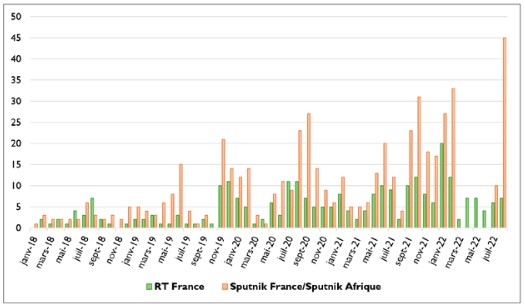
Here, we more precisely study a corpus of 340 articles in French published over 14 months, between January 2021 and February 2022, by Sputnik France (227 articles) and RT France (113 articles), and collected on the pages of the two websites corresponding to the tag “Mali”. The lexicometric analysis of this content is performed with the free software IRaMuTeQ, which can develop statistical analyses of the vocabulary used in large corpuses.(x) Based on the Alceste method developed by the linguist Max Reinert, the tool segments and then formally reorganizes sequences of texts: the resulting “top-down hierarchical classification” highlights the dominant themes (or “lexical worlds”, according to Reinert(x)) of a corpus of texts. IRaMuTeQ categorizes the segments into lexical classes, in the form of a dendrogram, according to the proximity of the forms composing them. Widely used in linguistics and information and communication sciences, the lexicometric method has recently been adopted by political science, particularly in the study of international relations.(x) Beyond the specific case studied, we also seek to show that textual analysis can be appropriately used to identify the speeches and current or recurrent narratives of an actor of informational influence.
We chose to divide the corpus into two sub-corpuses, the first running from January to August 2021 (8 months) and the second from September 2021 to February 2022 (6 months). The event setting the two corpuses apart is the start of negotiations between the Malian transition government and the Wagner Group in September 2021, a few months after Assimi Goïta’s coup d’état (see above) and a few months before the arrival of the Russian mercenaries and the announcement of the withdrawal of Barkhane. In so doing, we have sought to highlight how RT and Sputnik cover, within the Malian news, the action of the Malian authorities, the role of Russia in Mali and the French presence, by comparing the way these two periods are treated. The relevance of the analysis lies above all in the contrast between the dominant themes and the lexical choices of the two sub-corpuses studied.
The first corpus, consisting of 124 articles from RT France (47 articles) and Sputnik France (77 articles), runs from January 1 to August 31, 2021. As reflected in the dendrogram in Figure No. 1, six lexical classes stand out, corresponding to the six main “lexical worlds” of the French-language content on Mali produced by the two Russian media during this period.(x)
Figure No. 1
Dendrogram of sub-corpus No. 1, articles from RT France and Sputnik France referenced under the tag “Mali”, January-August 2021 (IRaMuTeQ)
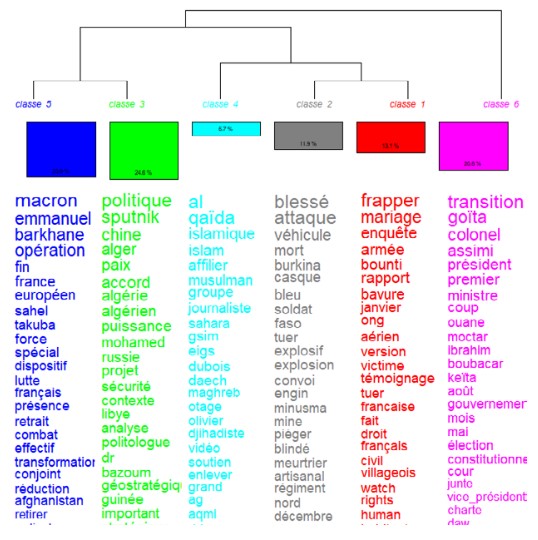
The first group of lexical classes, comprising classes 1, 2 and 4, accounts for a little more than 30% of the discursive area of the corpus and concerns the operational dimension of the fighting led by the French army against Jihadist groups in Mali or the MINUSMA peacekeeping operations. Class 4 (5.7% of the corpus) refers precisely to these armed groups, with several articles dedicated to the French journalist Olivier Dubois, who was kidnapped in April 2021 by the Support Group for Islam and Muslims (GSIM). Class 2 (11.9% of the corpus), the content of which often comes from international news agencies cited by RT and Sputnik, concerns lethal or non-lethal “attacks” on Barkhane soldiers or MINUSMA blue helmets. Lastly, the Bounti attack, which is particularly sensitive for the French Army(x), is at the heart of class 4, representing 13.1% of the classified segments. RT France and Sputnik France devoted some 15 articles to the affair between January and June 2021. While there are 27 occurrences of the word “bavure” (blunder) in the sub-corpus, RT and Sputnik present the two diverging versions of the French army and MINUSMA. We will note that RT’s articles on Bounti feature among the content of the “Mali” corpus that generated the most interaction on social media networks.(x)
The action of international actors is the topic of the second lexical group, consisting of classes 3 and 5. Class 3 (24.6 %) relates to the “geostrategic” (géostratégique) context and security management in West Africa and Mali (the 2015 Algiers peace agreements are mentioned about twenty times), and the role played by regional (Algeria) and world powers (China and Russia in particular, the latter only being presented in this sub-corpus from an official perspective). In class 5, French operations in the Sahel and their developments also cover around a quarter of the discursive area of the corpus; the most representative segments of this class highlight the June 2021 announcement of the “end” (fin) and the “withdrawal” (retrait) of Barkhane.
Finally, class 6, shows that more than 20% of the segments that come from RT and Sputnik articles on Mali concern Malian political news, its ruling elite and the “transition” regime led by Colonel Assimi Goïta, head of state since the second coup in May 2021. We will note that while the notion of “transition” (214 occurrences) used by the Malian authorities and the terms derived from it (“transitional authorities”, “transition government”, “transition president”, etc.) dominate the corpus, the term “junte” (junta), proscribed by the authorities in view of its pejorative connotation, also finds its place in the sub-corpus (25 occurrences).
We will now look at the second sub-corpus, classified in the dendrogram in Figure 2. This more robust sub-corpus contains 215 articles written over six months (66 from RT France and 149 from Sputnik France), between September 1, 2021 and February 28, 2022, a few days after the invasion of Ukraine.(x) The period was above all marked by a new event, that of the deployment, in theory first, and then effective, of Wagner Group mercenaries in Mali.
Figure No. 2
Dendrogram of sub-corpus No. 2, articles from RT France and Sputnik France referenced under the tag “Mali”, September 2021-February 2022 (IRaMuTeQ)
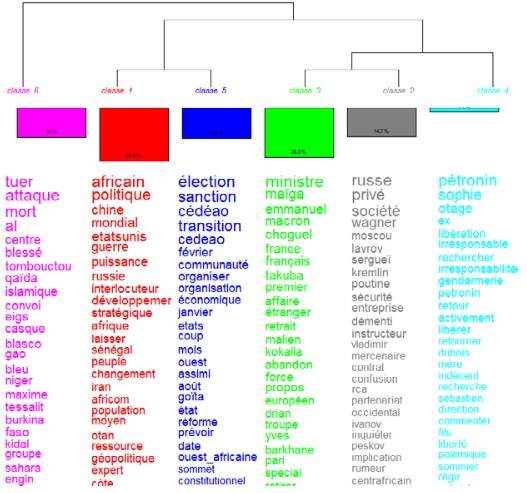
Not surprisingly, this Russian factor and the heightened Russian presence in Mali is reflected in the content produced over the period: the word “Russie” (Russia) occurs 196 times in the second sub-corpus (and only 24 times in the first) and the lemmatized word “russe” (Russian) is mentioned 337 times (vs. only six in the previous corpus). This is what class 2 – the most significant in our analysis – suggests, as it is found in 14.7% of the segments of the sub-corpus. This class is entirely devoted to Russia’s presence, under both of its facets. But what is the case in detail?
Official Russian presence is mainly represented in class 2 by the terms “Moscou” (Moscow, with 90 occurrences), “Kremlin” (31 occurrences), “Vladimir Poutine” (28 occurrences), “Sergueï Lavrov” (36 occurrences) or “[Dmitri] Peskov” (the Kremlin’s spokesperson, 11 occurrences). However, the class predominately features terms related to Russia’s unofficial presence in Mali, that of the Wagner Group: the names or expressions “Wagner”, “mercenaire” (mercenary), “société militaire privée”’(private military company), “société de sécurité privée” (private security company) and “société paramilitaire” (paramilitary company) are mentioned 191, 34, 45, 31 and 13 times in the corpus respectively. This situation is all the more surprising as, in a similar lexicometric analysis carried out on the coverage of Central African Republic news by RT and Sputnik between 2018 and 2020, these semantic choices were clearly not favored and the terms were used sparingly, or even totally avoided.(x) Only the term “instructor” which, as we saw in the RIA FAN corpus, suggests the lawful dimension of the Russian fighters and corresponds to language used recurrently in the Prigozhin galaxy, was adopted to describe Wagner members in the Central African Republic.
However, this apparent semantic shift should be qualified. As already seen in our previous work, the coverage of “Russian instructors” by the Russian media is selective, even sterile. “Au Mali, Moscou apporte son expertise, son savoir-faire dans de nombreux domaines” [In Mali, Moscow brings its expertise and know-how in many fields], titles Sputnik France in one of the most dithyrambic articles of the corpus. Its author quotes the Gabonese director of the pro-Russian blog Mir magazine (presented as a “media specializing in Russian-African news”), mentions the “positive results” of Russia’s latest interventions in Africa and says that “Russia contributed to the emancipation of the African peoples from colonial tutelage, notably in Mali” (Sputnik France, February 16, 2022).
The most controversial aspects of Wagner’s action, on the other hand, are muted in the corpus: the terms “looting”, “mining”, “predation”, or “extorsion” (widely documented practices of the Wagner Group, as we have seen) do not appear in this lexical class.(x) Russia’s role in the field of private military companies is regularly played down: “The head of Russian diplomacy had […] condemned the European tendency to worry about the arrival of new foreign security actors in Mali and recalled that the activity of private military companies was ‘not a Russian phenomenon at all’, but had its origins in Western countries”, is found in four RT France articles between December 2021 and February 2022. The links between the Wagner Group and the Russian state are never reported or documented either. Similarly, the term “instructeur” (instructor, 37 occurrences) is systematically used as such, outside any quotation, whereas the term “mercenaire” (mercenary, 34 occurrences) appears either in the reported statements of Western representatives, or in segments of text where this presence is denied or put into perspective: “Russian officials, who confirm the presence of 1,135 instructors in the Central African Republic, refute this deliberately maintained confusion between their military and the mercenaries of private companies”, reports this article from Sputnik France, introducing an interview with Aleksandr Ivanov, a figure of the Prigozhin network already mentioned (“Too many ‘rumors are flying around about the Wagner Group, although this company remains invisible’”, December 10, 2021).
Furthermore, in the vast majority of cases, the terms “privé” (private), “société” (company), and “wagner” are positioned near other words which, again, cast doubt on the reality of this presence in Mali, as evidenced by the terms “démenti” (denial, 35 occurrences), “rumeur” (rumor, 26 occurrences), “confusion” (confusion, 15 occurrences), “allegation” (allegation, 14 occurrences), “prétendu” (alleged, 9 occurrences), “sans fondement” (unfounded, 7 occurrences) or “aucune preuve” (no evidence, 4 occurrences), all of which are present in this lexical class. Here, we add two of the ten most representative segments of this lexical class centered on Russian presence, as classified by IRaMuTeQ:
“For his part, Kremlin spokesman Dmitry Peskov said on September 15 that Moscow was not negotiating any military presence in Mali, after the Reuters news agency had relayed information about a possible agreement between Bamako and the private Russian company Wagner” (“La France menace le Mali en cas d’accord avec des sociétés privées russes” [France threatens Mali in the event of an agreement with private Russian companies], Sputnik France, September 29, 2021).
“For his part, the head of French diplomacy, Jean-Yves Le Drian, criticized Bamako on January 28 for “calling on a private Russian militia close to Putin which is directly using Mali’s own resources”, despite a recent denial by the Malian government concerning the deployment of the private security company Wagner. Last December, the Russian Foreign Ministry accused the West of “hysteria” over the issue” (““Imbroglio”, ”un pays qui nous humilie”: l’opposition au diapason sur la situation au Mali” [“Imbroglio”, “a country humiliating us”: the opposition in step on the situation in Mali], RT France, February 2, 2022).
This dimension is also illustrated in Graph 3 below, which is an analysis of similarities – another feature built into IRaMuTeQ(x) – of the first 150 terms of class 2 (the most represented being the term “Russian” with 337 occurrences). The two communities at the top right of the graph, in red and orange, are those corresponding to the “private security company” Wagner: we note the proximity of the terms “denial”, “proof”, “allegation” and “rumor” to the terms “company” and “wagner”.
Graph No. 3
Analysis of similarities of the first 150 terms in class 2 of the second sub-corpus devoted to Russia’s presence in Mali (IRaMuTeQ/Gephi)
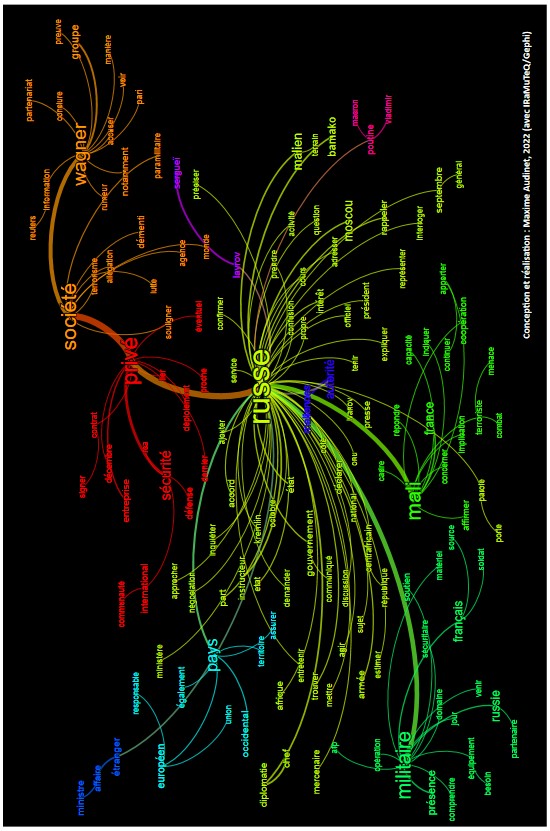
Another article published on February 18, 2022 in Sputnik France deserves specific mention, as it illustrates the type of coverage developed by the Russian international media to cover Wagner’s action in sub-Saharan Africa. Its title is: “Prigojine compare les rumeurs autour de Wagner à la légende de Robin des Bois” [Prigozhin compares the rumors about Wagner to the legend of Robin Hood]. The article presents Prigozhin as a simple “Russian businessman” and is built around a series of his statements reported without any further contextualization or contradictions: “I would like to stress once again that the private military company Wagner as a phenomenon does not exist”, says Wagner’s main sponsor, adding that “going back to Mali, the French plundered this country for over 150 years. With the advent of the new liberation government [of Assimi Goïta], the crimes committed over the years have been actively uncovered […]. The relations [of Africans] with France have been ruined by the thieves who came to power after Jacques Chirac.”
We conclude this textual analysis with the other lexical classes of the second sub-corpus (see Figure 2). Class 1 (27.7% of the classified segments) refers to themes similar to those of class 3 of the first sub-corpus, with additional emphasis on competition between major powers on the African continent. Class 6 (15% of classified segments) corresponds to classes 2 and 4 of the first sub-corpus on the fighting of coalition forces and attacks on French forces; and class 5 (15.6%) continues the topics of Malian interior policy seen earlier, with the appearance of a lot of content on the economic and diplomatic sanctions adopted by ECOWAS against Bamako in early January.
The very small Class 4 (1.9% of segments) comes from a series of seven articles published in November 2021 by RT and Sputnik about the case of Sophie Pétronin. This humanitarian worker and former French hostage, kidnapped in 2016 in Gao and released from captivity in October 2020, chose to return to Mali of her own free will a year later, prompting a wave of criticism from French political and military officials. It is on this controversial dimension that RT France and Sputnik France, which are keen on highly polemical topics – and the term “polémique” comes up in the class – relating to French current affairs(x), focused in their coverage of the Pétronin affair. ““Irresponsable”, “indécent”: le retour de Sophie Pétronin au Mali agace la droite et le gouvernement” [“Irresponsible”, “indecent”: Sophie Pétronin’s return to Mali annoys the right wing and the government”], runs the RT France headline of November 3, 2021, echoing the words of Thierry Mariani, the MEP close to the Rassemblement National (RN) party, known for his pro-Kremlin views.
Lastly, class 3, which covers a quarter of the area of the corpus, refers to the relationship between France and Mali and its rapid deterioration since the coup of June 2022. As the most representative terms of the class suggest, this deterioration is reflected in the statements made by the Malian Prime Minister at the UN in September 2021: Choguel Kokalla Maïga criticized the French authorities for “pulling out in full flight” (“abandon en plein vol”, 29 occurrences in the sub-corpus) after the announcement of the end of Barkhane, justifying in passing the need for Mali to find new partners to ensure its security. The ensuing verbal escalation between Paris and Bamako was widely covered by the Russian media. As shown in Table 2, which was created by combining data from the social media monitoring tools CrowdTangl and Buzzsumo, eight of the ten most viral articles on Facebook in sub-corpus 2 concern this deterioration in relations between Mali and France.
Table No. 2
RT France and Sputnik France articles published between 09/01/2021 and 02/28/2022 on Mali which generated the most interaction on Facebook (CrowdTangl/Buzzsumo)
| Title | Date | Source | Number of interactions on Facebook |
| Mali: French ambassador ordered by authorities to leave the country within 72 hours | 01/31/2022 | RT France | 2 967 |
| Mali asks France to withdraw its soldiers from Barkhane and Takuba “without delay” | 02/18/2022 | RT France | 2 553 |
| Mali summons French ambassador and denounces Macron’s “unfriendly remarks” | 10/05/2021 | RT France | 2 052 |
| Mali accuses France of violating its airspace | 01/12/2022 | RT France | 1 678 |
| Malian Prime Minister accuses France of training terrorists | 10/08/2021 | Sputnik France | 1 263 |
| “We don’t need France”: demonstration in Mali celebrating the departure of French soldiers | 20/02/2022 | RT France | 1 261 |
| Mali asserts “the right to cooperate with any state” in the interest of its people | 08/10/2021 | RT France | 1 022 |
| Russian instructors: Wagner for the Malians: “Security is what matters” | 02/12/2022 | Sputnik France | 980 |
| France threatens Mali in the event of an agreement with Russian private companies | 09/29/2021 | Sputnik France | 857 |
| France wound up by the prospect of a contract between Mali and a Russian private company | 09/16/2021 | RT France | 838 |
As the case of Mali shows, the coverage of African current affairs by international Russian state media has become significantly brisker in terms of content production, especially in countries where the Russian presence – and in particular that of the Wagner Group – is expanding. Although the treatment is, on the whole, undeniably more retrained than that of RIA FAN and sources linked to the Prigozhin galaxy, RT France and Sputnik France nonetheless develop an editorial line that is clearly compatible with Russia’s official agenda on the continent. This textual analysis could therefore serve as a basis for a more detailed analysis, should these two media outlets, now sidelined in the West, decide to become more competitive on the various media markets of sub-Saharan Africa.
Finally, it should be mentioned that Russia is just beginning to reinvest in the cultural dimension of its public diplomacy in Mali. As reported by Izvestia in November 2022(x), the federal agency Rossotrudnichestvo, which coordinates Russia’s cultural and exchange diplomacy(x), has recently opened four new “Russian Houses” – Russia’s cultural institutes abroad – in Egypt, Algeria, Sudan, and Mali. At the same time, the number of government grants provided by Rossotrudnichestvo to allow African citizens to study in Russia will increase from 2,300 currently to 4,700 for the 2023/2024 academic year. This quota goes from 35 to 290 for Malian students only – the highest growth observed on the continent. After having long neglected sub-Saharan Africa in the post-Soviet era, this new impetus of Russia’s cultural diplomacy is another indicator that Moscow, in search of support in the “Non-West” (in Russia, Ne-Zapad), also wishes to consolidate its soft power over the long term in the region, including in the countries where Wagner is deployed.
Conclusion
Moscow’s engagement with Bamako started before the Malian political crisis that began in 2021. Reviving ties with Mali is part of a regional trend characterized by the strengthening of Russia’s presence in several sub-Saharan African countries, which has significantly increased since 2014. Until the May 2021 coup d’état, this revival was mostly based on developing defense cooperation between the two countries, starting with the signing of new arms contracts. Following a pattern already seen in the other African countries in which the Wagner Group is deployed, the Prigozhin galaxy, whose crucial role in Russia’s expansion in the Sahel has been shown, placed its pawns in Mali at the end of 2021 thanks to a major political crisis and a climate of heightened security instability. This new Russian presence is also evolving in parallel to a “re-articulation” of the French Barkhane force outside Mali.
One year after the arrival of the Russian paramilitaries, their activities mainly involve training units of the Malian armed forces, participating in armed operations carried out by the latter and, with less obvious success at this stage than in the Central African Republic, infiltrating decision-making circles in order to obtain political dividends (Russian competition with Western “neo-colonialism”, support for Russia on the international scene) and material rewards (access to resources). However, the Praetorian guard role that Wagner plays in other countries, in particular in the Central African Republic, is not reproduced in similar proportions in Bamako to protect the government’s elite. Although these “adhocratic” entities and the business people who support them flaunt their private nature and have their own agenda, it is clear that their actions in Mali also regularly, or most often, serve Russia’s official policy to revive its engagement in sub-Saharan Africa. Alongside this non-state presence and the composite information ecosystem accompanying Wagner’s deployment, Moscow has also recently increased its institutionalized cooperation with Mali. As with many other countries in the region, these cooperations are relatively advanced in the military-technical sphere, but still limited in the economic and trade sectors. It is, in any event, far off the expectations to which the first Russia-Africa summit in Sochi gave rise. Therefore, Russia’s presence in Mali today is characterized by this two-sided but complementary dimension, allowing for opportunistic use of the principle of plausible deniability and with seemingly little concern for potentially contradicting semantics or agendas between its actors.
Today, Russia enjoys a mostly positive image in Mali. A worldwide Gallup poll conducted between April 2021 and January 2022 suggested that Mali had the highest rate of approval of Russian leaders in the world (84%), ahead of Kyrgyzstan (76%) and Mongolia (73%).(x) Both the entities in the Prigozhin galaxy, and the international Russian state media outlets, actively work to legitimize Russia’s presence and run down its opponents. These actors use a range of information practices including public diplomacy, propaganda, disinformation and secret operations. They manage to interact with some success with endogenous ecosystems of local actors and relays which share the same political, ideological or strategic interests.(x) RT and Sputnik are also seeking new momentum in Mali – as in most French-speaking African countries – after being suspended from broadcasting in the European Union, following the invasion of Ukraine.
The latest survey of the Friedrich Erbert Foundation’s Mali-Mètre report, conducted from March 13 to April 4, 2022 in the district of Bamako and all regional capitals of Mali(x), would seem to confirm the foothold being gained by Russia in Mali and the decline in French presence, in the context of the withdrawal of its armed forces.(x) While 92% of respondents say they trust Russia to restore the country’s territorial integrity, 73% say they are dissatisfied with Operation Barkhane (this figure was already 79% in 2019) and 83% believe that the French withdrawal will have positive impacts on the security environment. More significantly, two thirds of the Mali-Mètre respondents consider Russian forces in Mali to be “instructors”, the term used by the international Russian media, the Prigozhin galaxy and the Malian authorities, while only 10% describe them as “mercenaries”. Although they do not precisely reveal the direct causal mechanisms of Russian influence operations in Mali, these figures do show how public opinion is receptive to the strategic narratives disseminated by Russia in sub-Saharan Africa.
This Russian penetration in Mali has sparked a lot of reactions internationally, particularly from France. While the French armed forces are withdrawing from the “physical” ground in Mali, they do not appear to have any intention, in conjunction with other French institutions (Quai d’Orsay, General Secretariat for Defense and National Security)(x), to leave the field open to Russian actors in the African information space. Despite different and asymmetrical methods, the information battle between Paris and Moscow in the Sahel is, in fact, adding to the list of conflicts in the region.
B ibliography
Irina Abramova, Lûdmila Šelehova, Ol’ga Konstantinova, “Rossijsko-Malijskoe èkonomičeskoe vzaimodejstvie: sostoânie i perspecktivy” [Status and prospects of economic cooperation between Russia and Mali], Vestnik Adygejskogo gosudarstvennogo universiteta [Adyghe State University Bulletin], 2018, vol. 1, p. 181-189, https://cyberleninka.ru.
All Eyes On Wagner, “One year of Wagner in Mali: A Human Rights Report”, November 2022, 58 p.
Christopher Andrew, Vasili Mitrokhin, The Mitrokhin Archive II: The KGB in the World, Londres, Penguin, 2018 (2005), 677 p.
Maxime Audinet, “Anatomie de la diplomatie culturelle russe à l’ère post-soviétique”, Hérodote, 2017, 166-167, p. 165-177
Maxime Audinet, Le Lion, l’Ours et les Hyènes: Acteurs, pratiques et récits de l’influence informationnelle russe en Afrique subsaharienne francophone, Report 83, IRSEM, July 2021, 93 p.
Maxime Audinet, Kevin Limonier, “Le dispositif d’influence informationnelle de la Russie en Afrique subsaharienne francophone: un écosystème flexible et composite”, Questions de communication, 41, 2022, p. 129-148.
Maxime Audinet, Colin Gérard, “Les ‘libérateurs’: comment la “galaxie Prigozhin” raconte la chevauchée du groupe Wagner au Sahel”, inLe Rubicon,Les nouvelles formes de guerre, Paris, Éd. des Équateurs, 2022, chap. 5, p. 69-86.
Maxime Audinet, Russia Today (RT): Un média d’influence au service de l’État russe, Bry-sur-Marne, INA, 2021, 192 p.
Maxime Audinet, Benjamin Harding, “En Centrafrique, la Russie externalise son influence”, La Revue des médias, October 13, 2022, https://larevuedesmedias.ina.fr.
Warren Bennisand Philip Slater, The Temporary Society, New York, Harper & Row, 1968, 170 p.
Alice Baillat, Fabien Emprin, Frédéric Ramel, “Des mots et des discours: du quantitatif au qualitatif”, in G. Devin (dir.), Méthodes de recherche en relations internationales, Paris, Presses de Sciences Po, 2016, chap. 12, p. 227-246.
Pádraig Carmody, The New Scramble for Africa, Cambridge, Polity Press (2nded.), 2016, 326 p.
Philippe Decraenne, “Deux décennies de politique extérieure malienne (1960-1980)”, Politique étrangère, 45 (2), June 1980, p. 437-451.
Frédérick Douzet, Kévin Limonier, Selma Mihoubi and Élodie René, “Cartographier la propagation des contenus russes et chinois sur le Web africain francophone”, Hérodote, 177-178, 2020, p. 77-99.
Emmanuel Dreyfus, “Les sociétés militaires privées en Russie: à l’Est, quoi de nouveau?”, Research paper no. 63, IRSEM, October 12, 2018, 11 p.
Emmanuel Dreyfus, “Sociétés militaires russes. Wagner, combien de divisions?”, Orient XXI, April 24, 2020, https://orientxxi.info/magazine/societes-militaires-russes-wagner-combien-de-divisions,3804.
Emmanuel Dreyfus, “Emulation and Military Change in Russia”, Russia Matters, Belfer Center, October 23, 2020, https://www.russiamatters.org.
Emmanuel Dreyfus, “Les forces armées russes, meilleur allié du Kremlin?”, Annuaire français des relations internationales, vol. 23, 2022, p. 609-624.
world economy and international affairs faculty of theMOSCOW HSE, “Afrika: perspektivy razvitiâ i rekomendacii dlâ politiki Rossii” [Africa: development perspectives and recommendation for Russian policy], 2021, 142 p., https://globalaffairs.ru.
Gallup Organization, “Russia’s Leadership Not Highly Popular Before Ukraine War”, April 15, 2022, https://news.gallup.com.
Colin Gérard, “Usines à “trolls” russes: de l’association patriotique locale à l’entreprise globale”, La Revue des médias, June 20, 2019, https://larevuedesmedias.ina.fr.
Irina Gridan, Gaëlle Le Boulanger, “Les relations militaires entre l’Algérie et l’URSS, de l’indépendance aux années 1970”, Outre-Mers. Revue d’Histoire, 354-355, p. 37-61.
Shelby Grossmanet al., “In Bed with Embeds: How a Network Tied to IRA Operations Created Fake “Man on the Street” Content Embedded in News Articles”, Stanford Internet Observatory, Cyber Policy Center, December 2, 2021, https://cyber.fsi.stanford.edu.
Evgeny Korendyasov, Olga Konstantinova, “Peace in Mali: The path to security in the Sahara-Sahel subregion”, Asia Today and Africa, 11, 2020, p. 17-25, https://ras.jes.su.
Elena KoroL’kova, “Meždunarodno-pravovoe regulirovanie deâtel’nosti častnyh voennyh i ohrannyh kompanij” [International law and the regulation of the activity of private military and security companies], Russian Institute for International Affairs, 19 mai 2022.
Jean Le Roux, “Pro-Russian Facebook assets in Mali coordinated support for Wagner Group, anti-democracy protests”, DFRLab, February 17, 2022, https://medium.com/dfrlab.
Marlène Laruelle, Kevin Limonier, “Beyond “hybrid warfare”: a digital exploration of Russia’s entrepreneurs of influence”, Post-Soviet Affairs, 37 (4), 2021, p. 318-335.
Kevin Limonier, “Diffusion de l’information russe en Afrique: Essai de cartographie générale”, Research paper no. 66, IRSEM, 2018, 21 p.
Kevin Limonier, Marlène Laruelle, “Typologie des manœuvres informationnelles russes à l’égard des pays francophones”, Annuaire français de relations internationales, vol. 23, 2022, p. 65-80.
Kevin Limonier, Maxime Audinet, “De l’enquête au terrain numérique: les apports de l’OSINT à l’étude des phénomènes géopolitiques”, Hérodote, 186, 2022, p. 5-17.
Lucie Loubère, “L’analyse de similitude pour modéliser les classifications hiérarchiques descendantes”, International Days for statistical analysis of textual data, 2016.
Kimberly MARTEN, “Russia’s use of semi-state security forces: the case of the Wagner Group”, Post-Soviet Affairs, 35 (3), 2019, p. 181-204
Anne-Laure Mahé, Maxime Ricard, “Dynamiques locales, stratégies globales: l’appui russe aux pouvoirs militaires maliens et soudanais”, Revue Défense Nationale, 852, July 2022, p. 131-137.
Pierre Ratinaud, Lucie Loubère, “Documentation IRaMuTeQ: 0.6 alpha 3 version 0.1.”, 2014, 37 p.
Max Reinert, “Les “mondes lexicaux“ et leur “logique” à travers l’analyse statistique d’un corpus de récits de cauchemars”, Langage & Société, 66, 1993.
Maxime Ricard, “Mali kura, Mali fanga: la trajectoire politique du Mali sous domination militaire”, Research paper, IRSEM, 2022, to be published.
Laura Roselle, Alister Miskimmon, Ben O’Loughlin, Forging the World: Strategic Narratives and International Relations, Ann Arbor, The University of Michigan Press, 2017, 352 p.
Ûrij Rubinskij, “Sotrudničestvo meždu Rossiej i Franciej vygodno obeim stranam” [Cooperation between Russia and France benefits both countries], Russian International Affairs Council, August 15, 2013, https://russiancouncil.ru.
Vladimir Šajkin, Istoričeskij put’ učiliŝa [Institute’s history], Râzanskoe vysčee vozdučno-desantnoe komandnoe učiliše (Voennyj Institut) imeni generala armii V.F. Margelova [Higher Military School of Airborne Troops V.F. Margelov], 2012, 267 p.
Nikos Smyrnaios, Charis Papaevangelou, “Guerre en Ukraine: les plateformes numériques rattrapées par la géopolitique”, La Revue des médias, April 15, 2022, https://larevuedesmedias.ina.fr.
Krishnaswamy Subrahmanyam, The Second Cold War, New Delhi, ABC Publishing House, 1983.
Manon Touron, “Le Mali, 1960-1968. Exporter la guerre froide dans le pré carré français”, Bulletin de l’Institut Pierre Renouvin, 1 (45), 2017, p. 83-95.