The Politicisation of Central European States’ Foreign Policies Towards Ukraine
Download the PDF version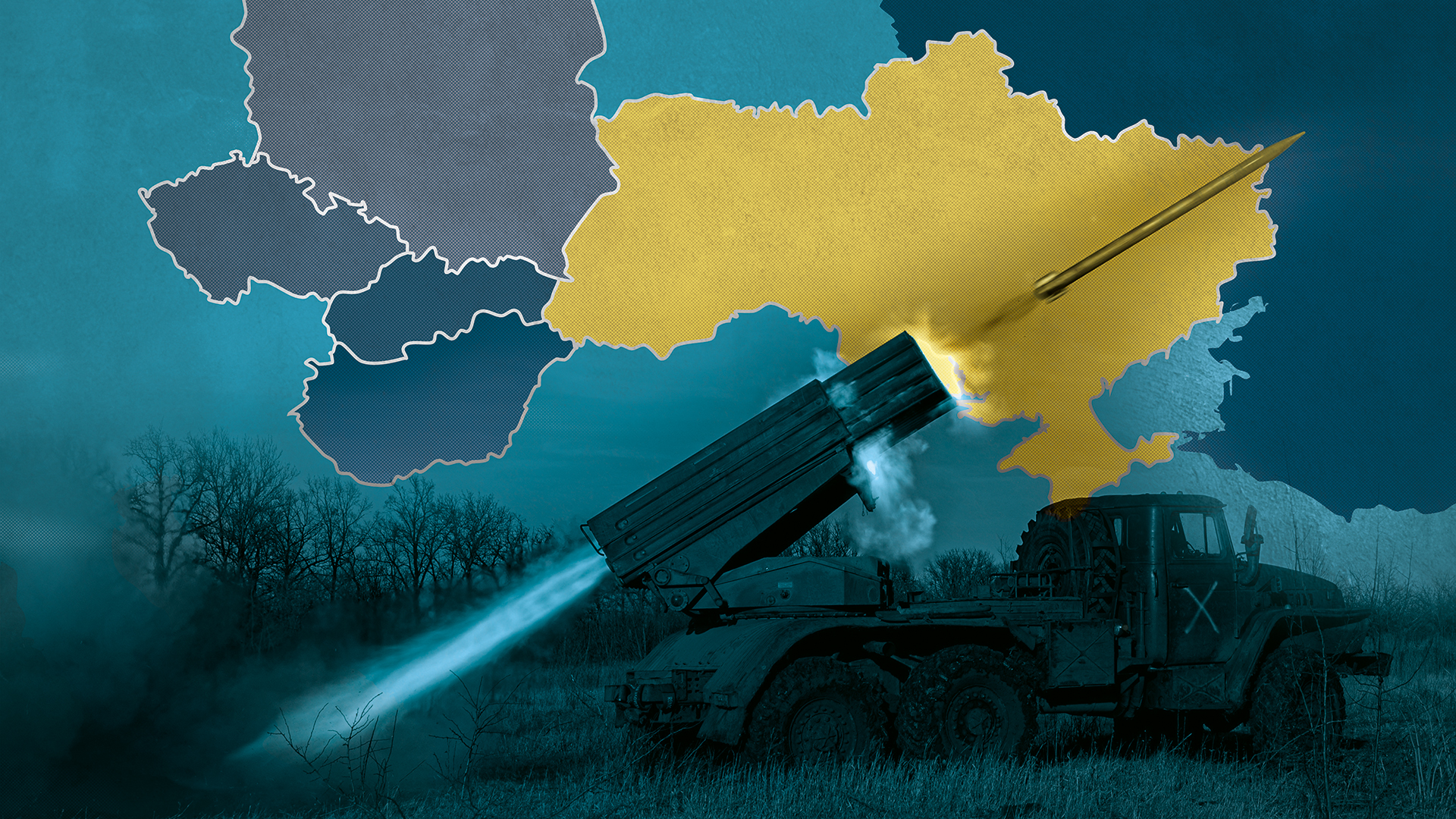
European countries’ policies towards Russia and Ukraine are often seen as a function of their history and geography. States that have been victims of Russia’s imperialism in the past and that are most exposed to its contemporary military power due to geographic proximity are generally expected to be more sensitive to the strategic threat it poses and, relatedly, to stand among the staunchest supporters of Ukraine. In that sense, the variations in and across the foreign policies of Hungary, Slovakia, Czechia and Poland – commonly referred to as the Visegrad countries – appear analytically puzzling. Across the region, political actors are increasingly calling economic and military aid to Ukraine into question, whether from the ranks of the opposition or from government. In Hungary, Viktor Orbán went the furthest in denouncing, and at times blocking, European support to Ukraine while he was in power. His successor, Péter Magyar, has mended relations with Kyiv and clearly denounced Moscow as the aggressor in the war, yet without starting to provide weapons to Ukraine or halting energy imports from Russia. In Slovakia, after returning to power in 2023, Robert Fico has suspended military aid to Ukraine, blocked for a time the adoption of EU sanctions against Russia, and travelled to Moscow to attend World War II celebrations. In Czechia, since he returned to office in 2025, Andrej Babiš has stopped funding the ammunition initiative for Ukraine launched by the previous government and has vowed to toughen conditions for Ukrainian refugees. These positions contrast with Bratislava’s and Prague’s forward-leaning stances in the months that followed the outbreak of the Russia-Ukraine war, when they were the first to transfer certain types of heavy weaponry to Kyiv before other European capitals followed suit. For its part, Poland has remained a steady and crucial security provider and logistical hub for Ukraine – it has long regarded the country as the lynchpin of its own security, and there has been little difference among successive Polish governments in this regard. But even there, President Karol Nawrocki has adopted increasingly critical rhetoric towards Ukraine, while opposition parties are seeking to capitalise on growing anti-Ukrainian sentiment in Polish society. This study argues that these alterations in Visegrad countries’ policies towards Ukraine and Russia are the mark of their growing politicisation. The Russia-Ukraine war is increasingly becoming an issue of domestic and electoral politics in Central Europe. In this context, politicisation takes the form not of an expansion of the actors and audiences involved in foreign policy making, but of an increased use of the Russia-Ukraine war in domestic political competition. More specifically, the war and its consequences are instrumentalised by populist and, to a lesser extent, anti-populist actors with a view to mobilising supporters and marking a difference with, and attacking, political opponents. Relatedly, the shifts in Visegrad countries’ stances towards Ukraine proceed less from programmatic, comprehensive and substantive geostrategic reorientations than from contingent domestic political calculations, of which foreign policy occasionally becomes a collateral victim. In fact, the study documents a certain dualism in the stances of several Central European populist leaders, between harsh rhetoric and limited policy implementation, and between uncompromising posturing for domestic audiences and more consensual attitudes in closed diplomatic settings. For instance, Fico has suspended military aid but not military sales to Ukraine, while the Babiš government has cut funding for the ammunition initiative but continued to coordinate it. This study unpacks the politicisation of Visegrad countries’ policies towards Ukraine by analysing the four countries in turn, relying on comparison and process tracing. It builds on content analysis of official documents and speeches, as well as on interviews conducted in three of the four Central European capitals. The study sheds light in particular on the role of populism as a driver of politicisation, both in itself, as a domestic political practice, and in its dialectical opposition to anti-populism. As such, it contributes to scholarship on the effects of populism on foreign policy, on Visegrad countries’ foreign policies, and on European states’ reactions to the Russia-Ukraine war. Indeed, several of the conditions that favoured the politicisation of the Ukraine question in Central Europe – namely polarised political systems, the opposition between populist and anti-populist actors, war fatigue and strained public finances – are very much present in other EU member states. The findings of this study may thus help to understand and anticipate how Ukraine is likely to feature – and is already featuring – in the upcoming French presidential election, whether in terms of the drivers and forms of politicisation or of the narratives and strategies employed.
Introduction
“The progressives in Brussels are clenching us from the West and the Ukrainians from the East – Brussels is threatening us with financial sanctions and Kyiv has placed Hungary under an oil blockade.”(x) Pronounced in the run-up to the 2026 Hungarian elections, this statement by Viktor Orbán epitomises how much Ukraine has become an issue of domestic politics in Central Europe and how, in this context, political leaders have taken stances that break with the region’s traditional geopolitical imaginary. In the latter, Central Europe has commonly been represented as being stuck, not between Ukraine and the EU, but between Germany and Russia. As the former Czech foreign minister and Atlanticist entrepreneur Alexandr Vondra put it twenty years ago, “history has taught these [Central European] nations never to be caught alone in a dark alley with Germany or Russia.”(x) Today, the geopolitical pressure felt from Russia should be expected to be at its highest, considering what Moscow’s war of aggression in Ukraine revealed about its strategic adventurism. Threat assessment being indeed partly a function of geographic proximity (along with aggregate power, offensive capabilities and hostile intentions),(x) the countries closest to Russia are generally expected to be the most sensitive to the Russian threat and, relatedly, to provide the strongest support to Ukraine.(x) States that share a direct border with Russia – such as Poland or the Baltic states – can be considered as the most exposed in this regard, but those who share a direct border with Ukraine – such as Slovakia or Hungary – should come as close second. Many observers were thus puzzled to see the two leading contenders in the Hungarian elections arguing over whether the main threat to their country was coming from Russia or Ukraine.(x)
While Orbán was undeniably the Central European leader who went the furthest in criticising, opposing, and even at times blocking, European support to Ukraine, similar though variegated patterns are also visible in most of the other Visegrad countries.(x) In Slovakia, Robert Fico suspended military aid to Ukraine after coming to power and he temporarily blocked the adoption of the 18th EU sanctions package against Russia in July 2025, while in Czechia Andrej Babiš has withdrawn funding for the ammunition initiative for Ukraine launched by the previous government and vowed to toughen conditions for Ukrainian refugees. In addition, like Orbán’s Hungary, both countries have refused to contribute to the €90 billion EU loan made available to Ukraine for the 2026-2027 period. These positions markedly contrast with Prague and Bratislava’s attitudes in the months that followed the outbreak of the Russia-Ukraine war, during which they stood out as counting among the staunchest supporters of Kyiv, being the first for instance to provide it with certain types of weapons (such as combat helicopters and fighter jets). The situation is somewhat different in Poland, in the sense that Ukraine has long been regarded as the ultimate barrier against Russia’s imperialism and therefore as the lynchpin of Polish national security – and that there has been little variation in successive governments’ policies towards Russia or Ukraine. But even there, President Nawrocki has increasingly adopted a critical attitude since he came to power – pronouncing himself for instance against Ukraine’s NATO accession in a marked break with Poland’s position of previous years – while opposition parties are seeking to instrumentalise the growing anti-Ukrainian sentiments in Polish society. This rising anti-Ukrainian sentiment contrasts sharply, once again, with the overwhelming support and solidarity that Polish and Central European societies showed Ukrainians after the outbreak of the full-scale invasion.
These patterns and evolutions speak against the common and stereotypical view that Central European states’ foreign policies towards Ukraine and Russia are overdetermined by geopolitics or history. Quite simply, these factors have remained constant since 2022 and, as such, they are unable to explain the alterations noted, for instance, in Slovakia and Czechia’s attitudes towards the Russia-Ukraine war. But they also struggle to account for long-term differences across the four countries. Considering Poland’s greater geostrategic exposure to, and more deeply conflictual history with, Russia, it is not surprising that Warsaw has consistently adopted the toughest positions towards Russia. At the same time though, Czechia’s history with Russia cannot really be said to be more conflictual than Hungary’s and it is, in any case, less exposed geostrategically than Hungary or Slovakia to the extent that it does not share a border with Ukraine. Yet, Prague has often adopted stances towards Russia and Ukraine that are closer to Warsaw’s than to Budapest’s or Bratislava’s.
Accounting for these variations and differences requires integrating the effects of domestic political dynamics in the analysis. This study argues more specifically that the alterations noted in Central European states’ policies towards Ukraine are the mark of their growing politicisation. The Russia-Ukraine war has indeed become an issue in domestic politics that actors seize upon to mobilise their base and attack their competitors – and this has in turn direct and indirect effects on foreign policy making. To shed light on the manifestations, drivers and implications of this politicisation, I analyse and compare the evolutions of Visegrad countries’ foreign policies towards Ukraine. In the few comparative analyses available, the latter have mainly been studied in relation to factors such as historical memory, geopolitical imaginary or strategic culture,(x) but rarely through the lens of the dynamic interplay between politics and policy. I begin by specifying the conceptual framework and methodological approach employed throughout the study. The four cases are then analysed in turn, from overall least to most supportive of Ukraine: Hungary, Slovakia, Czechia, and Poland. The conclusion draws comparative insights on the politicisation of the Ukraine question and puts them in a broader European perspective.
Conceptual Framework and Methodology
In its broadest sense, politicisation refers to “making previously unpolitical matters political.”(x) It can take various forms and result from different sources, however, depending on how the ‘political’ is understood (sphere or action); on the levels of analysis (individuals, nation-states or International Organisations); and on the disciplinary angle favoured (Sociology, Public Policy, EU Studies or International Relations).(x) For instance, seminal definitions that conceive politics as a sphere and operate at the level of International Organisations tend to conceptualise politicisation as making an issue “an object of public discussion” and as “moving [it] into the realm of public choice,” while emphasising that it relatedly entails the “expansion of actors and audiences” in political decision-making.(x) Yet, as this study will show, this definition fails to capture the way the Ukraine question is being politicised in Central Europe, as it does not really result in a broadening of the audiences and actors involved in making public choices about foreign policy. Therefore, politics is instead approached here as an action and the analytical emphasis is placed on national political systems. More specifically, politicisation is understood as the use of public policies as a resource in the competition to exercise political power.(x) Public policies – foreign policy among them – can indeed play an important role in the construction of political legitimacy and affirmation of political identities in opposition to political adversaries.(x) Relatedly, politicisation can result from strategies of contestation of, or conformation to, existing policy regimes, which can be pursued by opposition parties as well as governments.(x) Tracing signs of politicisation then implies examining how much political logics permeate foreign policy discourses and, more concretely, how and whether actors refer to their political competitors in relation to foreign policy (or vice versa).
Politicisation can stem from various sources, whether structural (globalisation, authority transfer, party system), conjunctural (crises, economic hardship, societal transformation) or agential (partisan activation, previous depoliticisation, social movements).(x) This study places the focus on the latter and, more specifically, on the political strategies of populist and anti-populist actors (in government or in the opposition). Populism can be expected to feed the politicisation of foreign policy: its inherent logics of differentiation and mobilisation translate into a greater tendency to 1- define foreign policy preferences in opposition to that of predecessors (counter-step foreign policy) and to 2- use foreign policy as a terrain and instrument to battle domestic political opponents (battleground foreign policy).(x) But the same can be said of anti-populism, which by and large functions as an inverted mirror of populism: it rests on similar logics and produces comparable effects.(x) In politicising foreign policy in such ways, populist and anti-populist actors can contribute to promote, enable or disable certain policy options by making them appear legitimate or not.(x) For instance, to attack each other, populist and anti-populist actors frequently rely on denigration by foreign associations – except that while the former generally amalgamate the establishment with historical others (such as Germany) or supranational organisations (such as the EU), the latter tend to associate populists with geopolitical foes (such as Russia). The populist and anti-populist politicisation of foreign policy is likely to be most acute in situations where these actors succeed one another in power – as has been the case in Visegrad countries in recent years. Populism and anti-populism also feed politicisation because, in themselves and through their dialectical interaction, they fuel polarisation. To unpack the politicisation of Visegrad countries’ foreign policies, the methodology rests on structured comparison and within-case process tracing.(x)
Compared to other European states, these countries could be regarded as least likely cases for the politicisation of their policies towards the Russia-Ukraine war considering their geostrategic locations and historical relations with Russia. At the same time, taken together and upon closer inspection, they actually offer variations with regard to the factors traditionally retained as determining positions towards the Russia-Ukraine war and to the contextual conditions generally regarded in the academic literature as conducive to politicisation. When it comes to the latter though, they share one common feature that is placed at the centre of the explanation: the presence and alternation of populist and anti-populist actors in power in recent years. When it comes to data, the study relies on the content analysis of official documents, foreign policy speeches and political programs, as well as on elite interviews conducted in Bratislava, Prague and Warsaw. It also builds on the academic scholarship on the domestic politics and foreign policy of Visegrad countries, particularly in relation to Hungary, where no fieldwork was conducted.
Hungary: The Domestic Drivers of Viktor Orbán’s Russia and Ukraine Policies
Though in recent years Viktor Orbán was often regarded as Russia’s ‘trojan horse’ in Europe, he made his first appearance in Hungarian politics in 1989 as a young liberal dissident who called for the withdrawal of Soviet troops during the reburial ceremony organised for Imre Nagy, the hero of the 1956 uprising. During his first stint as Prime Minister (1998-2002), he conducted a rather Atlanticist foreign policy and, while in the opposition (2002-2010), he criticised successive Socialist–Liberal governing coalitions “for cultivating overly cordial relations with Moscow at the cost of Hungary’s Western orientation.”(x) Understanding the subsequent evolution of his stances on Russia and Ukraine implies factoring in the effects of his domestic political strategy.
While Orbán came back to power in 2010 with a clear nationalist-populist domestic political agenda, he brought little change to Hungarian foreign policy initially,(x) naming for instance as Foreign Minister a known Atlanticist. It was not until 2014 that he implemented a consistent policy of diplomatic overture towards Russia and China, incarnated notably by the ‘Eastern Opening’ initiative. The timing of this new foreign policy direction suggests that it doesn’t strictly proceed from Orbán’s ideological preferences – it would have been pursued from his first days in office had that been the case.(x) Instead, Orbán focused on consolidating his internal power and on regime building at home, notably by colonising state structures, taking over public media and weakening checks and balances. Yet, this domestic takeover came with encroachments on the rule of law, which prompted a response and increased pressure from EU institutions, notably in the context of Article 7 procedures.(x) In this context, geopolitical flirtations with Russia started to constitute both an alternative source of legitimation and a way to gain some room for manoeuvre vis-à-vis Brussels – in fact, Viktor Orbán explicitly described the relationship with Moscow as a way to gain leverage in negotiations with the EU in a conversation with his advisers.(x) As such, more than as a profound and systematic geopolitical allegiance to Russia, Orbán’s posture was best characterised as a “balancing act” or as a “flexible” and “multi-vectorial” foreign policy move, as several authors have noted.(x)
The 2022 Russia-Ukraine war led Orbán to carry forward and even accentuate this strategy, notably because the domestic political context provided both incentives and opportunities to do so. The war broke out as Hungary was in the middle of the campaign for the April 2022 legislative elections, one where Orbán’s Fidesz was in a delicate position in the polls, notably due to deteriorated economic conditions following the COVID-19 pandemic and Hungary’s exclusion from the post-pandemic EU funding schemes due to its rule of law infringements. In this context, Orbán adopted a dual rhetorical strategy aimed at legitimising his rule by delegitimising both the EU and his domestic opposition in relation to the war – he resorted in other words to the ‘battleground politicisation’ of foreign policy. On the one hand, he consistently blamed the deteriorated economic conditions on the EU, claiming that the sanctions imposed on Russia were responsible for high inflation, market volatility and weak output.(x) In a way, the EU’s reaction to the Russia-Ukraine war came to replace other items – like migration or sexual minority rights – around which Orbán’s Eurosceptic and scapegoating messaging was organised.(x) In addition, the Orbán government increasingly used the Russia-Ukraine war as leverage in its balancing act against and feud with EU institutions – a situation that Müller and Slominsky described as the “soft hostage-taking of EU foreign policy.”(x) Russia’s aggression against Ukraine fostered a sense of urgency throughout the EU, but most decisions require unanimity and deadlocks in the Council create asymmetric costs. In this context, the Hungarian government repeatedly used its veto or threatened to, blocking for instance in December 2022 the €18bn Ukraine aid package days after the Commission had proposed freezing €7.5bn in cohesion funds for Hungary. Another case in point was the December 2023 European Council, when Orbán walked out of the room to allow the unanimous adoption of the opening of accession negotiations with Ukraine, days after the EU Commission had unblocked €10.2 billion in frozen EU cohesion funds earmarked for Hungary.(x) The threat or use of veto as leverage by EU member states is of course not an uncommon practice in the Council; the point here is more to emphasise the instrumentalisation of a foreign policy issue (the Russia-Ukraine war) for a domestic political purpose (regime consolidation and fending off rule of law infringement procedures).
On the other hand, Orbán consistently depicted the united opposition as a pro-Ukraine camp that would drag Hungary into the war and used the Russia-Ukraine war to recast the State’s identity. As documented by Markus Balázs Göransson, the Orbán government framed the war as a conflict between ‘East’ and ‘West’ in which ‘Central Europe’ – represented as a geopolitical entity distinct from both – was the perennial loser.(x) This narrative drew on a classic image of Central Europe as pawn in and victim of great power politics, which has often been mobilised by political entrepreneurs in domestic debates since the 2000s, although it is less often invoked in pan-European debates. More specifically, the trope on the risk of seeing Hungary “drift into” the war was accompanied by a securitisation of EU and EU member states’ policy proposals (be it arms transfer, energy sanctions, no fly-zones or troop deployments) as well as an obfuscation of Russia’s agency in the outbreak and continuation of the war.(x) Most crucially, this discourse on the war was put at the service of both othering and denigrating the opposition, who was castigated as a reckless “war party” serving as such foreign interests rather than Central Europe’s. On 26 March 2022, the Fidesz Foreign Minister, Péter Szijjártó, declared for instance that “those who want peace and security will vote for Fidesz. Those who vote for the left, risk that Hungary will be drawn into the war.”(x) In other words, the Hungarian government relied on both battleground and counter-step politicisation in relation to the Russia-Ukraine war.
This politicisation of the Ukraine question continued throughout Orbán’s fourth (in reality fifth) term and, unsurprisingly, became even more acute in the run-up to the 2026 legislative elections, where again Fidesz was in unfavourable positions in the polls, both due to poor economic results and to growing discontent against the regime’s nepotism.(x) In this context, as illustrated by the quote cited in the opening of this paper, Orbán increasingly described Ukraine not just as a risk but also as a threat, both to the Hungarian nation and to the country’s sovereignty. In his rhetoric, the former conspicuously encompasses Hungarian minorities in Ukraine (Transcarpathia), which have been an irritant in the bilateral relation for decades (i.e. not just under Orbán) as Hungary’s kin-state politics and Ukraine’s nation-state-building efforts often clashed.(x) Orbán abundantly instrumentalised the topic though, citing for instance Ukrainian language laws as a reason to block Ukraine’s cooperation with NATO and oppose Ukraine’s EU accession, while accusing Kyiv more generally of failing to live up to the bloc’s rule of law standards. More specifically, in reference to the war, the fate of these minorities was invoked by the Orbán government both to justify the opposition to arms transfer and to attack the opposition supporting these measures. The first minister in the Prime Minister’s office, Gergely Gulyás, declared for instance: “To send soldiers and arms, as the left wants, is to pour oil on the flames. In this situation it endangers the security of the country and the security of the Transcarpathian Hungarians.”(x)
In the first half of 2026, relations between Hungary and Ukraine escalated over Budapest’s blocking of the €90 billion EU aid package to Ukraine, Kyiv’s refusal to repair a pipeline damaged by Russian bombing and to deliver oil to Hungary, and President Zelensky’s apparent threats against Viktor Orbán’s physical integrity.(x) In this context, the Orbán government systematically depicted his main contender in the election, Péter Magyar, as a “puppet” of Zelensky and as a fifth column of Ukrainian interests. He went as far as featuring the two of them, together with Ursula von der Leyen, on his electoral billboard. As evoked, the domestic strategy of denigration by association is not only mobilised by populist leaders, but also at times by anti-populist leaders: Péter Magyar for his part consistently castigated Orbán as Russia’s “trojan horse” and accused him of appealing to GRU agents to sway the elections. In sum, foreign policy became heavily politicised in the 2026 Hungarian elections, not because Hungarian voters cast their ballots on foreign policy issues, but because the two main contenders regularly invoked the Russia-Ukraine war to mobilise their base and attack one another.
Since he came to power, the Magyar government has mended fences with Brussels and Kyiv and has clearly denounced Moscow as the aggressor in the Russia-Ukraine war. Yet, it has not overturned Hungary’s foreign policy towards the war – it has performed a reset rather than a pivot. The new Hungarian government notably continues to: oppose delivering weapons to Kyiv and Ukraine’s fast-track accession to the EU; seize upon and emphasise the issue of ethnic Hungarians in Transcarpathia; and import Russian energy despite campaign promises to phase it out by 2035 (way beyond the 2027 EU target). This can be explained by structural dependencies, but also by the fact that political opportunity structures have not fundamentally changed in Hungary. In 2025, the share of Hungarians identifying Ukraine as a threat (50%) was greater than the share refusing to describe it as such (22%) and this was even true of Tisza voters (36% vs 32%).(x) Another, more recent survey conducted by the ECFR just after the April 2026 elections showed that very few Hungarians supported sending military (12%) or financial (24%) aid to Ukraine, while 54% opposed lifting Hungary’s blocking of Ukraine’s EU accession negotiations and 52% opposed halting energy imports from Russia.(x)
Slovakia: Robert Fico’s radicalisation and persistent dualism on Russia and Ukraine
Over the last two decades, more than in any of the other Visegrad countries, Slovakia’s policies towards Russia have varied along with changes of governments. This trend was confirmed following Russia’s full-scale invasion of Ukraine, as the Heger (2021-2023) and Fico IV (2023-) governments adopted markedly different positions towards the war. Under the leadership of the former and, especially, of President Zuzana Čaputová, Slovakia stood out as a strong backer of Ukraine. In addition to providing the country with humanitarian aid and to welcoming Ukrainian refugees on its soil (see figure 1), Slovakia was the first to transfer certain heavy weaponry to Kyiv – namely MiG-29 fighter jets and S-300 air defence systems – and it lobbied other member states in favour of Ukraine’s EU membership.(x) This forward-leaning attitude was notably driven from within foreign policy structures by a small group of “Atlanticist, pro-European and Russia-hawkish” entrepreneurs who considered that Slovakia might be next in line if Ukraine was to fall.(x) By contrast, since coming back to power in October 2023, Robert Fico has suspended military aid to Ukraine and clashed with Kyiv’s political leadership while multiplying diplomatic overtures towards Moscow. According to him, the threats to Slovakia’s security are not stemming from Russian aggressive behaviour, but from the externalities of the war itself and from the risk of being dragged into it: he has regularly blamed the West for fuelling the conflict and called for an “immediate peace,” even if in practice this essentially amounted to the capitulation of Ukraine. During his previous tenures, Fico had already adopted a comparatively more Russia-friendly discourse than other post-2004 Slovak Prime Ministers. Yet, his fourth (and current) term nevertheless marks a turn in his attitude towards Russia and Ukraine, in the sense that he has displayed a greater readiness to singularise Slovakia at the EU level on these topics and that he has seemingly put into question his “dual track approach” of maintaining good relations with both Kyiv and Moscow.(x) For instance, he was the only EU leader to travel to Moscow in May 2025 for the WWII celebrations – prompting Poland, Lithuania and Latvia to close their airspace to Fico’s plane to manifest their disapproval – and, in July of that same year, he blocked for a time the adoption of EU sanctions package against Russia. Geopolitical factors struggle to account for this evolution: if anything, the greater sense of urgency and unity at the EU level on the Russia-Ukraine war should have translated into a greater pressure on Fico’s Slovakia to ‘fall in line’. Instead, Fico’s policies towards Russia and Ukraine appear largely driven by domestic political factors, calculus and dynamics.
At the turn of the 2020s, Fico appeared to have reached his political nadir: he was forced to resign in 2018 (i.e. before the end of his third term) amid mass protests, his party Smer suffered a severe defeat in the 2020 elections and subsequently splintered, and he faced corruption charges that he denounced as political persecution. This led him to seek to mobilise a new electoral base and adopt a “vengeful style of politics” aimed at his political predecessors and opponents.(x) Fico notably started to court disaffected non-voters or former far-right voters by mobilising around issues such as COVID-19, anti-Americanism, or the Russia-Ukraine war.(x) On the latter dossier, he sought to exploit the cognitive dissonance between these voters’ positive image of Russia and the previous government’s forward-leaning pushback against the invasion of Ukraine. Overall, Slovak public opinion has generally been more positively (or rather less negatively) inclined towards Russia than that of the other Visegrad countries, Hungary excepted. A GLOBSEC survey published in 2020 found for instance that only 20% of Slovaks were regarding Russia as a “significant threat,” compared to 47% of Czechs and 68% of Poles.(x) This share grew markedly after Russia’s 2022 full-scale attack on Ukraine, but it remained comparatively lower than in Czechia or Poland (see figures 2 and 3) and, more crucially, varied significantly along party lines. Available polling data reveals for instance that SMER and far-right voters tend to favour a balancing position between East and West, overwhelmingly oppose military aid to Ukraine, and for many even wish a Russian victory in the war.(x) Fico’s rhetoric on the war has been directly aimed at catering to these voters: he has tended to represent the war as a fratricidal conflict between Slavs fuelled by external powers, most notably the West and the EU, while at the same time exonerating Russia.(x)
In practice though, Fico’s Russia-friendly discourse has inconsistently translated into concrete and substantive policy outputs, which speaks in favour of seeing it as a component of his domestic political strategy rather than as a coherent foreign policy program. For instance, despite having repeatedly criticised them during the campaign, the Fico government did not oppose the renewal of economic sanctions against Russia at the EU level in its first year and a half in office. When it started doing so in July 2025, by blocking for a time the adoption of the 18th package, the aim was seemingly less to shoot down this specific policy than to use it as a leverage to obtain an exemption from the EU Commission legislation on phasing out the import of Russian gas and oil (REPowerEU), which contrary to sanctions is not adopted by unanimity but by QMV. Energy plays a central role in Fico’s domestic political power, both through the revenues generated by energy transit and the cheap household gas prices maintained thanks to continued state subsidy – a hike in the latter would in fact be costly electorally for Fico. In autumn 2025 and again in winter 2026, the Fico government again blocked for several weeks – together with Hungary – the adoption of the 19th and 20th packages, again invoking energy considerations, before lifting its veto. By contrast, having lost his Hungarian ally following Magyar’s election, he did not oppose the adoption of the 21st package in the summer of 2026.
More crucially, Fico has not, despite his anti-populist opponents’ accusations, taken steps that would meaningfully and effectively put into question Slovakia’s geopolitical anchoring in NATO and the EU. Under his leadership, Slovakia has continued to participate in NATO’s Enhanced Forward Presence (hosting a multinational battlegroup on its territory and participating in another in Latvia) and has joined common European defence initiatives (such as the European Sky Shield Initiative and the Security Action for Europe instrument). Overall, Fico’s approach to foreign policy often appears marked by a dualism, between provocative posturing at home and more consensual stances in closed EU and NATO settings. As a European ambassador put it, noting for instance the discrepancy between rhetorical declarations of solidarity with Orbán’s Hungary and a wariness not to be fully associated with it at the European Council, “the Fico you interact with in bilateral meetings is not the same one you see on TV.”(x) The fact that Fico’s posturing on foreign policy issues appears above all driven by domestic political considerations does not mean that it is without consequences for the country’s international image, however. It has notably contributed to isolating Slovakia in Europe, in contrast to previous Slovak governments’ – including Fico’s own earlier ones – endeavour to install it in the EU core.(x) For instance, Fico’s leaking to the Slovak press the French proposal to contemplate the deployment of European military personnel in Ukraine a couple of days before it was to be discussed at the Paris summit of February 2024 led Bratislava to be excluded from European meetings sharing sensitive security and military information.(x) The gradual deterioration of bilateral relations between Slovakia and Ukraine provides another case in point.
Fico’s attitude and policies towards Ukraine since his return to office very much reflect the patterns described above. In the run-up to the 2023 elections, he campaigned against military aid to Ukraine and vowed not to provide Kyiv with a “single additional bullet.” He did follow through on his promise once in power, yet not completely: in line with his foreign policy dualism, he stopped military aid(x) but not military sales to Ukraine. On the contrary, weapons sales to Kyiv have continued and even increased under his watch, with the Slovak defence industry emerging as one of the main providers to the Ukrainian war effort.(x) Denouncing and withholding military aid to Ukraine has been a way for the Fico government not only to cater to its political base (which as mentioned was vastly averse to it), but also to attack and denigrate its political opponents and predecessors by accusing them of having irresponsibly exposed Slovakia through their transfers of key military assets to Ukraine. The governmental program castigates for instance the “previous government’s incomprehensible removal of all means of air defence”(x) – an explicit mention that testifies to the counter-step politicisation of this foreign policy dossier.
Initially though, in spite of all the negative rhetoric, the Fico government pursued a pragmatic and even positive policy of diplomatic overture towards Ukraine. In its first year in office, not only did it support EU level initiatives in favour of Ukraine contrary to what many had feared, but it also laid the foundations for continued and even strengthened cooperation at the bilateral level. In January 2024, the two countries agreed on an “unprecedented” bilateral intergovernmental format that was to be based – according to the roadmap for political dialogue adopted in April 2024 and to the “surprise” of the Ukrainian Prime Minister considering Fico’s domestic rhetoric – on the “condemnation of Russian aggression and respect for Ukrainian sovereignty.”(x) Bilateral relations started deteriorating, and Fico’s position radicalising further, towards the end of 2024 however, notably around energy issues. Fico vehemently denounced Ukraine’s decision not to extend the agreement that was permitting Russian gas to reach Europe by transiting through Slovakia, openly clashing with President Zelensky at the December 2024 European Council on the subject and accusing him of hurting Slovakia’s economic interest.(x) A few days later, the Slovak Prime Minister made an unannounced trip to Moscow to discuss gas supplies with Vladimir Putin and threatened to veto EU aid to Kyiv and halt Slovak electricity supply to Ukraine.(x) While Fico might have been emboldened by the election of Donald Trump and the prospect of a shift in US policies towards Ukraine, the centrality of energy issues in his domestic political strategy remains an important factor in explaining his radicalisation on this dossier. He eventually dropped his threat of veto in exchange for a mere mention, in the March 2025 European Council Conclusions, of the need of “finding a workable solution to the gas transit issue” and of “taking into consideration the concerns raised by Slovakia.”(x) From that moment onwards, Fico occasionally seized upon the topic of EU aid to Ukraine to cast himself as opposing the EU mainstream and attempt to extract concessions on energy, yet without actually blocking EU initiatives in this regard.(x) His dualism has made his Ukraine policy increasingly difficult to read, one day explicitly depicting Ukraine as an ‘enemy’ in Slovak media and the next vowing to support Ukraine’s EU accession in a joint presser in Kyiv.(x)
Czechia: Populist and anti-populist politicisation of the Russia-Ukraine war
Variations are also notable in Czechia’s policies towards Russia in the past two decades, which again invalidates the idea that they are strictly overdetermined by history and geopolitics. In some instances, Prague has adopted positions similar to those of Warsaw (e.g. vis-à-vis the 2008 Russia-Georgia war), while in others it stood closer to Budapest or at least occupied a middle ground (e.g. vis-à-vis the 2014 Ukraine conflict). These variations have been less profound and less clear-cut than in Slovakia though and, most crucially, they do not simply proceed from or correlate to changes of governments. Rather, they have often been a function of the entrepreneurial roles of Czech foreign policy elites and Czech Presidents, of how much they aligned with one another and with the political orientation of the party in power, and of the extent to which foreign policy became hostage to domestic politics.(x) When the Russia-Ukraine war broke out, the centre-right coalition government firmly condemned the invasion and a small group operating within Czech foreign policy structures quickly organised the delivery of humanitarian and military aid for Kyiv,(x) while President Zeman reversed his previous pro-Russian positions in the face of this geopolitical shock. Czechia stood out in fact as one of the earliest and staunchest supporters of Ukraine: Prime Minister Fiala was one of the first European leaders to travel to Kyiv (in a joint surprise visit with his Polish and Slovenian counterparts); Czechia welcomed over 500 000 refugees (amounting to about 5% of its population); and the Czech government adopted unilateral sanctions against Russia (in complement to those enacted at the EU level), transferred early on tanks and infantry vehicles, and put in place a mechanism for the joint acquisition of artillery shells for Ukraine (the so-called Czech ammunition initiative).(x) Since he returned to power in 2025 and although he had adopted a rather indeterminate but overall pro-Western foreign policy orientation during his first term as Prime Minister (2017-2021),(x) the entrepreneurial populist Andrej Babiš has been much less forward-leaning when it comes to Czechia’s support for Ukraine and has even increasingly called it into question rhetorically. In both cases, governing actors have sought to instrumentalise the Russia-Ukraine war in the context of their domestic political strategies, and this has been reflected in their respective foreign policy positions.
The coalition of centre-right parties that came to power following the 2021 legislative elections had largely built its political identity in opposition to the two populist figures that dominated Czech politics until then, namely Prime Minister Babiš and President Zeman. In their campaign rhetoric, they regularly “contrasted economically irresponsible and pro-Eastern (that is, pro-Russian and pro-Chinese) populism that is divisive, amoral and untruthful, with economically responsible and pro-Western anti-populist forces that are unifying, moral and truthful.”(x) Stated differently, they relied on an anti-populist political strategy organised around the denunciation of the dangers that, in their view, populists pose to the country’s political system as well as its geopolitical anchor – in other words they contributed to politicise foreign policy in the sense understood in this study. This notably transpired in the Coalition Agreement and Policy Statement adopted after their coming to power in November 2021 and January 2022 respectively: they castigate the “unfortunate decisions” and “reckless irresponsibility” of the “previous government” while vowing to preserve “the Czech Republic as a solid part of the Euro-Atlantic civilization.”(x) The explicit negative mention of political competitors in programmatic documents constitutes a clear sign of counter-step politicisation – in fact there was no such mention in the Policy Statement adopted when the Prime Minister’s party was last in power.(x) Patterns of battleground politicisation of foreign policy were also salient in relation to Russia, as the Fiala government often resorted to denigration by association with a view to delegitimise its populist rivals and predecessors,(x) a tendency that was only reinforced after Russia’s full-scale invasion of Ukraine. For instance, Prime Minister Fiala charged the Babiš government with “allowing [Czechia] to become almost one hundred percent dependent on Putin’s Russia in the supply of gas” and wondered aloud “whether this was a mistake or an intention,” while for his part Foreign Minister Lipavský labelled Babiš as a “threat” to national security and as a “pro-Russian chaotic” in declarations to the press.(x) To be sure, the desire to weaken political opponents has not been the main let alone the sole driver of the Fiala government’s firm reaction to the Russia-Ukraine war – the evaluation of the geopolitical threat posed by Moscow’s neo-imperial adventurism has of course been an important factor. But the Fiala government has used this reaction to mark a difference with and undermine its main opponent, while its strong standing for Ukraine and with the West was also seen by the Czech foreign policy elites as a way to wash away the trauma of Zeman and Babiš I populist governance.(x)
While in the opposition and with a view to reconquer power during the 2025 elections, Andrej Babiš increasingly sought to capitalise on the growing war fatigue in Czech public opinion and correspondingly politicised Czechia’s policies towards the Russia-Ukraine war.(x) A survey conducted in January 2025 found that 72% of the Czech population favoured a swift end of the war even if that means territorial gains for Russia and that 47% regarded the aid provided to Kyiv by their country as too large (against 4% judging it as insufficient and 34% as adequate).(x) In this context, to mobilise his base, affirm his distinctive political identity, and prop up his own legitimacy, Babiš attacked the record of the Fiala government in three ways during the campaign (amounting to both battleground and counter-step politicisation). First, in a country that took one of the highest influxes of Ukrainian refugees per capita, he charged the Fiala government with spending too much time and resources on the latter at the expense of Czech citizens and also pronounced himself against Ukraine’s accession to the EU.(x) Second, he vowed to dismantle the Czech initiative coordinating ammunition delivery for Ukraine – one of the flagship policies of the Fiala government – and represented the latter as subservient to the interests of the armament industry. Third, he accused the Fiala government of “dreaming about war with Russia” and of constituting the “biggest threat to state security.”(x) The 2025 campaign for the Czech legislative elections thus illustrated how anti-populist and populist discourses fed off one another and fuelled the politicisation of the Ukraine question.
ANO won these elections and Andrej Babiš formed a government with the populist right-wing Motorists for themselves (Motoristé sobě, AUTO) and the far-right Freedom and Direct Democracy (Svoboda a přímá demokracie, SPD). In his first declaration following the announcement of his victory, Babiš insisted, however, on presenting himself as “strongly pro-EU and pro-NATO”(x) and upon entering office he appeared in fact to be toning down some of his campaign positions on Ukraine. For instance, in one of the first concrete foreign policy decisions he had to make on Ukraine after his re-election, Babiš sought to strike a balance between his reluctance to go against the European mainstream in foreign affairs and his desire to exploit this dossier for domestic political purposes: at the December 2025 European Council, Czechia endorsed the Conclusions setting up a loan mechanism of €90 billion for Ukraine for 2026-2027, unlike Hungary and Slovakia, but like them it refused to contribute financially to this scheme. In this context, he invoked the constraints facing Czechia’s budget and the need to focus on Czech citizens’ needs, in line with his campaign rhetoric and recurrent criticism of the previous government’s policies. In fact, in his new mandate as Prime Minister, Babiš seems bent on continuing using Ukraine as a way to mark a difference with and attack the previous government, which he accused at the same time of “scaring people with war,” of “stifling” the defence budget, and of being influenced by a “lobbyist with ties to Russia” in one of the first long interviews he gave on foreign affairs.(x)
At the same time, the Babiš government has appeared rather ambivalent on the issue of military aid to Ukraine. After winning the elections, it hinted that the symbolic ammunition initiative should be reviewed or transferred to NATO rather than simply dismantled. Later on, it stated that it would stop funding the initiative entirely but agreed to continue coordinating it – a stance that is reminiscent of Fico’s approach to arms exports to Ukraine – and Foreign Minister Macinka confirmed its continuation during a visit to Kyiv in January 2026.(x) Similarly, although just before entering office it had vowed “not [to] give Ukraine a single crown from the [Czech] budget for weapons,” the Babiš government announced on the eve of the July 2026 NATO summit that it was redirecting some of its (non-lethal) Ukraine budget to PURL, the programme set up to purchase American armaments for Kyiv and in which Czechia had not been registered thus far.(x) Both the ammunition initiative and PURL decisions were vehemently criticised by the SPD and, in that sense, Babiš’s dualism on the Russia-Ukraine war seems to stem both from his general indeterminacy on foreign policy matters and from the need to prevent the fragmentation of the governing coalition.
While ambivalent when it comes to policy outputs and implementation, the Babiš government has grown increasingly negative towards Ukraine in its rhetoric and public gestures. In spring 2026, Babiš vowed to reform the status and social benefits of Ukrainian refugees settled in Czechia and, there again, he articulated his position with reference to his political opponents. Indeed, he declared his intent to “toughen the conditions established by the previous government, which had placed Ukrainian refugees above citizens of the Czech Republic.”(x) For his part, Tomio Okamura, the Speaker of the lower house and leader of the SPD, removed the Ukrainian flag from the front of the Czech Parliament in a much-publicised move.
In sum, the Babiš II government has perpetuated and even accentuated the politicisation of Czechia’s policies towards Ukraine – by its own actions and statements and by the reactions they will trigger. This politicisation is not limited to the issue of Ukraine but also affects, due to open conflicts between Prime Minister Babiš and President Pavel, various aspects of foreign policy making, such as the appointment of Ambassadors, the representation at international summits, and the nomination of ministers.
Poland: Shifting Political Strategies on, and Societal Attitudes towards, Ukraine
Poland’s positioning vis-à-vis Russia has significantly differed from that of the other Visegrad countries, to the extent that it has been consistently hawkish over the past two decades and that there have been very few substantive differences in the attitude of its political class towards Russia. This has not prevented though the two main political parties, the centre-right PO (Platforma Obywatelska) and right-wing populist PiS (Prawo i Sprawiedliwość) from accusing each other of being pro-Russian, precisely because it is the ultimate way to delegitimise an adversary in the Polish context. It remains that the Russia policies of the successive PO (2007-2015 and since 2023) and PiS (2015-2023) governments have been characterised by steady continuity and similarity.(x)
By contrast, divergences on Ukraine have become increasingly salient across the Polish political spectrum. The country has long occupied a distinctive place in the Polish security imaginary, where it is regarded both as a necessary buffer against the geopolitical threat posed by Russia and as a springboard of Poland’s regional leadership.(x) Relatedly, Warsaw has long been one of the staunchest advocates of Ukraine’s EU and NATO accession – “sometimes more decisively than Ukraine itself.”(x) This does not mean that the bilateral relationship was free of occasional political and societal tensions – especially around the contentious memory of World War II – but geostrategic considerations tended to override them. Already before the full-scale Russia-Ukraine war though, the PiS government had begun to put into question this arbitration: its historical policy led it to denounce the “pedagogy of shame” purportedly embraced by the previous government and to adopt in contrast a more offensive posture in memory politics, particularly vis-à-vis Ukraine and at a time when Kyiv was itself engaged in nationalist identity building.(x) In this context, the PiS foreign minister notably threatened to veto Ukraine’s EU accession, even though it was not on the agenda at that time.(x) Since 2022, the Ukraine question has become even more politicised, around these historical issues, but also around the status of Ukrainian refugees in Poland.
Warsaw’s reaction to the war is sometimes characterised by referring to the slogan that the Polish government coined to advertise its supporting and leadership role: Poland – first to help. The country started providing lethal weapons to Kyiv as early as January 2022 (i.e. before the invasion began) and, in the months that followed, it surpassed all other countries but the United States in terms of amount of military aid committed.(x) More generally, Poland has consistently ranked – together with Denmark and the Baltic States – among the EU member states that devoted the greatest share of their GDP to economic, military and humanitarian support to Ukraine.(x) In addition, the Polish government sought to play a proactive role in spurring and steering EU policies, whether on enlargement or economic sanctions against Russia. Together with his Czech and Slovenian counterparts, the Polish Prime Minister travelled to Kyiv in March 2022, where he called for Ukraine’s EU and NATO membership. For the PiS executive, affirming a leadership role in Europe on this dossier was both a way to reverse its relative isolation following its open conflict with EU institutions over rule of law infringements and to incarnate its long-held counter-hegemonic discourse arguing that Poland had been unduly kept down by big Western member states (Germany especially).(x) Lastly, Poland acted as a hub of humanitarian assistance and opened its borders to around 3.5 million Ukrainian refugees, about a third of whom settled in the country for the long term, where they joined another sizeable community of already-established Ukrainian immigrants.(x)
This prompt and decisive reaction was made possible by the fact that Warsaw felt vindicated in its pre-2022 security orientations and by the strong political and societal consensus on the acuteness of the Russia threat. When the Russia-Ukraine war broke out, as much as 85% of Poles regarded it as a direct threat to their country.(x) Relatedly, the governmental response enjoyed strong support from public opinion (up to 90% in February 2023(x)) and the new centre-right government that took office after the legislative elections of autumn 2023 largely carried forward the same policies when it comes to supporting Ukraine. Its new Prime Minister, PO leader Donald Tusk, declared on a visit to Kyiv in December 2023 that while “there are political conflicts in Poland…there is no difference of opinion regarding support for Ukraine…because our security is also at stake.”(x) On closer inspection, though, while the necessity to favour a Ukraine victory and counter Russia’s imperialistic behaviour remained overwhelmingly consensual, other dimensions such as coordination with European partners in relation to the Russia-Ukraine war and the bilateral relationship with Kyiv became eminently politicised.
After calling for national unity in the first months that followed its outbreak, Polish political parties increasingly used the war to attack one another. The anti-populist, liberal opposition charged the PiS government with having undermined Western unity and, thereby, Poland’s security through years of conflictual policies towards the EU and some of its member states.(x) In addition, Tusk sought to draw parallels between PiS and the Russian regime, by suggesting that they had a similar approach to the rule of law and by accusing the former of playing into the latter’s propaganda through its rhetoric putting Brussels and Moscow on equal footing as enemies.(x) For its part, the PiS government’s heavy criticism of Germany’s past policies and initial reaction to the war was also a way to target the PO, which had cultivated a close relationship with Berlin when it was in government. More crucially though, a new political force relying on anti-Ukrainian rhetoric gained prominence and significantly altered electoral equilibriums. Created in the run-up to the 2019 European elections, the alliance of far-right parties Konfederacja (Konfederacja Wolność i Niepodległość) emerged as a vehement critic of the PiS government’s Ukraine policy and notably accused it of creating a “privileged” status for Ukrainian refugees at the expense of Polish citizens.(x) One of the movement’s leaders, Grzegorz Braun, repeatedly denounced the “Ukrainization of Poland.”(x) As Konfederacja emerged as a likely kingmaker in the 2023 legislative elections and as the nationalist-conservative PiS could not afford being outflanked from the right, the PiS government adopted a tougher attitude towards Ukraine, yet without putting into question the support to its war effort. For instance, to cater to voters concerned about the economic impact of Ukrainian agricultural imports, Prime Minister Morawiecki decided to continue to block grain imports despite the expiration of the EU-wide ban.(x) Nevertheless, the PiS was defeated in the 2023 legislative elections, which brought back the PO and Donald Tusk to power. From the opposition, PiS further radicalised its stances on Ukraine.
The 2025 presidential elections constituted a critical juncture that transformed further the domestic political context in which Poland’s Ukraine policies are formulated. Konfederacja’s candidate in the election, Sławomir Mentzen, and Grzegorz Braun, who split from the movement to be able to run as well, gathered the support of a significant share of the electorate (obtaining respectively 14% and 6% of votes in the first round). During the campaign, they constantly attempted to stir, and capitalise on, anti-Ukrainian sentiments.(x) Again, this led other candidates to follow suit: even the liberal candidate, Rafał Trzaskowski (PO), came to pronounce himself in favour of reducing the allowance for Ukrainian refugees. More crucially, the election saw the victory of the PiS-backed candidate, Karol Nawrocki, and therefore inaugurated a new configuration of cohabitation at the helm of the Polish executive. Tensions between the President and Prime Minister have since occasionally paralysed Polish foreign policy, not least as Nawrocki seems determined to use his position to undermine the PO government and lay the ground for a PiS victory in the 2027 legislative elections.(x) Ukraine has been one of the points of contention and a dossier where Nawrocki has sought to showcase his uncompromising posture. As a former Director of the Institute of National Remembrance (IPN) and in line with PiS’s aforementioned position on memory politics, he seized upon historical issues in particular, helped in that sense by some controversial moves by Kyiv. The peak of diplomatic tensions between the two countries came when President Zelensky decided in May 2026 to name a military unit after the Ukrainian Insurgent Army (UPA), which is responsible for the ethnic cleansing of more than 100 000 Poles during World War II (also known as the Volhynia massacres). In response, President Nawrocki stripped his Ukrainian counterpart of Poland’s highest honour, the Order of the White Eagle, which then caused Zelensky to cancel a visit to Poland.(x)
From the opposition, the PiS has sought more generally to tap into the growing negative sentiments towards Ukrainians living in Poland, whereby the latter are depicted as displaying a sense of entitlement and as making too little effort to integrate themselves in Polish society, as documented by a 2025 study from the University of Warsaw.(x) For instance, the party has called for Ukrainian men of conscription age who are not legally working in Poland to be deported back to Ukraine, a proposal that governmental representatives have denounced as “demagogical,” “absurd” and “disgusting.”(x) PiS and Konfederacja are at the same time tailing, feeding, and competing for, these anti-Ukrainian sentiments – these sentiments have in fact become so prevalent that even the PO government has toughened its rhetoric. According to surveys conducted in 2026 by CBOS, 46% of Poles now have a negative view of Polish-Ukrainian relations compared with 3% in mid-2023; 46% oppose welcoming Ukrainian refugees compared with 3% in 2022; and 50% support Ukraine’s EU membership against 74% in October 2023 and 90% in March 2022.(x)
Without leading Warsaw to put into question the sizeable support it has been bringing to Kyiv in the Russia-Ukraine war, this politicisation has nevertheless had an effect on Polish foreign policy outputs.(x) For instance, while historical disputes and strategic considerations might also have played a role,(x) the Polish government’s decision not to commit troops to the reassurance force to be deployed in Ukraine by the Coalition of the Willing after a ceasefire can be read as a byproduct of this political context.(x) Doing so would have been politically costly for the government and could have provided ammunition for its competitors. Finally and more concretely, President Nawrocki put some of his rhetoric into practice by vetoing the extension of the legal framework governing Ukrainian refugee status and benefits (Act on Assistance to Ukrainian Citizens) in August 2025 as well as the bill meant to facilitate Poland’s receipt of almost €44 billion in loans to fund defence spending from the European Union’s SAFE programme.
Conclusion
The full-scale Russia-Ukraine war has represented a major geopolitical shock for Visegrad countries’ foreign policies. As the war dragged on however, the issue has become increasingly politicised in their national polities and Central European leaders’ positions on Ukraine cannot be fully understood without factoring in their political strategies and that of their adversaries. In this context, politicisation takes the form, not so much of an expansion of actors and audiences in foreign policy making, but rather of an increased use of the Russia-Ukraine war in domestic political competition, with a view to mark a difference with and attack political opponents (what I have termed here counter-step and battleground politicisation). This politicisation has been driven by both populist and, to a lesser extent, anti-populist political entrepreneurs acting either from the opposition or from government.
The shifts noted in Visegrad countries’ policies towards Ukraine often proceed less from a deliberate, systematic and substantive geostrategic reorientation than from domestic political calculations of which foreign policy becomes a collateral victim. Overall, across the four countries studied, anti-Ukraine stances often stem from a desire to showcase an opposition to and independence from the European and domestic mainstream more than from consistent and complete geopolitical allegiance to Russia. In fact, this posturing intended for domestic audiences does not always translate into actual and concrete foreign policy decisions that are consistently implemented at the international level – a certain dualism was regularly noted across these two dimensions. This corroborates the view that populism affects the conduct of foreign policy more than its substance.(x)
In any case, these results call for qualifying the view that Central European states’ stances towards Russia and Ukraine are overdetermined by history and geography. Binary accounts of the region tend to essentialise these positions – that is, to treat them as fixed, given and immanent – in the context of ideological debates over Russia. The suggestion that geographic proximity and conflictual history automatically translate into permanent clairvoyance about Russia’s “true nature” generally reveals an intention to make a point about Russia, more than a genuine interest in the fine-grained and methodical analysis of Central European states’ foreign policies. Variegated political and societal views towards the Russia-Ukraine war in the region should not be dismissed as an anomaly or aberration but analysed in their own right. If, as this study has shown, a growing number of political actors are mobilising their electoral base by denouncing the military aid provided to Ukraine and the social benefits granted to Ukrainian refugees, it is that political opportunity structures are conducive to such messaging. These dynamics therefore deserve further analytical scrutiny.
The Visegrad countries are not isolated cases in Europe. The contextual conditions that favoured the politicisation of the Ukraine question – namely polarised political systems, dialectic opposition between populist and anti-populist actors, war fatigue in public opinion, and strained public finances – are very much present in other EU member states as well.(x) The insights generated on the four Central European cases studied may thus help, for instance, to understand and anticipate the way in which the Russia-Ukraine war is likely to become (or is already) politicised in the context of the 2027 French presidential campaign. This is true of the drivers and forms of politicisation as well as of the narratives and strategies employed. In France, the political debate on the Russia-Ukraine war is increasingly polarised between, on the one hand, populist actors castigating the government as “warmongers” concerned with Ukrainian rather than French citizens and, on the other hand, anti-populist actors denouncing populist parties’ “capitulationism” and “collaborationism” with Russia. As in Central Europe, populist actors appear less inclined to profess allegiance to Russia than to criticise national and European aid to Ukraine – Marine Le Pen recently vowed for instance to cut French financial aid to Ukraine if she were elected while significantly tempering her previous pro-Russian stances. The numerous parallels between French and Central European politicians’ positions on the Russia-Ukraine war are another incentive to pay attention to domestic political dynamics and strategies, rather than seeing these positions as overdetermined by history and geography.