
This study examines the way in which Saudi Prince Mohammed Bin Salman (MBS), designated heir to the throne in 2017, is putting the kingdom’s youth at the heart of his economic and social transformation program, Vision 2030. Lacking support from his family, apart from that of his father, King Salman, which bestows upon him a measure of kingly legitimacy, the Prince chooses to rely on the majority class of the population, young people. He is using the enthusiasm among urban youth for his reform plans to consolidate his power through a communications strategy based on new technologies. By claiming to embody the aspirations of Saudi youth, MBS is laying the groundwork for a new type of governance, which is studied here in parallel with perceptions and expectations among a sample of young urban Saudis in Riyadh. Looking beyond the ultra-repressive authoritarian approach that characterizes the Prince’s governance, this study shows that by gambling on the allegiance of connected young urbanites, MBS is preparing his long-term political future. By reforming school curricula, prioritizing certain career paths, promoting a nationalist narrative and an Islam of the “righteous path”, he is turning away from Wahhabism in order to mold young urban Saudis via Vision 2030.
Introduction
Arab youth has only been the subject of a few social science studies in French. Mounia Bennani-Chraïbi’s trailblazing book(x) studies young students in Morocco’s urban areas during the early 1990s in a country that “has changed more in a decade than in a century.”(x) The author identifies the behaviors and representations of these young people while observing that they do not automatically question the way the system works, but seek instead, and above all, to benefit from it. These young urban students who saw themselves as “having rights” aspired naturally to social mobility in the context of a small job market.
Two decades later, the Arab world witnessed the youth uprisings of “Arab Spring”. Spreading from the poor, rural governorate of Sidi Bouzid in central Tunisia on December 17 2010, with the immolation of Mohammed Bouazizi, a young travelling salesman, the revolt quickly reached the capital, Tunis. The protest movement then took off in Egypt and swept through the Arab world. Young people, both under-educated and highly educated, facing mass unemployment and a future with no prospects, took to the streets to demonstrate their anger and unhappiness.
The social media revolution took off at the same time. The young seized this opportunity during the “Arab Spring”(x), becoming the central catalyst of confrontation between the state and society in the Arab world. Even if Saudi youths did not rise up collectively against their leaders and the system, like their Tunisian, Egyptian, Libyan, Syrian, Yemeni or even Bahraini counterparts, they were making massive use of social networks as a privileged way to transmit messages and inform themselves.
The concept of “youth” needs to be clarified. Its sociological definition developed in the Western world has changed given the increased time spent in higher education and the difficulty for young graduates of finding a stable job that would enable them to support themselves financially. The dependence of young people on their families often lasts till the age of 29, or even 30(x), in the case of urban Arab youth. The sociological reality of youth, described by Olivier Galland in his work, applies to the Arab urban world and even to the Saudi context today.
Patriarchal Saudi society, mainly structured around the family unit and tribal affiliation, has been undergoing massive urbanization since the 1960s. Land development and city-dwelling have profoundly disrupted the social organization of the country. In the wake of forced urbanization, which has turned 87% of Saudis(x) into city-dwellers, it is now the wide reach of social media that is transforming the relationship between the state and society, as well as relations within families. Young Saudis face the same problems of mass unemployment and the same desire to emancipate themselves from family tutelage as their Arab co-religionists who mobilized massively in the last decade. This reality is creating more tension in the kingdom than it did in the 2000s when the price of a barrel of oil held stable at around 100 dollars, a price which has since been halved. The kingdom can no longer afford the largesse of a welfare state when it depends for 80% of its budget on fossil fuel revenues.
In this study I propose an analysis of the way in which Prince Mohammed Bin Salman (MBS) – King Salman’s favorite son and designated successor since June 22 2017, two years after his father’s accession to the throne – is putting Saudi youth at the heart of his program of economic and social transformation, known as Vision 2030. Since he cannot rely on the support of his family (apart from that of his father, which confers a measure of kingly legitimacy), the Prince is capitalizing on the enthusiasm he has generated among the urban youth to begin the process of consolidating his power by developing a specific strategy for this new following. Within the Saudi monarchy, the traditional method of appointing a dauphin is through family consensus. Since this is not the case for MBS, the Prince has chosen to invent a new method, relying on the majority base of the country’s population. Indeed, young people have quickly supported the changes he has proposed. By claiming to embody their aspirations, MBS is laying the groundwork for a new power strategy at the head of the monarchy. I study this in parallel with the perceptions and expectations of a part of the Saudi urban youth, that is to say young Riyadhis.
The genesis of Arab youth studies
In 2019 the Arab world had an estimated population of 409.5 million people, 60% of whom were under the age of 30.(x) This proportion is precisely reflected in Saudi Arabia’s demographics with almost 60% of its 21 million nationals being under 30, in a total population of 32.9 million (Tables 1 and 2, pp. 28 and 40).
For several decades, young Arabs have faced regimes led by autocrats who do not pay attention to them. They are trying to reverse the trend by launching popular mobilizations, all of which are characterized by the deliberate absence of leaders, a hallmark of the “Arab spring”.(x) These mobilizations began in Tunisia in December 2010, continued in Egypt, and by contagion, reached the monarchies of Bahrain and to a lesser extent Oman. The protests turned into civil and regional wars in Libya, Syria, and Yemen.(x) The outbursts in Lebanon in 2019, and in Algeria linked to the Hirak movement, prolonged these popular protests until the Covid-19 health crisis, which appeared at the beginning of the year 2020, interrupted this dynamic. Young people are asserting themselves in the Arab World as a force capable of bringing about social change.(x) They have shown themselves capable of exerting unprecedented pressure on traditional power structures through the sheer magnitude of support rallied by these protests, which were echoed on social networks throughout the world.
Saudi Arabia has not experienced protests similar to those of its close neighbors in the Arabian Peninsula, Yemen, Bahrain and, to a lesser extent, Oman. Nevertheless, far from escaping the social networking revolution, the kingdom is a world leader in terms of the number of different platforms (YouTube, WhatsApp, TikTok, Twitter, Instagram, Snapchat…) used per capita in the world.
In Saudi Arabia, it is a dynamic of generational compression between the bottom(x) and the top that sets the tempo for change. MBS, who has just turned 30, understands that by embodying the aspirations of young people for change in society, he will be able to set in motion a new, irreversible dynamic. 2010 was the start of the decade of social networks, and in the context of these protests, a moment of abundance in innovative expression on the part of youth movements, as explained in a book devoted to Arab youth edited by Laurent Bonnefoy and Myriam Catusse(x).
What place does Saudi youth occupy in society?
MBS was 31 years old in April 2016 when he presented Vision 2030 to the Saudis with the reform of the bureaucratic apparatus as a central element in its realization. The priority targets for initiating changes are education and economic diversification. The pivotal strategic tool for this is the PIF (Public Investment Fund), which is intended to diversify the state’s sources of revenue by serving as a stabilization and development fund. The aim is to make it the largest sovereign fund in the world, with the management of financial assets worth $2 trillion by 2030. This capital would serve to cushion the state budget against volatile market prices, to finance megaprojects – Neom, Qidiyya, Red Sea Projects, Amlaj – in the tourism and entertainment sector(x), to build a defense industry or SAMI (Saudi Arabia Military Industry)(x), and finally to attract foreign direct investment (FDI) and foreign expertise in order to facilitate the transfer of technology to the kingdom.
The Prince makes use of this fund, which grants him direct access to public money, to create a range of businesses and encourage young people to work in the private sector (see Part 2). He presents himself as the figure, of all the royal family, best placed to transform the country. Through attracting the sympathy of young people, he has staked his political fate on this new contract. Before MBS’s rise to power, young Saudis were overlooked by the authorities. For previous rulers, all of whom were elderly, young people were not a significant public in their own right, but a simple category with no identity beyond the family. Despite this, in the course of his reign (2005-2015), King Abdullah embarked on a very ambitious program to improve the training and higher education of nearly 200,000 Saudi scholarship holders in top western universities (mainly in North America and the United Kingdom).
The Prince chose to announce the broad outlines of Vision 2030 first via a foreign media outlet.(x) The US firm McKinsey and Company(x), the source of reform plans in the United Arab Emirates (UAE), Qatar, Bahrain, and even Malaysia, mapped out the transformation project based on 96 strategic objectives, structured around 13 programs (Vision Realization Programs). The influence of Anglo-Saxon consultancies, particularly American ones, dates back to the time when close ties were being forged between the young kingdom of Saudi Arabia and Aramco, or rather its ancestor Socal (1933), which became Casoc in 1936.(x) Subsequently, consultancy firms with ties to the U.S. defense industry, Booz Allen, PwC, along with others specializing in management strategy, such as Boston Consulting, have advised Saudi leaders, as McKinsey is doing today with Vision 2030. In April 2016(x), four months after the initial announcement, the Prince addressed Saudi audiences on the Al-’Arabiyya channel, and gave a detailed presentation of the three sequences of the five-year national transformation plans of Vision 2030.
The Prince presents Vision 2030 as the tool that will promote a new social contract; he invests it with an unprecedented national vision, intended to forge the foundations of the Saudi nation, “the new Saudi Arabia”. Others point to the enterprise as a series of milestones leading to the formation of the fourth Al Saud state.(x)
This study of Riyadh’s youth emphasizes the increasing concentration of power around the Prince and its greater centralization since the launch of Vision 2030 from the capital, where Riyadhis have welcomed it with enthusiasm: projects and opportunities are more concentrated in Riyadh than in the peripheral secondary cities (see Map 1, p. 25). The work of Mark C. Thompson(x), which focuses on a vast sample of students from across the country, shows how Vision 2030 contributes to the consolidation of social inequalities between the different provinces, favored or not by the projects that the program involves. To these inequities are sometimes added the misunderstanding and poor reception of modernization projects that disrupt lifestyles, particularly in the rural peripheries, thus bringing to light the contrasts in identity between the center and the peripheries.
The population of Saudi Arabia is unevenly distributed across the thirteen regions that make up the country, all of which have very diverse cultural, demographic and socio-economic characteristics. Most of the population is concentrated in the major conurbations of the three most populous provinces: Riyadh, Mecca, and the Eastern province, ash-Sharqiya (Table 2, p. 40).
In Saudi Arabia, the challenges faced by new generations were first brought to light in the West by the pioneering work of Saudi anthropologist Mai Yamani in 2000.(x) From 2005 onwards, and increasingly with the proliferation of social networks towards the end of the decade, Abdullah’s reign began to open the way to pluralistic expression. Testimonies of young peoples’ lives, and in particular women’s stories, in blogs and books, are now flooding popular Saudi literature, but remain unknown abroad.(x)
In addition to Mark C. Thompson’s contribution, Pascal Ménoret’s book on marginalized urban youth in Riyadh in the 2000s(x) provides a very rich description of the urban sociology of the capital, as well as a detailed analysis of disillusionment among the young with the high levels of corruption among the princely elite in the city’s property market, which generates social segregation and a nepotistic system of co-option. In studying rodeos urbains, reckless, exhibitionist driving similar to joyriding, with cars or motorcycles (tahfît), the author depicts the socio-economic and political marginalization of youths from low-income neighborhoods: hayy al-dakhl al-mahdûd – حيّ الدخل المحدود These young people adopt certain behaviors in response to the structural violence of the state, characterized by social and spatial segregation, police repression, but also boredom. Riyadh is described not only as the centralized product of the Saudi state, of which the current King Salman has been the governor for almost 50 years, but above all as yet another globalized megalopolis, generating social marginalization, and with it the possibility of urban revolts.
My observations from four short field investigations in Riyadh on the modernization policy initiated by the heir to the throne, ostensibly in a style opposed to that of his family, but in reality consistent with an ultra-centralized policy, are in line with the work of these three authors. Familiar with the Saudi terrain, and in particular with the urban centers, which I have been visiting regularly since the beginning of the 2000s, most notably Riyadh and Jeddah, I have been able to measure the extent of the changes that have occurred in Saudi society since the launch of Vision 2030 in 2016, but without being able to fully assess its consequences.
The objective of the study is to establish whether or not the generational divide with which the Prince hopes to shape the younger generations’ identity through the values of Vision 2030 is a fundamental marker of his leadership.
Structure of the Study
This study is structured in three parts. The first part presents the demographic preponderance of youths (under 30) in the country and analyzes its profile. I focused on Riyadh’s youth and selected a sample of 50 people under the age of 30 to conduct my surveys. This section shows the reception of Vision 2030 by Riyadh’s youth. It also draws on international and national surveys based on multiple statistical data(x), as well as Mark Thompson’s book. It enables a better understanding of the different perceptions of Vision 2030 across the country and a comparison of the project’s reception on the one hand, in the capital, and on the other, and in the peripheral cities.
The second part examines the Prince’s communication strategy with young people through his MISK Foundation and the promotion of Vision 2030. In this part I analyze how social networks are used by the Prince to create a generational identity divide in the country. He is primarily targeting an audience of millennials, communicating mainly through social networking platforms, and through the dissemination of interactive electronic games. The objective, through playful socialization, is to transmit the hallmark values of Vision 2030 that promote a new modern and globalized dynamic for the new Arabia promoted by MBS.
In addition, this section studies the Prince’s management of austerity, with which he aims to transform a social contract which remains based on a system of redistribution inherited from the golden age of the Saudi welfare state. This ambition is at the heart of the governance challenges facing the heir to the throne. MBS must convince young people to assimilate a new work culture, while offering them leisure and entertainment in a more liberalized society by way of compensation. At the same time, he has to deal with the visible discontent of older generations, who are used to the comfort and security provided under the old social contract.
The third part puts into perspective the very different perceptions of the Prince’s management of Vision 2030 by young Riyadhis and by senior citizens (mainly managers, SME entrepreneurs) who are better informed about the content of Vision 2030, along with its shortcomings and those of the government.
This part corresponds to the survey phase, which coincided with the radicalization of MBS’s governance and his authoritarian approach to modernizing the country. Indeed, in the fall of 2017 he arrested intellectuals and human rights activists before launching the so-called “anti-corruption” operation at the Ritz-Carlton hotel. This wave of repression continued into spring and summer 2018, with the arrests of feminist activists, including the iconic Loujain al-Hathloul.(x) The year ended with the infamous murder of Saudi journalist, Jamal Khashoggi, on October 2, 2018. The purge is still underway, and reached a new peak at the height of the Covid-19 pandemic with a shift towards targeting officials in the security and defense apparatus (see Conclusion).
Methodology
Each of the five field trips for this study lasted ten to fifteen days. The first, in May 2016, was designed to sound out the Saudi political context after accession of King Salman to the throne and the launch of the Vision 2030 campaign by his son Mohammed. MBS was at that time Deputy Crown Prince, Minister of Defense, and Chair of the Council of Economic and Development Affairs (CEDA). The following four field surveys form the core of this study. The first round of interviews took place in two fifteen-day periods in March and December 2017. It was between these two dates that MBS became Crown Prince, in June 2017, and was consolidating his power.
A second round of interviews took place in December 2018, and then in April 2019, in a very tense regional and international context for the kingdom. The flattering image within the international community of a bold prince with ambitions to transform his archaic country was turning sour: following the murder of Saudi journalist Jamal Khashoggi in the Saudi consulate in Istanbul, Turkey, he’d become a pariah.
I interviewed at least fifty young people under 30 of age, in most cases at least twice during my investigations between March 2017 and April 2019. A group interview with young women-students (March 2017) was also conducted in the capital.
This sample is restrictive, given the diversity of profiles that the country presents. However, the objective is not to create a comprehensive sample, but to identify the major trends I observed in the country’s main city.
Interviews lasted an average of two to three hours. They were made possible by my network of personal contacts, built up since the early 2000s, and by numerous informal discussions. Fifteen other interviews, focused on the perception of Vision 2030, were conducted with institutional actors (civil servants from the Ministries of the Interior, Health, National Education, Planning and Transport), staff from MISK Foundation, and managers of SMEs, as well as academics and one UN expert.
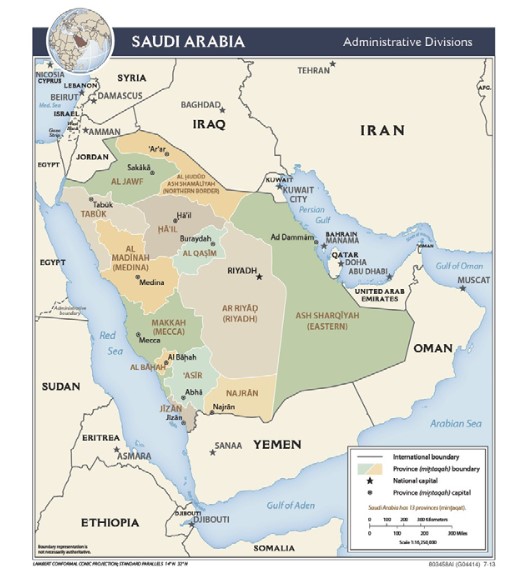
Map 1
Administrative division of the thirteen provinces that make up the Kingdom of Saudi Arabia, following the enactment of the Basic Law(x) on March 1st 1992, by King Fahd
Sources: Texas Austin University Library.
I. Saudi youth and Vision 2030
Young people have been at the heart of four structural socio-economic challenges in Saudi society since the 1990s.(x) The first of these is unemployment, with an average of 300,000 young people now entering the labor market each year, compared to 150,000 in the 1990s.
The decade of 2030 will see the arrival of six million young people, twice the number of arrivals than in the 2010s. This shows that the Prince’s gamble, to reinvent a new political economy for his country, puts the issue of youth at the center of his transformation project. In modernizing the kingdom, MBS is undertaking the task of changing the terms of the Saudi social contract. The still high annual population growth rate of 2%, the structural problem of massive youth unemployment (38.8% for 20-24 year olds), and a significant drop in oil prices since late 2014, due to the decline in global demand for hydrocarbons: all this has led to an explosion of public spending and a welfare state that has become unsustainable.
The representation of young people in Saudi society
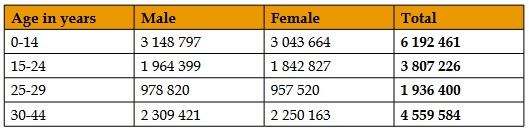
The following statistical table shows that 70% of the Saudi population, or nearly 16.5 million people, are under 44 years of age. More importantly, it shows the extent of the demographic pressure on the under-30 age group.
The 15 to 29 age group, with more than 5.5 million people, accounts for a third of the Saudi population. The other point of tension concerns the under-15s, who account for another third of the population, with over 6 million. The milestone of 2030 is especially symbolic because it is a pivotal year that will see this latter age group enter the labor market en masse. Under-29s account for nearly 12 million Saudis out of a population of nearly 21 million, i.e. around 60%. 52.8% of this age group are under 15 years of age, and these, along with millennials, are the Prince’s target audience. They are urbanized, ultra-connected and hyper-globalized (see Part 2). It is for them that he is implementing his communications strategy through his MISK Foundation, as well as a new school curriculum, now part of the new national education program(x), designed to shape the “ideal citizen” of the new Arabia envisaged by Vision 2030.
Table 1
Saudi age groups up until the age of 44
Source: General Authority for Statistics, Population characteristics 2017, Saudi Arabia, Table 2.
I have not taken into account data on the foreign population, which in 2018, according to the same source, totaled just over 12 million out of a total population of 32.5 million. This population is not only excluded from the social contract, but is also readily being sacrificed on the altar of Vision 2030, whose objective is to prioritize job offers to Saudis. Among young nationals, unemployment is very high, with an average of 30 to 40% for under-25s. It is estimated at 35-60% for women under 35; for men, the average varies between 5% and 17%, while the official average was 12% in the fourth quarter of 2019(x).
The twelfth report of the surveys conducted by the Arab Youth Survey (AYS) in 2020(x) reveals that Arab youths is in tune with the social networking revolution and fully inserted in the culture of the digital economy, as were the young Riyadhis interviewed for this study.
This AYS report is based on a general survey of 3,400 interviews with young people (women and men aged 18 to 24) equally distributed among 17 Arab states (including five Gulf Cooperation Council [GCC] states, the exception being Qatar) in the capitals and major metropolitan areas of their countries.
The survey shows that 40% of the 3,400 young respondents have expectations that mainly concern the battle against corruption and the improvement of governance. 29% of them consider access to better jobs to be essential, followed by 27% who are in favor of more social justice; 21% are in favor of more freedom of expression and respect for fundamental rights, while only 15% aspire to more democracy.
As we can see from the hashtags on social networks, young Saudis are becoming increasingly angry about venality and influence peddling. I was able to sense this during the interviews I conducted in December 2017, on the occasion of the so-called anti-corruption campaign, launched by the Prince on November 4, 2017(x), consisting of a vast purge of the elites (members of his family, powerful businessmen, former ministers) who were members of “the old guard(x)”. This operation, orchestrated by the Crown Prince, had, at that precise moment, considerably strengthened MBS’s popularity among the young interviewees, but also among a large number of their family and tribal relations(x).
The Arab Youth Survey also notes that while religion remains the primary identity marker, particularly for Algeria, Sudan and Egypt (between 72 and 69 per cent of respondents), it drops to 60 per cent in Saudi Arabia (surveys in Riyadh, Jeddah and Dammam, not in the suburbs, where religion is more pronounced). In Morocco it is 62% and in Tunisia 59%, compared to only 8% in the United Arab Emirates, the city-states of Dubai and Abu Dhabi. The other Northern Emirates, which are considered more religious, were not surveyed. 66% of those surveyed believe that religion plays too important a role in Middle Eastern countries, compared to 25% who believe the opposite. Moreover, the same report, which published a specific survey on youth perceptions in August 2020 amid the Covid-19 pandemic, shows that 89% of youth surveyed in the GCC states support the Saudi decision to restrict the number of Hajj (Grand Pilgrimage) pilgrims, compared to 68% of North Africans.
My fieldwork corroborates this finding, as the young Riyadhis I interviewed unanimously expressed relief that the religious authorities no longer exercise social control.
On political issues, Saudi youths and even more so Emirati youths, as the AYS also notes, are less politicized than elsewhere in the Arab world. 62% of Saudi youths believe that it is more important to ensure the stability of the country than to promote democracy, compared to 56% in the Levant.
The sample of young Riyadhis as a reflection of Riyadh’s urbanization policy
Of the 50 youths interviewed in my sample, 32 are from parents who migrated to Riyadh and of those, 15 are from the central province of Qasim. Their families came from the cities of Unayza and Burayda to work in the government, especially in the army and police, during the 1960s. Six other young people are from the southern provinces of Asir and al-Baha, and have come to join extend family members (uncles or cousins) who settled in the 1970s, in order to study and work in the capital: their own close family members have remained in their home provinces. The eleven other young people in this group of 32, whose parents, or members of their families, migrated to the capital come from cities in the west of the kingdom, Medina, Jeddah, Mecca, but also from Hâil, in the north, or from the east, from Qatif (see Map 1, p. 25). The 18 remaining interviewees are native Riyadhis who, depending on their professional mobility, have had the opportunity to relocate to the residential areas further to the northwest of the city (see Map 3, p. 37).
The first phase of Riyadh’s urban expansion (see Map 2, p. 36) was planned by the Greek architect Constantinos A. Doxiadis between 1968 and 1972.(x) The second urban plan for the city was designed from 1982 onwards by the French public company, SCET International.(x) The first planned urban works had to take into account the desire of Prince Salman – who remained governor of the province of Riyadh from 1963 to 2012, when he became Crown Prince before becoming king in January 2015 – to expel one fifth of the capital’s inhabitants. This involved relocating 60,000 Bedouins out of 300,000 inhabitants(x) to the outskirts of the city in 1968. Riyadh’s expansion occurred in parallel with an intensification of massive immigration of low-skilled, cheap foreign workforce and the 1973 oil boom, which also attracted rural migrants from all parts of the country, radically changing urbanization. These movements pushed the middle classes to flock to real estate agents and developers, who were courtiers of the royal family. The real estate sector, owned by the Princes, became a powerful tool for dividing up available wealth(x).
With increasing dependence on state subsidies, public salaries and interest-free loans the gap is widening between “native” urban Saudis and migrants from the countryside or abroad. The royal family encourages the formation of networks of allegiance organized around princely fiefdoms and powerful commoners serving as intermediaries or, more precisely, as facilitators (wasta, see p. 35). While urban sprawl is primarily the result of the growing tendency of Saudis to live in single-family homes, it is also linked to the oil boom culture – thaqâfat al-tafra, ثقافة الطفرة – as ordinary Saudis define it, although the official terminology is that of development (tanmiya, التنمية).
The urban geography of the capital satisfies a demand for a highly segregated distribution of space, largely designed to give pride of place to the car. Bedouins are housed in the less well-to-do neighborhoods of what is for the moment the southwest of the city, al-Aziziya, Shubra, Shifa, Dirab, Okaz, and even Badar (ochre and yellow on Map 3, which specifies prices per square meter for each neighborhood, see p. 37). Most young people from migrant families in the central province live in Badar, where the population of the Najd (a large desert region in central Arabia) is clustered. As Paul Bonnenfant shows in his analysis of the Saudi capital(x), family groupings are based on tribal affiliation, and neighborhoods made up of blocks of houses that form a large “checkerboard” are named after these tribes. The remainder of this subgroup includes some native Riyadhis and young people from the southern provinces, who live in the southeastern part of the city in low-income neighborhoods (Laban, al-Nasim, and further east, in Janadriyah [yellow ochre]). These locations have land prices set at around 1,500 Saudi riyals (SAR) per square meter, or about 330€. They stand in sharp contrast to the impoverished Asian and African expatriate neighborhoods in the old city center (not colored on the map), near al-Malaz, where low-income Saudis live.
This part of the sample, i.e. Riyadhis of rural origin, are kept well away from the residential areas of the center and the northeastern and northwestern parts of the city. The Trans-Arabian Highway(x) (see Map 2, p. 36) marks a sharp divide between the low-income, lower middle classes who benefit from the citizen’s account (see below) and the formerly urbanized, so-called upper and affluent middle classes. These Riyadhis of rural origin are housed in government-subsidized accommodation, in low-income areas.
The term “lower middle stratum” has been officially clarified by the authorities with the introduction of the “citizen account” (حساب المواطن) which came into effect on December 21st 2017 to help families with household incomes of 20,000 SAR or less (low income), or about 4,500€. A Saudi household, to use the definition of the General Statistics Authority report published in 2016, includes a group of people, related or unrelated, living in the same residence. Therefore, domestic staff (nanny, maintenance staff, and driver) are part of that given household(x), which consists on average of 10 to 13 people.
The average salary of a Saudi employed in the public or private sector is 7,150 SAR (1,550€), according to the Saudi General Organization for Social Insurance (GOSI). In reality, the average salary of a Saudi employee in the public sector is 11,750 SAR (2,500€), compared to 6,450 SAR (1,410€) in the private sector(x), which amounts to a difference of nearly 40 percent.
Of the young people interviewed in this sample, all live with their parents or extended family (uncles and cousins). A minority live in the southern part of Riyadh (al-Aziziyah, Dar Al Baida, Al Mansourah, Laban), and the southeastern part (al-Nasim, al-Rawdah, Al Nahdah), which we show in ochre on Map 3 (p. 37).
One half of the middle-class sample is composed of young people whose parents are covered by the citizen’s account. They are public sector employees or retirees with incomes well over 20,000 SAR. In the redistribution system of a Gulf rentier state, they represent a category that has achieved social mobility. Thanks to the largesse of the welfare state, in the 1980s and 1990s, the most highly educated gained access to management jobs in the civil service or in large parastatal companies. These categories have benefited from networks of contacts and make up the clientele of vast princely and commoner networks. Such networks act as powerful intermediaries between the interests of their constituency and the state’s financial grip.(x) The bulk of this social category lives in the northeastern neighborhoods of Riyadh, in al-Yasmin, Narjis, al-Falah, al-Wadi, Qurtubah, al-Munsiyah, and al-Yarmuk (red and light blue on Map 3, p. 37). It includes mostly migrants from Medina and Qatif, but also young people whose families came from the central region, Qasim. This category, whose families have experienced significant upward mobility, has capitalized on its skills and its contact with the ruling and financial elite, and benefits from the opportunities offered by Vision 2030.
The remaining quarter of the sample is made up of upper-middle class youths whose parents are either executives of large parastatal firms or former senior civil servants, mostly from Riyadh. They live in and around King Saud University, near the diplomatic quarter (DQ), al-Khuzama, al-Raid, al-Nakeel (dark blue on Map 3, p. 37), or a little further south in the new, more up-market northwestern neighborhoods of Hittin, al-Malqaand al-Aqiq. These areas border on the many properties of the royal family in the northwestern area of the capital, close to Wadi Hanifa and Dir’iya, which are Al Saud strongholds (see Map 2, p. 36).
These upper-middle class youths, without belonging to the richest class in the country, still holds the most advantageous social capital, which they obtain from their high level of education. Members of this class capitalize on networks that allow them to use wasta for the benefit of their children and grandchildren. Such practices have become commonplace in Arabia, and elsewhere in the Middle East, as part of the quest for jobs, or to benefit from any potential administrative flexibility. This is not seen as an abuse of power or corruption, as it is in the West. Wasta is, as Mohammed Ramady(x) notes, a marker of social inequality. Along with corruption and lack of transparency, it is one of the societal ills most abhorrent to Saudi youth and their Arab co-religionists, as reported in the Arab Youth Survey.
Map 2
Map of Riyadh’s growth from 1920 to 2012
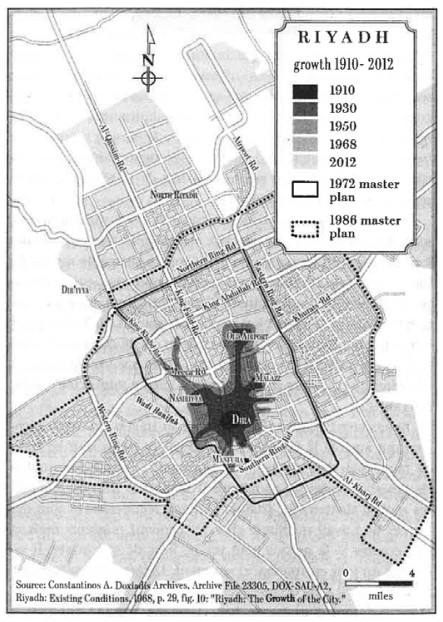
This map was retrieved from the archives of the Greek architect Constantinos A. Doxiadis (1968), who drew up Riyadh’s first urban planning document (taken from the book by Pascal Ménoret, Royaume d’asphalte. Jeunesse saoudienne en révolte, Paris, La Découverte, 2016, p. 86).
Map 3
The layout of the different neighborhoods according to prices per square meter of land
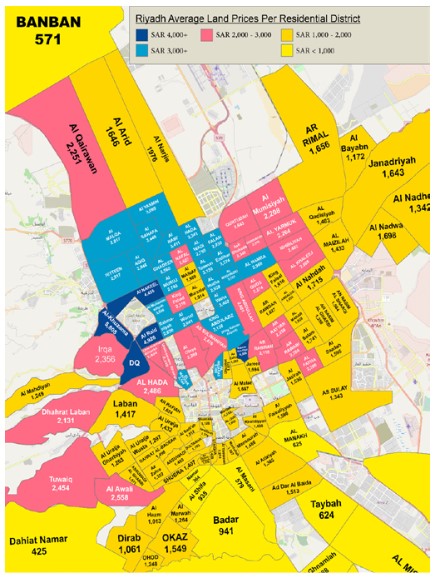
Fatiha Dazi-Héni, December 2020.
NB: Since there is no map of Riyadh representing the urban sociology of the city, owing to the political sensitivity of the subject, I decided, with the help of a Saudi academic colleague, to design this map, drawing on the district base map found here: https://en.rei.sa/heatmap-charts/ and from the Real State General Authority sites: https://rega.gov.sa/ and https://sa.aqar.fm. These sites show land prices per square meter for each district between the first and fourth quarters of 2019. This overlapping data makes it possible to situate the social background of the sample of youths selected for my surveys, even if the price indicator alone is not a sufficient parameter for determining social mobilities and trajectories, as I explain in this first part.
The young Riyadhi interviewees from the upper middle class are clearly the most privileged of the sample and the most likely to take advantage of the best opportunities offered by Vision 2030, which nevertheless provides the less privileged of the educated classes with job opportunities that were previously non-existent.
The choice of Riyadh as the capital is therefore opportune, as it acts as a laboratory: with its 6.5 million inhabitants, 66.5% of whom are Saudis, it reflects the entire population of the kingdom.(x) Indeed, as I mentioned earlier, it is the city with the highest concentration of Saudis who have come from all over the kingdom to work and settle permanently. Riyadh is the third most populous megalopolis in the Arab world, after Cairo and Baghdad, and is by far the largest city of the Arabian Peninsula.
The city is at the heart of the dynamic of centralizing power and acts as the lungs of the country’s commerce, finance and economy. It is where all the decisions are made for projects carried out under Vision 2030, a project which permeates the city physically: signs promoting Vision 2030 with giant portraits of the King and the Crown Prince are posted on buildings along the main streets. “2030” propaganda has a physical public presence in the daily lives of Riyadhis. The capital, as the center of power, is therefore a natural vantage point for studying how the Crown Prince’s actions are perceived by young people.
The official campaign, whose style is reminiscent of Soviet propaganda, or indeed the more recent model of Saddam Hussein’s Iraq, is also striking for its very globalized and modern character, as Mark Thompson’s book clearly shows. The Crown Prince is a digital technology enthusiast, just like his young compatriots. He has built his entire communication strategy around the public reception of Vision 2030 on social networks, with platforms designed to communicate interactively with young people throughout the country (see Part 2).
19-30 year-olds, including those entering higher education (19-24), and those in the post-study and job-seeking phases, or young workers (25-30), are the primary target of the first phase of Vision 2030. Its short-term priority is to train young people to find jobs in the private sector in areas of business targeted by the National Transformation Program, NTP (see Part 2).
The 15-25 age group is the most affected by school dropouts and lack of attractive job opportunities. It is also the most likely to fall into a life of crime and radicalization. In his book,(x) Pascal Ménoret examines this vulnerable population, no longer under the control of either their families or the public authorities, because they have fallen prey to the widespread social scourges of boredom and addiction to drugs(x) and/or alcohol. He also describes how the absence of wasta, a future without prospects, as well as anger and frustration, leads them to defy the authorities with acts of incivility, such as road crime, joyriding or “urban rodeos”.
Several interviews I held at the Ministry of the Interior(x) shed light on a rising individualism in the behavior of young people, who are a category of choice for recruitment cells linked to Islamic State. Investigations conducted by the Ministry of the Interior and the Ministry of Health into families confirm the existence of the first suspicious signs of addiction and reclusiveness. Such warning signs may announce delinquent or even suicidal behavior, or even radicalization and terrorist violence. They are, according to General Turki Al Mansour, spokesperson for the Ministry of Interior, frequently detectable in “destructured” families (divorced households, polygamous fathers). Some civil servants point to Vision 2030 as a step in the right direction in the fight to divert young people from their individualistic reclusion. Nevertheless, this observation is largely refuted by young Riyadhis (see Part 2).
Table 2
The distribution of the Saudi and resident non-Saudi population among the thirteen regions and the high proportion of the young in these regions
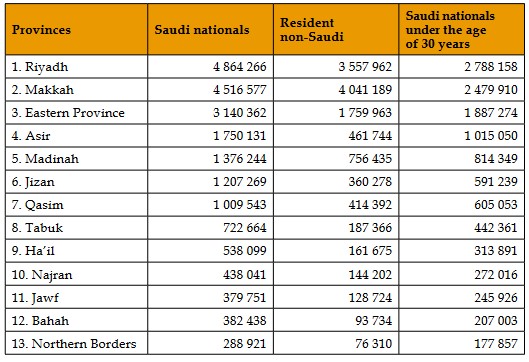
Source: General Authority for Statistics, Demographic Survey 2017, Saudi Arabia.
The table shows that Saudis under 30 living in Riyadh province account for 10% of the Saudi national population, or nearly 2.8 million out of almost 21 million. In the poorest provinces, al-Jawf and the Northern Province, Saudis under 30 are only 423,000 strong. If we take the three areas with the largest conurbations, that is to say the province of Riyadh and its capital, the province of Mecca, with Jeddah as its main urban center, and the Eastern Province, with the conurbation of Dahran-Dammam-Khobar, this amounts to more than seven million people under the age of 30, or more than one-third of the total Saudi population.
This strong representation of younger Saudis in the country’s main urban centers explains why the demographic dimension is a key factor in MBS’s strategy for consolidating power.
The Prince’s 2030 vision
On April 25th 2016, MBS unveiled the major steps of the National Transformation Program (NTP)(x) to his fellow citizens on the satellite channel Al’Arabiyya. The fall in oil prices, to 28$ per barrel in February 2016, forced him to invest all his energy in his program of reforms to achieve Vision 2030, based on three five-year plans. This marked a radical break with the philosophy of the previous nine plans. The vision is intimately linked to the Prince, which is why the decision-making apparatus has been designed and centralized around him, as Stephan Roll notes: “The Vision 2030 decision-making processes have been centralized and tailored to the Crown Prince.”(x) In fact, the NTP and the implementation of the Vision 2030 agenda are his responsibility, and unlike his predecessors, he will be personally accountable for it, especially in the eyes of young people, the priority target of the reforms.
On paper, the vision is founded on three clearly identified pillars.(x)
The first emphasizes the kingdom’s identity as the cradle of the Islamic world and aims to create a dynamic society, dominated by a new work culture, in which society and religion would live in greater harmony, and would stimulate the economy.
Vision 2030 is organized into 13 implementation programs (Vision Realization Programs [VRP]), each steered by a coordinating committee headed by a minister acting under the authority of the CEDA (a sub-cabinet of ministries related to economic and social activity), which is chaired by the Crown Prince.(x) The CEDA sets the objectives to be achieved, using the Anglo-Saxon governance technique of performance indicators: KPIs (Key Performance Indicators) make it possible to measure, on a regular basis, the progress towards the objectives to be achieved by each ministry. These programs are carried out within the framework of new public entities in parallel with pre-existing bureaucratic bodies, and are regularly adapted, reviewed, and improved. The restructuring of the bureaucracy to make it more efficient has led to an uneasy coexistence between the new entities of Vision 2030 and the old bureaucracy – a situation that gives rise to confusion and exemplifies the climate of tension that is prevailing during this transition phase.
The new approach, which is supposed to be applied nationwide, is not, in fact, being done so, due to the lack of training in the domain of local human resources. Performance management, which has been in use for decades in Anglo-Saxon countries and those in Southeast Asia that have chosen to transform and promote the efficiency of their economies, has produced very good results. In the Gulf region it is new and after more than a year and a half of experience, as of December 2017, the lack of qualified staff has proven to be a very serious problem.
According to Dr. Salim Al Gudea(x), Vision 2030 is “ultimately the new national doctrine conjured up to streamline the country’s economic transformation”.
The second pillar of the vision is the diversification of the economy in order to reduce dependence on the volatility of hydrocarbon prices. This step necessitates better training of human resources, exploitation and development of more mineral resources, as well as related industrial sectors, and the continuing development of religious tourism, which is a significant source of income. The development of a new ecosystem is intended to prioritize young people through the promotion of a new digitized economy and services, with cultural and archaeological tourism, events, entertainment, and sports.
Finally, the third pillar of the vision, contingent on the first two, aims at the building and consolidation of a prosperous and ambitious nation. The emphasis, here, is on a new national narrative, driven by values of loyalty towards the country’s leadership, and a sense of national pride intensified by “hyper-nationalist”(x) rhetoric (see Part 3).
The Prince’s stated objective is to overhaul a careless and unwieldy bureaucratic apparatus, in short, to modernize the workings of the state as it was set up by King Faisal in the 1960s. The fieldwork stages of this study took place during the first four years of this initiative to transform the country, and were characterized by severe austerity. MBS seized the opportunity to assert his power by appealing primarily to young people, proposing to change the terms of a social contract that the rentier welfare state could no longer support, and pushing for a new ecosystem with a radical political approach and an unprecedentedly vertical conception of power.
Many young people are aware that they are at the heart of the Vision 2030 project, which they perceive as a framework for new opportunities. Having themselves benefited from the generosity of the welfare state, parents and grandparents are quick to agree that the time has come to reach out more to the young.
Vision 2030 through the eyes of Riyadhis
Vision 2030 is seen positively and as a source of inspiration by young women studying at Prince Sultan University(x),which encourages them to believe in the future, because they find support for their plans and ambitions in wider society. Nauf, who is eight years older than the young women she teaches, says she is struck by their force of will and determination. At their age, she didn’t have that kind of confidence. It is the new mindset instilled by the Prince’s plan for economic and social transformation, rather than its often unfamiliar content, that is winning over young people to Vision 2030.
It must be said, says Nauf(x), that the communication around Vision 2030 resembles a huge, bludgeoning propaganda exercise where every problem is resolved the moment it arises. Following the accounts of intellectuals or recognized experts on social media allows Nauf to get some perspective on the matter. She adds that many social network users (see Part 2), express themselves on the subject in a mocking tone, especially on Snapchat, Instagram or Twitter.
Between September 2016 and April 2017 social networks were flooded with photos, cartoons, and jokes about what standards of living would be like in 2030 as subsidies were cut, prices and energy bills rose, and new taxes were introduced as a result of the reform. This period saw the most severe austerity measures ever taken in Saudi Arabia. The April 2017 royal decree ending these measure also put an end to this wave of online discontent.
This group of carefree young girls, from upper-middle-class families, are not directly affected by the burdens taken on by their parents. They benefit fully from the new, more liberal mindset promoted by Vision 2030. Their teacher, who is certainly in tune with her fellow citizens, glad of the new, more relaxed environment, is nevertheless aware of the sacrifices that the cost of the vision implies for the purchasing power of Saudis.
The first phase of surveys is a testament to the general feeling of relief and euphoria among young Riyadhis concerning the measure prohibiting the religious police (مطاوعة) from exercising social control over them; ensuring among other things, the observance of non-mixity and the respect of strict dress codes.
It must be said that before their powers were restricted the agents of this morality police would zealously check the identities and/or proceeded to abusive arrests of citizens whose behavior was deemed not to comply with the principles they had laid down.
All the interviewees (women and men), aged between 19 and 27 years old, of all classes, Maha, Lina, Nadia, Nauf, Ahmad, Redha, Mohammed or Khaled, insist on the ground-breaking psychological impact they felt after the publication of the royal decree taking this decision, which they had not expected to see in their lifetimes. The religious police, in their view, were robbing them of their youth. MBS intends to use this more relaxed social atmosphere to better sell, among the younger generations, his ambition to transform Saudi Arabia by preaching his Vision 2030 to an audience, which he intends to make into the basis of his popular legitimacy (see Part 2).
The story of Shaykha, 24 years old(x), is particularly revealing as to the perception of the vision by her entourage. She refrains from sharing her personal feelings because of her work in promoting the vision at the Ministry of Information. She indicates that the young people (20-30 years old) she works with are overwhelmingly in favor of the project because they know they are its main beneficiaries. I am told that the focus is currently on freedom of choice. If people don’t want to go to concerts or shows, or refuse to go to cafés and restaurants, nothing obliges them to go. However, there is no longer any reason for them to forbid others to do so. It is this state of mind that generates the enthusiasm and optimism of young Riyadhis.
Nevertheless, this observation does not describe the situation across the entire country.(x) Although the religious police have become invisible in the major urban centers (Riyadh, Jeddah, Dammam-Khobar-Dhahran), they still operate on the periphery, in the secondary cities where conservative clerics continue to exert strong local influence, often relayed through the tribes. This is evidence of the growing cultural and territorial divide between secondary cities of rural provinces and large conurbations. The latter are now accommodating leisure, entertainment, and, more broadly, a new social organization based on public and mixed social interaction.
To reassure the conservative majority population worried about the issuance of the royal decree of April 13 2016 prohibiting the religious police (alhay’a, الهيئة) from carrying out its mission and ensuring “the facilitation of good and the prohibition of evil”: (الأمر بالمعروف و النهى عن المنكر) the Majlis al-Shoura (the advisory assembly), has embarked on discussions to propose a secularist mode of social regulation and control. In order to accompany these changes, the Council of Ministers has indeed passed a law put forward by the Majlis al-Shoura on 28 September, 2019, establishing a code of proper conduct respectful of tradition.(x)
Given that everything had been under the control of the religious police, this sudden change worries some young people, who nevertheless support the reduction in the police’s powers and even its withdrawal. The fear of losing one’s sense of identity affects young Riyadhis from the upper middle class as well as those young people from less privileged strata and from the peripheral regions.
The national celebration of September 23, 2017, in Riyadh, commemorated the establishment of the Kingdom of Saudi Arabia in 1932(x) with a music and dance show hosted by a disc jockey, attended by a mixed audience inside the King Fahd Stadium. This was a historic turning point between pre– and post-MBS society.
The celebration left its mark on people’s minds and caused a stir on social networks, highlighting the divide between the center and the peripheral and rural regions. This unprecedented public event caused tension among the most conservative Saudis but also concern among those who are in favor of change and entertainment but fear being left behind.
There was a stark contrast between the mixed and joyous euphoria of a secular national holiday commemorated with splendor, and the usual absence of public events, apart from traditional folk festivals and celebrations of religious holidays. Moreover, the festivities took place against the backdrop of a country embroiled in a disastrous and costly war in Yemen, provoking anger and bewilderment among the military and their tribes of origin.
Abdallah(x) (24), a job-seeking graduate with a master’s degree in finance from the United States, whose mother is a member of the Majlis al-Shoura and his father a businessman, is concerned about the rapid changes in young people’s behavior. An open-minded, upper-middle-class city-dweller, he is concerned that young people no longer know how to behave or show respect in relation to their elders – especially certain younger women, who no longer bother to hide their smoking even in the presence of their mothers.
One year after the adoption of the code of conduct for decency in public spaces, social changes continue to generate debate and controversy among the population, as Eman Alhussein(x) shows in his blog.
Nevertheless, Vision 2030 is raising hopes among Riyadhis, who see it as an opportunity to project themselves into career paths that were previously unavailable.
The entertainment and leisure sectors, access to sports for all, the creation of amusement parks in the city of al-Qiddiya (40 kilometers south of Riyadh), but also sports tourism with trekking and rafting in the Asir in the south, as well as the exploitation and development of the previously banned archaeological sites of al-’Ula in the north and Faw in the east, figure prominently in the programs promoted by Vision 2030.
The aim, says Ma’moun (30), manager of the sports competitions division at al-Qiddiya, “is to create new jobs for young people, and encourage a new local consumer market to compete with the destinations, popular with Saudis, of Manama in Bahrain and Dubai in the United Arab Emirates.”
The opening of theaters, cinemas, art galleries, as well as the development of classic identity reference models with a new Islamic museum and a museum of the horse – in order that no one should be left out – are all new opportunities largely designed to get the country’s young to embrace the values and societal project proposed by the new dauphin and his Vision 2030.
Young Riyadhis are in favor of the Prince’s strategy, which addresses the youth in order to transform the country.
Redha: “All the young people around me are fans of Vision 2030 because, for once in this country, someone is thinking about young men and women. My sisters tell me that this vision aligns with the march of history. Before it was launched, everything was off-limits to us, as if this country of mostly young people was designed exclusively for the old.”(x)
Redha’s palpable enthusiasm, like that of other Riyadhis, is linked to MBS’s personality. He embodies their aspirations and above all opens up new possibilities that were previously closed. Regardless of their social background, young people are offered many opportunities, hitherto unexplored, by the new economic context.
The more mixed and less dazzling perspective from the fringes
Mansour(x), who works in Riyadh, reported to us that young people from the less developed peripheries such as al Jawf (north) or even Abha (south), are reinvesting in local circles of sociability, particularly within the diwaniyyât(x)38 (دوانيات) of their extended family and tribe. For instance, Mansour, who comes from the large Zahrani tribe in Asir, says that he feels a significant disconnect between his behavior and way of life where he studied and worked, in Riyadh, and the way of life that he adopts in his home town amongst family and tribal members.
Renewed interest in one’s tribe goes hand in hand with the strengthening of regional identity stemming from economic marginalization and distance from the center.(x) This observation is shared by other researchers in neighboring monarchies(x) and was the subject of an interesting report by the Italian think tank, ISPI(x).
Opposition to the Neom project
2030 vision, launched from Riyadh, is driven by the imperatives of economic diversification and is turning villagers’ daily lives upside down. These villagers, like in the 1960s, are forced to abandon their way of life for the sake of mass urbanization.
The ambitious project for the futuristic city of Neom, to be built by 2025, with the hope of making it the AI hub of the Arab world, comes at a staggering cost estimated at 500 billion dollars.(x) Tensions led security forces to shoot dead Abd al-Rahim Al-Howeiti in the village of Khuraybah, at the heart of the Neom project, on April 17, 2020. Al-Howeiti, a member of the prominent Howeitat tribe (which stretches across northern Saudi Arabia into Jordan), was targeted for refusing to obey an eviction order to make way for the construction work on Neom. This radical policy of evicting Bedouins to develop the urban fabric is reminiscent of the decision taken in 1968 by the former governor of Riyadh and current king, to evict 60,000 Bedouins to modernize the capital. Crown Prince Mohammed is following in the footsteps of his father, with whom he shares an authoritarian and determined temperament.
In protest, a video has been widely circulating on Twitter and YouTube. Entitled “Against eviction in Neom” (ضد الترحيل نيوم), it explains the reason behind the rejection of the Neom project by certain members of the Howeitat tribe. In it, Abd al-Rahim Ahmad Mahmoud al-Howeiti denounces, in his own words, “the state terrorism used by the security forces to push villagers to give up their homes against their will even in exchange for compensation, and this, in the name of a nation to which they feel no sense of belonging”. He identifies solely with his home, his family, his tribe, his community منطقة in Khuraybah, and with the values of Islam. This he clearly states throughout the 20 minutes of his video recording.(x)
This villager’s account testifies to the incomprehension and even rejection that the Vision 2030 projects decided in Riyadh have been met with. Villagers see these modernization projects more as international self-promotion rather than as a way to reach out to the local population. Such public diplomacy makes no sense to a villager from the Howeitat tribe, who sees it as the destruction of his own and his ancestors’ way of life.
In the East: support vs suspicion
In the Eastern Province, which is predominantly inhabited by the Shi’ite community, the promotion of Vision 2030 has the positive corollary of not emphasizing the sectarian rhetoric that was favored when Wahhabism, the state religion, was brandished as the standard-bearer of the monarchy’s official ideology, particularly during the reign of King Fahd (1982-2005). While things began to change under the reign of King Abdullah (2005-2015), with MBS, the nationalist narrative(x), leaning on a moderate Islam(x) of the “righteous path”, has replaced references to the Wahhabi corpus in a far more radical manner.
On January 2, 2016, the Shi’ite cleric Shaykh Nimr al-Nimr(x), a symbol of the politicized Shi’ite community was executed. He had repeatedly called for secession, from his old al-Awamiyya neighborhood in the city of Qatif. His execution fanned the flames of an old conflict between the state and the Shi’ite community in the eastern province. This situation lasted until July 2017, when violent clashes between residents and the police escalated, resulting in the deaths of 20 civilians.(x) With its narrow alleys, this poor, cramped neighborhood of Qatif has long been prone to protests organized by residents. They denounce the religious and employment discrimination to which their community has always been subjected. Al-Awamiyya has become the stronghold of the most radical Shi’ite protest against the power of the Al Saud dynasty, which is allied to the conservative orthodox and very anti-Shia Wahhabi establishment.
By deciding to raze this old neighborhood in July 2017, the government was making opportunistic use of the reforming and modernizing showcase of Vision 2030 to eliminate a traditionally rebellious neighborhood and a pillar of resistance to the Al-Saud state.
More than 300 million dollars are being invested to redevelop the neighborhood as a collection of large plazas, and modern buildings with a commercial and entertainment center. The goal is to encourage local entrepreneurship and new businesses, and to create jobs. The more politicized see the gentrification of al-Awamiyya as a political maneuver, and a strategy to co-opt the more compliant part of the Shia population.
Described as an accidental “desectarianization” process – “a byproduct of the new vision of Saudi identity”(x) – 2030 vision is nonetheless favored by less politicized youths who benefit from it. It is according to the standards of these new opportunities that 2030 vision is embraced or rejected (or at least met with suspicion). Thus, when the government invests in the Eastern Province in the health industry, or chooses the city of Khobar as a pilot city in the Middle East for the testing of the 5G wireless network, many inhabitants, tired of confrontation with the state, are pleased. Unemployment figures in the province are down significantly to 6.1% in the first quarter of 2020 from 8.9% in the same period(x) last year.
Moreover, these changes are accompanied by strict regulation of anti-Shia rhetoric in the media, and on social networks, as well as in mosques, where preaching promotes the official narrative of a “moderate” Islam and the “righteous path”.
Until now, it was the direct redistribution of oil revenues that linked local village, tribal and regional identities. Vision 2030, designed to attract other sources of revenue, is presented as the Prince’s preferred instrument for opening up new development and employment opportunities for young people across the country. In reality, the regions benefit unevenly, depending on their geographical location, urban development, and demographics.
II. Young people as a target of MBS’s strategy of communication and legitimization
After orchestrating a palace revolution on 22 June 2017(x)1 to make his son his dauphin, King Salman proceeded to transform the Saudi monarchical system. He is establishing a vertical power structure, with his son as the central hinge of the monarchy, thus sidelining the royal family.(x) The Al-Saud monarchy, like its neighbors in the Gulf Cooperation Council (GCC) – with the exception of the Sultanate of Oman, which differentiated itself through absolute power under Qaboos – has long fallen into the category of dynastic monarchies(x). The royal family acted as the central player in the monarchy, it acted as a group, with the king as primus inter pares, not as the sole holder of power.
King Salman is thus at the origin of an unprecedented structural transformation of the mode of governance of the Saudi monarchy, which has led to a strengthening of the authoritarian mechanics of power, now concentrated in the hands of his son. These two men, both of whom have an authoritarian temperament, know that the monarchy’s governance has become ossified, and both have recognized the imperative of establishing a vertical decision-making process centered on MBS rather than on the royal family.(x) The modernization of the Saudi government is a key element in the process of change. It is with this modernization of the monarchy, and the consolidation of its power at its head, that the Prince, aided by his father, has set out to invent a new model of legitimacy.
The rise of Mohammed Bin Salman as Crown Prince is in many ways at the heart of a generational dynamic that takes different forms. The transmission of power is, in the Saudi case, a source of tension for two reasons. The first is related to the fact that King Salman is breaking with the horizontal dynastic tradition of monarchical power, in which power is handed from one brother to the next(x), according to the traditional principle of seniority. The second is intergenerational: in choosing his successor from within his own lineage – in this case one of his ten sons, Mohammed, who was not the most qualified to aspire to the title of dauphin – King Salman has placed himself as the last of the sons of the founder to rule the kingdom.
Rather than trying to win his family around, the young Mohammed developed a radical strategy to establish himself.(x)6 He eliminated his most serious opponents and co-opted his peers, from his own generation, in such a manner that they are now accountable to him. He thus became the new leader of the royal family. To this end, he appointed several cousins from his generation to strategic positions(x); his cousin Mohammed Bin Nayef was brutally ousted on June 22, 2017 as Minister of the Interior only to find his own nephew being appointed in his place. Another cousin from the Bandar Bin Sultan branch(x) has been appointed in place of Prince Mitaab, another important rival of MBS, as the new Minister of the National Guard.
He is overturning generational relations with a dual purpose. On the one hand, he is seeking to consolidate his power by making himself indispensable to his young co-religionists, whom he intends to turn into the base of his popular legitimacy, and on the other, he aims to remove all members of his family who challenge him. To achieve this, he has co-opted a network of princes whose acquiescence was based more on generational dimensions and loyalty than on their skills and experience. He then proceeded, following the palace revolution of June 22 2017, to renew the head of the kingdom’s security apparatus. He moved its center of power, consisting of the powerful intelligence service (al-Mabahîth), and the special forces within the Ministry of the Interior, to the royal palace. He created the new key coercive institution of state security (Amn al-Dawla), borrowed from the Egyptian authoritarian security model, by appointing the former director of the intelligence services, Abd al-Aziz Al-Huwayrini as its head.
In this context of generational change within the royal family, he is bringing a strategy of radical modernization to the bureaucratic apparatus – a strategy designed to serve his own ambitions, and to strip his family of its traditional role as a pillar of monarchical power.
MBS embodies a new type of youthful, dynamic, and uncompromising and brutal leadership that breaks with the style of older, readily consensual leaders such as his predecessor, Mohammed Bin Nayef (MBN). The eldest of the founder’s generation of grandsons, competent and conservative, MBN represented the leadership most likely to ensure a smooth transition between two generations of the royal family. He was brutally ousted in the “coup” staged during the night of June 21-22 2017, on the 27 day of the month of Ramadan designated in the Qu’ran as the night of destiny (laylat-al-Qadr), and placed under house arrest in his palace in Jeddah before being incarcerated on March 7th, 2020.
Challenged within his own family circle, Mohammed Bin Salman is implementing a break-away strategy by targeting young people in order to turn them into the base of his popular legitimacy, thereupon compensating for the lack of support from a part of his family. He is developing a political communications strategy designed to create a generational divide.
The rise of a generational identity
The issue of the generational divide, present in all societies, arises in way particular to Saudi Arabia.
All researchers working on Gulf societies agree that the revolution in communications techniques, social network platforms, and today the digitization of the administration and the economy, are the fundamental markers that differentiate generations.(x)9 Thus, while the gap between one generation and the other used to be set at 30 years, it has narrowed considerably in the Gulf to merely a decade. While the older generations identify primarily with family, Islamic and traditional values, the younger generations emphasize progress and individual development.
Individualistic behavior, and the growing role of women in the labor market, which are signs of a more marked westernization of the urban lifestyle, but equally of the “normalization” of Saudi society, generate a great deal of anxiety within Saudi society. This tension is reflected in the split between the enthusiasm of young people and the anxiety that rapid change causes among their parents and elders, who feel that everything is moving too fast without knowing what might come of it.
Prince Mohammed Bin Salman has perfectly understood that access to new means of communication and the addiction of young people to the digital age were the way to set himself apart from his elders. MBS is taking advantage of this opportunity to present himself within the royal family as the man best able to embody the aspirations of young Saudis.
Unlike his predecessors, whose collegial and distant tone was the norm when addressing the population, MBS uses a more direct and relaxed mode of communication, imbued with the local dialect, which appeals to young people and especially to Riyadhis. This communications approach uses populist strategy explored in other countries to seduce the “true people”(x), in this case the youth. He immediately won their sympathy with his desire to inject a dose of social liberalization by proposing, through his Vision 2030, sociability and leisure practices that would help the young to flourish.
His dirigiste, provocative, and divisive style, which appeals to young people, is met with skepticism among the older population. Others, more critical, take issue with his confused and hasty way of initiating changes on all fronts at once, both inside and outside the country.
The Prince favors social networks to address Saudi Arabia’s globalized youth, who, like him, are steeped in digital culture. His goal is to trigger an identity shock – also a culture shock – by establishing a direct, interactive channel of communication.
The social media revolution as a factor in changing the state-society dynamic is central to his communications strategy. It is destined to captivate younger audiences.
By assuming power, the Prince intends to transform social life in a permanent way and create a cohesive generational identity.(x) The coincidence of his rise to power with a very young national demographic is conducive to accelerating social change (Tables 1 and 2, pp. 28 and 40).
MBS addresses young people with generational cultural references of the kind promoted by the MISK Foundation, which he created in 2011(x) and which has since been working in support of Vision 2030. MISK, a non-profit foundation, aims to develop centers of excellence and attract 18-35 year olds in the fields of multimedia and digitization of the new economy(x), where creativity is exploding with the social networking revolution.
Shima Hamidudin, vice director of the foundation, explains this dimension well: “A fan of ultra-connected information technology, like the majority of young Saudis who get their information exclusively via virtual platforms and social networks, the Prince, who dreams of establishing a ‘Silicon Valley’ (planned in the Neom project along with the robotization of a city), has organized several forums in his foundation since 2016 intended to form a base of start-ups from which young people can create and innovate in various sectors of activity, from a simple download app to the creation of an SME.”(x)
Activities related to new services (digitization of the economy) for which young Saudis show a real inclination are the sectors which the Prince wants investments to prioritize. His ambition is to encourage young people to work in the private sector, where new opportunities are opening up in leisure, tourism, culture, catering, sports, and new technologies. The creation of jobs in the defense manufacturing sector(x) is one of the major projects that MBS has earmarked for youth employment in Vision 2030.
Iman, a young communications officer at the MISK Foundation, explains that the foundation is a pilot structure designed to brand Saudi Arabia as a kingdom in tune with the digital and multimedia culture of a young generation that is among the most connected in the world per capita of population.
The idea, according to Shaykha(x), a communications consultant, is “to associate the youth with this platform that promotes events, forums and workshops throughout the country, which are then disseminated through applications that function in all 13 provinces thus allowing the whole kingdom to interact through them, so that young people feel involved, on a national scale. The objective is to allow any young person, from any corner of the kingdom, to apply for scholarship programs abroad or for training in the fields of artistic production, the digital economy, and new technologies, so as to finance their programs thereafter”.
The capture of millenials by social media
To attract the audience of millennials and the young in Saudi society, the communications industry put in place by the MISK Foundation calls on creative and innovative “stars” of social networks. YouTube video makers are responsible, says Shaykha, “for simplifying and communicating Vision 2030 to children and teenagers; the production company Masâmîr, which produces successful YouTube films for this demographic, won the bid for the contract”. “Influencers”, stars of platforms such as YouTube, Twitter, Facebook, Instagram and Snapchat, real opinion makers among a highly connected youth, relay the advertising films and information about Vision 2030. Statistical indicators from January 2018(x) show record rates of penetration and active users, with 91% of the entire population connected to the internet, 75% on social networks whose most visited platforms are, in descending order: WhatsApp, YouTube, Facebook, Instagram, Twitter, Messenger, and Snapchat. The same source indicates that the main body of Facebook users are in the 24-35-year-old age group; 15-23-year-olds using Facebook also favor other platforms such as YouTube, WhatsApp, Snapchat and Instagram. TikTok is the most popular platform for under-15s.(x) The curve on the graph of active users declines for 35-44-year-olds and even more so beyond the age of 45.
The Prince’s approach intends to create a direct communication channel with the categoryage group (6-15s) that will be at the heart of the kingdom’s transformation in the next two decades. Thus, without going through the filter of their family circle, children socialize on digital platforms. The objective is to encourage them to make up their own minds through the playful tools that the MISK Foundation puts at their disposal to promote Vision 2030: electronic games, workshops and interactive contests on digital platforms.
This link that the Prince is forging with young Saudis is meant to transition to a generational cultural identity that transcends the family unit in which young people used to be confined. Gaming and the electronic games industry are the preferred vector of the Prince’s foundation(x) to seduce the youngest in Saudi society, who are frenetic video game consumers.
The following excerpt from an interview with Lina illustrates how young Riyadhis are immersed in Prince’s Foundation’s Vision 2030 propaganda: “Contrary to what my parents think, by following YouTube productions and other platforms on social networks, I am not at all disconnected from real life. On the contrary, most of the social exchanges between young people are done through these networks. We are told that we are in our own bubble, but it is exactly the opposite. Vision 2030 and the events organized by MISK have perfectly captured this reality. MISK understood that by organizing multimedia forums, it was entering the world in which young Saudis communicate. The Prince also knew how to make us feel less guilty about being young by opening up spaces for socializing and meeting up, for listening to music, for going to the cinema or for playing sports. We finally became normal people at home without having to hide to relax and have fun. This gives us a lot of energy and self-confidence, for us it is a fantastic gain that is changing our lives…”(x)
The Prince, who shares young people’s addiction to games, is making the strategic bet of capturing the young through this mode of communication adapted to new generations. The aim is to shape young minds while dissociating them from the traditional family mode of socialization.
Uhûd(x) holds a US master’s degree in management but has been unemployed for the last year for lack of being able to rely on a network of contacts. She thinks that encouraging the youngest to consume electronic games without measure or encouraging them to socialize on social networks is a way to plunge them into cultural illiteracy. She believes that if young Saudis are, like their young co-religionists in the world, very connected to TikTok or Snapchat platforms and are experts when it comes to the latest hits of fashionable stars, they are on the other hand ignorant of international issues and are not aware, as other young people in the world are, of ecological and climate issues.
Dima Al-Yahia, director of the “innovation division” of the MISK Foundation(x), reiterates the official objective of shaping children and young adolescents: “The objective is to deliver from early childhood a new learning method, based on computer skills, in order to give them, from the very first years of schooling, an education based on more technical, mathematical and digital lessons in order to break with the traditional education that is unsuitable for the labor market.”
The changes are primarily based on the redesign of school curriculums and the introduction of bilingual Arabic-English teaching starting with the primary cycle. Religious education now serves as an auxiliary subject to emphasize the importance of Saudi Arabia as the cradle of Islam in the Muslim world, but is no longer the central subject of the school curriculum, as was the case for decades.(x) Focus has shifted towards “moderate” Islam(x) and dialogue with other religions, with an emphasis on the concepts of shûra (consultation) and divine revelation as the ultimate authorities on values and principles. Similarly, history is now taught in a long-term perspective with the study of the pre-Islamic era. One part is devoted to the Nabataean civilization: the site of al-’Ulâ has been rehabilitated after years in the shadow of Wahhabi doxa attributing all that precedes the birth of Islam to jahiliyya (ignorance), which must be beaten back. The inclusion of al-’Ulâ and its emblematic site of Madâ’in Saleh in the new historical narrative and in the school curriculum is directly linked to the projects of Vision 2030, since these reforms are part of the megaprojects that supposedly embody the Crown Prince’s ambition to transform the kingdom into a strong nation.(x)
To turn young people into loyal citizens, this new narrative reinforces the civics textbooks (تربية وطانية), starting at primary level. The textbooks were introduced during King Abdullah’s reign at the university level in the early 2000s.(x) A textbook specifically designed to describe how the Saudi state imagines the ideal Saudi citizen, entitled “Youth and Citizenship Values in Saudi Society(x)” serves for reference.
The objective is to mould the young Saudi from an early age to the principles promoted by 2030 Vision by instilling its qiyâm (قيام), or values, as the center on which social life is organized. These values emphasize the pride of belonging to the Saudi nation, whose pillar is Islamic identity, which in turn favors the values of security and prosperity. The construction of an “ideal” citizen for the “new Arabia”, dear to MBS, recalls the socialization methods of other nationalist state experiments, such as that of Mao Zedong’s China and its cultural revolution.
To encourage young people to feel proud to be Saudi, the Prince has refashioned the celebration of moments of national communion promoted under King Abdullah such as the Saudi national holiday of September 23 and the great cultural festivals of the Janadriyya and the Souk Okaz. Indeed, MBS has turned these festive events more towards young people through the use of fireworks, music and dance shows.
The 10th annual report of the Burson Masteller Youth Survey, conducted in 2018(x), indicates that 92% of millennials surveyed are convinced of the success of Vision 2030 and approve of the social reforms introduced by the Prince. This was overwhelmingly the case in the interviews I conducted for this study. The young interviewees believe that the Crown Prince’s impetus and energy are fueling the dynamic of very rapid change in the kingdom. This enthusiasm on the part of young people is linked to the phenomenon of hyperglobalization(x) identified by sociologists studying the impacts of globalization on Middle Eastern societies.(x) These sociologists have noted that Gulf societies have massively and very rapidly integrated the globalization process due to the hyper-connectedness of the young.
A new social contract
The re-evaluation of the social contract as the cornerstone of the Saudi welfare state proposed by the Prince, in order to transform the nature of the relationship between society and the state, is necessary because of the severe contraction of the economy and the resulting social pressure.
A similar situation had already occurred in the 1980s under King Fahd, with the price of oil plunging to 7 US $ in 1986. During this period of severe austerity, King Fahd offered exclusively political management. He permitted the clerics of the religious establishment to zealously promote Wahhabi doctrine allowing the spread of political Islam, inspired by the Muslim Brotherhood, through intellectuals and clerics from the sahwa, or “Islamic awakening” movement(x). This period was part of a broader process of economic and social change, set against the backdrop of the Cold War, with the invasion of Afghanistan by the USSR, the establishment of the Iranian Islamic Republic and the traumatic episode of the hostage-taking at the Great Mosque of Mecca in November 1979. In addition to this chain of events, the fall in the price of oil, which began in 1982, and the demographic take-off contributed to weakening social cohesion and the so-called religious homogeneity of the kingdom.
King Salman and his son have come to power in a second period of austerity, which also coincides with severe demographic strain characterized by a very young age pyramid, with an average age of 27(x) (see Part 1), and an unemployment rate that hits young people the hardest. This time, in response, King Salman and his son aim to transform and modernize the economy and society in a much more vertical and authoritarian way to maximize efficiency and speed of execution. They have chosen to adopt radical and unprecedented measures at a time when the collapse of oil prices, which began in the second half of 2014(x), no longer allows the state to sustain the social contract based on a generous redistribution of oil revenues among the national population.
The distribution of well-paid lifetime jobs in the public sector, subsidized consumer prices, free health care, free education, and zero-interest credits for housing purchases was the foundation of the contract between the state and society.(x) In 2016, the share of the Saudi workforce in the public sector was 70 per cent and paying their wages accounted for 45 per cent of government expenditure. The social pact’s commitment to caring for the population is enshrined in the text of the Basic Law adopted on March 1, 1992 under King Fahd. Organized popular protest that challenged the House of Saud testify to the fact that the status quo is no longer sustainable.
As in the 1980s and 1990s, the economic crisis is once again putting pressure on the social pact. The crisis demands a response through radical reform of the redistributive system that defines the social contract.(x) Ideally, economic structural reforms of this magnitude should have been carried out in times of plenty. Many Saudis, aware of the implications of the social contract, believe that the most successful decade in the kingdom’s history (2003-2013) was squandered by poor economic governance. It is true that nearly 800 US $ billion in cash was deposited in the central bank (SAMA). However, with an annual average price of 100$ per barrel of oil, this decade should have been devoted to economic diversification so that the standard of living among Saudis would not fall as it has today.(x) This miscalculation symbolizes the paradox of rentier oil states, as theorized by Terry Lynn Karl in his book The Paradox of Plenty(x).
The definition of the social contract in Saudi Arabia and the Gulf is far removed from the one that emerged during the formation of modern European states. In the Gulf, it reflects the idea of mutual benefits: the state provides comfort and job security (the welfare state) and in return citizens show their loyalty to the system without any possibility of opposition.(x)
The radical transformation of the social contract proposed by MBS consists in encouraging nationals to gradually replace the foreign workforce, which occupies 80% of private sector jobs. This is part of the “Saudization” policy initiated under King Abdullah in 2005. The reduction of subsidization for energy prices, the 50% increase in gasoline prices and the introduction of an unprecedented tax system, with taxes on tobacco and soft drinks as well as the announcement of VAT at 5 per cent as of January 1, 2018, are all measures that shake up the terms of the social contract.
In this context, the government decided to reduce public spending by 16 per cent compared to the previous year, at this point the price of oil was around $30 per barrel in March 2016, and military spending was among the highest in the world in terms of percentage of GDP (between 8 and 9 per cent).(x) This spending is notably intended to finance the war in Yemen(x) that MBS hastily launched in March 2015, presenting it as an in-out 15-day operation.
All economic actors are impacted by the decline in oil revenues, that irrigate the country’s entire economy. 90% of Saudi companies were depending on payments from the state, which were withdrawn as of September 2015. Many SMEs working in construction and subcontracting for the state are filing for bankruptcy. For many Saudis, the situation is no longer satisfactory, especially since the government imposed brutal austerity measures in September 2016, i.e. just after the summer vacation, by eliminating the allowances paid to Saudi employees in the public sector, who still constitute 70% of the national workforce.
This measure, which was announced without any prior explanation, led to a 20-30% drop in civil service salaries and a fall in their domestic consumption as a consequence. The widespread discontent of civil servants and their families, including those of soldiers deployed on the Yemeni front, wasa expressed through an active campaign on social networks. Economic pressure, adding to the social tension, made such austerity measures untenable and led to their abandonment by a royal decree of April 23, 2017, which also announced the retroactive reimbursement of civil servants in regard to the previously suppressed 6 months’ worth of allowances.
Salma, a teacher in Jeddah(x), summarizes the prevailing tension well: “Many mistakes were made in implementing the austerity measures without the population being prepared beforehand. The cost of living has suddenly spiked; electricity bills have tripled for my household; my salary has dropped by 30% and my husband’s by 20%. You can’t just eat away at us from all sides and not offer anything in return, especially with the public services no longer being up to par! In Saudi Arabia, people have never been used to making so many sacrifices – and in exchange for what? Everyone felt this was an injustice.”
In many cases, interviewees(x) in work express incomprehension in the face of such radical measures and the unpreparedness of the authorities to deal with the sensitive issue of austerity in a country where citizens have always benefited from free services that they consider their due. However, it is clear that the discontent expressed for nearly six months on social networks did not lead to a popular protest, for which the population was not prepared.
The adjustments that have been made show the extreme sensitivity of the structural reforms underway but the new leadership has the ambition to radically change the habits linked to a conception of life where effort has never been valued. Only women willing to thrive have seized the job opportunities, opened by King Abdullah and expanded by Prince Mohammed, to increase the percentage of working women, estimated at 18% in 2016, to 30% by 2030. In Q4 2019, this percentage had reached an average of 25.(x) Unemployment, however, remains very high among women with an average of 35-60% for under-35s compared to 5-17% for men of around the same age.(x)
Fiscal policy in 2017-2018 was better prepared and implemented than in 2016. The creation of the citizen’s account for Saudi households earning 20,000 SAR (4,500 €) or less(x), and the introduction of exemptions for military and police officers as well as bonuses for civil servants and students, corrected previous overly radical measures.
Despite his blunders, the Prince’s spontaneous style of acknowledging his mistakes is generally well regarded. “Yes, we made a mistake and we are going to do things differently. This shows that there is a real proactive policy to make the necessary changes for a better educated society, which is willing to go along with this.”(x) Dr. Awad, a professor of law at King Saud University, who is convinced of the relevance of the reform, goes on to characterize the transformation of the social pact in the following terms: “The philosophy involved in the NTP is to address this challenge of the move from a welfare and benefit state, a distributor of resources, to a productive system, transforming the assisted citizen into a citizen who participates and shares the burden of costs to make the economy productive.”
Another executive justifies the substantial increase in the price of energy bills by the concern of the new leadership to make citizens responsible for their consumption of water and electricity, whose high cost they were not aware of, since the state pays 80% of their bills. Mohammed, an executive in the company Maaden(x), says that “the free provision of these services has led to an explosion in domestic energy consumption, which consumes 30% of the country’s oil production”.
The difficulty of getting a population that has not been educated to accept sacrifices reflects the complexity of the task of transforming the social contract. The radical approach adopted in the first year of the launch of Vision 2030 failed because it singled out the demographic mass that constitutes the clientele of the rentier state.
It is not surprising, therefore, that the Crown Prince has chosen to focus his efforts on communicating with young people in an effort to bring about a rapid change in mentality, instilling the values of the new social contract and the “ideal citizen” based on a culture of effort, meritocracy and loyalty to the nation and its leader.
The enthusiasm that I encountered among young Riyadhis towards the reforms announced by the Prince is mainly due to the intense communications campaign organized by the Misk Foundation and the numerous foreign communications companies that have come to reinforce MBS’s public diplomacy(x) towards the young. However, as we have seen, this euphoric atmosphere contrasts with the doubts expressed by some, including the generations directly affected by the radical measures taken to deal with austerity.
Mohammed A.(x), a 40-year-old manager of a small company, sees it as a “strategy to keep two-thirds of the population busy in order to make their lives more pleasant, by selling them dreams and entertainment. This approach is clever and cheap for the Prince.”
The failure to “saudize” jobs in the private sector
The plan to change people’s mentalities within 15 years by making the public sector less attractive seems unrealistic since the it offers job security for life and 20-30 per cent more pay than the private sector, except for areas of excellence. The average salary of a Saudi employee in the public sector is2,860 $ compared to 2,020$(x) in the private sector – and $980 for an expat.
The “Saudization” of jobs policy(x), introduced in the fall of 2005, had already foreseen the replacement of the foreign workforce by nationals over a period of 25 years to fill 75% of private sector jobs. In 2016, the foreign workforce(x) accounted for 80 percent of the private sector. The strict quota policy requiring companies to have at least 35% of nationals in their employee base or face penalties – regardless of the sector of activity or the strength of the workforce – has encouraged small companies and large corporations not to comply. Employers have preferred to pay penalties and halve the number of employed nationals, who are poorly trained, in favor of foreigners, who are both cheaper and more competent.
In addition, young people have become accustomed to waiting years for a comfortable public sector job, yet many lack the networks and “connections” to achieve that prospect or start their own business.(x)
While there are many highly qualified leaders in the country, what is sorely lacking for the follow-up and execution of the vision is a maintenance and technical managerial stratum. And it is on this, says Dr. Ashock Nigam, who was the UNDP’s Vision 2030 coordinator between 2016 and 2018, that the U.N. agency is working by training young Saudis, because the kingdom is still massively dependent on foreign labor and expertise.
“The vision is a long-term undertaking and the problem we face is the lack of motivation of young people who have studied management, to come and work long term as technical advisors in institutional structures that do not offer the same opportunities for profit as in the private sector.”(x)
While the logistical infrastructure and institutions exist, Vision 2030 faces the fundamental obstacle of a lack of skills among its nationals. Indeed, Vision 2030 is totally dependent on the expertise of foreign consultants. “The NTP has considerably increased the government’s structural dependence on foreign consultancy firms (McKinsey, BCG, PwC, Booz Allen Hamilton, etc.)(x) that are bringing a very different type of management to the ministries, along with the many new public authorities created to circumvent the unwieldy plodding of the bureaucracy, which constitutes another obstacle to the implementation of Vision 2030.”(x)
The measures taken since the launch of the transformation plan aim to facilitate access to a digitized administration in order to speed up procedures, digitize the service sector and encourage e-commerce by offering financial aid to facilitate the creation of micro-enterprises. Although they do not offer permanent job security, they encourage young people to consider starting their own businesses and, above all, to increase their self-confidence and help them look to their future in a more positive way.
Several young Riyadhis told me that they took advantage of this new climate to obtain aid or register their own businesses, and open cafés(x) or food trucks(x) which have grown exponentially between 2016 and 2018. Other young people (students or teachers), from low-income backgrounds(x) who are the beneficiaries of wasta, also work a few hours as Uber or Careem drivers, or as cashiers in the many mixed cafés and tea shops that opened in Riyadh in 2016-2017.
Most of these young people see these “extras” as an experience that can help them reorient themselves and create their own business, as Redha clearly explains: “The odd jobs allow us to open up our horizons, to have our first experience in working life and to follow a training course at the same time. This allows us to look forward to the future and a real career in various fields by creating a business, since the orientation of 2030 is clearly to help young people to become entrepreneurs and open their own business.”(x)
The proliferation of start-ups has created a real craze among young urbanites.(x) This momentum is encouraged by the implementation of new regulations to facilitate the creation and development of SMEs in order to significantly increase their contribution to GDP, ideally from 20% in 2016 to 35% in 2030. Nevertheless, despite the success of food trucks, we are mainly witnessing an inflation in the number of new smartphone applications: 10% of which succeed, especially in the restaurant sector (meal delivery or restaurant recommendation: وين نأكل؟, Where to eat!, Jahez, HungerStation etc.); the remaining 90% fail.
Despite the facilities and new rules introducing a legal, competitive environment(x) and commercial courts in 2017(x), as well as a law regulating business bankruptcies in 2018(x), young people are wary, and afraid to take the risk of entrepreneurship. The fear of failure, which is very much a part of Saudi culture, remains pronounced, even in the highly prized digital sector.
The Saudi government made significant progress between 2016 and 2020 in reducing red tape to make it easier to start a business, introducing social reforms to make the business environment more attractive, and engaging in negotiations with the private sector to prioritize certain sectors and professions. Nevertheless, the stated ambition of Vision 2030 to transform the country’s economic fundamentals in 15 years is more a publicity stunt than a reality.
How indeed can an economy based almost entirely on oil revenues and public employment be transformed into one that relies on a private sector representing 65% of GDP compared to 40% in 2016, attracting foreign direct investment (FDI) at 5.7% compared to 3.8% and developing a non-oil sector from 16% to 50%? Steffen Hertog, a specialist in the political economy of the kingdom, believes that in order to succeed in such a task, the private sector would have to absorb all the new jobs, whereas in five years only 40,000 jobs have been created and the wage gap between Saudi employees in the public and private sectors is still too high.(x) Furthermore, the idea that the mass departure of foreigners would benefit Saudi hiring is erroneous: since 2016, nearly two million expatriate workers (mostly in the construction sector) have left the country due to the loss of their jobs, without being replaced. The Saudi workforce refuses to do those sorts of jobs.
A new strategy for promoting young people in the labor market
In the first quarter of 2019, with the national unemployment rate at 12.5 %, the 20-29 age group accounted for 64 percent of the unemployed, 53% of whom were university graduates.(x) This high unemployment rate among young Saudi graduates is close to those of Arab countries that experienced popular uprisings during the Arab Spring. This situation has prompted the Saudi government to initiate new measures under the guise of Vision 2030. It has realized the need to make a major effort to improve the training of young people in technical and engineering fields and, from the start of secondary school, to help them move towards careers.
This strategy is being implemented upstream with the re-evaluation of school programs and a new conception of teaching that is more methodological and critical, and no longer based on rote learning or an overload of religious teachings that do not meet the needs of the labor market.
Thus, instead of setting unachievable numerical targets for 2030 that serve only as a publicity stunt (increasing the share of non-oil production from 16 to 50 %, increasing the private sector from 38 to 65 %, or reducing unemployment from 12.9 % in 2015 to 7 % by 2030), the government is re-thinking its priorities.
The MISK Academy report calls for a clear strengthening of science, technology and computer sciences(x), especially mathematics (the kingdom is ranked at the bottom of the international TIMSS(x) benchmarking system). The previous report, published in 2015, indicated that 60% of the curriculum of university students did not meet the qualification requirements for job offers. The 2019 report records the progress made. The strategic reorientation presented by the MISK Academy report corrects the mistakes that led to the failure to “Saudize” jobs for young Saudis over the past 15 years.
The government is organizing its support for students around the five priority industries(x) selected by the Council of Economic and Development Affairs (CEDA) to prepare them for careers in information and communications, manufacturing, transportation and storage, finance, insurance, wholesale and retail. A mentoring program helps them target courses of study that can lead to jobs in these five priority sectors. These five sectors, which account for 74% of non-oil GDP, currently employ 49% of the Saudi workforce. The plan is to increase this percentage to 86% by the end of 2022. The other eighteen sectors selected are service-related occupations: catering, tourism, entertainment, art, culture, innovation, health, education, social services.(x)
Information and needs evaluations were collected from employers in these sectors and from training and apprenticeship institutes in order to hire managers, executives, and project managers in sales, manufacturing and finance. Engineers, analysts, developers, and other IT/cybersecurity experts and technicians are to be hired in communications.(x) These jobs are currently filled primarily by skilled expatriates. The finance and insurance sectors, with their majority Saudi workforces stand out as exceptions.
These sectors are the niches favored by the Prince to modernize the country according to targeted political and audit orientations. The trajectories promoted are aimed at professions preparing for management and supervision, with technical fields – computer science, electronics, technology, without forgetting the cyber domain. These choices are part of his strategy to develop professions related to the defense and security industry. Knowing that the electronics industry represents between 30 and 40% of the cost of defense systems and that Saudi Arabia is the third largest importer of weapons in the world, with an average of US$20 billion spent each year, the Prince has chosen to develop a “defense industry”, prioritizing the hiring of young in assembly factories, and preparing them for mechanical and technical maintenance jobs. The objective is also to promote the private security sector.(x)
Not surprisingly, it is in the three largest conurbations (see Part 1) that the most job opportunities for young Saudis in the five sectors considered as priorities are concentrated.(x) Riyadh attracts on average one and a half to two times as much job creation as the provinces of Makkah and the East, and between 35 and 40 times more than to the poorest provinces (mainly the North and South). However, these disparities are more nuanced for Medina, Tabuk and the southern provinces, which should benefit more from the activities of the second wave: tourism and industrial megaprojects along the Red Sea, from north to south, provided that the kingdom emerges from its disastrous and costly war in Yemen.
By 2020, nearly one million Saudis had completed vocational training compared to only 36,000 in 2016. 950,000 Saudis enrolled in technical and vocational courses, up from 104,000 in 2016. The Ministry of Labor’s goal is to see 50% of these young people find employment in the private sector.(x)
These measures, taken in consultation with the industrial and commercial sectors involved, are a belated correction of the mistakes made by the restrictive and counterproductive “Saudization” policy of 2005-2011, and are only the prelude to a revival of the private sector.
According to the IMF, between 500,000 and 1.4 million new young Saudi workers are expected in 2023 in a low-growth environment. The unemployment rate in the fourth quarter of 2019 stood at 12% compared to 12.5% in the first quarter of the same year, and 12.9% in 2015. The decline in the unemployment rate in five years has been minuscule and yet the goal in 2030 is to reduce it to 7%.
The structural transformation of the economy can only evolve very gradually. For the time being there are three objectives: creating the fundamentals for an attractive, entrepreneurial, business-friendly environment, educating and training two generations of Saudis to meet the needs of the labor market, and changing mindsets. The other aspect to consider in driving these transformations is the ability of the new Saudi leadership to attract foreign investment (see Part 3).
III. PERCEPTION OF THE PRINCE’S LEADERSHIP
The palace “revolution” of June 22, 2017, orchestrated by King Salman, which ousted Mohammed Bin Nayef (MBN), the former interior minister and dauphin to the throne despite Salman having appointed him to those positions in April 2015, dealt an unprecedented blow to the succession process. The appointment of his favorite son as heir to the throne has provoked anger in the ranks of the royal family. Of course, succession has always been the Achilles heel of the Saudi monarchy.(x) However, institutional arrangements were put in place to better govern the process, first in 1992 under King Fahd with the adoption of the Basic Law, which set out the principles of succession. This was improved under King Abdullah in October 2006 by an amendment regarding the creation of the Council of Allegiance, which brings together the 35 major members of the 13 clans that make up the royal dynasty, followed by the text regulating the amendment’s application on December 10, 2007.(x)
These institutional arrangements did not prevent King Salman from deciding otherwise. He radically changed the line of succession(x) by choosing the father to son hereditary mode of succession (without specifying primogeniture, which cedes power to the eldest son), thus no longer abiding by horizontal adelphic(x) principle or seniority between brothers as principles of succession. Also, without going as far as dissolving the Council of Allegiance, the King is ignoring the body supposed to approve his decision by consensus. Three major Princes among the 35 members of this council refused to recognize the new dauphin(x) while the rest quickly accepted or resigned.
Some Saudi intellectuals(x) do not hesitate to consider this new phase as the fourth stage of the construction of the Al Saud state.(x) This recourse to force imposes the radical approach of authoritarian modernization(x) embraced by the new dual executive.
To manage the tension that has characterized the country since his meteoric rise to power, the successor has opted for an approach that alternates between hot and cold.(x) Thus, while giving young people and women concrete pledges of his determination to liberalize society, to offer them leisure and entertainment as well as job opportunities in new sectors, he also proceeds with a relentless and systematic use of political strong-arm tactics against of all those who dare to criticize his reforms.
Between September and October 2017, he announced that women would have the right to drive as of June 2018, and at the same time proceeded to arrest dozens of intellectuals, including civil rights activists, prestigious and popular clerics from the “sahwist” movement (close to the ideas of the Muslim Brotherhood), as well as academics.(x)
The PIF sovereign wealth fund, intended to finance Vision 2030, is very closely linked to the consolidation of the Prince’s power. MBS is reorganizing the country’s economic transformation around financial assets derived in part from the purchase of shares in gigantic public companies such as ARAMCO or SABIC, but also from assets from large high-tech multinationals. As Stephan Roll analyzes in his study on the PIF(x), the fund gives the Prince direct access to the financial resources of the state to carry out his projects, implying de facto international support for his personal political agenda.
The first “Davos of the Desert” forum on October 24-25, 2017, organized by the PIF, brought together the world’s largest multinational companies, inviting them to invest in Vision 2030 projects. It took place during the first phase of repression launched by the Prince to silence critics of his policies.
On November 4, ten days after this international seduction operation, MBS ordered a large-scale purge, unprecedented in the history of the kingdom. He proceeded to the arrest of several hundred people belonging to the who’s who of Saudi society and requisitioned the luxurious Ritz-Carlton hotel as a holding center.
The Ritz-Carlton operation as seen by Riyadh’s youth
Presented as an anti-corruption operation against the princely and business elite that ran the country during the years of opulence under the reign of King Abdullah, the purge stunned the outside world. Within the kingdom, it is greeted either with fervor, especially by Riyadhis I met, or with dread, especially by those linked to incriminated business networks.
As I observed in the field, the purge generated immediate popular enthusiasm, especially among young people. Moreover, the interviews showed that the radical and spectacular approach favored by the Prince during this purge was perceived as proof of the effectiveness of his reforming action.
The interviews with Ma’moun and his friend Mahmoud(x), the former working on the Qiddiya Project (City of Entertainment and Sports), the latter for the Red Sea Project, summarize well the perception of all young Riyadhis we met on this subject. The two young men (30 and 28 years old) state that their group of peers, colleagues and friends alike are convinced that only a firm approach can lead to a rapid change in mentalities and make the kingdom a powerful and respected country in the world.
Ma’moun: “I think that a strong leader is a necessity in Saudi Arabia because to ensure the proper execution and success of the ‘vision’, he has to control the whole decision-making process until it is achieved. Otherwise, nothing can be done. This is the only way for MBS to impose his choices. His determination and his very strong personality are his greatest assets.”
His friend Mahmoud agrees and believes that MBS is the right person at the right time to start this new dynamic.
“This anti-corruption fight, I see it like all those around me do, young and old, women and men. It is the end of the impunity of the all-powerful and of special privileges. These practises had become the law of the land and it blocked any possibility of change because these all-powerful people controlled everything and kept everyone under their thumb. By doing this, MBS is showing us that no one is above the law.”
Abd al-Aziz, 26 years old, a computer scientist: “I really believed in change a year and a half ago when the royal palace issued the decree announcing the death sentence for a prince who murdered another Saudi citizen. Before that, like many of my friends, I was not planning my future in this country. With this purge that strikes a blow against the system of preferential treatment, “connections” and illegal enrichment of the powerful, I feel that members of the royal family will no longer enjoy the impunity that made them first-class Saudis and us second-class citizens. This new state of mind is unexpected and gives me confidence and the desire to raise my children in this country. It is true that King Abdullah has done a lot to get closer to the Saudi population, unlike King Fahd, but with MBS it is even more the case. The relationship he has with Saudis, young people in particular, is direct, without frills like other members of the royal family. He doesn’t distance himself from people and he makes us feel that we are all equal.”
When asked about the real meaning of the Ritz-Carlton operation, the young people I interviewed generally responded that the kingdom has come a long way (after all corruption has always been the norm) but that they don’t expect a transparent system to emerge before some time. However, all of them consider the arrest of this elite as an event that they never imagined in their lifetimes.
“These people have been helping themselves to the state coffers with impunity for 20, 30, 40 years. To put an end to this widespread system is an incredible step forward. But to imagine that the Princes of the first circle like MBS and others are going to give up their benefits is of course unthinkable. Nonetheless, this move reflects a desire to establish a system of regulation and distribution within the royal circle. While this will probably remain secret, one thing is certain: the extent of corruption should be greatly reduced.”(x)
All the interviews conducted show that the process of delegitimizing the royal family as an institution carried out by MBS appears to be the strongest and most revealing action of his leadership. It seems to the interviewees to be a bold break with a dynastic power that is considered too ceremonious, very corrupt and ultimately very unpopular. Only King Abdullah is spared, who is still perceived as a father of the nation.
The main thing that emerges from the young people’s comments on the Ritz-Carlton operation is their admiration for the Prince’s courage in relentlessly taking on the most powerful members of his family. These words reflect the extreme unpopularity of the royal family institution and raise hopes that the preferential treatment of the powerful will come to an end. The Prince’s show of force against his own circle is all the more popular as the humiliation inflicted on the elite of society is seen as justice for ordinary Saudis, whose access to this private “caste” is closed.
This “one-two punch” operation consisted in discrediting the elite of the “ancien regime”. It has inflicted public humiliation(x) on powerful members of the royal family, key former ministers (Economy, Labour), the former chairman of the High Investment Authority, King Abdullah’s former chief of staff Khaled Al-Tuwaijri(x), and powerful businessmen in the country.(x) The Prince’s approach reveals his logic of legitimization, and is part of the populist approach (more typical of democratically elected regimes) to consolidate his position as a representative of “real people” against the elite.(x) Strengthened by his father’s unwavering support, MBS is dismantling the core of the old regime, which structured the system of redistribution among the princely fiefdoms, the business networks and the bureaucratic system of the monarchy in place since the reign of King Faysal (1964-1975).(x) The arrested Princes and businessmen were all members of the inner circles of former rulers Abdullah and King Fahd. The circle close to the former powerful Prince Sultan, who “ruled” the Ministry of Defense, was marginalized during Abdullah’s reign and has quickly joined the circle of King Salman and his son.
As Pascal Ménoret(x) explains, the real estate sector is a powerful tool for distributing oil revenues, and Riyadh’s growth is set by the rhythm of brokerage operations between the royal family and individual owners. Middlemen make fortunes by receiving land from the royal family, setting up real estate companies, and trading land in what is a booming market.
During the anti-corruption purge, the Prince used the issue of land to stigmatize and attack the princely caste, which had enriched itself by negotiating higher prices for the resale of land. He decided to levy a 5% tax on unbuilt land of more than 5,000 m2 to encourage owners, most of whom are wealthy Princes, to invest in housing construction, the shortage of which is another major social problem for young people. Over the last three decades, there has been a growing gap between population growth and the construction pace of low-cost housing. This lack of construction has resulted in a housing shortage estimated in 2016 at 1.7 million homes.(x)
The tax is part of the populist approach of discrediting the elites and taking the side of the “people”, especially the young who are the most affected by the housing crisis. This is the reason for the popularity of his anti-corruption operation at the Ritz-Carlton among young people, but also among the vast majority of the Saudi population, which rejects the endemic corruption embodied by the royal family.
With the purge of the Ritz-Carlton, the Prince was making a strong statement about his determination to put an end to a system whose clientelist practices and wasta favors made up (in his own words) “the DNA of these ruling elites who have largely gorged themselves on the back of the rentier state”. He presents this operation as a legitimate punishment for the profiteers of the decade of affluence that characterized Abdullah’s reign and which resulted in immense waste. Many believe that King Salman played an important role in this purge, due to the financial restrictions imposed on him during the reign of his half-brother Abdullah, which had dried up Salman’s finances by the beginning of the decade.
In this explanation, the Ritz-Carlton operation would indeed reflect the new dauphin’s desire to wipe out the old regime and secure control of power. Others consider that the operation was above all a money collecting scheme meant to replenish state coffers between November 2017 and January 2018. In all, 380 individuals were accused of either proven corruption, money laundering, influence peddling, or misappropriation of public funds for personal gain.(x) The lack of transparency and respect for the rule of law in the investigations was flagrant. The fates of Princes Walid Bin Talal and Mitaab (banned from leaving the kingdom) were settled in exchange for financial arrangements and the transfer of shares in their properties and companies. The purge, in the name of anti-corruption, targeting members of the royal family continued during the Covid-19(x) pandemic, particularly against Princes holding senior positions in the army.
MBS, his choice of new leaders and his Vision 2030 as seen by older generations
Overall, the senior citizens interviewed (executives in the private and public sectors, managers of small and medium-sized businesses, as well as family members and relatives of the sample of young people interviewed) consider corruption to be an evil at the root of the problems of governance. If the method used by the young Prince was surprisingly radical, this was attributed to his determination to accelerate the country’s transformation. Indeed, all agreed that corruption is endemic. I held discussions on the purge, and more generally on the perception of new figures of power, with three SME managers, an executive consultant for a foreign subsidiary, two academics, and two military retirees, now consultants in a think tank.(x)
From these interviews stems an overall sense of lack of clarity concerning the establishment of new regulatory authorities that are supposed to embody the new economic environment. The question is whether the purge might not simply have been a matter of replacing old client networks with new ones. These fresh connections, harbingers of crony capitalism(x), would build on the economic environment polarized by the Crown Prince and concentrating the bulk of business opportunities, in a similar way to what has happened in neighboring states.
An inner circle characterized by its members’ loyalty to the prince
The SME managers interviewed believe that the limitations of the current reforms lie mainly in the weaknesses of the leadership, which affect in particular the entourage of the Prince.
“The circle around the Prince functions as a close clique, even a mafia,” one academic told me.
“The elites appointed to head the pivotal institutions responsible for achieving the goals of Vision 2030(x) are close to the Crown Prince, childhood friends or former business partners. The same people are appointed to various positions of responsibility in the new regulatory authorities or on the directive and executive committees in various capacities. This redistribution of roles within one same circle bodes nothing good.”(x)
“Badr Al-Asaker is a central person in the Prince’s inner circle. He heads the Misk Foundation, which is at the heart of the Prince’s ambition to transform key sectors of society: education, communication, and the digitization of the economy. He is, crucially, the director of the Prince’s private office, and holds the rank of minister in the royal palace. He is a key person who manages the Prince’s agenda, and is his most trusted servant. He distinguishes himself through his discretion, unlike two other people close to the Prince who are very noisy and dynamic because of their positions.”(x)
Turki Al Shaykh, the very authoritarian and controversial chairman of the High Sports Authority, and Saud Al-Qahtani, who heads the communications center at the royal palace and is also the head of the new cyber authority(x), are both very active “influencers” on social networks. They played a very active role in the extremely hostile communication campaign against Qatar on various platforms, including Twitter and YouTube, during the Gulf crisis that broke out on June 5, 2017.
“Ahmad Al Khatib is also central to MBS’s scheme. He sits on the executive and financial board of the PIF. He is also the head of the SAMI (Saudi Authority of Military Industry), which has ambitions to become the industrial sector recruiting the largest number of Saudis, and he has the rank of minister. He was Minister of Health only for a very short time. Health is a sector at the heart of the reforms because it uses so much money. He was fired by the King and the Prince appointed him to head the entertainment authority but he was removed by the King in June 2018.”(x)
The four individuals mentioned here, Badr Al-Asaker, Turki Al Shaykh, Saud Al-Qahtani, and Ahmad Al Khatib, form the Prince’s innermost and most loyal circle.(x) They are the most important people among the close intimate circle of the Prince. Two of them have been implicated in the spying on, and repression of Saudi dissidents at home and abroad. The murder of Saudi journalist Jamal Khashoggi in the Saudi consulate in Istanbul on October 2, 2018, directly implicated Saud Al-Qahtani, as evidenced by Turkish intelligence wiretaps, which have been confirmed by the CIA. Following very strong pressure from the US Congress, the kingdom was forced to prosecute Al-Qahtani who, due to lack of evidence, was cleared by the verdict of December 23, 2019, along with Ahmed Al-Assiri (former number two in the General Intelligence Presidency [GIP], the foreign intelligence service).(x) Al-Qahtani is also accused of conducting interrogations and assisting in the torture of Saudi feminist activists, including the iconic Loujain Al-Hathloul, who was arrested in May 2018, sentenced on December 27, 2020 to 5 years and 8 months in prison, and then released in February 2021.(x)
The role of Badr al-Asaker, as Secretary General of the MISK Foundation, was called into question by the American justice system, following the indictment of two Twitter employees who were spying for the foundation on the accounts of Saudi dissidents exiled in the US.(x) Since his indictment by the US justice system, al-Asaker no longer appears on Misk’s organizational chart. His name was also mentioned by the Turkish newspaper Yeni Safak in the Khashoggi affair, where four calls from al-Asaker to the consulate of the Kingdom of Saudi Arabia in Istanbul were allegedly intercepted at the time of the journalist’s assassination.(x) More seriously, his name appears alongside those of Saoud Al-Qahtani and Ahmed Al-Assiri in a complaint filed by the lawyers of Dr. Saad Al-Jabri.(x) The complaint was filed in the US under the Torture Victim Protection Act (TVPA) on August 6 2020(x) and alleged that Crown Prince Mohammed Bin Salman had attempted to assassinate Al-Jabri.
Turki Al Shaykh, while not involved in these networks of espionage and repression of opponents, played an important role, as head of the sports authority until December 26, 2018 (the date of the third ministerial reshuffle by King Salman), in the anti-Qatar smear campaign on social networks during the 2017 Gulf crisis.(x)
While few interviewees from the March and December 2017 interviews questioned the Prince’s extreme determination to transform the kingdom and society, they were unanimous in criticizing his entourage. The interviewees questioned the lack of oversight of the new regulatory authorities, as well as the distribution of strategic leadership and implementation positions in the governance of Vision 2030. Those close to the Prince who occupy the key positions responsible for organizing and regulating the new redistribution system are described as courtiers, who do not dare to oppose the strategic directions set by the Prince for fear of losing their position.
The words of Dr. A.-A., manager of an SME in management consultancy in the high-tech sector, testify to this skepticism: “My fear is that the high placed people I have met in my capacity as a consultant at the human resources center for public officials, whether in the Royal Cabinet, the executive, administrative and financial councils of the PIF, or certain ministers, do not constitute the right environment for advising the crown Prince. They only say what the Prince likes to hear, whereas the Prince needs to be challenged, contradicted, and stimulated…
What defines good leadership is a deep and genuine belief in going above and beyond the call of duty for one’s country. This is the type of person the Crown Prince needs because his ambition and hopes to achieve his dream of transforming the kingdom are immense. I am for collective and non-political leadership. Saudi administration is represented by civil servants who play politics in the sense that all their energy is devoted to jealously fighting to preserve their position, and not to making the system that employs them efficient. This is what the Crown Prince is facing, and unfortunately he is not helped by his entourage, which reproduces exactly the same model of bureaucracy that the Prince is trying to correct, by putting in place another system based on efficiency, competence and boldness.”(x)
These words illustrate the unfortunate experience of a competent manager, Dr. Ghassan Ahmad Al-Sulayman(x), who for three short weeks was placed at the sensitive head of the SME Authority, an institution at the heart of Vision 2030 scheme to massively employ young people in the private sector.
The Saudi press had some coverage of Dr Ghassan’s sudden ousting. Several of the managers we met reported that “this competent man came in and started to implement very timely and interesting regulatory measures. He therefore caused a sense of panic in the Prince’s entourage which ousted him on a false pretext.”
A trap was set for him, he participated in a women’s fashion show, and welcomed this type of event in a television interview. This caused an uproar among conservative clerics, who were already unhappy with some of the decisions taken to liberalize society and reduce their social control. This maneuver is typical of how the administration works: when a person is appointed on the basis of his or her competence, he or she makes a lot of enemies and becomes the person to be taken out.”(x)
Other interviews with private sector managers who have come to work in the Vision Realization Office (VRO) in the hope of participating in the announced transition, attest to the difficulty of modernizing the bureaucratic apparatus. The first obstacle is the resistance of a staff used to well-established practices. However, in the unanimous opinion of these managers, the other major problem is the competition between department heads. It is common to see one manager trying to bring down another, rather than combining their talents to improve the performance of their respective departments.
This type of situation, adds Dr. A.-A, “does not contribute to the creation of a new business environment. The Crown Prince’s entourage is too political, so if he has the makings of an entrepreneur, which I believe he does, he should surround himself with entrepreneurs, not flattering courtiers. Thus, in the IT sector and the digital economy, which the Prince is passionate about (a sector in which I work through my SME), the kingdom must attract talent and create an open pool of competitiveness, where a spirit of emulation can emerge and inspire innovation.”(x)
These interviews reveal a great deal of skepticism about the chances of success of the announced transformation. In the end, it is mainly in the field of communication that the leadership is active, whether through the Misk Foundation, social networks or other institutions dedicated to communication and run by the Prince’s inner circle. Thus, the communication office of the royal palace, headed in its time by Saud Al-Qahtani, or the Ettidal center, dedicated to advocating a moderate Islam and fighting extremism and terrorism, are powerful propaganda tools for shaping the “ideal” citizen of the new Saudi Arabia conveyed by Vision 2030.
The limits of Vision 2030 governance
The skepticism expressed above about the lack of transparency and leadership failures corroborates Stephan Roll’s analysis of the sovereign fund, PIF.(x) The fund is seen as a typical case study of the new political economy environment that the Crown Prince has created around himself, as illustrated by its steering committees.(x) These are not composed of the governor of the central bank and senior officials representing various ministries and administrations. Instead, Decree 270/2015 stipulates that the chairman of the CEDA (Crown Prince) is the chairperson and that the Prime Minister (i.e. the King) appoints the other members of the fund’s steering committees. The six ministers and two royal palace advisors along with the PIF governor, Yasir Othman Al Rumayyan(x), who is also secretary general of Aramco, are appointed more on the basis of their degree of proximity to the Prince than on the basis of the ministerial positions they hold.
The Prince’s omnipresence and control of the PIF is reshuffling the deck of a multi-dimensional clientelist ecosystem, once structured around powerful princely strongholds that acted as checks and balances on the executive branch. Today, the system is concentrated around and in favor of one Prince alone, with no one to question his choices or decisions. The PIF is today the only state investor on the international scene. The centralization of public contracts and external investments by a fund subject to discretionary procedures for appointing its directors, and without any public control, raises the question of the governance of Vision 2030, as the sample of older citizens and managers interviewed for this study point out.
The governance model of the “vision”(x) complicates the task of the program managers responsible for achieving the objectives set in their ministry or authority (VRO), because they must report on their initiatives to their supervisory minister, who in turn reports to the CEDA. In fact, the executive layer, located between the Prince and the VROs, often short-circuit program managers’ work and initiatives that are considered too risky, for fear of displeasing the Prince. Three VROs who have served in the Ministry of Planning, the Ministry of Transport, and the Civil Service Reform Authority reported the resulting administrative paralysis that makes it difficult for reforms to take place, as initiatives rarely succeed and are usually abandoned. This situation also explains the brevity of the missions of these managers, who are dismissed after six months or resign after one year in office.
If we look at the appointment decrees of the VROs in the ministries and public authorities, it is obvious that the frequency of rotations and the change of teams since the implementation of Vision 2030 in 2016, characterize the difficulty of imposing a new model of management of the administration.
According to Mohammed Al-Suwayyed, the reform of the bureaucracy under Vision 2030 will not succeed unless there is a separation of powers(x) between those responsible for implementing the reform program and those who hold ministerial positions and legislate in the Council of Ministers. This sums up the structural problem with the leadership of Vision 2030, which is articulated within a circle of the Prince’s intimates in many senior positions, and between ministerial officials who act as courtiers defending their position rather than fighting to make the implementation of reforms effective.
The Ritz-Carlton anti-corruption campaign has proven necessary, as two academics agree: “Transparency measures in governance are urgently needed, especially since the Prince, who has certainly endeavored to reduce corruption so that it is no longer the norm, is not exempt in this regard. The fact that he concentrates all the powers mechanically reduces the extent of corruption, but it is up to him to impose confidence-building measures and to open public debates so that a real national project that unites the population emerges(x).”
There have even been rumors of the transfer of funds seized in the purge within the PIF. The total amount of money requisitioned is estimated, according to the Attorney General, to be 100 billion dollars, mainly in company shares, land, and real estate.
“For the time being, it is a project that he is building around his person, so it is more a personal project than one of building a nation. It is true that MBS has truly acquired the support of the base of young people, but he must now work to convince them. Young people rightly perceive a real determination from above to make the necessary changes for a better educated society and they are ready to play along. However, even if the need for change is real and the Prince legitimately embodies it in the eyes of young people, this is not enough in light of the many uncertainties and unanswered questions(x).”
The impact of the Khashoggi affaire on MBS’s standing as leader
The murder of journalist Jamal Khashoggi on October 2, 2018(x) by a commando of a dozen Saudis from Riyadh in the Saudi Arabian consulate in Istanbul has irreparably tarnished the image of the kingdom and that of its crown Prince. This murder, whose sordid details were delivered sparingly, day by day, by the Turkish press, and confirmed by statements from President Erdogan and his intelligence chief, held the world press in suspense, which covered the event for several weeks. Jamal Khashoggi had taken refuge a year earlier in the US, where he published regular op-eds in the international press (The Washington Post, The New York Times, and The Wall Street Journal) on the very repressive and authoritarian political context of his country since MBS took control.
The reputation of the kingdom, already damaged by the war in Yemen, has deteriorated further with the Khashoggi affair and given MBS the image of a pariah, which has yet to wear off. The coverage of the murder by the Qatari satellite channel Al-Jazeera, an impressive vehicle of soft power used by the Qatari state, further discredited the Saudi Prince in the eyes of an Arab-Muslim public that was already unfavorable towards him. Similarly, the affair completed the deterioration of Saudi-Turkish relations. While President Erdogan spares King Salman, saying he is convinced that he had nothing to do with the barbaric murder of the Saudi journalist, he directly implicates the Crown Prince, Mohammed Bin Salman.
On the international scene, President Trump assured the Prince of his support, against the advice of Congress, but Joe Biden’s victory in the presidential election in November 2020 changed the situation.(x) The Biden administration, some of whose appointees served in the Obama administration, is composed of people like Secretary of State Anthony Blinken and Democratic officials familiar with the Pentagon and intelligence agencies, who were close to the deposed former Crown Prince Mohammed Bin Nayef (MBN). The latter was highly regarded for his skills in the struggle against against Islamic terrorism. MBS’s discretionary governance now places him in greater difficulty with the Biden team. Sensitive to issues of human rights violations in Saudi Arabia and concerned about ongoing legal proceedings involving several people close to the Crown Prince, and who are accused of setting up spy networks in the US to intimidate Saudi dissidents, the Biden administration is in a position to hinder and weaken MBS’ leadership. President Biden – who, during his election campaign, called the kingdom a pariah state in view of the Khashoggi affair – could, if he had the political will, pressure the Saudi Prince into releasing peaceful dissidents, feminist activists, and Princes MBN(x) and Ahmed, the King’s younger brother, both of whom have been held in prison since March 7, 2020.
Nationalist narrative to the prince’s rescue
Despite the real shockwave caused in the kingdom, many young Saudis interviewed between December 2018 and April 2019 told us they didn’t take kindly to the demonization of their country and the Prince as a result of the Khashoggi affair. The tarnished image of the Prince and the kingdom abroad has allowed MBS to rally popular support, playing on the symbol of an isolated Saudi nation.
The mobilization of a “hyper-nationalist”(x) narrative has in part paid off and has proven to be a very useful tool for the consolidation of the Prince’s power at the head of the state. By delivering an aggressive narrative that compels total loyalty from the population, MBS is introducing a new form of social contract based on the embrace of the values of security, prosperity, national pride, and loyalty to the state, which are supposed to define the characteristics of the good citizen as presented in Vision 2030 (see Part 2).
This narrative resonates well with young people. Against the backdrop of nationalist sentiment exacerbated by anti-Qatari and anti-Turkish propaganda, some have developed the thesis of a conspiracy hatched by third party countries in order to undermine the chances of success of the modernizing reforms undertaken by the Prince. Others, more numerous, blamed the murdered journalist for his supposed proximity to the Turkish authorities. Many tweets were attacks on his Turkish fiancée, who was described as a spy in the pay of her country’s government, given her direct relationship with a member of the AKP, who is reputedly close to President Erdogan. This conspiracy version of the Khashoggi affair has been relayed on social networks with ultra-nationalist rhetoric that is relatively unprecedented in Saudi Arabia. It has its origins in the virtual information battle between the UAE and Saudi Arabia and Qatar during the Gulf crisis, which gave rise to an unprecedented campaign of denigration and false information relayed by numerous and often fake Twitter accounts(x).
A minority of young people interviewed made vague comments to me repeating official rhetoric, and the accusations of treachery and collusion with foreign states made against those who criticized some of the Prince’s decisions, such as choosing to isolate Qatar. Thus, Abd-al-Rahman sees in “Al-Jazeera’s and the Turkish press’s insistent media attacks signs of a desire to harm the Prince, who is the first figure in the royal family to be in tune with the vast majority of society. This situation leads them to want to divide us and exacerbate tensions in our country in order to get rid of the Prince.”(x) These tones of conspiracy don’t reflect the majority, but young people play a bigger role in relaying them than their elders.
On the other hand, many of them confided in me that they felt unhappy and uneasy about the worldwide media coverage of the Khashoggi scandal, which presented the Crown Prince as a pariah and, as a result, associated the country and its flag with this disastrous image.
This reference to the flag, uncommon from a Saudi, nevertheless came up several times during discussions during my field trip in December 2018. This discourse is intended to defend the reputation of the Prince, whose person is associated with the preservation of the homeland. On the occasion of a meeting in a tearoom in the capital, the subject came up by itself thanks to a live broadcast of the ceremony of the 13th G20 summit in Buenos Aires on December 1, 2018. The image of the Prince, isolated and snubbed by all the leaders but saved in extremis by President Putin’s carefully staged friendly tap, brought loud applause, laughter and above all, relief. Still others commented on the courage MBS showed in going to the G20 summit in Argentina in the middle of the Khashoggi affair. Many Saudis of all generations were very worried about the consequences that the affair could have on the future of the kingdom and the crown Prince.
After the shock and disbelief over the murder, most of the young people I met were uneasy. Many of them told me that they couldn’t wait to stop hearing about this episode and move on. The sense of horror that it provoked in the world contrasted sharply with the support that the Prince enjoyed in Riyadh. Despite being compromised, MBS still found favor among many young people, on account of the changes he had quickly managed to bring about in the country that no one before him had been willing to lead.(x)
Nevertheless, the assassination was a wakeup call for those in power with the sudden grasp of the urgent need to remove the Prince’s often amateurish confidants incriminated in the murder. The vast ministerial and especially administrative reshuffle of December 26, 2018(x) gave key positions back to heavyweights in the Saudi bureaucracy in order to consolidate the royal decision-making machinery. Two months after Khashoggi’s assassination, the appointment of former Royal Cabinet Director and Minister of State Musaid Al-Aiban, a close associate of King Salman and a seasoned senior official(x), combined with the dismissal of Saud Al-Qahtani, one of the pivotal instigators of the Prince’s system of discretionary repression, as national security advisor, were clear signs that the King was reclaiming control of a situation that had eluded him and his close advisors.
The aim of the King’s move to take things in hand concerning the most sensitive sovereign issues was not simply to reassure the Saudi population, which was shocked by the affair (traditionally, the kingdom is not a police state where discretionary power is the law), but above all to give guarantees to the international community. This maneuver was also a political calculation intended to save the heir’s “head”. If the entourage of amateurs who advise the Prince were the first King’s primary target, MBS himself was not threatened. He has kept close to his most loyal relatives, whom he has appointed to other positions (Turki Al-Shaykh, Ahmad al-Khatib, Badr al-Asaker) and surrounded himself with a number of royal family members of his generation (Abd al-Aziz Bin Turki Al Faysal at the Ministry of Sport, Abdallah Bin Bandar, as head of the National Guard).
MBS’s model of governance is more akin to that of despotic regimes or the sultanistic ideal(x) described by Linz and Chalabi in their analysis of the years of the reign of the Shah of Iran, between 1963 and 1979, as “petroleum despotism”. Similarly, Mohammed Reza Shah’s “white revolution” consisting of an authoritarian modernization of Iranian society(x) offers a timely comparison with the top-down approach favored by the Saudi Crown Prince to transform and modernize his country. He uses the same discretionary modes, also helping to create a sense of fear and spur on the zeal of his most loyal servants.
The Khashoggi affair as well as the one described by Dr. Saad Al-Jabri (see p. 93), bear strong similarities to the more contemporary model of highly personalized despotic regimes(x) theorized by Linz, in which strategic positions are assigned according to the degree of loyalty and closeness to the Prince, not the level of competence. Indeed, MBS’s intimates are chosen for their loyalty and do not hesitate to take arbitrary personal decisions and use violence, if necessary, to support their boss.
As one of my interlocutors confided to me: “Saudis can no longer express themselves openly with confidence, fear prevails. Radical methods of repression, whether it is the Khashoggi case, the Ritz-Carlton operation, or feminists in prison accused of collusion with the “Qatari or Turkish enemy”, produce a very high level of tension and maintain a generalized climate of suspicion, leading to a form of terror. Only young people who are carefree, like my children, are satisfied with this situation.”(x)
Interviewees in December 2018, still in the midst of the Khashoggi scandal, emphasize the failings of the Prince’s entourage when they talk about his leadership.
Conclusion
Four months before the launch of Saudi Arabia’s Vision 2030, Prince Mohammed Bin Salman had reserved the exclusive right to announce his ambitious plan to modernize and diversify his country’s economy to a renowned international media outlet, The Economist. This choice was heavily criticized on social networks. The Saudis I met during my exploratory mission in May 2016, a year and a half after King Salman’s accession to the throne, shared with me their incomprehension of such a decision. Why was the ambitious project to transform the economy, society, and life in their country being previewed in the Anglo-Saxon media before the Saudis themselves had been informed of its content?
This choice was characteristic of the Prince’s communication strategy, which imposes a fait accompli and an image of a man in a hurry. His ambition is to reinvent the kingdom and shape a new Saudi Arabia according to Vision 2030, while making himself the pillar of the monarchical system in place of the royal family.
At the heart of his reform is the transformation of the social contract, thanks to which the Al Saud dynasty has prospered since the first oil boom in the 1970s by monopolizing the redistribution of income and building clientelist networks among the population. Until then, it was direct redistribution that linked local urban, village, tribal, and regional identities together.
The severe austerity that is taking hold in the kingdom, due to the sharp drop in oil prices since the second half of 2014, gives Prince Mohammed the chance to launch Vision 2030 thanks to his father’s blank cheque. The vision is designed to attract alternative sources to oil revenues in order to provide new development and employment opportunities for the country’s youth. It blends populist approaches with communications techniques on various social networking platforms as well as gaming, to capture an audience of millennials and younger teenagers in particular.
By making the changes aimed at young people irreversible, the Prince is writing a new page in the history of the Al Saud monarchy, where some see signs of the emergence of the fourth incarnation of the Al Saud state (see beginning of Part 3).
The young Mohammed has invented a new model of legitimacy. He has forcefully positioned himself as the center, co-opting a new set of Princes who gravitate around him. He has eliminated everything which resembled the old regime, that is to say senior Princes and their business networks, as a result of the Ritz-Carlton operation. Challenged by some of his peers, he is putting in place a breakaway strategy by targeting young people so as to turn them into his base of “popular” legitimacy.
MBS, by provoking a cultural and identity shock among young people through his communications strategy, has fomented a generational rupture. The study shows the enthusiastic reception that Riyadh’s urban youth gave to the Prince’s modernizing actions during the first two years of his power and the attraction exerted by his personality. This was verified in the country’s other two major conurbations. This targeted communication was accompanied by the redesign of an educational system intended to train young Saudis in the principles and values of the “ideal citizen”, in accordance with the concept of the “new Arabia” extolled by the Prince in an unprecedented nationalist narrative that has been well received by young people.
These interviews with young Riyadhis indicate that they embrace the broad dynamics of Vision 2030 and a society of leisure adapted to their lifestyles, but the Vision’s content less so. I have shown in this study that the strategy of raising awareness and encouraging socialization around this “new Arabia” targeting highly connected young urbanites, also aims to create a bond and a generational cultural identity that can transcend the family unit and wider tribal affiliations.
Beyond the radical and ultra-repressive authoritarian approach that characterizes the governance of this busy Prince, this study also shows that in developing a strategy that focuses on youth, MBS is looking to the long term. He is molding young minds to his vision with the overhaul of school curricula and the prioritization of certain career paths.
However, the conduct of liberal economic reform can in fact be summarized simply as the use of the Public Investment Fund (PIF), the main tool for diversifying and privatizing the economy, and control over its financial resources. In reality, it is becoming the engine of an economy that remains highly state-controlled, under the direct control of the Prince and his inner circle. This model of state-supported private sector development, which is used in China, Singapore and the United Arab Emirates, has proven its efficiency. However, the Saudi leadership is now at a crossroads in a transitional context of excitement, hope, but also doubt, and undeniable tension. To the austerity, aggravated by the Covid-19 pandemic and the paralysis of the global economy, is added the disorder of the regional environment, plagued by the disastrous and very costly war in Yemen.
Furthermore, MBS seems to continue to consolidate his power by systematically eliminating his opponents. Evidence of this can be found in the new wave of arrests, which began in March 2020, with the imprisonment of the major Princes of the al-Sudayri clan(x), his cousin, Mohammed Bin Nayef and his uncle, Prince Ahmad. The arrests continued, on August 30, with those of Prince and General Fahd Bin Turki bin Abdal-Aziz Al Saud(x), commander of the coalition forces in Yemen, and his son, Prince Abd-al-Aziz, vice-governor of al-Jawf province, along with a dozen officers, all on charges of corruption in major tourism projects in the south of the country. The ousting of Prince Fahd, a high-ranking officer with a reputation for competence as head of the Saudi armed forces’ most sensitive post, that of conducting operations in Yemen, is more likely due to his disagreement with the Prince over the conflicts of interest posed for Saudi Arabia by the Emirati presence on the island of Socotra and in Aden in southern Yemen.
The anti-corruption campaign continues in the wake of the Ritz-Carlton operation, with 45 arrests(x) of officers and senior officials in the Ministries of Defense, Justice, Transportation, and Human Resources on December 14, 2020. The failed war in Yemen and the cost of reforms related to Vision 2030 attest to the tension and instability of the country’s bureaucratic transformation process.
Five years after its inception, Vision 2030 is correcting and revising its overly ambitious goals, ill-suited to human resources that are poorly trained and unable to meet the structural challenges (see Part 3). The dual global health and economic crisis is not a favorable context for relaunching the large-scale programs that are underway. Moreover, the Prince’s leadership, compromised by a continuing purge of the senior civil service, particularly in the security field, which has not spared his own family, is a source of concern to the world, including the new US president, Joe Biden. Aside from Secretary of State Anthony Blinken, his administration includes, among its key members, General Austin Lloyd at the head of the Pentagon who is a veteran of the wars in Iraq and Afghanistan, Jake Sullivan at national security and William Burns at the CIA. All four served in the Obama administration and are experts on the Middle East and the Gulf.(x) All worked with the former Saudi crown Prince and interior minister, since deposed and imprisoned by Prince Mohammed Bin Salman.
While the Prince can count on his father’s trust, the advanced age of the King, the many regional challenges on the kingdom’s borders, and the difficult relationship with the US can only complicate the transformation of the social contract. It will be difficult for MBS to keep the many promises he has made to young people, who will hold him solely responsible for the success or failure of his project.
Bibliography
Books
Aarts Paul, Nonneman Gerd (eds.), Saudi Arabia in the Balance: Political Economy, Society, Foreign Affairs, New York, New York University Press, 2006.
Al-Jaber Khaled, Elareschi Mokhtar, Barrie Gunter (eds.), Social Media in the Arab World Communication and Public Opinion in the Gulf States, London, I.B. Tauris, 2016.
Al-Rasheed Madawi (ed.), Salman’s Legacy. The Dilemmas of a new era in Saudi Arabia, London, Hurst & Company, 2018.
Ayari Michaël Béchir, Geisser Vincent, Renaissances arabes. 7 questions clés sur des révolutions en marche, Paris, Éditions de l’Atelier, 2011.
Bayart Jean-François, Mbembe Achille, Toulabor Comi, La politique par le bas en Afrique noire, Paris, Karthala, new expanded edition, 2008.
Beblawi Hazem, Luciani Giacomo (eds.), The Rentier State, London, Croom Helm, 1987.
Bennani-Chraïbi Mounia, Soumis et rebelles, les jeunes au Maroc, Paris, CNRS Éditions, 1994.
Bonnefoy Laurent, Catusse Myriam, Jeunesses arabes. Du Maroc au Yémen: loisirs, cultures et politiques, Paris, La Découverte, 2013.
Bonnenfant Paul (ed.), La péninsule Arabique d’aujourd’hui, t. II, Paris, CNRS, 1982.
Chehabi Houchang E., Linz Juan, Sultanistic Regimes (ed.), Baltimore, Johns Hopkins University, 1998.
Cull Nicholas, Public Diplomacy: Lessons from the Past, Center on Public Diplomacy, Los Angeles, CA, Figueroa Press, 2009.
Da Lage Olivier (ed.), Nationalismes religieux au Moyen-Orient, Paris, L’Harmattan, IREMMO, 2020.
Dazi-Héni Fatiha, L’Arabie saoudite en 100 questions, Paris, Tallandier, 2017; 2nd ed. Updated, coll. Texto, 2018; 3rd ed., 2020.
Dazi-Héni Fatiha, Monarchies et sociétés d’Arabie. Le temps des confrontations, Paris, Presses de Sciences Po, 2006.
Dazi-Héni Fatiha, La dîwâniyya: entre changement social et recompositions politiques au Koweït au cours de la décennie 1981-1992, Paris, Sciences Po Paris, PhD under the supervision of Rémy Leveau and Ghassan Salamé, 1996.
Dieckhoff Alain, Jaffrelot Christophe, Massicard Élise (eds.), Populismes au pouvoir, Paris, Presses de Sciences Po, 2019.
Galland Olivier, Sociologie de la jeunesse, Paris, Armand Colin, collection U, 6th ed., 2017.
Herb Michael, All in the Family: Absolutism, Revolution, and Democracy in the Middle Eastern Monarchies, Albany, State University of New York Press, 1999.
Hertog Steffen, Princes, Brokers, Bureaucrats. Oil and the State in Saudi Arabia, Ithaca, London, Cornell University Press, 2010.
Karl Terry Lyn, The Paradox of Plenty. Oil Booms and Petro States, Berkeley, CA, University of California Press, 1997.
Lacroix Stéphane, Les islamistes saoudiens: une insurrection manquée, Paris, PUF, 2010.
Linz Juan, Totalitarian and Authoritarian regimes, Boulder, CO, Lynne Rienner Publishers, 2000.
Marangé Céline, Quessard Maud, Les guerres de l’information à l’ère numérique, Paris, PUF, 2021.
Ménoret Pascal, Royaume d’asphalte. Jeunesse saoudienne en révolte, Paris, La Découverte, 2016.
Müller Jan Werner, Qu’est-ce que le populisme ? Définir enfin la menace, translated from german, Paris, Premier parallèle, 2016.
Ramady Mohammed A., The Political Economy of Wasta: Use and Abuse of Social Capital Networking, Cham, Switzerland, Springer, 2016.
Thompson Mark C., Being Young, Male and Saudi. Identity and Politics in a Globalized Kingdom, Cambridge, CUB, 2019.
Vassiliev Alexei, The History of Saudi Arabia, London, Saqi Books, 2000.
Zayani Mohamed, Digital Middle East: State and Society in the Information Age, London, Hurst and Co, 2018.
Articles
Al Kawari Maryam, “Tribal Revival in the Gulf: A Trojan Horse or a Threat to National identities?” The London School of Economics and Political Science, Middle East Blog, August 31, 2018.
Al Omran Ahmed, “Loujain’s conviction, Prominent Saudi activist to appeal jail sentence”, Riyadh Bureau, December 30, 2020.
Alhussein Eman, “New Saudi Textbooks Put Nation First”, The Arab Gulf States Institute in Washington (AGSIW), October 17, 2019.
Alhussein Eman, “One year on, Saudi Public Decency Law still meeting resistance”, AGSIW, September 30, 2020.
Alhussein Eman, “Saudi Arabia Champions “Moderate Islam”, Underpinning Reform Efforts”, AGSIW, December 15, 2020.
Alhussein Eman, “Saudi First: How hyper-nationalism is transforming Saudi Arabia”, European Council of Foreign Relations, June 19, 2019.
Alhussein Eman, “Vision 2030 in Saudi Peripheries: Modeling local identities”, ISPI, September 10, 2020.
Al-Kibsi Gassan, Woetzel Jonathan, Isherwood Tom, Khan Jawad, Mischke Jan, Noura Hassan, Moving Saudi Arabia’s economy beyond oil, McKinsey Global Institute, December 1, 2015.
Al-Rasheed Madawi, “Saudi Arabia’s Mr Hashtag: Where is Saud al-Qahtani?”, Middle East Eye, September 3, 2019.
Al-Suwayed Mohammed, “Saudi Bureaucrat’s Incentives Jeopardize the Vision 2030 Implementation Plan”, EGIC (Euro-Gulf Information Center), https://www.egic.info/saudi-bureaucrats-jeopardize-vision [last accessed June 18, 2020].
Ardemagni Elonora (ed.), “Saudi Arabia’s peripheries in times of reform: the local puzzle”, ISPI, September 10, 2020.
Arnold Tom, Shamseddine Reem, Paul Kate, “In Boost to Reform, Saudi Arabia’s Cabinet Approves Bankrupcy Law”, Reuters, February 18, 2018.
“Biography: Yasir O. Al-Rumayyan”, Softbank Group [last accessed December 2, 2020].
Blanchard Christopher M., Saudi Arabia: Background and U.S. relations, Congressional Research Service Report, February 2020.
Bsheer Rosie, “How Mohammed bin Salman Has Transformed Saudi Arabia”, The Nation, May 21, 2018, p. 1-27.
Carey Glen, Nereim Vivian, Cannon Christopher, “Sun, Sea and Robots: Saudi Arabia’s Sci-Fi City in the Desert”, Bloomberg, October 26, 2017.
Cofman Wittes Tamara, Riedel Bruce, “Order from chaos. Shuffling the deck chairs in Saudi Arabia”, Brookings, December 28, 2018.
Courbage Youssef, “Le temps de la jeunesse arabe”, Le Monde diplomatique, June 2011.
Dazi-Héni Fatiha, “Arabie saoudite: entre crise du Covid-19 et guerre du prix du pétrole”, Brève stratégique, 3, IRSEM, April 17, 2020.
Dazi-Héni Fatiha, “La monarchie saoudienne et l’affaire Khashoggi”, Esprit, 450, December 2018.
Dazi-Héni Fatiha, “Le Yémen, test de la nouvelle politique saoudienne”, Orient XXI, April 13, 2015.
Dazi-Héni Fatiha, “Mohammed Bin Salmane. La promesse d’une ère nouvelle”, Questions internationales, 89, January-February 2018, p. 54-64.
Diwan Ishac, Akin Tarik, “Fifty years of Fiscal Policy in the Arab Region“, Working Paper 914, working paper series, Economic Research Forum, Gizeh, Egypt, May 2015. England Andrew, Al Omran Ahmed, “Saudi crown prince’s inner circle vulnerable to shake up”, Financial Times, December 12, 2018.
“Full transcript of Prince Mohammed bin Salman’s Al Arabiya interview”, Al Arabiya News, April 25, 2016.
Gardner Frank, “Family of exiled top Saudi officer Saad al-Jabri ‘targeted’”, BBC, May 25, 2017.
“Governance Model for Achieving Saudi Arabia’s Vision 2030”, https://vision2030.gov.sa/en/governance [last accessed October 20, 2020].
Grand Stephen, Wolff Katherine, Assessing Saudi Vision 2030: A 2020 Review, Atlantic Council, Rafik Hariri Center For the Middle East, June 2020.
Gravitas desk, “Saudi Arabia carries out royal purge despite economic crisis, pandemic New Delhi”, Wion, December 16, 2020.
Hearst David, “Saudi purge: Why Mohammed bin Salman can never rest”, Middle East Eye, September 7, 2020.
Hertog Steffen, “Challenges to the Saudi distributional state in the age of austerity”, LES Research Online, December 12, 2016.
Hertog Steffen, “What would the Saudi Economy Have to Look Like to Be ‘Post Rentier?”, in POMEPS, The Politics of Rentier States in the Gulf, Studies 33, 2019, p. 29-33.
https://www.courthousenews.com/wp-content/uploads/2020/08/Aljabri-Complaint.pdf.
https://www.pif.gov.sa/en/Pages/Boradmembers.aspx [last accessed November 20, 2020].
Human Development Indices and Indicators, United Nations Development Programme, Human Development Reports, 2018.
Interview of Andreas Schwer, CEO of SAMI, in “How can Saudi Arabia develop an indigenous defence industry?”, Defense News TV, August 27, 2018.
Jeremy Laurence, “Saudi Arabia’s Bankrupcy Law Comes into Effect”, Arabian Business, August 19, 2018.
Kienle Eberhard, Louër Laurence (eds.), “Comprendre les enjeux économiques et sociaux des soulèvements arabes”, Critique internationale, 61, Presses de Sciences Po, 2013/4.
Kinninmont Jane, “To what extent is Twitter Changing Gulf Societies?”, London, Chatham House, February 2013.
Lacroix Stéphane, “En Arabie saoudite, modernisation de l’autoritarisme”, Orient XXI, September 25, 2017.
Law William, “Gaming the Kingdom of Saudi Arabia”, December 3, 2020 [last accessed December 10, 2020].
Mabon Simon, “Eastern Saudi Arabia: Is De-sectarianization a byproduct of Vision 2030?”, ISPI, September 10, 2020.
McCarthy Niall, “These countries have the biggest military budgets as a percentage of GDP”, World economic Forum, with the collaboration of Statista, May 2, 2019.
Montaigu Caroline, “Civil Society in Saudi Arabia: The Power and Challenges of Association”, The Royal Institute of International Affairs Research Paper, Middle East and North Africa Programme, London, Chatham House, March 2015.
Mouline Nabil, “Pouvoir et transition générationnelle en Arabie saoudite”, Critique internationale, 46, 2010, p. 125-146.
Nabil Sally, “Awamiya: Inside Saudi Shia town devasted by demolitions and fighting”, BBC News, August 16, 2017.
Nakashima Ellen, Bensinger Greg, “Former Twitter employees charged with spying for Saudi Arabia by digging into the accounts of Kingdom critics”, The Washington Post, November 6, 2019.
Nereim Vivian, “Saudi Arabia’s most famous prisoners go silent during pandemic”, Bloomberg, August 26, 2020.
Obaid Ruba, “PIF unit makes Saudi Arabia’s largest ever private military deal”, Arab News, December 28, 2020.
Prasad Ritu, “Biden cabinet: Does this new team better reflect America?”, BBC News, December 17, 2020.
“40 Per Cent of Young Saudi Drug Addicts Taking Captagon”, Arab News, October 28, 2015.
Roll Stephan, “A Sovereign Wealth Fund For the Prince. Economic Reforms and Power consolidation in Saudi Arabia”, SWP Research paper 8, Berlin, German Institute for International and Security Affairs, juillet 2019.
Salama Samir, “Average wage for Saudi government employees is SR 11. 754, according to official statistics”, Gulf News, December 7, 2020.
“Saudi Arabia arrests 45 in fresh ‘anti-corruption’ campaign”, The New Arab, October 16, 2020.
“Saudi Arabian charity Misk acquires 33.3% stake in SNK”, Gamasutra, May 7, 2021.
“Saudi Arabia’s King Salman appoints new foreign minister in sweeping Cabinet reshuffle”, Arab News, December 27, 2018.
Scheck Justin, Jones Rory, Said Summer, “A prince’s 500 Billion Desert Dream: Flying cars, Robot Dinosaurs and a Giant Artificial Moon”, The Wall Street Journal, July 25, 2019.
Sfeir Alain, Makhafah Shahid, “Saudi Arabia Issues a new Competition Law”, Clyde&Co, April 2, 2019.
Shay Shaul, “The Saudi Arabian Military Industries (SAMI)”, Herziliya Conference Papers, April 2018 [last accessed September 20, 2020].
Thompson Mark C., “Societal Transformation, Public Opinion and Saudi Youth: Views from an Academic Elite”, Middle Eastern Studies, 53:2017, p. 834-857.
Thompson Mark C., “The impact of globalization on Saudi male millennials identity narratives”, Asian Affairs, July 22, 2019.
“Transcript: Interview with Muhammad bin Salman”, The Economist, January 6, 2016.
Whitaker Brian, “How the Middle East became an electronic battle ground”, HackerNoon.com, June 19, 2017.
Wintour Patrick, “Saudi Arabia: Detained former Saudi crown prince at risk after social media attack, say lawyers”, The Guardian, December 4, 2020.
Video
https://www.youtube.com/watch?v=0kt4fyZxsWc
Statistical references
https://vision2030.gov.sa/sites/default/files/report/Saudi_vision2030_EN_2017.pdf
https://www.vision2030.gov.sa/download/file/fid/1319
https://www.stats.gov.sa/en/43 “Population estimates 2018, General Authority for Statistics, Saudi Arabia” [last accessed September 26, 2020].
دراسة تقييم احتياجات سوق العمل السعودي, Saudi job market: Needs Assessment Study.
Saudi Youth in Numbers. A report for International Youth Day 2020, Statistical Analysis and decision Support Center, General Authority for Statistics, August 2020.