

Major defence contractors: their role as knowledge architects
Download the PDF version
This research paper analyses the innovation process occurring in defence companies, from the original perspective of knowledge combinations. It aims at understanding how the specificities of military production influence the architectural knowledge of companies. Using a preliminary statistical study of patent data, we highlight a difference between the practices of civilian and defence companies. More specifically, defence firms are on average proner to explore novel technological combinations and make a greater use of common connections than civilian companies.
Introduction
The end of the Cold War was a turning point for the defence of Western countries. The intensification of asymmetrical conflicts combined with the strengthening of budgetary constraints on military spending have led to new problems for the defence industry. In this context, defence innovation plays a key role. Advocated by the French 2019-2025 Military Programming Law, military innovation is one of its four priorities. The French Ministry of the Armed Forces puts technological innovation at the heart of its policy: “To innovate in order to face future challenges, preparing the operational superiority of the armed forces on the long run; innovation will thus make it possible to possess equipment adapted to future threats”(x).
Analysts often distinguish between civilian and military innovation. Some technologies, such as nuclear bombs or the stealth of vehicles, are, if not specific to defence, almost exclusive to this field of application. Nevertheless, these technologies represent a small part of defence innovations and a larger part of the specificities of defence technology hinges more on specific performance requirements as well as an original architecture of systems.
According to the typology proposed by Henderson and Clark, weapon systems differ more in the way they produce combinations of knowledge, namely an architecture adapted to military specificities, than by mobilising knowledge specific to defence activities(x) (x) (x). Thanks to this approach, similarities between companies can be considered from the angle of knowledge rather than that of the industrial branch, which is too restrictive to study defence. Indeed, armament production is diverse and encompasses ships, submarines, missiles and satellites. This paper explores the way in which defence contractors combine knowledge in order to innovate.
In order to conduct research on the subject, the first section gives an overview of the characteristics of military innovations that can influence the architecture of knowledge in defence companies. The second section is dedicated to the development of our empirical approach based on patent data. The third presents the reader with the results and the discussion thereof. The conclusion ends the paper.
Architectural knowledge and defence innovation
The relationship between knowledge and innovation revolves around one key idea from Schumpeter, according to which innovations derive from new and unproven combinations of existing elements(x). In principle, research can be conducted in every field of knowledge. However, the total sum of knowledge possessed by agents (firms, organisms, individuals, etc.) as well as their social and technological environment can limit their combination activity to given fields of knowledge. The research process identifies pieces of knowledge that can be connected together in order to produce new knowledge(x). In economics, this approach is covered by the concept of architectural knowledge(x). Thanks to this notion, a distinction can be made within the innovation process between bricks of knowledge and the architecture of knowledge. While a brick corresponds to the smallest unit of knowledge, the architecture reveals the relationships linking the bricks of knowledge together. Thanks to this typology, the organisation of knowledge within a given firm can be studied. It also highlights the fact that in order for a firm to produce an innovation thanks to a brick of knowledge, not only must the company master the said knowledge but it also must be able to articulate it with other bricks of knowledge in its possession. This paper focuses on the companies’ architectural abilities. More precisely, it questions whether defence contractors, given the requirements of military innovation, develop a different architecture from that of civil companies.
In order to understand how specificities associated with military innovation affect the architecture of knowledge, we refer to Davies and Hobday’s works(x). They introduce three capabilities that can influence the architecture of knowledge within companies:
- the strategic capability
- the functional capability
- the project management capability
The strategic capability is the ability to allocate resources and to build long term plans in order to maintain, renew and expand organisational capabilities. The functional capability is structured around technological features such as design, engineering and the interaction between various bricks of knowledge. The project management capability refers to the management of relations with partners when designing and executing innovative projects. These capabilities related to the architecture of knowledge within companies are particularly being developed for composite systems, networks, infrastructures or complex engineering. The following section shows how specificities associated with defence activities affect the strategic, functional and project management capabilities of companies.
Firstly, the strategic capability of defence contractors is boosted by the duration of the life and development cycles of products and by the necessity to maintain single-application and/or obsolete competency necessary to military missions.
Defence innovation is said to be long-term innovation for two reasons: because of the time it takes to develop a product and because of the lifespan expected from systems. The production of weapon systems follows the “successive generations” paradigm whereby each generation has a defined lifecycle(x). Let us take combat aircraft for example: the launch of the Rafale project in the 1970s, which was meant to replace the former generation of Mirage 2000, resulted in its commissioning in 2002 in the French Navy and in 2006 in the French Air Force. This observation is bolstered by Mowery, who identifies the difference between defence-orientated R&D and that of other branches. He shows that defence-orientated R&D aims at developing technical solutions to complex problems, which often requires years or even decades before finally producing military hardware(x).
Furthermore, defence contractors mobilise this strategic capability by maintaining single-application knowledge on the long run, i.e. knowledge employed in one single type of project. For example, Naval Group (formerly DCNS) identifies several competences of the sort. When building submarines, the group defines thirty rare competences among which twelve single-application ones (inertial navigation, nuclear weapons safety, reciprocal safety of weapons, pyrotechnics, stealth technology, transmission of commands, etc.)(x). In addition to single-application knowledge, there is also obsolete knowledge. New weapon systems have to be embedded in an architecture of systems that does not always use the latest technologies, especially in terms of communication. Maier demonstrates this phenomenon thanks to a study on modern military systems and their eclectic composition when it comes to communication technology. Because of the long lifespan of military systems, the old communication systems have to be maintained long after the technology has become obsolete(x).
Secondly, the functional capability – which hinges on the technological aspects of production – is quite specific to defence companies. In order to create a personalised high-technology product, companies have to possess an evolutive basis of scientific and technological knowledge and competency(x). Requiring heavy engineering, these products comprehend a fair amount of technology and require a range of complementary competency(x). For example, when a car is made up of 4,000 component references, 19,000 are required to build an intercontinental missile guidance system(x). The technological diversity of defence innovations comes together with dual-use technology, which for companies implies spreading knowledge specific to the military in civilian spheres while incorporating knowledge stemming from civilian R&D into their military production. This dual-use is an issue for both the performance of military goods and the economic survival of defence companies, a majority of them operating on both military and civilian markets. Indeed, in addition to dual-use technology, defence companies also need to adopt dual-market strategies. The diversification between civilian and military markets can be achieved thanks to two different strategies. Firstly, it can be a market diversification that does not entail a diversification of competency, i.e. an increase in the value of their competency resulting from an adaptation to new clients. Secondly, they can offer new products to the same (military and/or civilian) clients by mustering new competences coming from the other field and rounding off the company’s existing savoir-faire(x). This twofold issue of dual-use technology and duality of the market makes defence contractors master an important diversity of knowledge and a potential for combinations quite distinct from civilian practices.
Thirdly, the project management capability can be understood thanks to what is called the project-based organisation(x). Such organisation enables i) the creation and reshaping of new organisational structures for each product and client; ii) flexibility when the client’s desires change; and iii) the assimilation of different types of knowledge and competency. In the case of defence companies, the competences that have to do with project organisation are heavily influenced by the particular relationship between companies and the client State. Indeed, military production is organised around two main players: the company, integrator of systems and general contractor, and the State, project owner and client(x). Defence companies supply the client State and build new weapon systems in close relationship with the State. Hobday insists on the notion of personalisation of projects according to the client(x). This close relationship between supply and demand makes up the very definition of military innovation that Sempere defines as the action or process of introducing new ideas essential to the achievement of defence missions, themselves directly defined by the State(x).
This project management capability is strengthened by the important number of players partaking in military innovation. Indeed, this activity is not solely defined by the relationship between client State and general contractor but also by the long chain of subcontractors and by the relations with academic research. Belin and Guille have demonstrated the importance of the subcontracting chain for military R&D(x). Their observation is strengthened by Frigant and Moura’s study which illustrated the importance of subcontracting strategies developed by SMEs partaking in military production(x). Furthermore, defence companies work hand in hand with academic researchers. The relations between science and the military field are profusely documented and contributed to critical technological defence advances(x).
Military programs are of a multifunctional and pluridisciplinary nature. They require companies to use a broad range of knowledge and technologies. Projects tend to be made up of various functions (i.e. planification, design, human resources, software, system integration). Defence activity is characterised by high-technology equipment, complex systems and also by the companies’ role of system integrator. Considered individually, these specificities do not exclusively belong to the defence sector. Yet because of their combination within a single domain of production, they become particularly relevant in the innovation economy. These characteristics influence how pieces of knowledge are combined in order to produce innovation, which justifies our interest in the analysis of differences in architectural knowledge between civilian and defence companies.
Method of analysis
In order to quantify the capacity of defence companies regarding architectural knowledge, we use the specific data source of patent data. The information contained in these documents generated by independent offices makes possible the quantification of the companies’ activity in terms of technological innovation(x).
However, using patent data as an approximation of innovation implies many biases as to our perception of technological innovation. Indeed, any organisation that manages to seize technological opportunities has to eventually protect its advance. In order to do so, companies can rely on two different methods of protection of their industrial intellectual property: on the one hand, legal protection through patenting and on the other, secrecy. The secrecy strategy sadly remains an insurmountable barrier to the empirical analysis of innovation. Secrets are by definition not to be shared and so are hard to observe.
In the specific case of defence innovation, the State can force an organisation to keep secret what the organisation would have preferred to patent. Because of sovereignty issues and even when the technology seems to have a high potential of distribution, the government can step in in order to limit the perimeter of economic exploitation of any given innovation. This incentive to secrecy in the field of defence could lead to the conclusion that this branch produces fewer patents than others. However, this specific limitation should be qualified. Indeed, studies show that companies involved in defence activities have a stronger tendency to patent(x).
Other limits that have to do with harmonising patent documents between different regional and national offices are resolved by restricting the analysis to American, Japanese and EU15 offices, the European Patent Office (EPO) and the World Intellectual Property Organization (WIPO)(x). The difficulty of reconstituting the patent portfolios of companies is resolved by using a database consolidated by the OECD and the European Commission. Finally, the bias implied by the patent filing strategies of companies is limited thanks to the grouping of patents into families according to the definition of the INPADOC(x).
If patents are an imperfect measure of innovation, it does not mean that studying them brings no further understanding – be it fragmented – of the creation process of new technological knowledge. Indeed, the amount of information contained in them must be considered cautiously but can shed light on the complex phenomenon of human creativity in an environment where available knowledge and access to it increase unceasingly. Many authors have established the benefit of studying patents in order to grasp various issues related to innovation, be it on macroeconomic, geographical, microeconomic scales or at the company level(x) (x) (x) (x).
Indicators of technological coherence are built on this patent data by authors belonging to the evolutionary conceptual framework, particularly Teece et al. or Nesta and Saviotti(x). The coherence analysis emerges in the literature dealing with business diversification. This literature focuses on the choices of diversification made by companies depending on the complementary or substitutable nature of the competency it acquires in the process. Thanks to these relations between competences, it is possible to analyse the coherence of the companies’ portfolios of activities, including technological ones. The architecture of knowledge, i.e. the companies’ ability to mobilise, combine and maintain knowledge necessary to innovate, can thus be approached by technological corporate coherence indicators(x). This notion of coherence in the knowledge foundation of a company refers to the idea that innovation is made possible by the combination of related pieces of knowledge. The patent portfolio of a company is said to be coherent if its technological combinations are similar to the technological combinations that can be found in the remaining patents.
These combinations are built thanks to references to technological classes found in patents. These classes indicate all technologies making up the invention according to the International Patent Classification of the WIPO(x). Traditionally, economists identify technologies in terms of “technological subclasses”, that is to say up to the 4th digit of the WIPO’s nomenclature(x). It can be applied to any patent in the world, no matter the country, the size of the company or the organisation registering the patent.
These indicators are set up in two steps. First, the technological relation between each technological class that can be found in the patent must be measured. An “expected” number of co-occurrences between technologies is calculated thanks to a hypergeometric law. The relation between two different technological classes depends on the difference between the number of reviewed co-occurrences and that of expected ones. If the difference is big, i.e. if the number of reviewed relations between the two technologies is higher than the number of “expected” relations, the two technologies are indeed related. The more important and positive the difference, the stronger their relationship with one another(x). This matrix of technological co-occurrence enables us to then build a number of indicators with the same formula, with variations in the technological relations considered in the calculation. The comparison made between technological relations established by the company and those established when considering the whole technological environment, i.e. the total amount of technological relations occurring between all studied patents, serves as a foundation to the calculation step. We thus produce two indicators(x):
- Exploitation. The exploitation indicator is based on reviewed and potential technological relations within the company and the rest of the technological environment, i.e. coherent relations. The stronger the exploitation indicator, the more the company produces technological combinations that are similar to the technological combinations found in the technological environment. Conversely, a weak exploitation indicator means that the company does not make evident connections that are commonly made in the technological environment.
- Exploration. The exploration indicator is based on reviewed relations that distinguish themselves from those made in the technological environment. This indicator shows a company’s ability to differentiate itself from the practices of others, either by making connections others do not make, or by not making connections abundantly made by others. The stronger this indicator, the more original the companies’ connections. Conversely, a weak indicator shows a low number of uncommon combinations.
In order to create these indicators, we mobilise two complementary databases ranging from 2010 to 2014. The first itemises the patent portfolio of the 2,000 most important groups worldwide in terms of R&D(x). The second identifies the most important defence contractors in the world(x). Thanks to a cross-reference analysis of the two databases, we find that among the 2,000 companies under review, 60 have a defence production and apply for patents. Missing data and in some cases the absence of patents led us to consider a sample of 1,223 companies among which 60 defence contractors. Our database regroups 2,100,858 patents from the 2010-2014 period belonging to 1,111,692 patent families. Defence companies have produced 123,903 of these families. So this selection is limited to the most important defence companies among the most important companies in the world.
Drawing from these characteristics specific to the aforementioned major defence contractors, we ask ourselves whether or not defence companies can be distinguished from civilian ones in terms of knowledge foundation. We more precisely investigate the differences in knowledge architecture aimed at producing technological innovations in defence and civilian fields. In order to do so, the following section presents a comparison between characteristics in terms of coherence thanks to descriptive statistics and a nonparametric test (Wilcoxon Rank Sum Test) that compares the distribution of indicators in defence and civilian companies(x).
Defence companies: original knowledge architectures
Graphs 1 and 2 present a graphic representation of the distribution of coherence indicators, exploitation and exploration respectively, as well as a chart with descriptive statistics and the results of the Wilcoxon Rank Sum Test, which enables the comparison of civilian and defence firms. Each coherence variable is an average for each company over the 2010-2014 period.
Graph 1 – Exploitation – Distinction between civil and defence companies
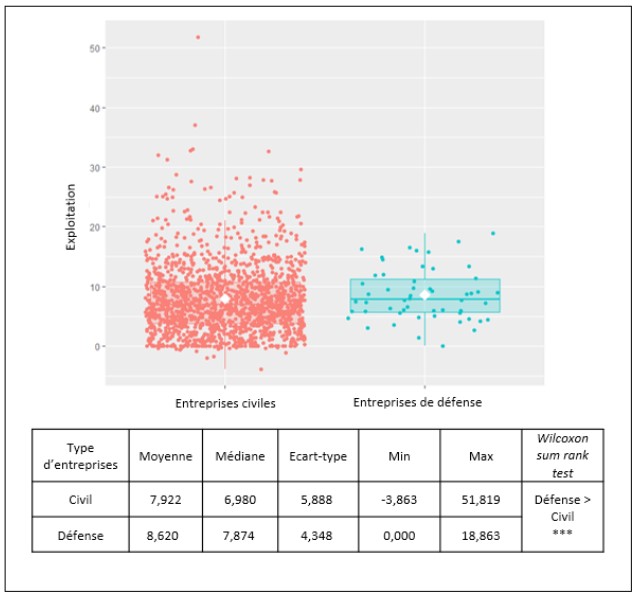
Interpretation: The graph is a boxplot that should be read as follows: the rectangle aggregates the second and third quartiles, the line represents the median, the diamond the mean value and the segments the first and ninth deciles. The chart presents the descriptive statistics associated with the two groups’ coherence indicators (civilian/defence). The last column presents the results of the Wilcoxon Rank Sum Test, the *** represent a p-value inferior to 1%, i.e. the probability of wrongly rejecting the null hypothesis.
Graph 1 presents the distribution and the descriptive statistic of the exploitation indicator per company, i.e. making common knowledge combinations. We make a difference between defence companies, according to the SIPRI Top 100, and civilian companies. Obviously the number of observations is much higher in the civilian group than in the defence one. A high exploitation indicator shows the capacity for a company to make knowledge combinations that are frequently observed in the studied patents. The distribution of this indicator is not scattered, with little outliers and a low standard deviation. Furthermore, the mean and the median of the exploitation score are higher in the group of the defence companies. These results were bolstered by testing the equality of the two distributions, which corroborated the significant superiority of defence companies in terms of exploitation of usual knowledge combinations.
This first aspect of knowledge foundation coherence is complemented by the second graph, which presents the exploration indicator of original combinations made by the company. We observe a scattered distribution with an important standard deviation in both groups. Furthermore, the mean and median of the exploration indicator are higher for defence contractors, which is confirmed when testing the equality of the two distributions. These two graphs shed light on the fact that the specificities of military production indeed influence the innovation process of defence companies by modifying knowledge architecture.
Graph 2 – Exploration – Distinction between civil and defence companies
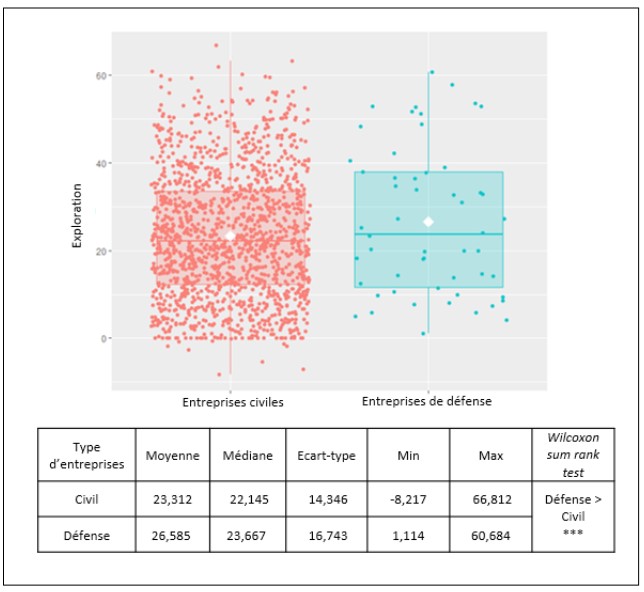
Defence companies thus seem to be more eager to explore original technological combinations and to exploit common relations further than civilian companies. This statistical study is quite preliminary and must be completed with further analysis. Thanks to the aforementioned indicators and a regression model adapted to count data, we have shed light on the closeness between the knowledge foundations of major defence contractors worldwide(x). This further analysis shows how important the exploration of original technological connections is to the production and sale of armament. Conversely, the exploitation of evident technological connections seems to have no impact on these sales. So although defence companies have activities as diverse as the automobile, chemical or aerospace sectors, their innovation processes share common characteristics.
Conclusion
This paper studied the innovation process of defence companies from the original standpoint of knowledge combinations. Thanks to a preliminary statistical analysis, we have foregrounded a significant difference between civilian and military companies in terms of practices. The architecture of knowledge of defence companies explores and exploits more than that of civilian firms, which means that not only do they make more original connections but the same holds true for common connections. Two reasons can shed light on these results. First, the external constraints companies producing weapons have to deal with. They can vary from the structure of the market, the collaboration environment, the purpose of products to the production organisation. Secondly, this specificity is fostered by the companies’ strategic choices in terms of diversification of their economic activities. It is as much of a challenge in terms of the technological composition of their military innovations as it is a challenge in terms of economic sustainability. Developing the very specificity entailed by defence production is key for defence companies to differentiate themselves from civilian ones.
Translation by Théo Ainley