

The official posture of the Japanese government which, for decades, has reconciled the U.S. nuclear umbrella with diplomacy in favor of abolishing nuclear weapons, has always been surrounded by discordant statements from senior political officials. These include the former Prime Minister Abe, claiming that Japan’s Constitution does not prohibit the possession of defense-oriented nuclear weapons, while various members of his entourage have already asserted the need for Japan to pursue a nuclear hedging strategy. Many observers and analysts have expressed their agreement, particularly because of two policies pursued by Tokyo and regarded as ambiguous owing to their duality: the maintenance of a program to extract plutonium from spent fuel, and a dynamic space program, increasingly affirming the role of outer space in national security. Rethinking the concepts of hedging and latent nuclear capabilities in the case of Japan shows that Japan’s latency is cultivated and is used by Tokyo as a diplomatic lever at the regional level, with the aim of limiting aggressiveness from China and North Korea toward it; it also serves as a political lever vis-à-vis Japan’s U.S. ally, in order to push Washington to strengthen its security guarantees, via the same implicit threat of rapid nuclear proliferation, in the event of a sudden change in the status quo. Through this reassessment of Japan’s nuclear policy, the differences between the Japanese government and a part of its population that favors nuclear abolitionism are examined, on a political level. On a conceptual level, this reassessment leads to challenging and rethinking the central concepts of hedging and latency, to adapt them to contemporary nonproliferation and even counter-proliferation issues. Finally, on a geopolitical level, it provides insight, through the singular example of Japan, into the consequences of the military rise of China and the failure to resolve the North Korean crisis on the stability not only of East Asia, but also of the world, insofar as these two phenomena weaken the nonproliferation regime established by the NPT fifty-two years ago.
Introduction
Context and principal issues
Japan’s relationship with military nuclear power is one of the major paradoxes of the country’s contemporary defense issues. The only nation to have suffered a nuclear strike on two occasions in August 1945, Japan promotes a world order ultimately rid of this weapon of mass destruction while placing its security under the nuclear umbrella of the United States. The prevalence of anti-nuclear movements within the population (historically against military nuclear power, and increasingly against civil nuclear power since the Fukushima accident) has strongly contributed to this component of Japanese diplomacy. Its abolitionist perspective is also in line with Japanese constitutional pacifism, as set out in the preamble to the 1947 Constitution and its Article 9 on the renunciation of war.
From the Korean War onwards (1950-1953), regional geopolitical instability was such that a pragmatic approach to security was called for alongside this constitutional pacifism. The unconditional surrender of August 1945 allowed the United States to put a stop to Japan’s nuclear aspirations in World War II while strongly limiting its defense capabilities, before working towards its military normalization in the framework of their bilateral alliance as of 1951. Subsequently, the conventional and then nuclear build-up of China, the asymmetric and vicarious conflicts of the Cold War, and the revelation of the North Korean nuclear program during the 1990s justified a gradual defense acquisition policy and prompted Japan to reconsider its insularity. Once synonymous with protection (along with the Kingdom of Siam, it is the only Asian country that has never been colonized), it has proved to be a major strategic drawback and a factor of Japan’s isolation in a region marked by growing tension.
The strengthening of this defense policy stems from the U.S. ambition to impose burden sharing within the alliance, deeming it useful for Japan to have minimal defense capabilities. However, the supreme guarantee of Japan’s protection officially remains the extended nuclear deterrence put in place by Washington. Extended deterrence means that a nuclear-armed state pledges to defend its ally with a nuclear strike when circumstances require, and thus represents the most ambitious defense commitment possible. (x)
The Japanese government is therefore forced to support certain initiatives in favor of nuclear disarmament, in order to satisfy public opinion that is largely behind this cause; but it cannot give its full support, as it would run the risk of alienating its American ally and losing the benefit of its nuclear umbrella, thereby creating a major security risk for Japan. This may partly explain the Abe government’s refusal to sign the Treaty on the Prohibition of Nuclear Weapons (TPNW) in July 2017, which illustrates the ambivalence of Japan’s official stand on military nuclear power.
The asymmetry of the U.S.-Japan alliance is central to understanding this ambiguity. Changes in Tokyo’s defense policy, including on a nuclear level, indeed depend on the reliability of the United States with respect to Japan. American researchers (x) have underlined the main difficulty of extended deterrence, which lies in the credibility of the security guarantee given to the ally, and sometimes amounts to the condition of its nonproliferation. The possibility of “abandonment” by the U.S. is a recurring theme within the alliance, making Japan keen to retain Washington’s esteem as an ally, in order to obtain guarantees of the U.S. security commitment.
Washington’s failure to convince the Japanese government that its nuclear commitments are firm could therefore spark a desire to acquire an autonomous nuclear strike force, so as to ensure its own security in a context of regional security regarded as increasingly threatening by Japan (ongoing territorial disputes with South Korea and Russia, Chinese incursions near the Senkaku Islands, the North Korean proliferation crisis, the security of Taiwan, seen by Japan as having a direct impact on its own, etc.).
The central aim of extended deterrence, for the nuclear power granting it, is to convince its enemy that it is determined to use nuclear weapons to defend its ally, but also to convince its ally of this same determination. This is therefore a fundamental security issue in modern-day Japan, which largely shapes its defense policy.
First, Japan is highly dependent on U.S. nuclear protection, such that any change in Washington’s doctrine can have immediate consequences for Tokyo. Between the Nuclear Posture Review (NPR) released in 2010 and the one drafted by the Trump administration in 2018, the conditions for exercising deterrence and more generally U.S. nuclear policy have been somewhat reoriented. Whereas the Obama administration pursued the goal of reducing the role of nuclear weapons, which may have raised concerns in Japan, the 2018 NPR acknowledged the possible use of non-strategic nuclear weapons, particularly to constrain Chinese military expansion.
The January 2021 inauguration of Joe Biden, who championed the principles of no first use (x) and sole purpose (x) during his election campaign, also suggests the possibility of a further U.S. about-turn, more pronounced than in the Obama era. Since 1960 Japan’s defense policy has therefore had to adapt to the evolving conditions for exercising U.S. extended deterrence, with the constant fear that such deterrence will not suffice to dissuade China and North Korea from attacking its territorial integrity.
The military development of these two countries (and to a lesser extent, Russia) is the main threat facing Japan today. Aiming to have a “world-class military” by the centenary of the founding of the People’s Republic of China (PRC) in 2049, Beijing has initiated a major modernization of its conventional and nuclear armed forces and is strengthening its second-strike capability. (x) Like its expansionist policy in the South China Sea, Beijing’s claims over the Senkaku Islands come with a constant and aggressive maritime presence, which Japan perceives as a direct attack on its territorial integrity. As for North Korea, the failure of the summits between Donald Trump and Kim Jong-un was followed by the resumption of ballistic tests (especially in the Sea of Japan) and the continuation of Pyongyang’s nuclear program, while bellicose rhetoric persists against Japan.
This dependence on the United States, perceived both as the core component of the country’s defense policy and a major vulnerability, along with the gradual rising threats from China and North Korea, explain the recurring views in Japan, since the 1960s, in favor of Tokyo acquiring nuclear weapons, particularly when Japan joined the NPT as a non-nuclear-weapon state, between 1968 and 1976. Expressed by prominent political figures such as Prime Minister Nobusuke Kishi (1957-1960), Defense Minister Shigeru Ishiba (2007-2008), and Prime Minister Shinzo Abe (2006-2007; 2012-2020), these views echo and fuel suspicions of an intention to proliferate in Japan, especially as they come almost exclusively from neo-nationalist and militarist factions of the Liberal Democratic Party (LDP) that has been in power almost continuously since 1955.
The connection between these views on the one hand, and the plutonium reprocessing and space launch vehicle programs on the other, is central to the concepts analyzed here, i.e., the concepts of “nuclear hedging” and “latent nuclear capabilities”. They contend that, despite advocating pacifism, nonproliferation and nuclear disarmament, for several decades Japan has pursued an implicit policy that would allow it to acquire nuclear weapons in the event of a significant deterioration in its regional strategic environment and a failure of U.S. security guarantees.
Literature review
The body of academic research on Japan’s position in relation to military nuclear power is primarily based on the concepts of “latent nuclear capabilities” and “nuclear hedging”, implying that Japan intentionally pursues a nuclear and space program that would enable it to acquire nuclear weapons and the relevant delivery systems if necessary.
“Latent nuclear capabilities”, or the possibility of launching a military nuclear program
The concept of latency aims at analyzing all of the technical, industrial, material and financial resources that a country requires to implement a military nuclear program. (x) The study of a state’s nuclear latency often includes an extensive list of technical indicators, seeking to cover all the parameters required to acquire nuclear weapons, and thus to detect the next proliferation crises. (x) For example, it may consist in an inventory of national mining activities, of the various dimensions of the fuel cycle, and of the qualifications of nuclear engineers in office. (x) Nuclear latency can thus be more generally defined, according to the words of John Carlson, as “the situation where a state has established, under a peaceful nuclear program, dual-use capabilities that could be used for the production of nuclear weapons.” (x)
This nuclear latency, Carlson continues, may be inadvertent when, for instance, the development of elaborate nuclear technology, such as plutonium reprocessing, renders the diversion of fissile material from civil to military purposes possible. This is the approach taken by the political scientist Ariel Levite, who disregards the notion of intentionality. (x) It may also be deliberate, when a state develops enrichment or reprocessing capabilities with a view to ensuring it can produce essential components for a military nuclear option should the strategic context deteriorate at some future time.
Due to this nuclear duality, latent nuclear capabilities can be lawfully achieved in accordance with the provisions of the NPT. It is simply a state of affairs where, from a certain point onwards, a state has the possibility of moving towards a military program – without taking account of the different processes it would need to develop it, if it decided to do so. This is how latency allows a proliferation threat to be assessed, essentially on the basis of technical nuclear capabilities, which remain authorized but whose advancement could lead to proliferation.
Japan is frequently referred to as a latent nuclear state, in that it retains the capacity to acquire nuclear weapons in a very short timeframe. (x) This introduces the concept of breakout time, i.e., the amount of time that a state capable of producing fissile material would take to produce the material necessary to manufacture a first nuclear device. (x) Used mainly in connection with Iran, this term and the analysis it covers thus give an estimation of the nuclear capabilities of a state and the speed with which a military program could be implemented, without in any way indicating the state’s intentions. In Japan’s case, if it decided to acquire nuclear weapons, this breakout time has often been assessed at between six months and a year. (x)
Nuclear hedging, or political will to have technical proliferation capabilities
While latency focuses mainly on scientific and technical fields, a geopolitical component should also be considered. Literature on the motives for proliferation (x) has clearly shown that there are several. A state’s decision to be on the nuclear threshold can be analyzed using the models established for proliferant states and, in particular, by taking the strategic environment into account. In a recent article published in the Observatoire de la dissuasion, (x) Benjamin Hautecouverture thus suggests completing the study of a state’s latency with an analysis of its strategic environment, which would shed light on its potential motivation to proliferate. This conception of latency comprises a study, if not of intentionality, at least of the reasons why a state might develop latent nuclear capabilities. These are not only collateral to the development of a peaceful civil nuclear program, but may in fact be part of a state’s intentional plan to have the technical possibility to proliferate. The latency concept can therefore lead to that of hedging, defined as an “intentional latency strategy.” (x)
The most widely used definition of hedging, as far as Japan is concerned, is the one given by Ariel Levite, who presents it as:
A national strategy of maintaining, or at least appearing to maintain, a viable option for the relatively rapid acquisition of nuclear weapons, based on an indigenous technical capacity to produce them within a relatively short time frame ranging from several weeks to a few years. (x)
It is therefore a coherent policy for developing significant technical capacities, but without using them to the full to obtain nuclear weapons. In this context, science and technology are at the service of political power, and their progress towards possible proliferation is decided at the highest level of government, either secretly or not. Hedging does not mean that the state in question is aiming to have weapons, but simply that it has chosen to develop latent nuclear capabilities to retain this option in the event, for example, of an imminent threat or a future risk of strategic upheaval that could compromise its vital interests. This is how A. Levite describes Japan’s hedging policy, making it “the most salient example of nuclear hedging to date.” (x)
A large part of the literature devoted to Japan as a nuclear hedging state therefore focuses on finding evidence of this initial intention to retain the capacity to be nuclear armed. In Asia in the Second Nuclear Age (2013), Richard Samuels and James Schoff went by a 1969 study conducted by the Japanese Ministry of Foreign Affairs which stated that Japan needed to maintain latent nuclear capabilities to make it a key example of a nuclear threshold state. (x) They saw a coherent policy by Tokyo, implemented since 1969 with the aim of being protected by the extended deterrence of the United States and maintaining a latent nuclear capability in the event of a major crisis and failure of that extended deterrence. The Japanese hedging policy is therefore thought to be central to its defense policy, aiming to retain an American or national nuclear guarantee to deal with any scenario.
Researchers specialized in nuclear disarmament also share this idea, like the Swedish researcher Andreas Persbo. In a recent study on nuclear hedging policies using Ariel Levite’s definition, A. Persbo develops the main idea that a hedging policy should be distinguished from a secret nuclear program, insofar as it mainly stems from the dual, both civil and military, nature of the nuclear and space technologies developed by Japan, which can thus retain latent capabilities without breaching the provisions of the NPT. (x) In his opinion, Japan’s latent nuclear capabilities suggest a singular type of nuclear weapon that is a like a handgun kept in a gun safe ready to be swiftly taken out if necessary. (x)
This first set of hedging theories therefore highlights the active, voluntary and defensive dimension of Japan’s hedging policy. The authors’ use of “nuclear hedging” in the progressive verb form points to a current and ongoing process aimed at building protection (hedge) against the identified threat.
However, a different approach is also taken to the hedging concept in the case of Japan, and focuses more on the fact that Tokyo has chosen not to possess weapons, but still has latent nuclear capabilities. To the political scientist Maria Rost Rublee, Japan is a “Nuclear threshold state” insofar as, despite the decision to join the NPT, marking its rejection of military nuclear power, it retains capabilities while in return proving its intention not to become a nuclear-armed stated by complying with the various nonproliferation rules. (x) The metaphor of the expression “Nuclear threshold state” clearly shows the deliberately restricted nature of the approach, with the refusal to take the step towards obtaining nuclear weapons.
This approach is also central to historical analyses of Japan’s ratification of the NPT, which was signed in 1970 but ratified in 1976. Through his analysis of archives declassified by the Japanese government, the historian Yu Takeda brings to light the struggles within the government prior to the NPT ratification between supporters of Japanese proliferation and advocates of U.S. extended deterrence. (x) The decision not to acquire weapons leads Y. Takeda, like M. Rost Rublee, to consider the nuclear threshold as a limit that has not been crossed in the past, a decision not to be nuclear armed at a time when Japan, nonetheless, already had the capacities to produce them.
Contrary to the previous hedging theories, this approach does not question the political motive for maintaining these proliferation capabilities. It focuses more on how maintaining these capabilities affects the coherence of Japan’s pacifist and anti-proliferation diplomacy.
Although they adopt different approaches, the hedging concept that these various researchers defend is based on an analysis of intention: either that Japan previously wished to be nuclear armed but went back on its decision (Takeda, Rost Rublee), or that Japan is seeking to maintain latent nuclear capabilities with the aim of keeping a proliferation option in the event of a major crisis (Levite, Samuels, Persbo, etc.). This question of intention has led to debate, particularly through the work of political scientist and historian Akira Kurosaki, who questioned the importance of the Japanese government’s stated desire to develop a “potential nuclear armament capacity” (senzaiteki kakubusō nōryoku) and analyzed the bureaucratic and scientific inaction of Japan’s nuclear institutions as one of the reasons for maintaining latent nuclear capabilities. (x) We will not come back to the question of intention, since it relates more to the work of historians dealing with archives or those well-versed in secret defense matters. Furthermore, whatever the intention, Japan really does have latent nuclear capabilities, which I will analyze in the second part.
So, except for Akira Kurosaki, the main studies of the idea of a Japanese nuclear hedging policy mentioned in this review represent a first way of interpreting the persisting latent nuclear capabilities in Japan and the gulf that exists between the image of the only country struck by the atomic weapon and the advancement of its nuclear technical capabilities. By introducing an element of intentionality in respect of Japan’s latency, the hedging concept forms the basis for speculations as to the possibility of nuclear proliferation by Japan, which could also be seen as a way of exerting geopolitical pressure on the U.S. to encourage it to meet its security commitments, and on China and North Korea, to avoid an escalation of tension.
Methodology
Sources
The sources of this study come mainly from scientific literature, particularly the literature mentioned in the above review, whether written in English, Japanese or French. The Japanese sources consulted and the works of Japanese researchers publishing in English confirmed how prominent this question has been in geopolitical research since the early 2000s. As mentioned in the review, the research is often divided between proponents of nuclear power in favor of Japanese nuclear deterrence, or even proliferation, and abolitionists who would like to see Japan put an end to the ambiguity and step up its disarmament efforts. In addition to the scientific literature, there was a large amount of gray literature with official reports, statements by political figures and the American and Japanese White Papers on defense.
Problematic and areas of research
This report sets out to rethink the concepts of nuclear hedging and latent nuclear capabilities as applied to Japan, preferring to highlight the political and diplomatic use of the ambiguity of some of the country’s technological undertakings and government statements. By reviewing the hedging theories and that of a possible Japanese nuclearization, this paper aims to show how Japan’s nuclear ambiguity is conceived, cultivated and used by Tokyo as a diplomatic lever at the regional level (to limit the aggressiveness of China and North Korea) and as a political lever within the alliance with the United States (to compel Washington to constantly strengthen its support) through the same implicit threat of rapid nuclear proliferation, in the event of a sudden change in the status quo.
This reassessment of Japan’s nuclear posture is significant in three respects. Politically, it allows us to study the differences between the Japanese government and a part of its population that favors nuclear abolitionism. Conceptually, it leads to challenging and rethinking the central concepts of hedging and deterrence. Finally, from a geopolitical perspective, through the singular example of Japan, it provides insight into the consequences of China’s military climb and of the failure to resolve the North Korean crisis on the stability not only of East Asia, but also of the world, insofar as these two phenomena weaken the non-proliferation regime established by the NPT fifty-two years ago.
Plan
This report is organized in three sections, to ultimately posit the suggestion that Japan’s ambiguity with regard to military nuclear power is a political tool for exerting pressure on both its antagonists and its allies.
First, the study of the nuclear aspect of the U.S.-Japan alliance aims to outline the foundations of Japan’s defense policy, while analyzing the growing factors of uncertainty that incite Tokyo to maintain its potential for proliferation. This study of the U.S.-Japan alliance integrates the long term into the reflection and shows that any change to the Japanese defense policy is only possible in this framework (I).
Insofar as Japan’s latent nuclear capabilities are central to the questions of nuclear hedging and latent nuclear capabilities, by analyzing Japan’s dual nuclear posture (between official rejection and persistent rhetoric in favor of possible proliferation) and studying the space and plutonium reprocessing programs, it is possible to assess the extent of Japan’s potential for proliferation and thus its diplomatic effectiveness in East Asia and in relation to the United States (II).
However, in spite of this technical state of affairs, the different obstacles that stand in the way of potential Japanese nuclearization must also be assessed, in order to rethink, in light of these conclusions, the application of the hedging concept to the case of Japan (III).
I. The U.S.-Japan alliance
A guarantee of Japan’s nuclear and conventional defense, but a growing source of uncertainty
Acquiring a nuclear capability is a statement of a lack of confidence in alternative security arrangements. (x)
Born in the aftermath of World War II and at the beginning of the Cold War, the alliance between the United States and Japan is the foundation of Japan’s defense policy as well as its ultimate guarantee of security, through the U.S. extended deterrence. It is therefore necessary to analyze its origins, the threats it faces, and the level of uncertainty it entails for Japan, as in any situation of extended deterrence. The possibility of Tokyo crossing the nuclear threshold is indeed only conceivable in relation to the effectiveness of this extended deterrence against the main dangers identified by Japan.
Foundations of the U.S. extended deterrence for Japan: protecting the territory and avoiding japanese proliferation
Origins of the alliance: a legal basis with a deliberately broad interpretation
The alliance was born out of the U.S. occupation and administration of Japan between 1945 and 1952. One of the major achievements of the Supreme Allied Command was the drafting and the adoption of a new Constitution in 1947 under General MacArthur.
Article 9 provides that:
The Japanese people forever renounce war as a sovereign right of the nation and the threat or use of force as means of settling international disputes […]. Land, sea, and air forces, as well as other war potential, will never be maintained.
In addition to the democratization of the political system and the rapid reconstruction of the economy, pacifism became a fundamental element of Japanese identity in the postwar period and the sine qua non for the normalization of relations with Washington. Article 9 did not, however, imply a status of neutrality, which would have Japan demonstrate impartiality between the parties in a conflict, and so the U.S.-Japan Security Alliance could later be established. By subjecting Tokyo to a drastic limitation on its defense capabilities, the United States neutralized any possibility of threat and then, from the end of the occupation, moved toward an alliance between the two sides. Through the unconditional surrender and the drafting of this pacifist constitution, Washington also ensured that Japan would not become a nuclear power as it had wished during World War II.
The constitutional reforms of the Japanese regime around democracy and pacifism thus allowed the signing of the 1951 Security Treaty with the United States, in parallel with the San Francisco Treaty. This legal foundation of the new regime’s first alliance initiated the international rehabilitation of Japan by integrating it into the Western bloc as well as into the U.S. regional security system. (x) However, although the treaty recognized that Japan did not have the means to effectively defend itself, it made no mention of extending the U.S. nuclear deterrence to Japan:
Japan grants, and the United States of America accepts, the right, […] to dispose United States land, air and sea forces in and about Japan. Such forces may be utilized to contribute to the maintenance of international peace and security in the Far East and to the security of Japan against armed attack from without. (x)
The same is true of the Mutual Cooperation and Security Treaty, which replaced it in 1960. Although it clarifies and reinforces the U.S. military presence in Japan, the strengthening of security guarantees does not come with an explicit provision for extended U.S. deterrence:
Each party recognizes that an armed attack against either Party in the territories under the administration of Japan would be dangerous to its own peace and safety and declares that it would act to meet the common danger in accordance with its constitutional provisions and processes. (x)
Although there is no mention of the U.S. nuclear umbrella, these treaties mark the starting point for Japan’s inclusion in the U.S. extended deterrence for three reasons.
First, the language in the two excerpts is very vague: the first does not specify that forces stationed in Japan must be conventional, while the second, stressing that any military intervention must be consistent with the constitution of the party concerned, does not prevent the United States from using nuclear weapons. Legally, then, both treaties can be broadly interpreted, with no restrictions whatsoever on the weapons employed or stored in Japan, thus opening the possibility of extending U.S. deterrence to Tokyo.
Moreover, this extension stemmed from Washington’s wish to further demilitarize Japan, by ensuring that Tokyo would not attempt to acquire nuclear weapons for its own security. This is thus both a policy of continued disarmament, contributing to the reconstruction of Japan as a peaceful nation, and a policy of nonproliferation. Nonproliferation could and can only be guaranteed if the extended deterrence offered in return has a better cost-benefit ratio for the Japanese leadership – which implies its possible and constant re-evaluation in the light of the changing security environment and the possibly divergent threat perceptions of the two powers.
Finally, because of U.S. involvement in the Korean War, during which the U.S. commanders considered nuclear strikes, (x) Japan took part in the conflict through its ports, which served as a rear base for U.S. aircraft sent to the battlefield. The integration of Japan into the U.S. extended deterrence provided Washington with projection and deterrence capabilities in the event of a new conflict in the region. It was this last point that partially justified the introduction of U.S. nuclear weapons into Japanese territory (thus made safe by the U.S. deterrence), notably on the island of Okinawa from 1954 onwards. (x) The justification put forward, which was revealed by various documents declassified in 2009, is precisely the general nature of these two treaties, which prevents any legal restriction on the introduction of these weapons into Japan. (x)
This historical detour through the two successive security treaties between Japan and the United States reveals the logic that underlies, even today, the U.S. nuclear deterrence extended to Japan: a guarantee of nonproliferation from a country with a pacifist constitution but which might be incited to acquire defense capabilities by an increasingly threatening regional environment. There is also a greater capacity for projection and deterrence against aggressive powers destabilizing the regional order (China and North Korea having replaced the Soviet Union as the main threats in Northeast Asia). However, it is only through the use of general and broad language that extended deterrence is made possible. It is not affirmatively written in either treaty, which explains why it has been formulated and specified in a series of political, rather than legal, documents and statements.
The political foundations of extended deterrence at the heart of Japan’s alliance and security
To clarify the role of the U.S. extended deterrence in Japan’s security policy, two main channels have been used within the alliance: U.S. declaratory policy, either publicly or confidentially, and the publication of the joint Guidelines for Japan-U.S. Defense Cooperation. The objectives of these two different means remain the same: to reaffirm, within the alliance, the U.S. commitment to provide Japan with its nuclear umbrella, in order to reduce the uncertainties inherent in any extended deterrence situation; and to remind the antagonists of both Japan and the U.S. that this alliance involves Washington’s nuclear capabilities. This is thus an eminently political undertaking to maintain U.S. credibility, to align U.S.-Japan threat perceptions, and to persuade Tokyo that autonomous nuclearization would create more instability than that facing the alliance and extended deterrence today.
Until the first guidelines in 1978, these extended deterrence guarantees were primarily expressed through statements of nuclear assurance made by U.S. presidents to Japan. In 1968, they played a central role in Japan’s adherence to the NPT, four years after the first Chinese nuclear test in October 1964. Prime Minister Sato then compared China to “a knife-wielding madman” and obtained confirmation of U.S. nuclear guarantees from Secretary of Defense Robert McNamara during his visit to Washington in January 1965 and then during his meeting with President Johnson at the White House in November 1967. This is the most important example of the renewed expression of U.S. guarantees to prevent proliferation by Japan in response to the emergence of a new nuclear threat, a phenomenon that has recurred since the start of North Korean nuclear tests in 2006. (x) The stakes were all the higher because the United States had to obtain Japan’s signature on the NPT by overcoming the reluctance of many LDP officials to completely give up the possibility of acquiring nuclear weapons in the event of a major crisis.
Communication of U.S. guarantees of extended deterrence evolved as the alliance became stronger and more structured, particularly around the “Guidelines for Japan-U.S. Defense Cooperation”. Changes seen in the expression of this deterrence are shown in the table below (Figure 1).
Figure 1
Change in the discourse on U.S. extended deterrence in the “Guidelines for Japan-U.S. Defense Cooperation” (1978-2015)
| Guidelines | |
| 1978 | “The United States will maintain a nuclear deterrent capability and the forward deployments of combat-ready forces and other forces capable of reinforcing [U.S. forces in Japan]” (Ministry of Defense of Japan, The Guidelines for Japan-U.S. Defense Cooperation, 1978). |
| 1997 | “In order to meet its commitments, the United States will maintain its nuclear deterrent capability, its forward deployed forces in the Asia-Pacific region, and other forces capable of reinforcing those forward deployed forces” (Ministry of Defense of Japan The Guidelines for Japan-U.S. Defense Cooperation, 1997). |
| 2015 | “The United States will continue to extend deterrence to Japan through the full range of capabilities, including U.S. nuclear forces.” “The United States will support Japan in a chemical, biological, radiological, and nuclear incident or attack prevention […] in an effort to ensure the protection of Japan, as appropriate” (Ministry of Foreign Affairs of Japan, The Guidelines for Japan-U.S. Defense Cooperation, 2015). |
These guidelines are intended to strengthen the alliance, both by establishing a basis for cooperation between the two countries’ armed forces and by working to render credible and public the potential for U.S. retaliation, under the 1960 treaty and in the event of an armed attack on Japan. From 1978 to 2015, the change is notable and makes the U.S. security guarantees increasingly clear, recalling that while conventional deterrence had developed within the alliance, notably through the growing contribution of Japan, the U.S. nuclear forces nonetheless remain central, especially with regard to threats based on weapons of mass destruction.
The changes in the alliance’s declaratory policy correspond to the evolution of roles within it. From the 1960 security treaty, which introduced defense reciprocity that was absent from the 1951 treaty, to the 2015 legislation authorizing the Japanese Self-Defense Forces (SDF) to intervene in collective self-defense (introducing a new interpretation of the Constitution), the history of the alliance is also the history of Japan’s rise and its growing assumption of responsibilities in this context. The U.S.-Japan alliance has thus been strengthened around extended deterrence, which is now discussed in various formats and no longer only through the statements of U.S. presidents.
The progressive institutionalization of extended deterrence within the alliance
This evolution corresponds to the gradual establishment of structures dedicated to extended deterrence within the framework of the U.S.-Japan alliance. Although the United States retains full sovereignty over the decision-making process, Japan is increasingly involved in the extended deterrence provided to it. This channel of communication with the United States is the result of insistent demands from many Japanese researchers and diplomats in the year leading up to the drafting of the Obama administration’s Nuclear Posture Review (NPR) in 2010. The major demand from Japan was the following:
If the credibility of the U.S. commitment is the question at issue, it is Japanese perceptions that matter. The U.S. commitment to provide extended deterrence to Japan has been repeatedly affirmed by presidents, including President Obama, and other senior officials as well as in agreed documents. Nevertheless, Japanese misgivings and doubts about American commitment persist. It is important for Tokyo to be officially engaged in consultations with Washington on deterrence strategy, including nuclear deterrence. Without such consultations, the Japanese government, let alone the public, will have to be speculative about the credibility of U.S. commitment. (x)
In other words, the verticality of the alliance works against its credibility in Japanese society and government, as it comes with opacity in decision-making and strategy. Thus, the ambivalent balance of U.S. extended deterrence is once again outlined: Washington must be able to retain its sovereignty over strategy and any decision concerning use, (x) but sufficiently involve Tokyo in extended deterrence and in implementing its strategy to provide it with the certainty of the commitment.
Japan’s insistence to the United States led to the creation of the Extended Deterrence Dialogue in 2010, a bilateral structure at the heart of the alliance designed to play a role similar to NATO’s Nuclear Planning Group. Through regular meetings (approximately two per year from 2010 to 2020), this new type of summit between the two allies led to the partial inclusion of Japan in the U.S. nuclear strategy, particularly through visits to nuclear sites in the United States and participation in discussions on U.S. nuclear forces. (x)
The creation of this new forum for political and diplomatic discussions between the two parties reflects the U.S. desire to reassure Japan that its security commitment is firm. One result of these semi-annual meetings has been a strengthening of the U.S. nuclear posture regarding extended deterrence in Asia, as evidenced by the semantic evolution of the NPR from 2010 to 2018.
In 2010, Japan was not even mentioned in the document, which, on the theme of alliances, merely recalled that:
Security architectures in key regions will retain a nuclear dimension as long as nuclear threats to U.S. allies and partners remain. […] The Administration is pursuing strategic dialogues with its allies and partners in East Asia and the Middle East to determine how best to cooperatively strengthen regional security architectures. (x)
This passage remains very ambiguous with regard to the alliance with Japan, which is not mentioned, while the expression “strategic dialogues” does not suggest any precise structure. Moreover, the temporal nuance of the first sentence (“as long as”), although not suggesting a sole purpose policy, indicates the Obama administration’s desire to reduce the role of nuclear weapons in U.S. deterrence (whether national or extended) in line with the 2009 Prague speech. Their central place within the security alliance thus appears less assured in the eyes of Japan, a fact that was partly amended by the 2018 NPR:
[Assurances for our allies and partners] include sustained allied dialogues to understand each other’s threat perceptions and to arrive at a shared understanding of how best to demonstrate our collective capabilities and resolve. […] [Our allies] have reaffirmed that extended nuclear deterrence is essential to their security, enabling most to eschew possession of nuclear weapons and thereby contributing to U.S. nonproliferation goals. (x)
The nuclear dimension of extended deterrence is strongly reaffirmed here, while intra-alliance dialogue is emphasized more than in the previous document, insofar as it aims at better identifying threats through shared perceptions (a key point for Tokyo, which does not face the same threats as Washington in its regional environment). However, this commitment came across as pious hope to Japan, in the face of President Trump’s unilateral approach.
The gradual institutionalization of extended deterrence within the alliance therefore meets a dual need: reaffirm U.S. security guarantees to Japan and strengthen the effectiveness of deterrence. To this end, Tokyo is being given a greater role in the strategy and supervision of the conventional side of this deterrence, which is also provided by the United States through its arms sales to Japan and its imposing military presence in the country.
The U.S. extended deterrence as a necessary guarantee of protection in the face of growing regional threats
China’s gray-zone strategy and Beijing’s growing assertiveness in the East China Sea
Since its first nuclear test in October 1964, China has been at the heart of Japan’s security concerns. The singularity of this strategic situation lies in the conjunction of strong economic ties – it is Japan’s biggest trade partner – and growing geopolitical tension.
The main dispute between China and Japan concerns the Senkaku Islands, (x) which helps to understand why Japan sees China as a growing threat in the region. This group of uninhabited rocks and islets in the East China Sea was ceded to Japan in 1895 via the Treaty of Shimonoseki, ending the Sino-Japanese War. The islands were under U.S. rule from 1947 to 1972, when Okinawa was returned to Japan, before being governed by the Japanese, without China making any territorial claims. These claims began in the late 1970s, concomitant with the discovery of vast hydrocarbon deposits within the continental shelf beneath the islands. In 2012, the islands, until then privately owned by a Japanese citizen, were nationalized by Tokyo.
This territorial dispute is instrumental in Japan’s perception of China. As a result, the latest National Defense White Paper, published in July 2021, portrays it as a state that “has relentlessly continued attempts to unilaterally change the status quo by coercion, […] [based on] unilateral assertions […] that are, fundamentally, a violation of international law.” (x) The main issue for the Japanese government is China’s method of circumventing the U.S. extended deterrence from below. This is the “gray zone” tactic of aggressive action that:
seeks to effect changes in the status quo while remaining below the level of provocation that would elicit a strong response from Japan or the U.S.-Japan alliance. (x)
China’s policy of changing the status quo can be studied in two stages, from the establishment of a safe zone to the development of forces capable of preserving it, as part of a policy of continuous pressure and fait accompli.
First, following on from the assertion of its historical rights, in 2013, in response to Tokyo’s nationalization of the islands, Beijing established an Air Defense Identification Zone (ADIZ) (x) overlapping Japan’s and ostensibly including the Senkaku Islands. Japan regards such a measure as a sovereign violation, insofar as it infers that any flying over the Senkaku Islands should be controlled by the Chinese authorities, despite their inclusion in the Japanese EEZ.
The second part of this fait accompli tactic is the development of forces to limit access to the space around the Senkaku Islands and to maintain a constant presence there, which is perceived by Japan as highly hostile pressure. The presence of the Chinese coast guard in the contiguous waters of the Senkaku Islands reached a record 333 days in 2020, (x) and came with legal developments of great concern to Tokyo, namely a shift from civilian to military administration under Xi Jinping’s command in 2018, and the promulgation in February 2021 of a new law authorizing them to have policing powers in waters under Chinese jurisdiction, with the ability to board ships, deny access, and fire in the event of a violation, etc.
This gray zone tactic by Beijing is now one of the Japanese government’s greatest concerns, in part because it seems to defeat the extended deterrence. Although three successive U.S. presidents over the past decade have reaffirmed that the 1960 security treaty – and thus extended nuclear deterrence – extends to the Senkaku Islands, these guarantees appear insufficient for two reasons.
First, as evidenced by the joint statement of Yoshihide Suga and Joe Biden when they met in Washington, D.C., on April 16, 2021, the United States merely defends Japan’s “administration” (x) of the Senkaku Islands, which means neither possession nor, more importantly, defense of the same sovereign rights as if it were Shikoku or Hokkaido. Such is the ambiguity of the U.S. position with respect to this geopolitical dispute, which extends its extended deterrence to a territory over which it recognizes only Japanese administration, not sovereignty.
Moreover, U.S. extended deterrence in no way prevents the massive presence of Chinese ships around the islands, nor a very assertive declaratory policy by Beijing, such as the words of Chinese Foreign Minister Wang Yi who, during his visit to Japan on November 28, 2020, declared before the Japanese government that Beijing would do everything to “guarantee China’s sovereignty over the Diaoyu Islands.” (x)
China’s operations on the ground as well as its declaratory policy thus increasingly defy U.S. security guarantees in Japan’s eyes. By remaining below the threshold of conflict, they undermine the credibility of extended deterrence over the Senkaku Islands, particularly with a view to driving the United States out of the region, by rendering meaningless any U.S. nuclear strike that could be launched under extended deterrence if the Senkaku Islands dispute were to escalate into open conflict, by the threat of a Chinese second strike. This is because any damage to the United States would, for Washington, be totally disproportionate to the initial stake – eight uninhabited islets in the East China Sea. This explains the deployment of several hundred members of the ground SDF on the Ryukyu islands near the Senkaku Islands, capable of intervening on the front line in the event of aggression and aiming, beyond deterring Chinese vessels, to reassure the United States of Japan’s ability to take charge of its own defense in the area. (x)
North Korea and the limits of U.S. diplomacy
The progress of the North Korean nuclear program and the lack of results from successive attempts at negotiation in this proliferation crisis make the Pyongyang regime the second major threat identified by Japan and the second factor likely to weaken the U.S. extended deterrence.
In its March 2021 report on North Korea, the UN Security Council’s Panel of Experts on North Korea found that between August 2020 and February 2021, the regime continued its production of highly enriched uranium at the Yongbyon site, plutonium mining, naval modernization activities at the Sinpo shipyard, etc., and, despite doubts about the ability of North Korean missiles to re-enter the atmosphere, consider it “highly likely that a nuclear device can be mounted on the intercontinental ballistic missiles, and […] that a nuclear device can be mounted on the medium-range ballistic missiles and short-range ballistic missiles.” (x)
These findings follow Kim Jong-un’s decision in January 2020 to end his self-imposed moratorium on nuclear testing (x) and ICBM launches, confirming the failure of negotiations with the United States. This failure should be viewed in the context of the Pyongyang regime’s military demonstrations. The October 10, 2020 parade unveiled a new ICBM, called Hwasong-16, which has been described as a MIRV, (x) while the closing parade of the 8th Congress of the Workers’ Party on January 14, 2021, presented a new SLBM, Pukguksong. The range of these two missiles, coupled with the MIRV, suggests that the United States would eventually be vulnerable to a North Korean strike, less likely to be stopped by U.S. missile defense. (x)
Pyongyang’s technological advances usher in a new era of threats to Japan and the U.S. extended deterrence. Japan is now within range of several types of North Korean missiles, while the new ICBMs would be likely to reach the U.S. territory.
As far as Japan is concerned, this is a direct threat as North Korea’s exuberant rhetoric makes it one of the nation’s mortal enemies. The April 2013 Law on Consolidating the Position of Nuclear Weapons State, specifies Pyongyang’s framework for the use of nuclear weapons, aimed at “deterring and repelling the aggression and attack of the enemy against the DPRK and dealing deadly retaliatory blows at the strongholds of aggression”. (x) While the United States figures prominently among these “strongholds of aggression”, its allies are also included to the extent that they are perceived as an extension of U.S. power; official speeches and the North Korean press, relayed by the online media outlet KCNA, frequently portray Japan as Washington’s “pawn”. Tokyo thus becomes the potential target of a North Korean nuclear strike, unconditioned by a possible no-first-use principle.
Rhetoric on the use of nuclear weapons has been supplemented by verbal provocations that clearly point to Japan as a target of Pyongyang. For example, following international sanctions in response to North Korea’s sixth nuclear test in September 2017, the Korea Asia-Pacific Peace Committee declared that “the four islands of the archipelago should be sunken into the sea by the nuclear bomb”, (x) accusing Japan of pandering to U.S. demands and failing to sincerely apologize for crimes committed during World War II.
While it seems difficult to see these threatening speeches as the counterpart of a coherent doctrine of nuclear weapon use, they show the extent to which North Korea perceives Japan as an enemy, an imperialist power that has only changed from the militaristic empire of World War II by being subservient to the United States today. From this adverse perception stems the sense of threat in Japan, especially in the face of North Korean nuclear and ballistic advances which, in addition to keeping the country within range, presuppose the defeat of U.S. deterrence.
Indeed, a study of the regime’s rhetoric shows the extent to which the North Korean nuclear program is aimed at perpetuating the Kim dynasty and securing its territory against the United States. Kim Jong-un’s July 27, 2020 address to Korean War veterans is a good example. (x) Seventy years after the end of the conflict, which was presented as a defeat of the “military offensive by the American imperialists”, Kim Jong-un deemed that “the fierce confrontation with the enemy” continues and that “the threat and pressure by the imperialists to invade and plunder our state have increased moment by moment”, before concluding that:
War is an armed clash which can be unleashed only against a weak one. […] Thanks to our reliable and effective self-defense nuclear deterrence, the word war would no longer exist on this land, and the security and future of our state will be guaranteed for ever. (x)
The North Korean nuclear program is thus presented as part of an age-old tradition of resistance to the invader, especially since the glorified figure of Kim Il Sung, the personification of the struggle against the Japanese colonizer, is also evoked. It is thus the preeminent revolutionary weapon for the regime insofar as it guarantees the regime’s survival against what it describes as American imperialist assaults. This is the official ideology of juche (a nationalist interpretation of Marxism-Leninism developed by Kim Il Sung and established as the official ideology by Kim Jong-il), making self-sufficiency, including in defense, the core of the regime’s doctrine.
The consequences of this ideology on the U.S. deterrence are immediate. The glaring conventional and nuclear asymmetry between North Korea and the United States forces Pyongyang to be pragmatic in implementing a minimal deterrence that can keep the United States at bay enough to continue building up its forces. This is why the regime’s recent technical advances are aimed at defeating U.S. deterrence, and thus the extended deterrence inclusive of Japan. SLBM development is part of the process of building an ocean component, with the goal of achieving a second-strike capability that could cast doubt on U.S. guarantees of Japan’s nuclear defense, out of fear of a strike by Pyongyang on its own territory. President Trump’s failure to resolve the North Korean crisis despite using the novel format of bilateral summits has also contributed to a decline in Japanese confidence in Washington’s ability to defend its interests in East Asia. The NIDS, the research arm of the Japanese Ministry of Defense, has acknowledged this failure in no uncertain terms, stating in a report that Japan believes the summits have produced “no fundamental change in the nature of North Korean nuclear and ballistic threats.” (x)
Thus, the intensification of Chinese and North Korean threats induces a strong sense of vulnerability for Japan, prompting numerous requests for U.S. assurances and guarantees from Tokyo. Faced with the emergence of significant decoupling risks and after the disruption of the alliance under President Donald Trump, Japan doubts the reliability of the U.S. ally and its security guarantees. This uncertainty is central to the question of a possible Japanese hedging policy, and to that of the acquisition of high-precision cruise missiles, with a view to a pre-emptive strike capability.
Japan’s uncertainty about U.S. nuclear umbrella guarantees
Risks of delinking at the center of Japanese concerns
The growing threats from China and North Korea have two implications for Japan and its alliance with the United States. First, it shows that extended deterrence and U.S. diplomatic efforts are not enough to slow the modernization of their respective nuclear forces. Deterrence is in part a mental power struggle, based on the adversary’s recognition of the credibility of the threat that is being presented and maintained. China’s gray-zone strategy and Pyongyang’s pursuit of its nuclear program can be seen as a test of that credibility.
The second consequence of the rise of these two threats is the risk of a strategic delinking of Japan’s interests from those of the United States. A first way to envisage this delinking, previously mentioned, is tied to the progressive development of missiles likely to reach American territory from China or the Korean peninsula, as well as the eventual acquisition of a second-strike capability. Several researchers or political leaders indeed believe that the United States’ new vulnerability to possible nuclear strikes from these two players would reduce or even eliminate any willingness to honor, if necessary, the nuclear side of its extended deterrence in respect of Tokyo. (x)
Although this theory is difficult to refute, reducing the potential causes of Japan-U.S. delinking to the technological advances of China and North Korea does not sufficiently reflect the uniqueness of these two situations. After analyzing Japanese concerns, two possible types of causes liable to lead to another form of strategic separation between American and Japanese vital interests can be considered.
First, this delinking could stem from the importance of economic ties between the United States and China, which could influence Washington’s strategic calculus. This is a new factor compared to the Cold War, negating the parallel between Sino-American and American-Soviet rivalries. In 1971, the USSR accounted for only 0.2% of total U.S. foreign trade, and the U.S. for 0.8% of Soviet foreign trade. (x) In 2020, China was the largest trading partner of the United States, accounting for 14.9% of its foreign trade, while the United States was the main destination of Chinese exports. (x) According to a Japanese researcher working on these issues, the economic interdependence between these two powers is sometimes seen in Japan as an advantage, precisely because it helps reduce the risks of an open conflict between Tokyo’s two main partners. (x)
This interdependence allows Japan to maintain strong economic ties with both China and the United States, by dissociating trade from geopolitical tension according to the doctrine of separating economics and politics (Yoshida doctrine of seikei bunri) formulated in the aftermath of World War II. However, economic interdependence between China and the United States can only prove to be an advantage for Tokyo if it has a calmer relationship with Beijing, with no risk of a territorial dispute such as the Senkaku Islands. Indeed, despite the assurances of firmness frequently reiterated by Washington, this interdependence could be an obstacle to massive American intervention.
Secondly, divergent perceptions of security could give rise to a delinking scenario. First, they could be external to the alliance, in the event of a misperception of the strategic environment or of U.S. and Japanese intentions by China and North Korea. This risk is particularly emphasized by the Japanese Ministry of Defense with regard to Pyongyang, insofar as the pursuit of its weapons program could lead the regime to believe that it has secured:
A strategic deterrence against the United States. However, if North Korea has such a false sense of confidence and recognition regarding its deterrence, it could lead to an increase and escalation of military provocations by North Korea in the region and could create situations that are deeply worrying also for Japan. (x)
The risk here is that North Korea imagines that it has the capacity to implement an “aggressive sanctuarization” policy like Beijing or Moscow, and thus underestimate the resolve of the United States to protect South Korea and Japan. For this reason, Tokyo is particularly concerned about the possibility of Pyongyang misjudging the power relationship.
Finally, delinking due to divergent security perceptions within the alliance is also a possibility. It would depend primarily on different interpretations by Japan and the United States of the security environment in East Asia. Discussion fora such as the Extended Deterrence Dialogue are designed precisely to limit any asymmetry of perceptions between the two allies. The frequency of these internal alliance meetings makes this cause of delinking less likely than the previous ones, without, however, invalidating it. For geographic and military reasons, North Korea is only a danger for the United States, whereas it represents an existential threat for Japan. (x)
These risks of delinking are at the heart of Japanese concerns about the effectiveness of U.S. security commitments. They constitute the structural uncertainty of this extended deterrence situation, which was coupled, between 2017 and 2021, with cyclical uncertainty about Washington’s reliability, due to Donald Trump’s position regarding the alliance.
Donald Trump’s policy and its ambivalent reception by Japan
The declassification of the United States Strategic Framework for the Indo-Pacific (x) (drafted in 2017) on January 12, 2021, was not simply an attempt by the Trump administration to glorify its track record days before President-elect Biden took office. It provides essential hindsight on Donald Trump’s objectives in relation to (among other things) the alliance with Japan, and allows for an analysis of the gap between stated intentions and actual results.
Two points seem essential with respect to Japan. First, the document acknowledges the Chinese ambition to “dissolve U.S. alliances” (p. 2) in order to exploit the vacuum left by possible delinking, hence the wish to adapt the U.S. defense strategy to this security context while strengthening alliances involving the United States. However, it is less about strengthening the bilateral structure itself and more of a desire to equalize roles and responsibilities, by “increasing burden sharing” (p. 4). The United States is signaling its wish to see Japan become a bridge to the Indo-Pacific security architecture by playing a greater role alongside it.
Second, regarding the threats identified by Tokyo, the Trump administration wants to deter China from using force against the United States and its allies, and convince the Pyongyang regime that “the only path to its survival is to relinquish its nuclear weapons” (p. 8). One of the main lines of this document is the desire for the United States’ partners to take more responsibility for resolving regional crises, and the development of alliances that can counteract the Chinese advance, mainly through the Quad. (x)
From this brief summary of the U.S. strategy for the Indo-Pacific, two criteria can be put forward to study the case of Japan and the alliance: the restoration of deterrence in relation to certain antagonists to prevent escalation; and the search for new partners and the creation of new formats as a means of resolving crises, especially in North Korea.
Given Japanese expectations of extended deterrence, the 2018 NPR arguably provided reassurance to Tokyo that U.S. security guarantees would be maintained.
First, it reaffirms the central role of nuclear power in deterrence, especially extended deterrence. Where the 2010 NPR and the Obama administration stated the aim of reducing the role of nuclear power in U.S. defense policy, the latest NPR presents it as the central means of deterrence and as the best way to reassure worried allies— avoiding, ipso facto, their possible proliferation. (x) Sole purpose is not mentioned, while the no-first-use option is firmly rejected. These doctrine choices thus met the expectations of the Japanese government, in line with the concerns expressed to the Obama administration to avoid the adoption of such principles in 2009. (x)
Second, the 2018 NPR provides for an adaptation of the nuclear deterrence doctrine, through an adjustment of the extended deterrence that includes Japan. Nuclear deterrence is adapted to the adversary in order to strengthen its deterrent effect – in part in response to the growing aggressiveness of and development of strategic capabilities by both China and North Korea. Its flexibility is presented as a way to prevent it from becoming ineffective and to reassure an ally worried about increasing regional threats.
Finally, the third point in line with Japan’s expectations is the expansion of counterattack options to match the adversary’s capabilities. This point refers in particular to the tactical nuclear arsenals of China and North Korea. The NPR recalls that U.S. non-strategic nuclear forces such as the B61 bomb are “a key contributor to continued regional deterrence stability and the assurance of allies”, before stating that:
Direct military conflict between China and the United States would have the potential for nuclear escalation. Our tailored strategy for China is designed to prevent Beijing from mistakenly concluding that it could secure an advantage through the limited use of its theater nuclear capabilities or that any use of nuclear weapons, however limited, is acceptable. (x)
This is how the United States endeavors to restore deterrence against China in order to avoid nuclear escalation in the event of a military conflict with Beijing. Japan reacted very favorably to this NPR through a statement issued by then-Foreign Minister Taro Kono the day after the NPR was released:
Japan highly appreciates the latest NPR which clearly articulates the U.S. resolve to ensure the effectiveness of its deterrence and its commitment to providing extended deterrence to its allies including Japan […]. Japan shares with the U.S. the same recognition of such severe security environment. (x)
It effectively corresponds to a strengthening of U.S. nuclear guarantees as well as a firmer stance by Washington in relation to pressure from China, especially in East Asia. It responds to what several researchers have described as insistent demands from the “hawks” of Abe’s government (including Prime Minister Abe himself), who wanted Washington to strengthen its nuclear policy in response to the Chinese and North Korean threats. (x) The first criterion from the U.S. Indo-Pacific strategy, i.e., adapting nuclear doctrine to new regional threats, is thus the major positive aspect of Donald Trump’s term in office with respect to the alliance with Tokyo, particularly in comparison to the fears of seeing the sole purpose principle adopted under the Obama administration.
The same cannot be said for the second criterion, i.e., the willingness to find new partners to resolve regional crises, most notably with regard to the North Korean crisis. While the first point satisfied Japan because it identified China as a threat to strategic stability, the second contributed greatly to sowing doubts in Japanese security circles about the reliability of the U.S. ally. The two causes of this failure, although they had significant consequences, remain cyclical in that they appear to be closely linked to the personality and political strategy of former President Trump.
The first cause that has prevented stronger multilateralism, despite the fact that this is the central objective of the US Indo-Pacific strategy, is Donald Trump’s transactional logic: all negotiations are conducted through a utilitarian prism borrowed from commercial practices, and immediate benefits must outweigh costs without taking the future positive externality of these costs (for example, the long-term maintenance of a vast network of alliances) into account. The distinction between friend and foe gives way to the financial optimization of a situation presented as having been, thus far, profoundly unfair to the United States and the American taxpayer.
The American President’s declaratory policy on this matter had in fact reached its peak during his election campaign in March 2016. When asked about the possibility of the nuclearization of South Korea and Japan in response to the Chinese and North Korean threats, Donald Trump gave an answer that can be analyzed in three steps. After recalling the excessive costs of maintaining alliances and presenting the United States as a financially strapped country, he said that it could no longer afford to be the “policeman of the world” before suggesting that a nuclear-armed Japan would defend itself much better against North Korea than with the U.S. extended deterrence. (x)
Even before his election, Donald Trump’s rejection of interventionism and his denunciation of the cost of extended deterrence were such that he broke the taboo surrounding possible Japanese proliferation. During his term in office, any effective U.S. intervention in the event of a conflict thus seemed to be contingent upon a renegotiation of the financial terms of the alliance in a manner more favorable to the United States, making Prime Minister Abe’s cabinet less sure about U.S. reliability. (x)
Finally, the second reason why multilateralism has not been reinforced, as indicated in the U.S. Indo-Pacific strategy, lies in President Trump’s wish to break with the foreign policy adopted until then in East Asia. The case of North Korea is the most emblematic, with the summit diplomacy previously mentioned. The Bush administration took part in the “Six-Party Talks” aimed at finding a diplomatic solution to the crisis, bringing together the United States, North Korea, South Korea, Japan, China and Russia between 2003 and 2009. The Obama administration’s “strategic patience” ensured that Japan and South Korea were involved in the implementation of multilateral sanctions in order to push Pyongyang to return to these talks, which were abandoned in 2009. (x)
However, Donald Trump’s policy on the matter has caused great concern in Japan, due to the escalation of rhetorical threats between the U.S. president and Kim Jong-un, while the summits between the two heads of state in Singapore and Hanoi have contributed to the marginalization of Japan in favor of a bilateral and interpersonal relationship, conceived by President Trump as the only means of resolving this crisis, which had been ongoing for more than twenty years. (x) The fact that Japan was thus sidelined in the resolution of the North Korean issue led some Japanese politicians and security experts to wonder whether their interests were not now being abandoned by the United States, (x) especially since Tokyo remained very committed to the “complete, verifiable, and irreversible” dismantling of North Korea’s nuclear arsenal, and worried that it had not been consulted when President Trump decided to engage dialogue with Pyongyang. (x)
Donald Trump’s “end of alliances” policy between 2017 and 2021 thus raised deep concerns within the Japanese government about U.S. security guarantees, which the arrival in office of Joe Biden in January 2021 has not entirely lifted despite the profound differences between him and his predecessor.
The beginning of Joe Biden’s tenure, between Japan’s desire for reassurance and its persistent concerns
In his campaign as well as in the beginning of his tenure, Joe Biden tried to emphasize the break he represents with Donald Trump by putting diplomacy and alliances of the United States back at the heart of U.S. foreign policy. Japan has quickly risen to the top of the new administration’s agenda, eager to reaffirm the unshakeable nature of the alliance and extended deterrence.
The new president’s assurances were expressed in two central meetings. The first was the Japan-U.S. Security Consultative Committee, attended by the foreign affairs and defense ministers of both sides (x) on March 16, 2021. The communiqué of this meeting is marked by its emphatic vocabulary, linking the destiny of peace and prosperity of the Indo-Pacific region to the alliance, whose strength is guaranteed by the United States: “The United States underscored its unwavering commitment to the defense of Japan, using its full range of its capabilities, including nuclear.” (x)
Such language was repeated, sometimes verbatim, at the meeting between Joe Biden and Yoshihide Suga at the White House on April 16, 2021, this time speaking of “unwavering support for the U.S.-Japan alliance and our shared security”. (x) This rhetoric, in addition to the fact that the Japanese Prime Minister is the first foreign head of state to be received by the new U.S. president, is clearly intended to show the government that the reliability of the United States should no longer be questioned.
However, beyond the rhetoric conveying a return to a form of normality and stability in the alliance, the election of Joe Biden is by no means a remedy for all the ills of extended deterrence for the Japanese government and security establishment. On the contrary, it raises two major doubts, for Japan, about the reliability of the U.S. ally.
The first uncertainty is doctrinal and concerns the nuclear policy of the Biden administration. Pending the development of a new national security strategy, on March 3, 2021 the United States Presidency released the Interim National Security Guidance specifying the place assigned to military nuclear power by the new administration:
We will take steps to reduce the role of nuclear weapons in our national security strategy, while ensuring our strategic deterrent remains safe, secure, and effective and that our extended deterrence commitments to our allies remain strong and credible. (x)
Although U.S. allies in the framework of extended deterrence are explicitly mentioned, suggesting a willingness to engage and maintain existing guarantees, this desire for a reduced role for nuclear power echoes the view advocated by Joe Biden both during his vice presidency and during his 2020 campaign:
As I said in 2017, I believe that the sole purpose of the U.S. nuclear arsenal should be deterring—and, if necessary, retaliating against—a nuclear attack. As president, I will work to put that belief into practice, in consultation with the U.S. military and U.S. allies. (x)
The term sole purpose is consistent with the new U.S. president’s view of military nuclear power, which puts Japan back in the same position of uncertainty as before the Obama administration’s NPR was written in 2010. This coincides with the Japanese government’s distrust of recent Democratic presidencies, which were seen as less convincing on issues of nuclear security and the guarantee of extended deterrence.
This concern can be explained by the possibility of rising tension, or even a conflict, to which Japan would be directly exposed. With regard to North Korea, the application of the sole purpose principle creates strategic uncertainty in the event of Pyongyang’s use of chemical or biological weapons of mass destruction, and suggests that they would only elicit a conventional response from the United States. The major risk then is that the North Korean regime would perceive a weakening of U.S. extended deterrence, possibly leading to increased confidence or risk-taking that could disrupt the status quo in East Asia.
For China, the major consequence of sole purpose is that it rules out a nuclear response to a conventional attack in East Asia, whether massive or not. Extended deterrence would no longer cover a Chinese conventional attack that would result in a purely conventional response by the United States, inevitably involving Japan by virtue of the alliance and the constitutional guarantee of the right to collective self-defense obtained in 2015 by the Abe government. The sole purpose principle would therefore expose Japan to a non-negligible risk of conventional conflict on its territory (U.S. bases in Japan could represent prime targets) as well as to a separation from the United States, whose territory would not be affected by this type of conflict. The release by the Department of Defense on March 28, 2022 of a presentation of the NPR 2022 (x) does not, however, mention the sole purpose concept, which the Russian invasion of Ukraine seems to rule out, for the time being, from the evolution of U.S. nuclear doctrine.
The second major uncertainty for the Japanese government as regards the Biden administration is political. It stems from the dilemma that Tokyo now faces: the new U.S. president’s willingness to put alliances back at the heart of U.S. foreign policy is an assurance that it will no longer be sidelined in regional crisis resolution processes, but it comes with a firm demand for reciprocity that could commit Japan to security far more than it would like. While the doctrinal shift toward sole purpose carries a risk of delinking, the new dynamic driving the alliance since Joe Biden’s election presents a significant risk of “excessive linking” for Tokyo.
The rise of China is the main cause here. The development and modernization of its ballistic capabilities are sparking the desire in the United States to deploy, from Hokkaido to Okinawa, a new network of ground-based missiles presented by Admiral Philip Davidson, former Commander of the U.S. Indo-Pacific Command, as the only way to rebalance the strategic relationship. (x) This issue follows on from the previous administration, whose withdrawal from the INF treaty in 2019 had raised deep concerns within the Abe government, fearing that Washington would exert pressure to deploy intermediate-range missiles on Japanese territory to better deter China in the context of President Trump’s rebalancing of the alliance. (x)
Admiral Davidson’s statements conclude with the need (“must”) for the United States to deploy these missile networks along the “first island chain”, i.e., from Japan to the Philippines, to contain the Chinese ballistic threat. (x) This measure, identified as a priority by Washington, is not yet presented as a formal request to Japan. It nevertheless represents a profound paradigm shift insofar as Tokyo has until now simply equipped Kongo and Atago destroyers with U.S. Aegis missile defense systems. The deployment of offensive missile systems would thus mark a turning point that is all the more problematic for Tokyo as Admiral Davidson sees it as a means of strengthening extended deterrence for both the Senkaku Islands and Taiwan.
Therein lies the major risk of excessive linking for Japan, reinforced by the joint statement issued by Yoshihide Suga and Joe Biden, in which the two alliance leaders mention Taiwan for the first time since 1969: “We underscore the importance of peace and stability across the Taiwan Strait and encourage the peaceful resolution of cross-strait issues.” (x) This statement in no way amounts to a guarantee of protection by Japan and the United States to Taiwan, and even less so an offer of extended deterrence. Coupled with the issue of the deployment of U.S. missile systems in Japan, it nevertheless marks Washington’s wish to involve Tokyo more fully in the alliance and the regional security issues it faces.
The strengthening of ties between Tokyo and Taipei, as well as Japan’s own willingness to support Taiwan more in the international arena, do not depend solely on the United States and also stem from a sovereign political decision. (x) The most recent Defense White Paper, published in July 2021, further states that stability in the Taiwan Strait is an important part of Japan’s security, which can be explained by its geographic proximity and the presence of U.S. armed forces on the island of Okinawa, close to Taipei. However, the alignment with Washington on this issue and the formulation of joint statements, in addition to the growing tension between Beijing and Taipei, increase the possibility of Japan’s direct involvement in the event of a cross-strait conflict. The AUKUS alliance between Washington, London and Canberra, as a policy of containment of China by the United States, could thus push Japan to adopt unprecedented geopolitical positions with regard to China and Taiwan, for fear of being relegated due to its pusillanimity. (x)
This is where the notion of “excessive linking” comes in: the American desire to rebalance its ballistic capabilities with China and to achieve a firm position on the part of the alliance is increasingly making Tokyo the potential target of Beijing, whose rhetoric towards the Suga government has been particularly virulent:
Japan, driven by the selfish aim to check China’s revitalization, willingly stoops to acting as a strategic vassal of the United States, going so far as to break faith, harm relations with China […]. We urge the United States and Japan to immediately stop interfering in China’s internal affairs, stop forming the anti-China clique, and stop undermining regional peace and stability. China will take all measures necessary to resolutely defend sovereignty, security and development interests. (x)
*
An analysis of the U.S.-Japan alliance is necessary in any reflection on the concept of nuclear hedging applied to Japan and the possibility of Japanese nuclearization, because U.S. extended deterrence is at the core of its defense policy. Despite the strengthening of U.S. dialogue and security assurances, Tokyo’s uncertainties in this regard persist due, in large part, to the growing Chinese and North Korean threats. Despite the change of president, Washington’s demands and the shortcomings of the extended deterrence remain the same in Japan’s eyes, if not intensified. The alliance’s situation here confirms the idea that the main challenge of extended deterrence is not so much deterring the enemy as trusting the security guarantees provided to the ally. This constant uncertainty, inherent in extended deterrence, is the starting point, if not chronologically, then intellectually, of Tokyo’s ambiguous relationship with military nuclear power and the possibility of arming itself. The previous U.S. administration, among others, was not mistaken, seeing the credibility of extended deterrence as the best way to avoid nuclear proliferation by its own allies. (x)
II. Principles and ambiguities of Japanese nuclear policy
Toward maintaining a possibility for proliferation?
For the time being Japan’s policy is not to have nuclear weapons, but we will always retain and take care not to restrict the economic and technical potential to manufacture nuclear weapons.
Ministry of Foreign Affairs of Japan, 1969 (x)
Japan has had a profoundly paradoxical relationship with military nuclear power since World War II. After setting up a research program in this area, it remains the only country to have suffered a nuclear attack, and then went on to join an alliance with the state responsible for these strikes, which provides its supreme guarantee of security through extended deterrence. Japan later signed and ratified the major global nonproliferation treaties, such as the NPT and the CTBT, and presents itself as a power that wants a world ultimately free of nuclear weapons; but these signatures were preceded by intense debate and governmental studies on the possibility of Japanese proliferation. Japan frequently repeats its three principles rejecting military nuclear power, but maintains a very advanced fuel cycle, and this topic is often mentioned in statements by conservative political figures recalling that it has the capacity to be nuclear armed.
All these factors contribute to the ambiguity of Japan’s nuclear policy and form the basis of reflection on a hypothetical hedging policy or a desire for proliferation. After underscoring the uncertainties inherent in the U.S. extended deterrence due to its internal weaknesses and the challenges it faces, this section sets out to analyze the coexistence, within the Japanese government, of two seemingly contradictory nuclear policies insofar as they reject military nuclear power and maintain the technological possibility of acquiring it. This tension between two opposing poles does not stem from doublespeak on the part of Tokyo, which is said to be conducting a secret military nuclear program, but from the exploitation, by some political leaders, of the reality of Japan’s latent capabilities.
The cornerstones of Japan’s official nuclear policy: rejection of national nuclear capability and adherence to U.S. extended deterrence
Political basis of Japanese nuclear policy: the legacy of Eisaku Sato
The 1960s in Japan were marked by intense debates over military nuclear power, which contributed to the development of Japanese nuclear policy during the tenures of Prime Minister Eisaku Sato (1964-1972). It is essential to recall these debates, insofar as the various contradictions and positions that fueled them are still present today, albeit less intensely.
Eisaku Sato was elected in a context of extreme nuclear tension in East Asia. Faced with the “communist threat” of China and the USSR, his LDP-member predecessors had argued that Japan should acquire nuclear weapons to ensure its own defense, at the same time as a revision of the 1947 Constitution was due to allow the intensification of Japanese rearmament. Thus, Ichiro Hatoyama (1954-1956), Tanzan Ishibashi (1956), Nobusuke Kishi (1956-1960), and Hayato Ikeda (1960-1964) advocated the establishment of a military nuclear program made possible by the development of civil nuclear power since 1955, partly thanks to President Eisenhower’s Atoms for Peace initiative. (x) The success of the nuclear test by Beijing in October 1964 heightened this sense of urgency and threat.
However, in addition to the conservative majority’s desire to see Japan acquire nuclear weapons due to a danger perceived as imminent, two trends led Prime Minister Sato to adopt a different policy. The revision of the security treaty with the United States in 1960 strengthened Tokyo’s ties with Washington, particularly around extended deterrence. Former Prime Minister Yoshida’s doctrine that cooperation with the United States should remain the foundation of Japanese foreign policy strongly influenced Sato, who believed that pursuit of greater strategic autonomy – and nuclear autonomy all the more – would only harm the alliance, without strengthening Japan’s security in relation to Beijing and Moscow. (x) In addition, major anti-militarist and anti-nuclear movements emerged in Japan in the early 1960s, obdurately opposing the U.S. extended deterrence and the possibility of Japanese proliferation. The overthrow of the Kishi government due to similar protests in 1960 had been seen by Sato and his close associates in the LDP as a red line, as a threat of political instability that they would not escape if they developed a policy contrary to popular demands. (x)
Therefore, between December 1967 and February 1968, Prime Minister Sato developed the so-called “Three Non-Nuclear Principles” (hikaku san gensoku) policy, in which Japan rejected the production and possession of nuclear weapons, as well as their introduction into the national territory by any other country. These principles were subsequently adopted by the House of Representatives in November 1971 and associated with three other nuclear policy objectives: support for disarmament and the total elimination of nuclear weapons, full acceptance of U.S. extended deterrence, and promotion of the peaceful use of nuclear energy. (x) This last point is in line with the Atomic Energy Basic Law enacted in 1955, Article 2 of which states that “The research, development and utilization of atomic energy shall be limited to peaceful purposes, aimed at ensuring safety and performed independently under democratic management.” (x)
The adoption of these principles by the Prime Minister against the neo-militarist tendencies of his own party can be explained as much by the aim of avoiding major public protests as of obtaining a guarantee of American nuclear protection at the same time as Washington was promoting the signature of the NPT, largely directed against West Germany and Japan because of their technological progress. (x)
The genesis of the “Three Non-Nuclear Principles”, coupled with Japan’s signing of the NPT, provides insight into Japanese nuclear policy. While it clearly rejected a national military nuclear program, it did not necessarily stem from a philosophical or moral conviction that Japan should do without military nuclear power. It was partly a conciliatory political maneuver by Eisaku Sato to avoid being ousted like his predecessor Kishi and to obtain guarantees from the United States regarding its extended deterrence for Japan. It is a pragmatic policy reiterating the decision to depend on the United States for its own security in the context of finding the best way to defend Japanese interests.
However, these principles are not in any way a juridically or legally binding basis as they were adopted by the National Diet as a resolution (ketsugi) and not an act (hōritsu). They therefore have no coercive value and are more of a political guideline than a requirement or a basic law. The real legal commitment is therefore not internal but international, with the 1976 ratification of the NPT.
Despite their purely political nature, the “Three Principles” still form the basis of Japanese nuclear policy today: “Japan adheres to the Three Non-Nuclear Principles as a fixed line of national policy.” (x) Thus, Japan’s official policy on military nuclear power is a composite set of principles with no legal value but which are firmly rooted in public opinion and political culture, legislation, such as the Atomic Energy Basic Law and international treaties like the NPT and the CTBT, ratified in 1997, associated with commitments made to the International Atomic Energy Agency (IAEA) allowing it to affirm that the Japanese nuclear program is purely civil (comprehensive safeguards agreement and additional protocol).
However, although the permanency of these principles since 1967 and the strong figure of Eisaku Sato create an impression of consistency and doctrinal stability, this policy has been challenged and reassessed on several occasions within the Japanese government, due to uncertainty over the U.S. security guarantees and the deterioration in the regional geopolitical context.
Constant questioning of the relevance of a Japanese military nuclear program
The nuclear policy introduced by Prime Minister Sato and upheld by his successors has suffered, ever since it was developed, from a lack of credibility, and even accusations of hypocrisy. Doubts as to the accuracy of this stated policy have arisen as a result of the Japanese government’s reassessment of the policy’s relevance. In other words, while maintaining the “Three Non-Nuclear Principles”, Japan has studied the possibility of acquiring nuclear weapons several times, without involving its American ally or Japanese public opinion.
As very few archives are available, only two reports internal to the government and the Ministry of Defense can be freely consulted. They clearly set out the costs and benefits of the possible nuclearization of Japan. Drafted in 1970 and 1995 respectively, they contain a lot of information that reveals the ambiguity of Japan’s nuclear policy beyond the official line on the “Three Principles”.
The first report, titled “A Basic Study of Japan’s Nuclear Policy”, was written between 1968 and 1970 at the request of Prime Minister Sato, with the aim of studying the feasibility of Japanese nuclearization. (x) The two main concerns that gave rise to this study were the development of China’s nuclear program and uncertainty surrounding the U.S. nuclear umbrella. These are therefore permanent features within Japan’s successive governments and are still present today. After analyzing the technical feasibility of acquiring nuclear weapons, the report studies the adverse impacts and risks of such a process.
The first argument put forward against Japanese nuclearization is based on the country’s geographical location and demographics. In 1970, 50% of the Japanese population and the main industries were located in 20% of the territory. (x) This lack of strategic depth heightens Japan’s vulnerability to a decapitation strike, which could totally paralyze its decision-making and retaliation capabilities.
The second argument is political and concerns public opinion. According to a survey published in the Yomiuri Shimbun on June 5, 1969, 72% of Japanese respondents polled were against the country’s acquisition of nuclear weapons, compared to only 16% in favor. The rejection of nuclearization due to public opinion ties in with the fear of being removed from office as a result of major grassroots demonstrations, already mentioned in connection with Sato’s cabinet.
The third argument is diplomatic. The report underlines the potential isolation of Japan as a result of its proliferation, with a risk of being rejected by the United States and finding itself on its own to face China and the USSR. Tensions with Washington would be more likely, particularly as the report was concomitant with the establishment of the nonproliferation regime under the NPT which was strongly supported by the American ally. Due to these three arguments, the report considered that the costs of nuclearization considerably outweighed the benefits and that dependence on U.S. extended deterrence was the best security option.
Several conclusions can be drawn from this report and are still valid today. First, the Japanese government feared a weakening of the American extended deterrence due to China’s technological ramp-up. Beijing’s ICBM program and the possibility of attacking U.S. territory are clearly defined as a risk of delinking and denial of extended deterrence. These two reasons were thus put forward as legitimate motives for implementing an endogenous military nuclear program.
Second, the reception that this report was given by the general public shows the perceptive gap between the Japanese government and the rest of the population as well as its opponents. The Japanese press published it in fall 1994, and many newspapers such as Asahi Shimbun highlighted the duplicity of the government by presenting it as a “secret nuclear plan”, as did China and North Korea. (x) However, these accusations of hypocrisy jarred with the utilitarian perspective of the report, which merely assessed the costs of such a program before deciding against it. Rather than reflecting an ambition to establish a secret military nuclear program, it set out to study the pertinence of possessing nuclear weapons at a turning point in the world order, at the time of signing the NPT. The Japanese government’s initial reluctance to sign and then ratify the treaty stemmed precisely from this wish to fully analyze the possibility of nuclearization, before it became banned under the new nonproliferation regime. (x) This point again reflects the pragmatism of Japanese nuclear policy, which evolves with the strategic context.
Finally, the context in which this report was drafted introduces an element that is central to the issues of nuclear hedging and virtual deterrence. Although it rejected the start of a military program, it was accompanied by the secret drafting within the Ministry of Foreign Affairs of the “Basic Principles of Japan’s Foreign Policy”, stating that:
For the time being Japan’s policy is not to have nuclear weapons, but we will always retain and take care not to restrict the economic and technical potential to manufacture nuclear weapons. (x)
It is in this respect that Prime Minister Sato’s principles were presented as a sign of doublespeak – which was not helped by the fact that he himself criticized them to the American ambassador in the same year, calling them “nonsense.” (x)
Although the “Three Non-Nuclear Principles” and the ratification of the NPT prevailed over the nuclearization of Japan, the continuation and retention of latent nuclear capabilities as well as the doubts about America’s security guarantees remained and led to a second report in 1995. In this case it was an internal note of the Defense Agency (former name of the current Ministry of Defense), which raised the same concerns and questions about the possible nuclearization of Japan.
The report questioned the advisability of maintaining the U.S. extended deterrence with the end of the Cold War. According to the writers, the technological and military advancement of China and the emerging North Korean proliferation crisis warranted maintaining the U.S. nuclear umbrella, but it was challenged in strong terms, reflecting the extent of the Japanese government’s doubts about American security guarantees:
In the case of Japan, due to the unilateral nature of the defense responsibility that has come from the formation of the Japan-U.S. Security Treaty, Japan has been in the inevitable position of suffering from a lack of measures to guarantee the commitment of the United States. (x)
However, despite these doubts, the document also reached the conclusion that the negative consequences of a possible acquisition of nuclear weapons were overriding, because of the risks of eroding the non-proliferation regime, the alliance with the United States and the resulting extended deterrence. The rejection of a military nuclear program was thus reaffirmed.
The historical detour taken by analyzing these two reports provides valuable information about Japan’s current relationship with military nuclear power. It emerges as extremely ambiguous insofar as the successive Japanese governments maintained the “Three Principles” but also pragmatically reassessed, before the signing of the NPT and shortly after its indefinite extension, the relevance of Japanese nuclear policy. Although these reports acknowledge that such a program lacks feasibility, maintaining a latent nuclear capability was confirmed and was not challenged in 1995. Lastly, the two reports illustrate how quickly the Japanese government reassesses its nuclear policy in response to changes in the global and especially regional geopolitical context.
All these factors therefore explain the ambivalence of Japanese nuclear policy, between the stated rejection of the military option and the decision to retain a latent capability in the event of a deterioration in the strategic environment. However, due to the refusal to develop a national military nuclear capability and despite major doubts about the U.S. security guarantees, they particularly underline the renewed confidence in extended deterrence, thus placing it at the center of Japan’s nuclear doctrine.
Change in the role of U.S. extended deterrence in Japanese defense policy
The main official Japanese documents evidencing the gradual integration of extended deterrence into the defense policy are the National Defense Program Guidelines (NDPG), published in 1976, 1995, 2004, 2010, 2013 and 2018. An analysis of these documents identifies the changes (Figure 2) and shows the ambivalence of Japan’s current nuclear policy, reconciling the ambition to ultimately see global nuclear disarmament with U.S. extended deterrence. They also bear witness to Japan’s attachment to the NPT.
However, when new NDPGs were published in 2004, the deterioration in the regional geopolitical context was gaining speed in the eyes of Japan. Suspicions regarding North Korea’s proliferation activities and the heightening of the crisis, marked by the expulsion of IAEA inspectors in 2002, are described as major destabilizing factors for regional security and the nonproliferation regime. China was also named for the first time, not as a threat but as a source of concern as regards its operations in the East China Sea. The North Korean crisis was more preponderant in the semantic evolution of Japanese nuclear policy, going from a “threat of nuclear weapons” (1994) to the protection of “its territory and people”. This policy thus became more concrete, preferring a summary definition of the vital interests to be defended over the mention of a general abstract nuclear threat. Interest in the U.S. deterrent capability is reaffirmed, along with the increment of nuclear disarmament.
Figure 2
Change in the description of U.S. extended deterrence in Japan’s defense policy (1976-2018)
| NDPG | |
| 1976 | “Against nuclear threat Japan will rely on the nuclear deterrent capability of the United States” (National Defense Council of Japan, “National Defense Program Outline for FY 1977 and Beyond”, October 29, 1976). |
| 1995 | “Against the threat of nuclear weapons, [Japan will] rely on the US nuclear deterrent, while working actively on international efforts for realistic and steady nuclear disarmament aiming at a world free from nuclear weapons” (Ministry of Foreign Affairs of Japan, “National Defense Program Guidelines for FY 1996 and Beyond”, November 28, 1995). |
| 2004 | “To protect its territory and people against the threat of nuclear weapons, Japan will continue to rely on the US nuclear deterrent. At the same time, Japan will play an active role in creating a world free of nuclear weapons by taking realistic step-by-step measures for nuclear disarmament and non-proliferation” (Ministry of Defense of Japan, “National Defense Program Guidelines, FY 2005”, December 10, 2004, p. 4). |
| 2010 | “To address the threat of nuclear weapons, Japan will play a constructive and active role in international nuclear disarmament and non-proliferation efforts, so as to achieve the long-term goal of creating a world without nuclear weapons. At the same time, as long as nuclear weapons exist, the extended deterrence provided by the United States, with nuclear deterrent as a vital element, will be indispensable. In order to maintain and improve the credibility of the extended deterrence, Japan will closely cooperate with the United States, and will also appropriately implement its own efforts, including ballistic missile defense and civil protection” (Ministry of Defense of Japan, “National Defense Program Guidelines for FY 2011 and Beyond”, December 17, 2010, p. 2). |
| 2013 | “With regard to the threat of nuclear weapons, the extended deterrence provided by the U.S. with nuclear deterrence at its core, is indispensable. In order to maintain and enhance the credibility of the extended deterrence, Japan will closely cooperate with the U.S. In addition, Japan will take appropriate responses through its own efforts, including ballistic missile defense (BMD) and protection of the people. At the same time, Japan will play a constructive and active role in international nuclear disarmament and non-proliferation efforts so as to achieve the long-term goal of creating a world free of nuclear weapons”(Ministry of Defense of Japan, “National Defense Program Guidelines for FY 2014 and Beyond”, December 17, 2013, p. 6). |
| 2018 | “In dealing with the threat of nuclear weapons, U.S. extended deterrence, with nuclear deterrence at its core, is essential: Japan will closely cooperate with the United States to maintain and enhance its credibility. To deal with the threat, Japan will also increase its own efforts including comprehensive air and missile defense as well as civil protection. At the same time, towards the long-term goal of bringing about a world free of nuclear weapons, Japan will play an active and positive role in nuclear disarmament and non-proliferation” (Ministry of Defense of Japan, “National Defense Program Guidelines for FY 2019 and Beyond”, December 18, 2018, p. 8). |
The 2010 NDPGs fully illustrate the Japanese government’s desire to partly align its nuclear policy with that of the United States. The need for action in favor of disarmament is mentioned first this time, taking up the rhetoric used by Barack Obama in Prague on multilateral efforts toward a world free of nuclear weapons. The emphasis placed on disarmament objectives alongside the United States also explains the introduction of conditionality in respect of U.S. extended deterrence. It is presented as temporary, essentially defensive, and necessary for Japan as long as nuclear weapons exist. This is how, a posteriori, the gradual nature of disarmament advocated by Japan is justified: it is contingent upon changes in the strategic context (aligning with the pragmatism of Eisaku Sato at the root of Japan’s nuclear policy), without which disarmament would be synonymous with weakened security guarantees against powers not wishing to make the same efforts. The latter are named once again, with North Korea being considered an immediate threat, (x) while the lack of transparency of China’s military policy and the intensification of its activities at sea are presented as a source of destabilization and uncertainty. The 2010 NDPGs also represent a turning point insofar as, although Japan continued to rely heavily on the U.S. extended deterrence, it recognized, for the very first time in its defense policy, the shift in the global order dominated by the United States, albeit in cautious terms (“relative change of influence of the United States”, which “continues to play the most significant role in securing global peace and stability” (x)).
The main change comes with the NDPGs released in 2013. Given the growing threat from North Korea and its inflamed rhetoric about Japan, along with the Chinese gray-zone policy and growing tension around the Senkaku Islands, the needs for disarmament are only mentioned last, after a strong reassertion of Japan’s interest in U.S. extended deterrence. The conditionality of this deterrence disappears: it is no longer necessary “as long as nuclear weapons exist” but vital per se, and henceforth unrelated to disarmament objectives. Although Japan welcomes the “rebalance to the Asia-Pacific region”, the doubts outlined in 2010 become fully-fledged uncertainties, since the United States no longer “continues” to play the leading role in security but “is expected to continue” to play this role (p. 1).
This profound uncertainty runs through all the latest NDPGs, released in 2018. China replaces North Korea as the principal threat due to its use of gray-zone strategies, regarded by Japan as a major risk of escalation, and the “strategic competition” with the United States, notably in East Asia. Regarding Pyongyang, the document mentions the advancement of the nuclear program (miniaturization) and indirectly recognizes the failure of the summits between Donald Trump and Kim Jong-un. (x) The growing regional instability explains why Tokyo maintains its policy language in respect of extended deterrence, considering it essential for its security before making any mention of disarmament objectives.
The chronological analysis of the six NDPGs allows some important conclusions to be drawn about changes in Japan’s nuclear policy and the role played by U.S. extended deterrence within it. From 1976 to 2018, this role has constantly become increasingly central in Japan’s defense policy, with the 2010 NDPGs marking the only interruption. In this respect, the latter are a good example of the Japanese government’s pragmatism: they aligned with the new American position, giving priority to disarmament, but only for three years since the 2013 NDPGs unconditionally stressed the core role played by extended deterrence. These changes reflect the permanent aim to be geopolitically pragmatic, putting the analysis of the security context (and extended deterrence as the best possible response) above the need for nuclear disarmament advocated by Japan to the UN since 1994. This pragmatic approach can also be regarded as a certain alignment with the evolving U.S. policy, as the Obama administration quickly distanced itself from the issue of nuclear disarmament.
Such is the ambivalence of Japan’s position on disarmament, which is at the center of its nuclear policy: as long as the aim of a world free of nuclear weapons is not achieved, Japan must be able to benefit from U.S. extended deterrence to prevent any aggression that could harm its vital interests and its pacifist action. The American nuclear umbrella is thus presented as a transitional means in the move towards the goal of generalized nuclear disarmament, guaranteeing protection for Japan threatened in its actions by China and North Korea.
This representation of extended deterrence aims to portray Japan’s adherence to the U.S. extended deterrence as a rational, consensual and conscious choice, made independently, and seen by the successive governments as the best way to defend the country’s vital interests. However, it disregards the historical constraint of the post-war period, when the alliance with the United States and extended deterrence were imposed by Washington, and when the NPT had to be signed to obtain the return of Okinawa from the United States. (x) After 1945, pacifism was therefore the only foreign policy option for Japan. Coupled with the rejection of the nuclear option, this pacifism made the U.S. extended deterrence the cornerstone of Japan’s defense policy.
Following the decision to ratify the NPT, which meant that Tokyo had to reject the nuclear option, it is difficult to present this adherence to U.S. extended deterrence as a choice. It is more a security necessity, which also explains the multiplication of NDPGs in an increasingly short time frame, reflecting Japan’s growing concern about the deterioration in its strategic environment. By continually repeating that it could do without the American nuclear umbrella, Japan was seeking to ensure that Washington would honor its commitments in the event of aggression or direct conflict.
Japan’s official nuclear policy is therefore extremely ambivalent, reconciling the need for America’s extended deterrence with the importance of global nuclear disarmament. It formally rejects the possibility of acquiring nuclear weapons, by joining the NPT and the CTBT, but Japan reassessed this policy twice and decided that it would be better to remain in the framework of its alliance with the United States, while proposing to maintain latent nuclear capabilities in the 1969 secret report. This ambiguity is heightened further by the persistent views which, since the 1950s and although in the minority, remain contrary to this official policy and assert that Japan should or could acquire nuclear weapons without violating the Constitution.
Japanese nuclear ambiguity heightened by persistent rhetoric in favor of the possible nuclearization of Japan
The divergent views of Japanese political leaders and the question of an alternative nuclear policy
The doctrinal stability of Japanese nuclear policy, based since the early 1970s on the “Three Non-Nuclear Principles”, does not, however, represent a uniform block. The drafting of studies on Japan’s possible nuclearization within the government itself indicates the extent to which it is questionable and liable to change. One of the singular features of Japan, representing the greatest ambiguity of its nuclear policy, is the persistence and recurrence of high-level political statements in favor of proliferation, or at least reiterating that although Japan does not have nuclear weapons, it is not due to technical deficiencies but to the lack of political will to do so, the words “for the time being”, often being added.
The table below (Figure 3) presents some of these statements, with the aim of identifying the main themes of the discourse in favor, if not of proliferation by Japan, at least of its formal possibility. This selection also provides insight into the origin of these statements and shows how the figures responsible for them, despite being in the minority, have or have had considerable political influence. The selection and presentation of these statements were based on two criteria: the diversity of the reasons given to justify a possible military nuclear program and the diversity of the positions of high responsibility held by the speakers.
Figure 3
Selection of statements in favor of a Japanese military nuclear program and/or supporting its formal possibility
| Name | Position at the time of the statement | Current Position | Statement | N° |
| Kabun Mutō | Minister of Foreign Affairs | X | “There is a clause in the NPT allowing withdrawal from the treaty. […] If North Korea develops nuclear weapons and that becomes a threat to Japan, first, there is the nuclear umbrella of the United States upon which we can rely. But if it comes down to a crunch, possessing the will that ‘we can do it’ [acquiring nuclear weapons] is important [July 1993]” (Sam Jameson, “Official Says Japan Will Need Nuclear Arms if N. Korea Threatens”, The Los Angeles Times, July 29, 1993). | 1 |
| Tsutomu Hata | Prime Minister (DP) | X | “It’s certainly the case that Japan has the capability to possess nuclear weapons but has not made them [June 1994]” (Emma Chanlett-Avery and Mary Beth Nikitin, Japan’s Nuclear Future: Policy Debate, Prospects and U.S. Interests, Congressional Research Service, February 16, 2019, p. 6). | 2 |
| Shinzō Abe | Member of the House of Representatives (PLD) | “The possession of nuclear bombs is constitutional, so long as they are small [May 2002]” (Yuka Hayashi, “Abe’s World View: In His Own Words”, The Wall Street Journal, December 18, 2012). | 3 | |
| Tarō Asō | Minister for Foreign Affairs | Deputy Prime Minister (LDP) | “India and Pakistan have them [nuclear weapons] too, as well as North Korea. If North Korea continues its nuclear development, even Japan would need to arm itself with nuclear weapons [March 2006]” (Nuclear Threat Initiative, “Japan: Nuclear”, October 2018). | 4 |
| Shigeru Ishiba | Member of the House of Representatives (LDP), former Defense Minister | “I don’t think Japan needs to possess nuclear weapons, but it’s important to maintain our commercial reactors because it would allow us to produce a nuclear warhead in a short amount of time […]. It’s a tacit nuclear deterrent [October 2011]” (Chester Dawson, “In Japan, Provocative Case for Staying Nuclear”, The Wall Street Journal, October 28, 2011). | 5 | |
| Nobuo Kishi | Member of the House of Representatives (LDP) | Defense Minister | To the question “What type of nuclear armament would you choose for Japan?”, he replied: “It would need thinking about according to the future evolution of international affairs [2012]” (Mainichi Shimbun, “shūinsen: kishi nobuo, kōhosha anketto no kaitō” [Elections of the Lower House: Nobuo Kishi, candidate’s answers to the enquiry], 2012). | 6 |
| Yūsuke Yokobatake | Director General of the Cabinet Legislation Bureau | Member of the National Public Safety Commission | To the question: “In accordance with the Constitution, can nuclear weapons be used against other countries?”, he replied: “In a way limited to the strict minimum required to defend [Japan] [March 2016]” (Mainichi Shimbun, “naikaku hōseikyoku chōkan: kakushiyō kenpō de kinshi sarezu” [Director General of the Cabinet Legislation Bureau: use of nuclear weapons is not prohibited by the Constitution], March 18, 2016). | 7 |
| Shinzō Abe | Prime Minister | Member of the House of Representatives (LDP) | “As a purely doctrinal issue about the relationship between Article 9 of the Constitution and nuclear weapons, our country has an inherent right of self-defense. The use of a minimum level of self-defense capabilities does not mean that nuclear weapons are prohibited under Article 9, Section 2 [April 2016]” (Eric Johnston, “Statement by lawmakers cloud Japan’s position on nuclear arms”, The Japan Times, April 9, 2016). | 8 |
| Tomomi Inada | Defense Minister | Member of the House of Representatives (LDP) | “According to the Constitution, there are no restrictions on the types of weapons that Japan can have as a necessary minimum [August 2016]” (Mainichi Shimbun, “abe shushō: kakuheiki hoyū arienai… inadashi hatsugen meguri” [Prime Minister Abe: “It is impossible to possess nuclear weapons” – comments by Ms Inada], August 6, 2016). | 9 |
| Shigeru Ishiba | Member of the House of Representatives (LDP), former Defense Minister | “I have maintained in numerous occasions of parliamentary debate that Japan’s constitution does not prohibit the government from possessing nuclear weapons if it is a defense force within the ‘minimum necessary level’ [August 2018]” (Fumihiko Yoshida, “Japan should scrutinise the credibility of the U.S. nuclear umbrella: An interview with Shigeru Ishiba”, Journal for Peace and Nuclear Disarmament, 1:2, 2018, p. 464-473). | 10 | |
| Nobukatsu Kanehara | Lecturer at Doshisha University (former deputy secretary general of Shinzo Abe, 2012-2019) | “We respect the ideals of non-proliferation, provided that the U.S. nuclear guarantee is perfect. Is it? Is it? That is the great, great concern for us [Japan] [February 2021]” (Fondation pour la recherche stratégique, “New World, New Concepts? The Future of the Indo-Pacific”, February 10, 2021). | 11 |
This sample of eleven citations can be classified according to the three main categories of arguments that it allows us to establish (Figure 4) and which are put forward by these various political leaders to justify the possibility of a military nuclear program.
Figure 4
Classification of the citations according to the three main types of argument in favor of a possible Japanese military nuclear program
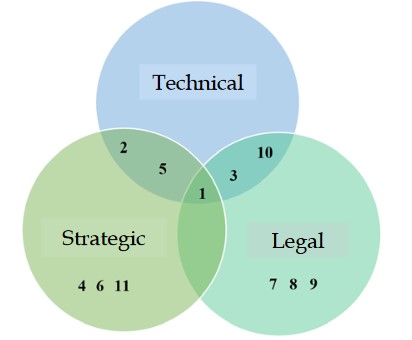
These three main types of arguments are by no means exclusive and, on the contrary, maintain a dynamic relationship between them in the construction of a discourse favorable to the possibility of a military nuclear program. The technical arguments, as in citation 2, aim mostly to recall that this is not the problem for Japan; policy decision, not a lack of competence, is the only reason why Japan does not have nuclear weapons. Repeating the fact that Tokyo refrained from making this choice implicitly contains the idea that it could go back on this decision, a possibility reinforced by adding legal arguments to mentions of Japan’s technical capabilities.
Citations 3 and 10 introduce capital elements on this topic, by making the legality of possible Japanese nuclear armament contingent upon its dimensions (“small in size”, “minimum level”). The technical scale of nuclear weapons is presented here as qualifying the pacifism guaranteed by the Constitution, by reasoning in terms of degree rather than type: nuclear weapons are not to be rejected per se, as essentially different from other types of weapons permitted by the Constitution. Only those that are too powerful, disproportionate to the minimal objective of a “defensive force”, should be rejected. Citations 7, 8 and 9 are in the same vein, underscoring the “minimum level of self-defense capability” as a condition for legal acceptance of nuclear weapons in Japan.
The mention of self-defense (jieiken) is everything but trivial, as it refers to the “inherent right of self-defense” established by Article 51 of Chapter VII of the United Nations Charter, which allows a departure from all the provisions of that same Charter. This is therefore a broad interpretation of the 1947 Constitution in the light of the founding text of contemporary international law, aimed at making self-defense and the possession of nuclear weapons conceptually and legally compatible, by conceiving them not as offensive weapons but as the last bastion in the event of aggression.
There are two aims to presenting nuclear weapons as compatible with the Constitution due to their small size and defensive nature. The first, as mentioned above, is a question of doctrine and seeks to render nuclear weapons compatible with the military dogma of “exclusively defense-oriented policy” (senshu bōei) derived from the Constitution, rejecting the possession of offensive capabilities or any that are out of proportion with their objective of protecting the territory and the people. The second is part of what Guibourg Delamotte calls Japan’s “normalization” political project, (x) i.e. moving out of its singular military position created by Article 9 of the Constitution, under Shinzo Abe’s leadership in particular. The latter regarded military normalization as a way to strengthen and rebalance the alliance, but also to be protected against its decline and the doubts as to the U.S. military commitment, by consolidating Japan’s own defense capabilities, which the nationalist forces also see as an increase in the conditions of the country’s strategic autonomy. (x)
Normalization aims gradually at encouraging the Japanese people to accept the possibility of having “armed forces like others”, due to the worsening strategic context in the region. However, Abe’s statements on nuclear weapons and self-defense here, do not seek to rally public opinion to the project of possessing nuclear weapons, but merely to disseminate the idea that it would not be legally impossible, nor necessarily morally wrong, insofar as self-defense could be invoked and the weapons possessed would be small.
The presupposition of citations 7, 8 and 9, and more broadly the constitutional justification for nuclear weapons in Japan, thus lies in the allegedly defensive nature of nuclear weapons, although it is in no way substantiated by the various speakers. Given the widely anti-nuclear public opinion, posing the question of the essentially defensive or offensive nature of these weapons would be difficult and would not escape a moral debate that could lead to deep ideological and social divide. For this reason, the arguments of the third type are frequently raised, to eliminate ethical considerations by using geopolitical and strategic factors.
Citation 4 clearly sets out the new geopolitical situation facing Japan. The 1990s saw India and Pakistan acquire nuclear weapons and the unveiling of North Korea’s military nuclear program, enclosing Japan in an area surrounded by several nuclear powers and not devoid of rivalry. The fear of seeing North Korea pursue its program, mentioned by former Prime Minister Aso, is directly regarded as a factor that could lead to the nuclearization of Japan as a last resort. Citations 6 and 11 are in a similar vein, by making compliance with nonproliferation obligations contingent upon the effectiveness of U.S. extended deterrence and developments in the strategic context.
The simultaneous mention of a threat and the lack of certainty surrounding American protection set aside the moral aspects by asserting only evidence of a serious deterioration in the geopolitical context. Japan must deal with it so as to gradually reach the “normalization” mentioned by Guibourg Delamotte, by overcoming the population’s qualms. According to the researcher, the mention of threats is the “vector of [military] normalization” sought by the most bellicose members of the LDP, such as Shinzo Abe or Shigeru Ishiba. (x)
Geopolitical arguments are not used solely for this purpose but also to support the technical and legal arguments. In this respect, citation 5 is central as it makes Japan’s civil nuclear program the source of a “tacit nuclear deterrence” because it would allow it “to produce a nuclear warhead in a short amount of time” (x) if necessary. This declaration transforms a technical situation into a political and diplomatic “deterrent” maneuver, in response to the strategic context threatening Japan.
Regarding the interaction between the strategic and legal arguments, the last statement made by former Foreign Minister Kabun Muto is the most telling and can sum up all the citations and arguments presented. If Japan’s security environment worsens considerably (case of North Korea) and if the U.S. nuclear umbrella fails, its technical ability to produce nuclear weapons could come into play and lead to its withdrawal from the NPT under Article X. (x)
This sample of eleven statements shows how technical, legal and strategic arguments interpenetrate into the rhetoric of Japanese officials in favor of maintaining Japan’s latent capabilities, and of a policy of hedging or even nuclearization in the event of a major crisis. Like Shinzo Abe with the “Three Non-Nuclear Principles”, they do not reject Japan’s official nuclear policy, but in parallel they lay down the conditions for accepting the retention of latent nuclear capabilities and the idea that Tokyo could lawfully possess nuclear weapons should it come to have them at a later date. It is more a question of gradually laying the foundations for an alternative nuclear policy than promoting or introducing a clandestine military nuclear program. Developing the capacity to acquire the weapon, whether in technical, intellectual or legal terms, is in no way similar to developing the weapon itself, as this would place Japan in contradiction with its international commitments.
It is important to note that although these arguments are apparently in the minority compared to Japan’s official policy line, the authority of the individuals who pronounced them is not. This small sample of eleven citations includes two Prime Ministers, three Defense Ministers (the current one and two former ministers), two former Foreign Ministers, the former Director General of Shinzo Abe’s Cabinet Legislation Bureau (equivalent of the Supreme Court), and Abe’s former deputy secretary general, etc. The importance of these executive and legislative powers therefore considerably increases the political significance of these statements, which only avoid establishing a coherent nuclear policy competing with the official doctrine by being spaced out in time.
However, the irregularity with which these statements are made should not be seen as random. They are often made in the context of tension or profound breakdown in East Asia. For instance, citations 1 and 2 respectively came after the cessation of North Korea’s cooperation with the IAEA and its attempt to withdraw from the NPT, which was suspended until 2003; citations 7 and 9 came after the fourth nuclear test carried out by Pyongyang in January 2016; citation 8 came only a few days after Donald Trump’s declarations suggesting that Japan could defend itself against North Korea by being nuclear armed, whereas the statement of citation 11 was made less than a month after Joe Biden’s inauguration.
The fact that these positions differing from the official policy were expressed simultaneously with notable geopolitical changes for Japan, is not entirely a coincidence. It allows Japan to implicitly remind the United States that any weakening of the extended deterrence could be synonymous with a proliferation ambition. This declaratory policy, as citation 5 partially shows, is also intended to remind China and North Korea that an escalation of tension with Japan could lead to a desire to acquire nuclear weapons, beyond all existing domestic and international restrictions.
Japan’s latent nuclear capabilities, at the center of accusations of a clandestine program
Energy policy choices leading to a stockpile of plutonium
On October 21, 2020, after the safety authority had agreed to the commissioning of the Rokkasho processing facility, the Japanese government announced the continuation of its spent fuel recycling program. (x) Use of the process for extracting plutonium produced by the fission reaction from spent fuel (uranium irradiated in a nuclear power plant) has been at the heart of the Japanese energy policy since 1967. It aims to create a closed fuel cycle, i.e. to allow the recycling of spent fuel in order to reuse uranium and plutonium in the form of fuel in civil power plants, thus limiting waste and the consumption of natural uranium. Once separated from the spent fuel, the plutonium must be converted into a new fuel, called MOX, (x) which is used as an energy source for compatible reactors, or in fast neutron reactors like the Monju prototype reactor.
In the wake of the Eisenhower administration’s Atoms for Peace initiative, the Japanese nuclear program began in 1955 with the Atomic Energy Basic Law. The implementation of a closed fuel cycle, with plutonium recycling, was a major objective of this program from the outset, aimed at fostering Japan’s energy autonomy.
This quest for autonomy is strongly linked to the insularity of Japan which has always appeared in the country’s history as both a guarantee of security and a geographical obstacle. As far as its energy supply is concerned, insularity is a major vulnerability, which the quest for autonomy in the generation of electricity by nuclear power has not been able to overcome. Since the Fukushima nuclear disaster on March 11, 2011 and the partial closure of Japan’s nuclear power plants, reliance on fossil fuels has steadily increased along with Tokyo’s dependence on foreign producers. In 2019, oil, coal, and gas accounted for 87% of Japan’s annual energy consumption with Tokyo importing 90% of these three energy sources. (x)
This excessive dependence on energy imports makes Japan vulnerable to the volatility of commodity prices, as during the 1973 and 1978 oil shocks, as well as to growing tension at sea along the main communication routes. Coming mainly from the Middle East, these imports are identified by the Japanese government as being at risk due to their transit through the Strait of Malacca or the South China Sea, which exposes them to potential acts of piracy as well as to Beijing’s increasing aggressiveness at sea. (x) There lies one of the main historical reasons for Japan’s civil nuclear program, which includes plutonium separation and recycling, i.e., to reduce the country’s energy vulnerability in case of unexpected disruptions in its supply chains.
However, numerous problems in the history of Japan’s civil nuclear program have prevented Tokyo from building the infrastructure necessary to reprocess plutonium extracted from irradiated uranium. Due to delays affecting several facilities, (x) making it impossible to immediately reprocess plutonium as planned, Japan has built up a considerable stockpile distributed between the national territory, the United Kingdom and France (as these two countries carry out reprocessing activities for Tokyo due to the problems mentioned). At the end of 2019, 8.9 tons were stored in Japan and 36.6 tons abroad, awaiting reprocessing. (x)
Criticism of nuclear policy exploited at the regional level
The decision taken by the Japanese government in October 2020 to pursue its plutonium extraction program was criticized across the region, mainly in China, North Korea and South Korea. The accumulation of this stockpile of plutonium, which is by far the largest in the world for a non-nuclear weapon state (NNWS), has come under criticism for several years for reasons relating to global security and the stability of the world nuclear order, especially since Japan’s plutonium stockpile has grown much faster than its capacity to produce MOX fuel. The criticism is based on three types of arguments.
The first is economic and concerns the profitability of the reprocessing program implemented by Tokyo. A study conducted by the American physicist Frank von Hippel estimates that producing MOX from plutonium derived from reprocessing is five times more expensive than the “conventional” use of low-enriched uranium. (x) In the singular case of Japan, there is also the question of infrastructure, in particular the Rokkasho complex in Aomori Prefecture. This project, which dates back to the late 1980s, aims to build a plutonium reprocessing plant next to the uranium enrichment plant already on the site, with the same objective of achieving energy autonomy and reducing production costs by recycling fuel. The goal is to separate nearly eight tons of plutonium per year. (x) However, the plant’s inauguration has been systematically postponed since the early 2000s, due to major technical and administrative problems that pushed the construction costs up to nearly twenty billion dollars in 2019. (x) The extent of the investments required for a program that has not yet begun operating and which is less profitable than low-enriched uranium is therefore at the heart of these questions, which do not take Tokyo’s energy autonomy goal into account.
The second type of argument is political and concerns Japan’s promises to reduce its plutonium stockpile. In 1991, the Japanese Atomic Energy Agency introduced a “no-surplus” policy, pledging not to produce more plutonium than Japan can consume, a policy later reiterated at the 2014 Hague Summit. Aimed at strengthening nuclear security and limiting the risk of nuclear terrorism, it included a series of commitments to which the participating States, including Japan, adhered:
Furthermore, a considerable amount of HEU has been down-blended to low-enriched uranium (LEU) and separated plutonium converted to mixed oxide (MOX) fuel. We encourage States to minimize their stocks of HEU and to keep their stockpile of separated plutonium to the minimum level, both as consistent with national requirements. (x)
These goals were strongly emphasized by Shinzo Abe in a statement issued after the summit, stressing the moral responsibility of Japan as a result of the August 1945 bombings and reasserting the aim of reducing plutonium production. (x) However, since 2015, the latter has stagnated rather than decreased which does not appear to be in line with the “national requirements” mentioned in The Hague, since Japan does not yet have the Rokkasho complex that would allow it to transform the plutonium it has separated into MOX.
Moreover, the plutonium reprocessing conducted by France and the United Kingdom on behalf of Japan is stagnating, which runs counter to the commitments made by Tokyo to decrease it. Moreover, the quantity stored on national territory alone is a thousand times higher than the “significant quantity” defined by the IAEA, according to which the possibility of manufacturing a nuclear weapon cannot be excluded beyond eight kilograms of plutonium. (x)
The third and main source of concern over Japan’s reprocessing program is therefore military, with Japan having a quantity of plutonium mathematically equivalent to about a thousand nuclear weapons on its territory, (x) making it the only NNWS to conduct a plutonium separation program of this scale.
Critics of Japan’s reprocessing policy see this combination of factors as so irrational from an economic, political and military perspective that it can only point to a hidden agenda, i.e., a hedging policy to retain the possibility of manufacturing nuclear weapons at all costs. (x)
The conjunction of these three arguments is also at the center of the criticism from Tokyo’s regional rivals, notably China. Beijing has condemned this plutonium separation program since the early 2000s, repeating all of the above arguments and adding significant doubts as to the intention behind the program, which it clearly sees as the desire to eventually develop nuclear weapons. (x) Beijing is therefore denouncing possible hypocrisy on the part of Tokyo, and also mentions the changes in the legislation governing Japan’s nuclear program, such as the June 2012 amendment of the Atomic Energy Basic Law which added the requirement of “guaranteeing security” (anzen no kakuhō wo munetoshite) (x) to the civil and peaceful purpose of nuclear power. Beijing sees this amendment as paving the way to an interpretation that would allow nuclear capabilities to be used to guarantee Japan’s national security. (x)
Chinese criticism is thus centered on the question of intentionality, seeing Tokyo as a possible proliferator in disguise, gradually putting in place all the conditions needed to be nuclear armed. However, its use of intention as a criterion for explaining the Japanese nuclear program suffers from a lack of evidence and is more of a prediction than a documented discovery. It is only by focusing on the two reports of 1970 and 1995 mentioned above and on the 1969 note proposing to maintain latent nuclear capabilities that the question of intention can be raised, without taking into account the numerous internal and international security guarantees concerning the reprocessing of plutonium.
A civil nuclear program can indeed be “diverted” to military objectives, if these activities are concealed from international control authorities or undertaken in violation of international commitments, as was the case of North Korea. Reactor-grade plutonium, although of lower quality than that produced by a plutonium production reactor, can be diverted to military uses by those states wishing to do so. (x) However, IAEA safeguards are designed to prevent such developments, with verification of the non-diversion of declared civil activities but also inspections of undeclared facilities, thus significantly reducing the risk of a state conducting a clandestine program. (x)
In addition to the safeguards agreed with the IAEA following the ratification of the NPT, which prohibit the diversion of fissile material to military use, (x) Japan signed the IAEA’s “Guidelines for International Plutonium Management” in 1997. It also signed an additional protocol in 1998. (x) These safeguards require the signatory states to make an annual declaration of plutonium stockpiles, whether spent or separated by reprocessing, and provide for verifications by IAEA inspectors who assess the peaceful purpose of the fuel cycle (confirmed in the case of Japan). (x) This transparency, verified by the IAEA, is a first external guarantee that fissile material held in Japan is not secretly diverted, by subjecting it to constant oversight. This process stems from Tokyo’s own initiative, as indicated in the 1998 circular, sometimes supplemented by a reminder of the “exclusively peaceful” purpose of Japan’s nuclear program within these same annual reports, as in 2018. (x) It can also be seen as a response to external requirements, due to its alliance with the United States and perhaps also to diplomatic pressure from China regarding the Japanese fuel cycle, creating the need for Tokyo to reaffirm its compliance with its nonproliferation commitments to international inspectors and placing an additional restriction on the establishment of a military program.
There is also an internal constraint, analyzed by supporters of the institutionalist method in political science, who study the case of Japan via veto players, i.e. those whose agreement is vital to change the status quo. (x) This method aims to take into account all the institutional stakeholders involved in the decision-making process to highlight the various blocking possibilities stemming from this plurality of decision centers. According to this theory, talking of a hedging policy in respect of Japan amounts to overlooking the permanence of past choices (continuing to reprocess plutonium pending the production of MOX fuel) and the highly rigid decision-making of the Japanese “nuclear village”. Thus, Jacques Hymans identifies various authorities pursuing contradicting objectives and playing a key role in Japan’s nuclear policy: the Prime Minister, the Japan Atomic Energy Commission (JAEC), public industrial companies such as TEPCO or JNFL which operate the plants, the Ministry for the Economy, Trade and Industry (METI), the Nuclear Regulation Authority (NRA), etc. The diversity of players involved in making decisions on the Japanese civil nuclear program represents a powerful obstacle to any unilateral decision to initiate a military nuclear program.
In light of these various constraints, the intention criterion used by China or upholders of the hedging concept can be strongly qualified. The problem with the idea of intention is that it can lead to implying, as does China, that Japan is conducting a secret military nuclear program, and this could retrospectively legitimate China’s own nuclear modernization. The issue of the Japanese government’s assumed intention to maintain the possibility of nuclearization is therefore more about political exploitation than actual observation of facts, particularly by Beijing.
Japan’s space program: Toward possible ballistic missiles?
The development of Japanese space launch vehicles is the second area of Tokyo’s latent nuclear capabilities. At the instigation of Shinzo Abe, Japan has constantly improved the quality of its launch vehicles. The most recent is the Epsilon model, developed by the Japan Aerospace Exploration Agency (JAXA) since 2013. Designed to place satellites in orbit and capable of carrying a 1.2-ton load over nearly 500 kilometers, it is now central to the Japanese space program, before the test of the Epsilon S in 2023 in order to increase the transportable load. (x)
The dual nature of technologies used in the launch vehicle programs has been underscored for several years. It was mentioned by the United States in 1998, in the Rumsfeld Commission’s report on ballistic threats weighing on Washington. (x) The Commission considered that the M-5 launcher program (predecessor of the Epsilon program) could swiftly be converted into ICBMs “rivaling those of the United States”. This report also links the potential to convert space launch vehicles into ballistic missiles directly to Japan’s plutonium stocks, indicating that the advancement of the space program coupled with this build-up of fissile material would enable Tokyo to develop a proliferant program.
The same is true today for Epsilon, which is the focus of questions about the military application of Japan’s space program. One of the leading researchers on the topic, Paul Kallender, believes that it could be converted into a ballistic missile, due to its solid fuel. (x) Epsilon could be loaded in advance, stored for a long time and launched rapidly. Furthermore, insofar as the JAXA masters re-entry technologies and has highly precise guidance and targeting systems (particularly the Quasi-Zenith Satellite System), enemy positions would be very vulnerable if this launch vehicle were militarized. For this reason, Paul Kallender considers that the technological progress of Japan’s space program over the past twenty years increases its status as a “recessed nuclear power”, bringing down the “technological barriers as regards outer space”, if the country’s political will is to possess nuclear weapons. (x)
China made similar observations a decade earlier, but more openly critical and public than the United States, by reconsidering this development in light of changing Japanese legislation. (x) The main turning point came in 2008 with the enactment of the Basic Space Law, whose Article 3 provides for use of space to “increase the national security of Japan.” (x) The June 2020 “Basic Plan on Space Policy” strengthened this move by again invoking essential national security in order to assert the need for “the achievement of superiority in outer space.” (x) Therefore, Japan’s space policy is no longer exclusively directed at exploration and scientific research, and is gradually moving into the realm of national defense, like France, China, the USA, and South Korea.
Japan’s space program has been deeply marked by the revelation of the nation’s vulnerability to North Korean ballistic missiles, since a Taepodong-1 flew over the country in April 1998, and the demonstration of China’s striking power when Beijing succeeded in destroying one of its own satellites in 2007 after launching an antisatellite missile (ASAT). Although these two events can provide arguments for the hypothesis of a Japanese hedging policy, Japan’s space program has not been conceived as a way of symmetrically responding to Chinese and North Korean threats.
It indeed depends largely on the alliance with the United States and partly stems from pressure exerted by the Obama administration for Japan to contribute more to its defense in space, while giving the alliance more weight. (x) This is, in fact, what the June 2020 “Basic Plan” recognizes, by again stating that Japanese space capabilities and self-defense forces “greatly depend” (koreni ōkiku izonshite iru) on U.S. space systems, particularly as regards surveillance and positioning. (x) As the 2015 “Guidelines for Defense Cooperation” state, space is one of the main areas of the alliance’s cooperation, aimed at reinforcing its joint deterrence capability. (x) The development of Japanese space capabilities therefore also fits into the framework of the alliance and cannot be attributed solely to the idea of a hedging policy.
However, setting aside the question of the intention behind the hedging policy, the fact remains that this space program is a central component of Japan’s latent capabilities, and could provide delivery systems for weapons that might be manufactured via the fuel cycle. Japan’s space development is not military, but in light of its dual use, it renders military application of these civil achievements possible. By resonating with the statements of politicians in favor of maintaining this possibility, it thus contributes to the ambivalence of Japan’s nuclear policy, which supports a world ultimately free of nuclear weapons while retaining latent nuclear capabilities.
III. Permanent major legal and political obstacles to nuclear proliferation by Japan
After analyzing Japan’s uncertainties regarding U.S. extended deterrence, the regional threats that fuel this sense of insecurity, the resulting ambiguity of the country’s nuclear policy and Tokyo’s latent nuclear capabilities, a study of the obstacles to nuclear proliferation by Japan will examine the possibility of the Japanese government eventually wishing to conduct a voluntary and adopted policy.
Although these obstacles are not completely insurmountable, the extent of them is such that they inevitably create an extremely restricted framework for any Japanese nuclearization, thereby considerably reducing the benefit of such a policy compared to the major risks and drawbacks it would entail for the country.
Domestic and international legal obstacles to proliferation by Japan
The ambiguity of the Constitutional restriction on military nuclear power
The interpretation of the Constitution is central to the debate over the domestic legal possibility of Japan possessing nuclear weapons, as the statements examined above indicate – since the Japanese Constitution does not, according to these speakers, prohibit the possession of nuclear weapons.
This analysis would appear to be confirmed by some important precedents, in particular the decision of the Supreme Court of Japan of December 16, 1959 in the “Sunakawa” case. The judges interpreted paragraph 2 of Article 9, which enshrines the rejection of any “war potential” (senryoku) in order to achieve the objective of international peace referred to in paragraph 1. This interpretation comprises three stages.
First, the judges state that nothing in the Constitution “would deny the right of self-defense inherent in our nation as a sovereign power.” (x) This right of self-defense thus echoes the Charter of the United Nations and allows the judges to infer that the pacifism specific to Japan’s Constitution is not synonymous with defenselessness or non-resistance against an armed aggression. After outlining the general framework of self-defense, the decision adds that the choice of means cannot be limited “as long as such measures are for the purpose of preserving the peace and security of our country.” (x) No category of weapons is mentioned or ruled out. The judges therefore decisively consider that:
The determination as to the scope of defensive power, the extent of its fulfillment, or what policies or methods should be adopted in this pursuit is purely a matter of political nature within the discretion of the Government, to be determined in the light of the world situation prevailing at a given time. (x)
Thus, the question of the legality of nuclear weapons seems to be more political than legal, and more within the province of the government than the Supreme Court. The Court’s ruling therefore makes the choice of means of Japanese defense policy very flexible, since its assessment may vary with the government in power. This was shown by Shinzo Abe, for example, with the 2015 law authorizing Japan to support the United States or any other ally in exercising the right of collective self-defense, even though this had not been recognized in the past due to prior interpretations of the Constitution. In addition to this political contingency, there is also the geopolitical factor, since the judges acknowledge that the choice of defense means must be adapted to the global strategic context without being limited as long as they serve the country’s security.
Thus, on the face of it, this interpretation of Article 9 can give the Japanese government significant freedom in choosing the technical means needed to defend Japan, which could include nuclear weapons. This was confirmed by the Ministry of Defense (then called the Defense Agency) in 1970, which found that it was constitutionally permissible to have low-intensity nuclear weapons as long as self-defense was their purpose and they did not pose an offensive threat to other countries. (x) The statements studied in Part II also fell within this interpretative framework of the Constitution.
However, although this formal possibility of possessing nuclear weapons in compliance with the Constitution remains, there are various stumbling blocks within the Japanese government’s own position. Japan’s most recent Defense White Paper, released in July 2021, illustrates the restriction that in practice still applies to the government’s interpretation of Article 9.
While reaffirming that the pacifism of the Constitution cannot limit the right to self-defense, the section titled “The Government’s View on Article 9 of the Constitution” highlights several points that qualify the feasibility of nuclear proliferation by Japan and, therefore, of virtual nuclear deterrence.
This section first states that, in order to remain compatible with “exclusively defense-oriented policy” (senshu bōei), the limitation of defense capabilities depends on annual deliberations in the Diet, especially as regards the budget allocated to their development. (x) While, pursuant to the 1959 ruling, the government has great freedom of interpretation and action to adapt defense policy to the geopolitical context, it cannot act without the agreement of the legislative power. The latter can be a major barrier to the ambition of strengthening military capabilities, particularly offensive ones, including on a constitutional level, since any revision requires a qualified two-thirds majority before being submitted to referendum. For example, the Abe government’s failure to obtain a revision of Article 9 so that the existence of the Self-Defense Forces was accepted, without even reaching the referendum stage, qualifies the idea disseminated by China and North Korea that Japan was stepping up its military development.
There is also another political “tradition” which, since 1977, has imposed a limit on defense-related expenditure at the symbolic threshold of 1% of Japan’s GDP, as a financial transposition of the Constitution’s pacifist dimension. (x) Keeping the defense budget below this threshold, even though there is no legal requirement, reflects the manner in which the Constitution consistently influences decision-making in defense matters – even between 2013 and 2020, with an Abe government often depicted as “militarist”. This adds another political obstacle stemming from the successive interpretations of Article 9, here in terms of budget, given the cost that a military nuclear program would represent.
The institutional barrier that the Constitution forms therefore creates some significant operational restrictions which, like the limit on the defense budget, are part of the doctrine of “exclusively defense-oriented policy”. Not only must nuclear weapons be of low intensity to be considered compatible with this principle, in line with the statements mentioned in Part II, but this restriction also applies to the delivery systems. The study of Japan’s space program showed just how central this question is to Japan’s latent nuclear capabilities since the stockpiling of fissile material alone is insufficient to denote the ability to produce a nuclear weapon ready for use.
The same section of the White Paper therefore adds:
The possession of so-called “offensive weapons,” which are designed to be used only for the mass destruction of another country, is not permissible under any circumstance as it would directly exceed the definition of the minimum necessary level for self-defense. For example, the SDF is not allowed to possess intercontinental ballistic missiles (ICBM), long-range strategic bombers, or attack aircraft carriers. (x)
Although the first sentence appears to refer to weapons of mass destruction, which include nuclear as well as biological and chemical weapons, it cannot be said to completely rule out the nuclear option insofar as, for Japan, this has frequently been presented as a low-intensity defensive option, which would not inevitably destroy another country. This uncertainty is exploited by those in favor of acquiring or the possibility of acquiring nuclear weapons and which would provide virtual deterrence.
However, the second part on delivery systems is just as crucial in as much as, in the name of respect for Article 9 of the Constitution, the Japanese government rejects strategic capabilities. (x) This provision limits the type of delivery systems that Tokyo can have and comes, not from the Constitution itself, but from the Japanese government’s interpretation of it.
This latter point shows how the domestic restriction on military nuclear power for Japan actually has three separate sources: the Constitution, which is the basic legal foundation of Japanese defense policy; the resulting doctrine of “exclusively defense-oriented policy”; and the Japanese government’s interpretation of the Constitution to comply with this doctrine, conceived as an abiding feature of the defense policy. In different ways, each of these three sources is an obstacle to nuclear proliferation by Japan, but none are truly insurmountable in view of how government can freely interpret them depending on changes in the geopolitical context – as Abe did with the new security laws in 2015.
The study of the Constitution and its interpretation shows that it does not, in any way, represent an infrangible bastion to the nuclearization of Japan, hence the inference by certain researchers and political leaders of a hedging policy. However, the threat of possible Japanese nuclear proliferation is greatly reduced by the restrictions imposed by the exclusively defense-oriented policy doctrine on the size and power of this hypothetical armament, and nothing guarantees that it would be capable of inflicting unacceptable harm or providing a small degree of deterrence against, for example, the superior nuclear and conventional capabilities of China. In other words, the Constitution is not an obstacle to Japanese nuclear proliferation but it is an obstacle to effective and truly deterrent proliferation.
International nonproliferation architecture and treaties: Legal or political obstacles?
The legal restriction forming an obstacle to Japanese nuclear proliferation is also international as it is part of the global nonproliferation order. Despite Tokyo’s initial hesitation before ratifying the NPT in 1976 and signing its indefinite extension in 1995, the country now adheres to numerous treaties which considerably limit the possibility of proliferation without, however, making it formally impossible (Figure 5).
Figure 5
Main nonproliferation treaties and agreements ratified by Japan (in 2021) (x)
| Treaty / Agreement | Signature | Ratification or entry into force | In force |
| Treaty on the Nonproliferation of Nuclear Weapons (NPT) | February 3, 1970 | June 8, 1976 | yes |
| Comprehensive safeguards agreement with the IAEA | March 4, 1977 | December 2, 1977 | yes |
| Comprehensive Nuclear Test Ban Treaty (CTBT) | September 24, 1996 | July 8, 1997 | no |
| Additional protocol to the agreement between the Japanese government and the IAEA | December 4, 1998 | December 16, 1999 | yes |
| The Hague Code of Conduct against Ballistic Missile Proliferation (HCoC) | November 25, 2002 | Not required | yes |
At the heart of the nonproliferation architecture of which Japan is a part is the NPT, whereby Tokyo undertakes not to produce or acquire nuclear weapons under Article II, whereas Article VI requires each party to implement a policy to further nuclear disarmament and nonproliferation. (x)
The CTBT comes in addition to the NPT and provides for a complete ban on nuclear testing of whatever nature. Although it has yet to enter into force and this prospect seems unlikely today, (x) the Comprehensive Nuclear-Test-Ban Treaty Organization (CTBTO), in coordination with the 168 States Parties, has already implemented several monitoring provisions of the treaty. Japan is a highly active member, and has ten stations of the international monitoring system on its territory aimed at detecting any nuclear tests, particularly thanks to the seismic monitoring stations (Kunigami, Chichijima, etc.) and infrasound stations (Isumi).
Japan is the third-largest financial contributor to the CTBTO (x) and one of the most important proponents of the CTBT, seeing its universal extension as a cornerstone of the nonproliferation order and as a way to further protect itself against North Korea’s nuclear program. Of the twenty-six statements made by Tokyo within the CTBTO Preparatory Commission between February 2017 and March 2021, twenty-two confirm the efficiency of the monitoring system as regards nuclear testing by Pyongyang, which is consistently presented as a threat for Japan and the international community. (x)
Thus, despite the non-entry into force of the CTBT and because of the North Korean threat, Japan considers that “the prohibition of nuclear testing has already become a de-facto international norm.” (x) This statement would seem to be intended to show that North Korea is going against a norm that could be recognized as the equivalent of an international legal custom, in order to increase pressure on the Pyongyang regime and to push for the implementation of the treaty’s spirit on a global scale.
However, although these treaties are legally binding, they all include withdrawal clauses. Article X of the NPT, for example, recognizes the right for a party “to withdraw from the Treaty if it decides that extraordinary events, related to the subject matter of this Treaty, have jeopardized the supreme interests of its country”. (x) This is also the case of the CTBT, in Article IX.
Despite Tokyo’s support for various aspects of the international nonproliferation architecture, the existence of these clauses partly underpins views on the possible nuclearization of Japan, (x) asserting that even international legal obstacles are not completely insurmountable. Nonetheless, the potential for nuclear proliferation by Japan based on its right to withdraw from these treaties can be qualified by two types of arguments.
The first is procedural. To withdraw from the NPT, countries must give notice setting out the “extraordinary events” that have jeopardized their “supreme interests” three months before the actual withdrawal. This notice must be given to the United Nations Security Council and to all the States Parties. The notice period is six months for the CTBT.
The notice periods imposed to duly withdraw from these treaties, i.e., three and six months, would generate a short spell of extreme geopolitical uncertainty during which Japan would potentially lay itself open to pre-emptive strikes, sanctions or attempted sabotage by states opposed to the idea of Japanese nuclear proliferation, without being able to fully deter them for want of robust and established nuclear capabilities. However, this time factor should only be taken into account in the case of a “legalistic” Japanese nuclear arms race, in compliance with all the provisions of the treaties ratified by Japan.
The second type of argument that reduces the relevance of Japan’s nuclearization is political and diplomatic. The two reports on the costs and benefits of potential proliferation already mentioned the major risks inherent in this decision. The 1968-1970 report underlines the diplomatic isolation that such nuclearization would inevitably entail for Japan, while creating tension with China, the USSR and even the United States. The 1995 report wonders, more broadly, about the consequences that a Japanese military nuclear program would have on the alliance with the United States, considering that it would run counter to extended deterrence which would be deprived of justification, whereas the capabilities would be inferior to those of the United States. It would also weaken the nonproliferation regime, recently reinforced with the indefinite extension of the NPT.
In light of these reports and after analyzing the conditions of withdrawing from the treaties mentioned above, the international legal restrictions therefore represent the main obstacle to nuclear proliferation by Japan. Beyond the purely legal restriction, which can be formally overcome due to the withdrawal clauses, these treaties also carry great political and diplomatic weight. The international isolation of North Korea and to a lesser extent, of Iran, illustrate the status of outcast engendered by breaching nonproliferation commitments, which Thérèse Delpech calls “strategic piracy”, i.e., rejecting established rules of the international order in favor of national interests. (x) This fear of becoming a nuclear weapon state but being isolated is, in fact, one of the main arguments put forward against the nuclearization of Japan in the 1968-1970 and 1995 reports. Furthermore, the Japanese government would face a bigger risk of protest and isolation in the event of nuclear proliferation since this risk is not only international, but also exists internally due to deep divides between the government and the Japanese people.
The aversion of Japanese public opinion to military nuclear power, an internal obstacle to Japanese nuclear proliferation
The legacy of the ’hibakusha’ and the rejection of military nuclear power
The current rejection of nuclear power by the Japanese population is the result of various political struggles structured since the 1950s. The first Japanese anti-nuclear movement was initiated by the hibakusha, a term used to designate people who survived the American nuclear bombings. British political scientist Glenn Hook distinguishes three stages in this movement, (x) showing the main lines of criticism directed against the Japanese government’s adherence to extended deterrence.
From the mid-1950s to the mid-1960s, the radioactive accident linked to the U.S. nuclear test at Castle Bravo in March 1954, as well as the first initiatives of the hibakusha, led to various demonstrations presenting radiation as the height of contemporary violence. In the same year, the Suginami Appeal, a petition opposing nuclear weapons, gathered almost 20 million signatures in Japan, out of 88 million inhabitants. This period saw the beginning of a simultaneous work of remembrance and anti-nuclear commitment, marked in particular by the first World Conference against Atomic and Hydrogen Bombs held in Hiroshima, on August 6, 1955.
From the 1960s to the end of the 1970s, alongside the strengthening of the U.S.-Japan alliance, the Japanese anti-nuclear movement split up over the question of the responsibility of the United States: weren’t the victims of nuclear bombs above all the victims of Washington? Real anti-Americanism developed in Japan, as illustrated by the overthrow of the Kishi government in 1960 and major demonstrations in Sasebo, in October 1964, to protest against the Japanese government’s decision to allow a U.S. nuclear submarine to anchor in this port of Nagasaki Prefecture. One of the key issues was to ring-fence the archipelago so that it remained free from any dangerous nuclear presence. The trauma of Hiroshima and Nagasaki thus generated a geographical and territorial factor in the wish of a part of the population to deny access to Japan for U.S. nuclear weapons.
Finally, from the 1970s to the end of the 1980s, hibakusha activism was aimed more at raising widespread awareness of the vulnerability of any society to nuclear bombs. Every individual is thus a potential hibakusha, and this universalization of identity was put to work for nuclear disarmament objectives.
Due to their aging, the hibakusha themselves are less active today and have been since the early 2000s, but this review of the first decades of their political struggle reveals several trends still at work today. The rejection of military nuclear power came with mistrust of the United States, both the former enemy responsible for the August 1945 nuclear bombings and Japan’s nuclear protector through the extended deterrence. This contradiction, still alive today, found its formulation in a haiku by the poet Matsuo Atsuyuki, a survivor of the Nagasaki bombing:
Protesting against nuclear under the nuclear umbrella (x)
This contradiction between the anti-nuclear engagement of the hibakusha, shared by an overwhelming majority of Japanese people, (x) and Washington’s security guarantees, is reflected in the low level of support for U.S. extended deterrence among the Japanese public. In a November 2015 NHK poll, only 10.3% of the Japanese population thought the U.S. deterrence was necessary for Japan’s security now and in the future; 18.6% believed it was necessary now, but not in the future, and 48.9% believed it was not necessary now or in the future. (x) However, the rejection of the U.S. extended deterrence is by no means synonymous with a desire for Japan to develop its own military nuclear capabilities. Another poll conducted by the Nippon think tank The Genron NPO in 2018 indicates that 65.5% of the population is against Japanese proliferation. (x)
Despite the attempts made by Shinzo Abe’s government to “normalize” Japanese defense policy, particularly by trying to raise public awareness of the Chinese and North Korean threats, and despite the strengthening of the alliance and the renewal of U.S. security guarantees, the Japanese people are not in favor of maintaining the extended deterrence. In the early 1970s, this public opinion prompted the LDP conservatives to refer to a “nuclear allergy” (kaku arerugi) among the population. While these words could be regarded as manipulation aimed at making this opinion a political pathology that could be cured by the leaders’ action to minimize its scale, (x) the extent of this rejection in 2015 illustrates the continuing legacy of the hibakusha’s pacifist and anti-nuclear activism.
The rejection of an autonomous military nuclear capability is also part of this legacy. The Japanese people’s aversion to military nuclear power is thus another obstacle to Japanese proliferation. However, Japanese politicians and researchers often present this obstacle as minor, through culturalist arguments asserting that the Japanese people are historically characterized by their pragmatism and their psychological ability to adapt to a new geopolitical environment in the event of a change, even if it means adopting a position diametrically opposed to the one previously upheld. (x)
A study of the political engagement of Japanese scientists avoids the difficulties of the culturalist and psychological debate, and shows how a part of Japanese civil society can represent a credible obstacle to the country’s nuclearization. From the end of the 1950s, alongside the hibakusha movement and without merging with it, significant action was taken by Japanese scientists, whose initial engagement still continues today.
After the Castle Bravo nuclear incident and the reports in the media of its radioactive fallout on a Japanese fishing vessel, the Daigo Fukuryū Maru, the July 1955 Russell-Einstein manifesto triggered action by many scientists against the development of nuclear weapons. Following these two events, the Pugwash Lecture Series was founded in July 1957, to bring together scientists from both the East and West to reflect on ways to rid the world of nuclear weapons. The creation of this forum was welcomed within the Japanese scientific community, at a time when the hibakusha were beginning to make their voices heard through legal proceedings and demonstrations. (x)
However, as Akira Kurosaki explains, in the early 1960s the Pugwash scientists concluded that nuclear weapons could not be totally eliminated due to their advanced state of development and the establishment of a deterrence structure between the United States and the USSR. (x) Therefore, under the leadership of physicists Hideki Yukawa and Shoichi Sakata, Japanese scientists objected to the findings of Pugwash and organized the first Kyoto Conference of Scientists in May 1962. The statement issued after this meeting rejected the theory of deterrence, believing that it fueled risks of nuclear war. It placed greater emphasis on Article 9 of the Constitution and the goal of global disarmament, while urging scientists to constantly ensure that their discoveries were not diverted to purposes contrary to peace. (x)
According to Kurosaki, the action of Japanese scientists in the wake of Pugwash was instrumental in developing a scientific culture that was largely hostile to military nuclear power. The effects of this early activism can still be felt today, as evidenced by the position of the Science Council of Japan, the organization which represents all Japanese academics and scientists, across all disciplines, operating under the jurisdiction of the Prime Minister but independently. On March 24, 2017, the Council issued a statement on research for military security, in a tone which resonates strongly with the conclusions of the Kyoto conference:
Contrary to the original intentions of scientists, research results may sometimes be diverted to military applications and for aggressive goals. Therefore, prudent judgment is required on sources of research funding and other conditions before actual research activities begin. […] Accordingly, each university or research institution should create a system to review research proposals that might be used for military security research for their appropriateness, both technologically and ethically, based on the validity of their research objectives, methods, and potential applications. (x)
Thus, despite Shinzo Abe’s wish for “normalization” (rather than massive militarization), the body representing Japanese scientists and academics expresses its refusal to see its research support the nation’s military development. The action of the Science Council is thus no longer limited, as it was in the Pugwash era, to appealing for nuclear disarmament or for an end to testing; it also includes a cautious, even distrustful, stance against any political and military use of research.
The legacy of anti-nuclear commitment with Pugwash, together with current reflection on ethical science that is not dictated by the projects of the SDF or the Prime Minister, could therefore stand in the way of any proliferation ambition. Without, however, being categorical about all Japanese scientists, Japan’s nuclearization is difficult to conceive when the experts supposed to be able to initiate it support anti-nuclear and anti-militarist ideals. Above all, the criticism of the Japanese government’s nuclear ambiguity does not only come from the scientific community, but is also found more generally within Japanese society, as illustrated by the debate over the Treaty on the Prohibition of Nuclear Weapons (TPNW).
Is the Treaty on the Prohibition of Nuclear Weapons the main sign of the rift between the Japanese people and government over military nuclear power?
The Treaty on the Prohibition of Nuclear Weapons (TPNW), which entered into force in 2021, clearly illustrates the ambiguity of the Japanese government’s nuclear policy in the eyes of its own people.
Adopted in July 2017 by 122 states, the TPNW is part of civil society-led campaigns on the humanitarian consequences of the use of nuclear weapons, such as ICAN, which won the Nobel Peace Prize that same year, particularly for widely promoting the TPNW. The preamble to the treaty notes the slow pace of nuclear disarmament under the NPT and, while it regards the NPT as the cornerstone of the international nonproliferation regime, considers that the treaty’s disarmament objectives can only be achieved through the establishment of a legally binding ban on nuclear weapons. Thus, under Article I, among other things, it is prohibited to possess or produce nuclear weapons, and to receive third-party military nuclear assistance. (x) Deploying these weapons and threatening to use them are prohibited for the parties to the treaty.
Japan refused to take part in all of the UN conferences leading up to the drafting of this treaty. Like the nuclear-armed states and states benefitting from extended nuclear deterrence, such as the NATO states (with the exception of the Netherlands, which participated in the vote to reject the treaty), Japan did not attend the UN General Assembly meeting held to adopt the treaty on July 7, 2017. (x)
At the opening session of the negotiations on March 27, 2017, Japan’s permanent representative to the UN Conference on Disarmament explained the reasons for the rejection. (x) Tokyo considered that the Hiroshima and Nagasaki bombings gave it a “mission” (shimei) to establish a world without nuclear weapons. The communiqué describes Japan’s approach as based on a commitment to cooperation between nuclear and non-nuclear weapon states, involving all stakeholders to achieve concrete disarmament results. Japan criticized the TPNW for this reason, arguing that the non-participation of the nuclear-weapon states and the ensuing divide between the signatories and all other states was not conducive to reducing the number of nuclear weapons.
Tokyo also emphasized the need to constantly tie disarmament goals to national security imperatives. For this reason, the statement mentions the example of North Korea, whose continued nuclear tests and ballistic missile launches demonstrate the continuing threat to both Japan and the NPT regime. This ongoing proliferation crisis is one of the reasons put forward for Japan’s refusal to join the TPNW, which would not resolve this crisis for Tokyo.
This statement underscores the complexity of Japan’s official nuclear policy in the face of extensive movements for nuclear disarmament. The reference to a “mission” incumbent upon Japan as the only nation to have suffered a nuclear strike seeks, from the outset, to address the moral dimension of the debate over the ban. This reminder of Japan’s special responsibility for disarmament is addressed to both the international community and the Japanese people, showing that it is a priority for Tokyo, which also mentions its annual resolution at the UN in favor of generalized nuclear disarmament.
However, another major reason for Japan’s rejection of the TPNW is not mentioned in the communiqué. Joining the treaty would indeed be incompatible with it benefiting from U.S. extended deterrence insofar as Article I prohibits the possibility of receiving nuclear assistance from a nuclear-armed state. This reason was mentioned by the Japanese Foreign Ministry in its September 2018 “Diplomatic Bluebook”:
As Japan is the only country that has experienced nuclear devastation during war, the Government of Japan shares the goal of the total elimination of nuclear weapons with the Treaty on the Prohibition of Nuclear Weapons. On the other hand, North Korea’s nuclear and missile development is an unprecedented, grave and imminent threat against peace and stability of Japan and the international community. As conventional weapons alone cannot effectively deter ones, such as North Korea, that threaten to use nuclear weapons, it is necessary to maintain the deterrence including nuclear deterrence under the Japan-U.S. Alliance. (x)
Here, a form of pragmatism accompanies Japan’s moral posture, refusing to delink ethical, humanitarian and security issues, and even suggesting that real morality lies in setting disarmament goals according to the level of threat faced by the Japanese population from Pyongyang. This decision takes into account North Korea’s reduced vulnerability to external pressure (such as the campaign to abolish nuclear weapons), to international prohibition norms, and to internal pressure from public opinion, rendering the regime’s gradual adherence to these new norms less plausible. (x)
Tokyo’s rejection of the TPNW should not be interpreted in the light of statements in favor of Japan maintaining a legal possibility of acquiring nuclear weapons. On this particular point, the position of Japan is similar to Belgium or Italy: it is a non-nuclear weapon state that cannot do without U.S. security guarantees, but these guarantees are inevitably inconsistent with joining the TPNW.
However, going by the polls, the Japanese government’s need to maintain the alliance with the United States and extended deterrence at all costs is creating a major rift with most of the Japanese people. An analysis of polls conducted between 2017 and 2019 by three U.S. politicians reveals a threefold disapproval of Japan’s nuclear policy by most of the population (Figure 6).
Firstly, the 2017 poll indicates a tacit acceptance of North Korea being nuclear-armed, which runs counter to the wish for complete, verifiable, and irreversible denuclearization of Pyongyang shared by Japan and the United States. Moreover, the population’s massive rejection of proliferation only reinforces the public opinion obstacle to a hypothetical acquisition of nuclear weapons. Although the government presents North Korea as the biggest threat to Japan, 69% of Japanese people do not regard it as a valid reason to be nuclear armed, contrary to many of the statements made by political leaders discussed above. If the government was truly pursuing a hedging policy, it would be widely rejected by public opinion.
Figure 6
Three polls showing opposition between the population and the Japanese government on military nuclear power (2017-2019) (x)
| Date | Main Question | Positive Response |
| 2017 | Japan should not acquire nuclear weapons even if North Korea continues to possess them. | 69% |
| 2018 | Does not support the use of U.S. nuclear weapons against North Korea, even in the event of a nuclear strike by Pyongyang against Japan. | 85% |
| 2019 | Japan should sign and ratify the Treaty on the Prohibition of Nuclear Weapons. | 75% |
The second poll reveals an even more problematic disapproval insofar as it corresponds to a refusal of the U.S. extended deterrence and security guarantees. Based on the threat of retaliation in the event of an attack, 85% of the population are against the strict application of extended deterrence. This rejection is not due to any particular hostility to the United States, but more to the rejection of nuclear weapons per se, since in the same year 71.8% of Japanese people thought that all nuclear weapons should be eliminated, compared with only 19.5% who thought they were necessary to prevent the outbreak of a new war. (x)
The position of most of the population is therefore diametrically opposed to the one expressed by the government to justify its non-adherence to the TPNW. Deeming nuclear weapons immoral in themselves, they want to see disarmament and non-use prevail over security and geopolitical issues, even if Japan were to suffer a North Korean strike.
The results of the third poll, in which 75% of the population calls for Japan to sign and ratify the TPNW, proceed from the conclusions that can be drawn from the previous polls. The rejection of nuclear weapons and use of extended deterrence logically leads to the spirit of the treaty. The political scientists who conducted these polls also point out that 72% of LDP respondents called for joining the TPNW. The disapproval of the government’s position on the treaty is not a question of partisan opposition but truly of ideological opposition. The population seems to be more ready to address the issue of nuclear weapons from an ethical perspective, contrary to the government which presents its policy as pragmatic.
This divide between idealism and realism is even deeper because the Japanese government lacks consistency in its support for nuclear disarmament in the eyes of the population, given that it did not sign the TPNW. The preamble to the treaty expressly mentions the hibakusha, on two occasions:
Mindful of the unacceptable suffering of and harm caused to the victims of the use of nuclear weapons (hibakusha), as well as of those affected by the testing of nuclear weapons […]. (x)
Japan’s failure to participate in a treaty that literally asserts the legacy of the victims of Hiroshima and Nagasaki also explains the lack of understanding on the part of its population, as well as its wish to see the government change its position on the TPNW. This divide over the treaty, following the post-Fukushima revival of anti-nuclear movements, illustrates the tension in Japan over military nuclear power. The government’s posture therefore rests on a rickety balance between defending its vital interests thanks to the U.S. nuclear umbrella and reconciliation with public opinion that is largely hostile to both civil and military nuclear energy. This gap between the two positions would appear to limit the possibility of proliferation by Japan, and the above-mentioned stand taken by Japanese scientific institutions could reinforce this limitation. Public opinion seems to be more of an obstacle than certain Japanese researchers or political leaders in favor of the possibility of acquiring nuclear weapons would like to admit.
Conclusion
The idea of a hedging policy is based on the existence of Japan’s latent nuclear capabilities, coupled with its doubts about U.S. security guarantees. Uncertainty with respect to extended deterrence is thought to push Tokyo to retain the ability to ultimately build its own deterrent capability, ready to take over if the alliance with the United States fails. The underlying idea is one of intentional Japanese ambiguity, as a 1974 memorandum by the director of the Defense Agency’s Bureau of Defense Policy, Takuya Kubo, may have suggested:
If Japan prepares a latent nuclear capability which would enable Japan to develop significant nuclear armament at any time, the United States would then be motivated to sustain the Japan-U.S. security system by providing nuclear guarantee to Japan, because otherwise, the U.S. would be afraid of a rapid deterioration of the stability in the international relations triggered by nuclear proliferation. (x)
In other words, the fact that Japan maintains latent nuclear capabilities can be seen as a means of pushing the United States to strengthen the alliance, in accordance with the vision developed by Washington in the 1950s, which regarded an alliance as a way to avoid Japanese proliferation. While this hypothesis cannot be confirmed solely by the existence of these types of statements, there is reason to think that the situation is used for political purposes (Japan has latent nuclear capabilities) in the context of these types of statements, which create a form of strategic uncertainty within the alliance and in East Asia.
This distinction is important insofar as it avoids considering that latent nuclear capabilities have been developed as an intentional pillar of Japanese defense policy. This would amount to disregarding Tokyo’s investment in consolidating the alliance with the United States. Japan’s efforts are much more focused on strengthening the alliance’s deterrence than on establishing an autonomous capability. This is evidenced by the alliance’s move toward more bilateral consultation with the Extended Deterrence Dialogue, the multiplication of official Japanese documents reaffirming the central place of U.S. deterrence in their defense policy, and U.S. communications again moving in this direction since Joe Biden took office. The development of Tokyo’s conventional capabilities, such as missile defense systems, contributes to reinforcing the overall deterrence of the alliance.
This is why the 1968-1970 and 1995 reports rejected an autonomous nuclear option for Tokyo, considering that Japan’s vital interests would be much better protected by extended deterrence than by implementing nuclear capabilities and relying solely on Japanese deterrence. Therefore, much more than the implicit threat of possible Japanese nuclear proliferation, Tokyo’s deterrence policy in relation to North Korea and China is centered on the U.S. extended deterrence, and the consolidation of this bilateral security partnership through Japan’s growing role in the alliance.
Bibliography
Scientific Literature
Baron Jonathan, Davis Gibbons Rebecca and Herzog Stephen, “Japanese Public Opinion, Political Persuasion, and the Treaty on the Prohibition of Nuclear Weapons”, Journal for Peace and Nuclear Disarmament, 3:2, 2020, p. 299-309.
Brodie Bernard, Strategy in the Missile Age, Princeton University Press, 1959, 423 p.
Carlson John, “’Peaceful’ Nuclear Programs and the Problem of Nuclear Latency”, Nuclear Threat Initiative, 2015, p. 6.
Chanlett-Avery Emma and Nikitin Mary Beth, Japan’s Nuclear Future: Policy Debate, Prospects and U.S. Interests, Congressional Research Service, February 16, 2019, p. 6.
Delamotte Guibourg, La Politique de Défense du Japon, Presses universitaires de France, 2010, 344 p.
Delpech Thérèse, La Dissuasion nucléaire au XXIe siècle, Odile Jacob, 2013, 304 p.
Freedman Lawrence, “Great Powers, Vital Interests and Nuclear Weapons“, Survival, 36:4, 1994, p. 35-52.
Fondation pour la recherche stratégique, “New World, New Concepts? The Future of the Indo-Pacific”, February 10, 2021.
Furukawa Katsuhisa and Green Michael, “Japan: New Nuclear Realism”, in Muthiah Alagappa (ed.), The Long Shadow. Nuclear Weapons and Security in 21st Century Asia, Stanford University Press, 2008, p. 347-373.
Furuya Kentaro, “The China Coast Guard Law and Challenges to the International Order – Implications for CCG Activity Around the Senkaku Islands”, Sasakawa Peace Foundation, 2021.
Gong Gerrit, Harrison Selig, Manning Robert and Wright David, “China/Japan/Korea – Commission to Assess the Ballistic Missile Threat to the United States. Appendix III: Unclassified Working Papers”, April 2, 1998.
Hautecouverture Benjamin, “’Latence’ nucléaire, dissuasion ‘virtuelle’ et notion de seuil : Introduction au cas iranien (1/3)”, Observatoire de la dissuasion, 83, 2021, p. 10-14.
Hautecouverture Benjamin, “’Latence’ nucléaire, dissuasion ‘virtuelle’ et notion de seuil : Introduction au cas iranien (2/3)”, Observatoire de la dissuasion, 84, 2021, p. 9-14.
Hippel Frank von, Takubo Masafumi and Kang Jungmin, Plutonium: How Nuclear Power’s Dream Fuel Became a Nightmare, Springer Press, 2019, 198 p.
Hook Glenn, “The Nuclearization of Language: Nuclear Allergy as Political Metaphor”, Journal of Peace Research, 21:3, 1984, p. 259-275.
Hook Glenn, “Evolution of the Anti-Nuclear Discourse in Japan”, Current Research on Peace and Violence, 10:1, 1987, p. 32-43.
Hughes Llewelyn, “Why Japan Will Not Go Nuclear (Yet): International and Domestic Constraints on the Nuclearization of Japan”, International Security, 31:4, 2007, p. 67-96.
Hymans Jacques, “Veto Players, Nuclear Energy, and Nonproliferation: Domestic Institutional Barriers to a Japanese Bomb”, International Security, 36:2, 2011, p. 154-189.
Hymans Jacques, “After Fukushima: Veto Players and Japanese Nuclear Policy”, in Anne Allison (ed.), Japan: The Precarious Future, New York University Press, 2015, p. 110-138.
Jones Gregory, Reactor-Grade Plutonium and Nuclear Weapons: Exploding the Myths, Nonproliferation Policy Education Center, 2018, 170 p.
Kallender Paul, “Japan’s New Dual-Use Space Policy. The Long Road to the 21st Century”, Notes de l’Ifri Asie, Visions, 88, November 2016, 40 p.
Kallender Paul, Hughes Christopher, “Hiding in Plain Sight? Japan’s Militarization of Space and Challenges to the Yoshida Doctrine”, Asian Security, 15:2, 2019, p. 180-204.
Kase Yuri, “The Costs and Benefits of Japan’s Nuclearization: An Insight Into the 1968/70 Internal Report”, The Nonproliferation Review, 8:2, 2001, p. 55-68.
Kim Hyun, “Comparing North Korea Policies of the Obama and Trump Administrations”, Nanzan Review of American Studies, 39, p. 45-69.
Kim Jack, Takenaka Kiyoshi, “North Korea threatens to ‘sink’ Japan, reduce US to ‘ashes and darkness’”, Reuters, September 14, 2017.
Kulacki Gregory, “Japan and America’s Nuclear Posture. An Update”, Union of Concerned Scientists, November 2013.
Kulacki Gregory and Rabson Steve, “Nuclear Hawks in Tokyo Call for Stronger US Nuclear Posture in Japan and Okinawa”, The Asia-Pacific Journal, 16:11, 2018.
Kurosaki Akira, “nihon kaku busō keikyū (1968) towa nandattaka – beikoku seifu no bunseki to no hikaku no shiten kara” (The 1968 Japanese nuclear weapons study: a comparatist perspective with the analyses of the American government), Kokusai seiji (International politics), 182, 2015, p. 125-139.
Kurosaki Akira, “Japanese Scientists’ Critique of Nuclear Deterrence Theory and its Influence on Pugwash, 1954-1964”, Journal of Cold War Studies, 20:1, 2018, p. 101-139.
Lafoy Scott, Wertz Daniel, McGrath Matthew, “North Korea’s Nuclear Weapons Program”, The National Committee on North Korea, 2018.
Lavoy Peter, “Nuclear Myths and the Causes of Nuclear Proliferation”, in Zachary Davis and Benjamin Frankel (ed.), The Proliferation Puzzle: Why Nuclear Weapons Spread and What Results, Routledge, 1993, p. 92-212.
Le Carrou Jérôme, “La stratégie de militarisation nord-coréenne à l’épreuve de la nouvelle administration américaine”, IRIS, February 5, 2021.
Levite Ariel, “Never Say Never Again: Nuclear Reversal Revisited”, International Security, 27:3, 2002, p. 59-88.
Levite Ariel, “Nuclear Hedging and Latency: History, Concepts and Issues”, in Joseph Pilat (ed.), Nuclear Latency and Hedging: Concepts, History and Issues, Woodrow Wilson Center, p. 21-43.
Liff Adam, “Japan, Taiwan, the United States, and the ‘Free and Open Indo-Pacific’”, in Abraham Denmark and Lucas Myers, Essays on the Rise of China and its Implications, Woodrow Wilson Center, 2021, p. 271-299.
Manning Robert, The Future of US Extended Deterrence in Asia to 2025, The Atlantic Council, 2014, 32 p.
Nakagawa Yoshiaki, Fukuda Junichi, Davis John et al., The U.S.-Japan Alliance and Deterring Gray Zone Coercion in the Maritime, Cyber, and Space Domains, Rand Corporation, 2017, p. 18.
The National Institute for Defense Studies, East Asian Strategic Review 2019, p. 223.
Niquet Valérie, “Dissuasion élargie, réassurance et risques de prolifération en Asie du Nord-Est”, Fondation pour la recherche stratégique, 2015.
Niquet Valérie, “Les réactions du Japon et de la Chine face à la fin du traité INF : même opposition, différentes raisons”, Observatoire de la dissuasion, 68, 2019, p. 5-8.
Niquet Valérie, “La question des missiles terrestres à moyenne portée au Japon : un sujet de débat en interne et aux États-Unis”, Observatoire de la dissuasion, 86, 2021 p. 9-12.
Ogilvy-White Tania, “Is There a Theory of Nuclear Proliferation? An Analysis of the Contemporary Debate”, The Nonproliferation Review, 4:1, 1996, p. 43-60.
Ōta Masakatsu, “Conceptual Twist of Japanese Nuclear Policy: Its Ambivalence and Coherence Under the US Umbrella”, Journal for Peace and Nuclear Disarmament, 1:1, 2018, p. 193-208.
Pajon Céline (ed.), “L’Alliance nippo-américaine à l’horizon 2030. Structure, dynamique, évolution”, Institut français des relations internationales, February 2016.
Pajon Céline, “Le Japon dans la tourmente : un bilan contrasté pour Shinzo Abe”, in Thierry de Montbrial, Les Chocs du futur : Ramses 2019, Institut français des relations internationales, 2018, p. 260-263.
Pajon Céline, “Chine/Japon : redéfinir la coexistence”, Politique étrangère, 86:2, 2021, p. 15-26.
Péron-Doise Marianne, “Le Japon face au durcissement des initiatives stratégiques américaines dans l’Indo-Pacifique”, Brève stratégique, 26, IRSEM, September 24, 2021.
Persbo Andreas, “Latent Nuclear Power, Hedging and Irreversibility”, in Joseph Pilat (ed.), Nuclear Latency and Hedging: Concepts, History, and Issues, Woodrow Wilson Center, 2019, p. 43-72.
Pyle Kenneth, “Japan’s Return to Great Power Politics: Abe’s Restoration”, Asia Policy, 13:2, 2018, p. 69-90.
Radzinsky Brian, “Nuclear Risks in Northeast Asia: Opportunities and Challenges for Extended Deterrence and Assurance”, Journal for Peace and Nuclear Disarmament, 1:2, 2018, p. 363-382.
Roberts Brad, Living With a Nuclear-Arming North Korea: Deterrence Decisions in a Deteriorating Threat Environment, The Stimson Center, 2020, 21 p.
Roche Nicolas, Pourquoi la dissuasion, Presses universitaires de France, 2017, 545 p.
Rost Rublee Maria, “The Nuclear Threshold States: Challenges and Opportunities Posed by Brazil and Japan”, The Nonproliferation Review, 17:1, 2010, p. 49-70.
Sagan Scott, “Why Do States Build Nuclear Weapons? Three Models in Search of a Bomb”, International Security, 21:3, 1996, p. 54-86.
Sagan Scott, “The Causes of Nuclear Weapons Proliferation”, Annual Review of Political Science, 14, 2011, p. 225-244.
Samuels Richard J. and Schoff James L., “Japan’s Nuclear Hedge: Beyond “Allergy” and Breakout”, Political Science Quarterly, 130:3, 2015, p. 475-503.
Sanada Natoaka, “sengo bōei seisaku to bōeihi – teiryōteki hadome wo chūshin ni” (Post-war defense policy and defense expenditure – emphasis on quantitative restrictions), 21 seiki shakaidezain kenkyū (Rikkyo Journal of social design studies), p. 31-44.
Satoh Yukio, “Agenda for Japan-U.S. Strategic Consultations”, in National Institute for Defense Studies, Major Powers’ Nuclear Policies and International Order in the 21st Century, 2010, p. 21-34.
Schelling Thomas, Arms and Influence, Yale University Press, 1966, 318 p.
Takeda Yu, “kaku fukakusanjōyaku (NPT) no keisei to nihon” (Development of the nonproliferation treaty [NPT] and Japan), The Database of Japanese Diplomatic History, Briefing Paper 1, 2019.
Tinguy Anne de, “Les relations économiques et commerciales soviéto-américaines de 1961 à 1974”, Revue d’études comparatives Est-Ouest, 6:4, 1975, p. 115-231.
Tosaki Hirofumi, “Japan and the Nuclear Ban Treaty”, in Shatabhisha Shetty et Denitsa Raynova, Breakthrough or Breakpoint? Global Perspectives on the Nuclear Ban Treaty, European Leadership Network, 2017, p. 32-37.
Walker William, “Destination Unknown: Rokkasho and the International Future of Nuclear Reprocessing”, International Affairs, 82:4, 2006, p. 743-761.
Waltz Kenneth, “The Spread of Nuclear Weapons: More May Be Better”, The Adelphi Papers, 21:171, 1981, p. 1.
Wampler Robert, “Nuclear Noh Drama: Tokyo, Washington and the Case of the Missing Nuclear Agreements”, The National Security Archive, 2009, consulted on 24/05/2021.
Yoshihara Toshi and Holmes James, “Thinking About the Unthinkable: Tokyo’s Nuclear Option”, Naval War College Review, 62:3, 2009, p. 59-78.
Official Documents and Reports
Biden Joe, “Why America Must Lead Again“, Foreign Affairs, March 2020.
Cabinet office, “heisei nijūnen hōritsu dai yonjūsango uchū kihonhō” (Law no. 43 – Basic Space Law), 2008.
Cabinet office, “uchū kihon keikaku no henshi nitsuite” (Modifications to the Basic Space law), June 30, 2020.
Defense Agency of Japan, “Concerning the Problem of the Proliferation of Weapons of Mass Destruction”, 1995, p. 66.
International Atomic Energy Agency, “INFCIRC/255 /‘The text of the agreement of 4 March 1977 between Japan and the International Atomic Energy Agency in implementation of Article III.1 and 4 of the Treaty on the Non-Proliferation of Nuclear Weapons’“, March 4, 1977.
International Atomic Energy Agency, “INFCIRC/549 /Communications reçues de certains États membres concernant les dispositions qu’ils ont décidé d’adopter pour la gestion du plutonium“, April 16, 1998.
International Atomic Energy Agency, IAEA Safeguards Glossary. 2001 Edition, 2001, 207 p.
International Atomic Energy Agency, “INFCIRC/549/Add.1/21/Communication reçue du Japon concernant les dispositions qu’il a décidé d’adopter pour la gestion du plutonium”, August 28, 2018.
Japan Atomic Energy Agency, “waregakuni no purutoniumu kanri jōkyō“ (Status of plutonium management in Japan), August 21, 2020.
Kim Jong-un, “The Feats Performed by the Great Victors Will Remain for Ever“, KCNA, July 27, 2020.
Ministry of Defense of Japan, The Guidelines for Japan-U.S. Defense Cooperation, 1978.
Ministry of Defense of Japan, The Guidelines for Japan-U.S. Defense Cooperation, 1997.
Ministry of Defense of Japan, “National Defense Program Guidelines, FY 2005“, December 10, 2004.
Ministry of Defense of Japan, “National Defense Program Guidelines for FY 2011 and Beyond“, December 17, 2010.
Ministry of Defense of Japan, “National Defense Program Guidelines for FY 2014 and Beyond”, December 17, 2013.
Ministry of Defense of Japan, “National Defense Program Guidelines for FY 2019 and Beyond“, December 18, 2018.
Ministry of Defense of Japan, “reiwa ni nen han bōei hakusho” (Defense White Paper – 2020), July 2020.
Ministry of Defense of Japan, “reiwa san nen han bōei hakusho” (Defense White Paper – 2021), July 2021.
Ministry of Foreign Affairs of the People’s Republic of China, “Foreign Ministry Spokesperson Zhao Lijian’s Regular Press Conference on March 17, 2021”, March 17, 2021.
Ministry of Foreign Affairs of Japan, Japan-U.S. Security Treaty (1960).
Ministry of Foreign Affairs of Japan, “wagakuni no gaikō seisaku taikō” (Basic Principles of Japan’s Foreign Policy), 1969.
Ministry of Foreign Affairs of Japan, “hikakuheiki narabini okinawa beigunkichi shukushō ni kansuru shūgiin ketsugi” (Resolution of the House of Representatives on non-nuclear principles and the reduction of U.S. military bases in Okinawa), November 24, 1971.
Ministry of Foreign Affairs of Japan, “National Defense Program Guidelines for FY 1996 and Beyond“, November 28, 1995.
Ministry of Foreign Affairs of Japan, “zentai kaigō abe sōri samarii suteetomen” (Plenary Session – Statement by Prime Minister Abe), March 24, 2014.
Ministry of Foreign Affairs of Japan, The Guidelines for Japan-U.S. Defense Cooperation, 2015.
Ministry of Foreign Affairs of Japan, “kakuheiki kinshi jōjaku kōshō daiikkai kaigi haireberu segumento ni ageru takamizawa gunshuku daihyōbu taishi ni yoru suteetomento” (Statement by Ambassador Takamizawa, Permanent Representative of Japan to the Conference on Disarmament, at the High-Level Segment of the first conference to negotiate a legally-binding instrument to prohibit nuclear weapons), March 27, 2017.
Ministry of Foreign Affairs of Japan, “beikoku no kakutaisei no minaoshi (NPR) no kōhyō nitsuite (gaimudaijin danwa)” (The Release of the U.S. Nuclear Posture Review [NPR] – Statement by the Minister of Foreign Affairs), February 3, 2018.
Ministry of Foreign Affairs of Japan, “gaikō seisho 2018” (Diplomatic Bluebook), September 20, 2018.
Ministry of Foreign Affairs of Japan, “Joint Statement of the Security Consultative Committee”, March 16, 2021.
National Defense Council of Japan, “National Defense Program Outline for FY 1977 and Beyond“, October 29, 1976.
Nuclear Regulation Authority, “genshiryoku kihonhō” (Atomic Energy Basic Law), 2012.
Nuclear Security Summit, “The Hague Nuclear Security Communiqué”, 2014.
Nuclear Threat Initiative, “Japan: Nuclear“, October 2018.
Permanent Mission of Japan to the International Organizations in Vienna, “kitachōsen no kakujikken ni kansuru hōkatsuteki kakujikken kinshi jōjaku kikan (CTBTO) junbi iinkai kaigō suteetomento” (Statement by Ambassador Mitsuru Kitano at the resumed 48th Session of the Preparatory Commission for the CTBTO in connection with the nuclear test conducted by the Democratic People’s Republic of Korea on September 3, 2017), September 4, 2017.
Permanent Mission of Japan to the International Organizations in Vienna, “kakugunshuku – kakujikken kinshi” (Nuclear Disarmament and Nuclear Test Ban), March 2021.
Pugwash Japan, “daiikkai kagakusha kyōto kaigi seimei” (Statement of the first Kyoto Conference of Scientists), May 9, 1962.
Science Council of Japan, “gunjiteki anzen hoshō kenkyū ni kansuru seimei” (Statement on Research for Military Security), March 24, 2017.
Supreme Court of Japan, “1959 (a) 710”, December 16, 1959.
United nations, “Treaty on the Prohibition of Nuclear Weapons”, July 7, 2017.
United Nations General Assembly, “United Nations conference to negotiate a legally-binding instrument to prohibit nuclear weapons: Second session”, July 7, 2017.
United Nations Office for Disarmament Affairs, “Treaty on the Non-Proliferation of Nuclear Weapons”, 2021.
United Nations Security Council, “Note de la Présidente du Conseil de sécurité “/S/2021/211, March 4, 2021.
United States Census Bureau, “Top Trading Partners – December 2020”, April 2021.
United States Senate Committee on Armed Services, “Statement of Admiral Philip S. Davidson, U.S. Navy Commander, U.S. Indo-Pacific Command before the Senate Armed Services Committee on U.S. Indo-Pacific Command Posture – 09 March 2021”, March 9, 2021.
U.S. Department of Defense, Nuclear Posture Review Report, 2010.
U.S. Department of Defense, Nuclear Posture Review, 2018.
U.S. Energy Information Administration, “Country Analysis Executive Summary: Japan”, October 2020.
The White House, “Statement from National Security Advisor Robert C. O’Brien. United States Strategic Framework for the Indo-Pacific”, January 12, 2021.
The White House, “Interim National Security Guidance”, March 3, 2021.
The White House, “U.S.-Japan Joint Leaders’ Statement: ‘U.S.-JAPAN GLOBAL PARTNERSHIP FOR A NEW ERA’”, April 16, 2021.
Yale Law School, Security Treaty Between the United States and Japan (1951).
Journalistic Sources
Dawson Chester, “In Japan, Provocative Case for Staying Nuclear”, The Wall Street Journal, October 28, 2011.
The Genron NPO, “The 6th Japan-South Korea Joint Public Opinion Poll (2018). Analysis Report on Comparative Data, June 2018”, June 2018, p. 31.
Hayashi Yuka, “Abe’s World View: In His Own Words“, The Wall Street Journal, December 18, 2012.
Jameson Sam, “Official Says Japan Will Need Nuclear Arms if N. Korea Threatens“, The Los Angeles Times, July 29, 1993.
The Japan Times, “Following criticism, Toshimitsu Motegi rebuffs Chinese counterpart’s remarks on Senkakus”, November 28, 2020.
Johnston Eric, “Statement by lawmakers cloud Japan’s position on nuclear arms“, The Japan Times, April 9, 2016.
Kim Jack, Takenaka Kiyoshi, “North Korea threatens to ‘sink’ Japan, reduce US to ‘ashes and darkness’”, Reuters, September 14, 2017.
The Mainichi, “Japan Sticks to Nuke Fuel Cycle Despite Plutonium Stockpile“, October 21, 2020.
Mainichi Shimbun, “shūinsen: kishi nobuo, kōhosha anketto no kaitō“ (Elections of the Lower House: Nobuo Kishi, candidate’s answers to the enquiry), 2012.
Mainichi Shimbun, “naikaku hōseikyoku chōkan: kakushiyō kenpō de kinshi sarezu” (Director General of the Cabinet Legislation Bureau: use of nuclear weapons is not prohibited by the Constitution), March 18, 2016.
Mainichi Shimbun, “abe shushō: kakuheiki hoyū arienai… inadashi hatsugen meguri” [Prime Minister Abe: “It is impossible to possess nuclear weapons” – comments by Ms Inada], August 6, 2016.
The New York Times, “Transcript: Donald Trump Expounds on his Foreign Policy Views”, March 26, 2016.
NHK, “genbakutōka kara nanajūnen usureru kioku, dō katari tsugu – genbaku ishiki chōsa (hiroshima – nagasaki – zenkoku) yori“ (70 years after the atomic bombings: how to transmit fading memories. Investigation into awareness of the A-bomb [Hiroshima, Nagasaki and the whole country]), November 1, 2015, p. 14.
NHK, “torampu jidai no amerika to nihon – seiken ichinen – nichibei dōji yoron chōsa kara” (The U.S. and Japan in the Trump Era – U.S. and Japanese opinion polls after one year in office), May 1, 2018, p. 22.
Rich Motoko, “Japan Fears Being Left Behind by Trump’s Talks with Kim Jong-un“, The New York Times, March 13, 2018.
Soble Jonathan, “Trump’s tough talk on North Korea Puts Japan’s Leader in Delicate Spot“, The New York Times, August 11, 2017.
Zhang Hui, “China Worries About Japanese Plutonium Stocks”, The Bulletin of Atomic Scientists, June 17, 2014.