

This study deals with the diversification of defence cooperation in the 21st century and proposes a typology for today’s cooperation. It classifies defence cooperation schemes according to i) their level of cooperation (bi-, mini- or multilateral), ii) their objectives (specific or general), iii) their length in time (transient or permanent), iv) their domain (related to operational aspects or investments), and v) their framework (institutionalised or not). Given the variety of cooperation forms, this study argues that it is necessary to examine their goals. More specifically, do states cooperate to ensure greater legitimacy or greater efficacy? Is it possible to combine the two? If so, what types and formats of cooperation should be favoured to achieve both efficacy and legitimacy? The study covers different defence cooperation schemes in the 21st century and questions their legitimacy and efficacy while taking into account the regional specificities of the cases being analysed.
Introduction
Legitimate or effective: the dilemma of all defence cooperation in the 21st century? (x)
Camille Morel and Friederike Richter
[…] the crisis of multilateralism is more about a renewal of the multilateral system rather than its end
Elena Lazarou (x)
While the first forms of supra-state cooperation in Europe appeared in the 17th century (x) during the great diplomatic peace conferences, (x) multilateralism in its current form traces back to the mid-19th century and does not focus exclusively on the fields of defence and security. Multilateralism is a process which allows to organise relations between more than two states (x) and implies a certain form of institutionalisation, (x) often amidst the framework of dedicated international regimes and organisations.
These large-scale management processes began to develop in a more institutionalised manner during the interwar period. The aim, at the time, was to fight against power politics and to avoid future conflicts on the international scene. (x) The creation of the League of Nations in 1920 thus marked a turning point and gave way, from 1945 onwards, to a proliferation of international organisations with regional or universal aspirations, such as the United Nations (UN) and the International Monetary Fund (IMF). This proliferation was coupled with the development of multilateral regimes, including the Charter of the United Nations, the General Agreement on Tariffs and Trade (GATT), and the Treaty on the Non-Proliferation of Nuclear Weapons (NPT). (x) Stemming from a liberal and institutionalist current, (x) multilateralism was considered back then to be ideally suited for managing interdependencies and solving common challenges through collective action. It developed in several domains including trade, security and defence, in part due to its underlying principles of non-discrimination, indivisibility and reciprocity. (x) The ideal of democracy on a global scale had prevailed and revived the hopes of a new governance model that would prove more legitimate and equitable than those of the 19th century based on power politics.
Nowadays, however, ‘multilateralism appears to be in crisis’. (x) This crisis does not seem to affect any domain in particular: it involves questions of health, trade and environmental protection as much as it impacts the security and defence sector. (x) The management of the Covid-19 pandemic, and the subsequent economic crisis, is a case in point. To cite but a few other examples that illustrate this trend, we can think about Donald Trump who, upon his arrival at the White House in 2017, left the multilateral accords on the Iranian nuclear programme and the Paris climate agreement signed two years earlier, and called into question the legitimacy of certain organisations including the North Atlantic Treaty Organisation (NATO). (x) Another example is the United Kingdom which left the European Union (EU) in 2020, after 47 years of membership. Finally, the Sino-Russian manoeuvres in Oriental Siberia and the Russian Far East, (x) dubbed “Vostok 2018”, are the sign of a closer cooperation (x) between two members of the United Nations Security Council (UNSC) that also make regular use of their veto rights to block multilateral resolutions. This was the case for the sanctions list prepared by London and Paris against Syrian officials and organisations, tied to the usage of chemical weapons, (x) that were blocked by China and Russia in February 2017. While veto rights are crucial for having well-functioning multilateral institutions, their repeated and coordinated use may be interpreted as a symbolic brake on the efficacy of multilateralism.
Multilateralism had becomean important legitimisation factor for military actions after the end of the Second World War. (x) In the post-Cold War period, however, an increasing number of agreements related to defence cooperation have been made both amidst and outside these large formal frameworks of multilateral cooperation. (x) Sometimes, these forms of cooperation are pursued in smaller groups, (x) while retaining a similar, formal character. We will refer to them as cooperation on a ‘bilateral’ or ‘minilateral’ level. (x) At other times, they bear an informal character. We will refer to those agreements as cooperation on a ‘binational’ and ‘mininational’ level if few states are involved, and as cooperation on a ‘multinational’ level if a larger number of states participates. Different terms are in fact used to describe cooperation agreements in the 21st century: we can think of ententes, partnerships, privileged relationships, friendships, etc. According to Olivier Schmitt, (x) such terms either reflect the language of their time or the diplomatic context under which the agreements have been established. Quite often, these alternative forms of cooperation strive for efficacy, which is the result of a greater freedom of action and a reduction of coordination costs, as compared to multilateral cooperation. (x) Although there is nothing new to binationalism/bilateralism, mininationalism/minilateralism and multinationalism/multilateralism in the realm of defence, (x) and even though there has been a recent interest in the literature as to how these different modes of defence cooperation articulate with each other, (x) the implications stemming from this process of diversification have yet to be analysed.
Given this theoretical gap, our research aims to explore in greater detail the different forms of defence cooperation in the 21st century and proposes a typology from the standpoint of their legitimacy and efficacy. We define defence cooperation as all formal and informal partnerships, whether or not they are based on an accord or a treaty. They can be of military nature, which includes training exchange programmes, joint exercises, and the development, production and export of defence equipment, but may also pertain to broader security-related problems, be it conventional issues such as peacekeeping or unconventional ones like piracy and terrorism. (x) First, we will show how the depletion of multilateralism in defence is related to the question of efficacy, whereas its success has drawn on its associated legitimacy. Then we will investigate the ongoing diversification of cooperation schemes, while questioning its impact on defence action in terms of efficacy and legitimacy. This reflection will allow us to think about reconciling the efficacy and legitimacy of defence cooperation within a single modus operandi. Finally, we will propose an original typology for defence cooperation in the 21st century that will serve as the baseline for the authors of this study in their different case studies.
Multilateralism in the realm of defence: legitimate but less effective?
As we have previously mentioned, (x) we define multilateralism as a process which allows to organise the relations of at least eight states and which implies a certain form of institutionalisation, often amidst the framework of dedicated international regimes and organisations. This institutionalisation juridically regularises the objectives and procedures of the cooperation and submits it to public scrutiny which, in turn, renders the collective action legitimate. (x) Legitimacy, whether juridical or political, distinguishes itself just as much in terms of the actor (auctoritas principis), the cause (causa justa), and the intention (intentio recta). As a result, the literature on cooperation mainly distinguishes two complementary approaches that allow states to justify their actions vis-à-vis (x) their population and/or the international community (x): political legitimacy and juridical legitimacy.
Juridical legitimacy assesses all forms of defence cooperation according to the laws, conventions, and accepted norms of the international community. This approach tends to question the legality of the objective of the cooperation as well as its intended procedure in relation to the values held by the international community. Juridical legitimacy has notably been sought after by states to justify their external operations in the 21st century. Indeed, because of the multiplication (x) and prolongation of military interventions since the 1990s, most operations have taken place within the framework of international coalitions. Multilateralism has thus allowed states to gain the support and approval of the international community for their interventions. Aside for the fact that multilateral bodies properly authorise multilateral forms of military cooperation, these instances can also collectively legitimise interventions that were initially thought of unilaterally, by implicating other states on a moral and/or material level in the decision and policy making process. For instance, in response to the September 11 attacks, the United States – while it could have acted on its own – sought to take military action that was compatible with international law and the principle of legitimate defence in order to prove that the goal of its operation was in the interest of a wider community. (x) As such, the United States proceeded to act through a UNSC resolution, which is generally considered the most legitimate organ for defining a military response to an international threat.
Political legitimacy, on the other hand, is obtained through the support of the citizens of the states involved. Indeed, all forms of cooperation and their governance apparatus tend to function better when they have the endorsement of the public. (x) Particularly sensitive to external operations, the support of the general public has become crucial for the legitimacy of military actions on the international scene. (x) This is particularly true since the 1990s. Consider, for example, the “war on terror”, i.e. the military campaigns that President George W. Bush launched following the September 11 attacks which we just mentioned. While the multilateral operations were backed-up by the UNSC Resolution 1373, domestic support was constantly dwindling in most of the countries at hand. According to the opinion polls of the PEW Research Centre, an American think-tank, 83% of Americans, 64% of the French, 61% of the Germans, and 59% of the Italians supported the war in Afghanistan in 2002. (x) By 2006, in contrast, the partisans of the “war on terror” were henceforth a minority in the United Kingdom (49%), Germany (47%), and France (43%). (x) The controversy surrounding the invasion and occupation of Iraq in 2003 had arguably strengthened this “war fatigue” of the general public, as it had become more and more opposed to the deployments of ground troops in environments where vital national interests were not directly threatened. (x) The media coverage of these interventions – systematic at that point – was not unrelated to this overall downward trend in public opinion. On the contrary, it amplified the reliance of the national interest on an international political legitimacy.
Decision-makers that wish to put into place a form of international cooperation must therefore seek and preserve an exogenous political legitimacy that is conferred by the international community, and/or an endogenous political legitimacy that is conferred at the national level by citizens, in order to justify it. This is particularly true for external operations as we have seen above, though it also applies to other domains of cooperation. Consider, for example, the production and export of defence equipment. To be deemed legitimate, the export of war supplies must notably be in accordance with international commitments when it comes to arms control, disarmament, and non-proliferation, and it must also try to find a purchaser who is considered acceptable in the eyes of civil society. (x) In this light, Germany declared its intentions to cease its arms trade with Saudi Arabia in October 2018 after the recipient country had been strongly denounced throughout Europe for its values and its behaviour towards human rights. For the Germans – or rather the German public – Saudi Arabia had become an illegitimate recipient of arms exports. (x)
While certain states make use of multilateralism in order to legitimise their military action, others engage in multilateral forms of cooperation for strategic, operational, and/or economic reasons. From a strategic point of view, multilateral forms of cooperation are susceptible to increase the level of international security: first, because the outcome of common efforts tends to be superior to the sum of individual efforts, (x) and second, because multilateral cooperation schemes allow cooperating states to influence the defence policies of third-party states. (x) From an operational point of view, multilateral forms of cooperation are intended to reinforce the interoperability of the armed forces in the long run, both on a technical and cultural level. (x) Last but not least, from an economic point of view, multilateral cooperation schemes can prompt states to minimise the duplication of equipment, to increase economies of scale, and to diminish costs for participating states through burden sharing. (x)
In spite of these benefits, multilateralism seems to be wearing down, (x) especially when it comes to security and defence. (x) Indeed, this method of operation makes it difficult to reach a consensus inside of what are sometimes very enlarged circles of cooperation. (x) The latter also highlight inequalities between participating states in terms of their political will, their representativeness, (x) and their economic means, as the enlargement of NATO illustrates all too well. Such an observation does not go without challenging the legitimacy of multilateralism, driven at first by the principle of non-discrimination. The political instrumentalisation of multilateral cooperation (x) often blocks its working mechanisms which, in turn, contributes to an institutional sluggishness that may affect the responsiveness of the organisation towards international crises. (x) In this regard, the flawed assessment of the multilateral actions taken by international organisations helps to conceal their lack of legitimacy. (x) Not to mention a range of other limitations which specifically complicate multilateral cooperation in the realm of defence and security: i) a nuanced perception of risks and threats, ii) differing political priorities that are sustained in public opinion and that bring specific budget constraints, iii) international competition in the defence industry, and iv) the “strategic” character of certain sensitive sectors. (x)
These shortcomings foster both opportunism and free-riding inside multilateral instances of cooperation, especially when these contain a sizeable number of member states. Multilateral forms of cooperation, therefore, are seldom based on fair and equitable funding rules, (x) and for that reason have to cope with disproportional burden sharing. (x) This is why multilateral cooperation schemes can become counterproductive (x) in their search for legitimacy through collective action. In addition to this, the price to pay when striving for consensus and the resulting legitimacy is that of a reduced efficacy. (x) Co-decisions become more intricate, in particular when the number of partners increases. In the case of external operations, they also require a strenuous coordination when it comes to armed forces and equipment as well as an exigent and quite often utopian interoperability between partners. During the NATO intervention in Kosovo in 1999, for instance, there was a clear lack of interoperability concerning air operations. (x) In addition, multilateral operations may suffer from redundant actions and diluted responsibilities between partners, pointing to the limitations of this model of cooperation.
From a more theoretical perspective, the long-term efficacy and reach of such a multilateral management of international affairs proves quite relative. Classical realists, in positing an anarchic vision of the world system, are known for placing the national interest at the centre of the state rationale – which is essentially an egoistic one. However, this does not discard the model of multilateral cooperation altogether. To the contrary, the classical realist current does include it in the form of – transient – regulatory mechanisms without central authorities. (x) The multilateral model of cooperation thus remains an instrument that serves the state and its interests at any given moment. The use of this model, conditional on the difficult conciliation between the state’s own interest and that of other parties, (x) even amidst a more reduced cooperation format, therefore does not seem viable in the long run. Neorealists will nevertheless attempt to amend the existing contradiction between the selfishness of states and the large-scale mechanisms of international cooperation using their theory of international regimes (x) and the world system structure. In relation to the precarious nature of this communal management process, Richard Hass has evoked the ‘multilateralism à la carte’ (x) of the United States who sometimes draws on multilateralism and sometimes on unilateralism at its own discretion.
Multilateralism is often accused of undermining the efficacy of cooperation initiatives (x) pertaining to defence and security because of the considerable number of partners it involves and the formalism it induces. For precisely this reason, it seems to be fading away in favour of groups that are formed in a more flexible and less institutionalised manner, and that are sometimes restricted in numbers. These seem more suited to face the challenges of the 21st century. (x)
Towards cooperation schemes that are more effective, but less legitimate?
Indeed, more restricted and sometimes more informal sorts of cooperation are coming to the fore, in line with a general movement of diversification in the modes of cooperation. Such partnerships take on tremendously varied forms: they can be either permanent or transient, formal or informal (in which case we will speak of “lateral” or “national” forms of cooperation as mentioned above), and can either adopt or eschew a military approach. Though often times established outside of all multilateral agreement, (x) some of these schemes can still be observed amidst the existing framework of institutionalised partnerships. The key aim of such cooperation modes is to reach greater efficacy in spite of their precarious groundings. Using them in combination with multilateralism could hence prove a solution to the usual problems identified with multilateral cooperation, such as free-riding, elevated coordination costs, and the quest for decisional uniformity despite heterogeneous preferences and needs.
In fact, the number of small-group partnerships has not stopped growing since the end of the Cold War. (x) While the liberal institutionalism of the 1980s as a whole promotes a multilateral management of international affairs, bilateralism is still sought at times without contravening those core tenets. (x) As the restricted mode of cooperation par excellence, it is reputed for its greater flexibility. (x) Bilateralism was notably used in parallel with multilateralism throughout the 20th century for all trade-related matters. The concomitant use of this cooperation mode on the economic level is, according to John Gerard Ruggie, due to the possibilities for adaptation that it offers, in particular when it comes to choosing the partners and the content of an agreement. (x) Bilateralism makes its own case from the moment transaction costs related to a given action are sufficiently low – i.e. when there is no need to share the burden with additional members – and perceived costs for any additional participating state turn out to be high. (x) In the more specific realm of defence, the usefulness of bilateralism was mainly put into practice by the United States after the Second World War in order to maintain the regional security of certain strategic zones – to which Asia pertained – and to strengthen its global hegemony by the same token. This inter alia explains the signing of a mutual defence treaty with Japan in 1951, as part of a wider system of bilateral alliances referred to as the San Francisco System. (x)
However, the elasticity of bilateralism compared to multilateralism can also be extended to other forms of cooperation, whether these constitute small formal groups (minilateralism) or informal groups of different magnitudes (what we refer to as binationalism, mininationalism, and multinationalism). Mininationalism and minilateralism, that both refer to a process of organising the relations between a limited number of participants (three to seven states) with or without (permanent) dedicated institutions, seem particularly fit to meet a very diverse range of objectives. This, in turn, explains in part their flexible nature. (x) A number of these small-group negotiations have taken place in the context of non-proliferation. The Six-Party Talks on North Korea, (x) launched in 2003 by North Korea, China, the United States, Japan, South Korea and Russia, is only one of many examples. Conflict resolution has been another recurrent context too, (x) as with the Normandy Format that was put into place between Russia, Ukraine, Germany, and France for the war in Ukraine since 2014. Other cooperation schemes have begun to formalise: among others we could mention the Nordic Defence Cooperation (NORDEFCO), based on a memorandum of understanding signed in 2009, that aims to strengthen the defensive capacities of the participating states, namely Denmark, Finland, Iceland, Norway, and Sweden. However, the restricted character of these governance models implies that they generally come across as less legitimate. (x)
Having said this, the current strengthening of this more restricted mode of defence cooperation has to do with a more general search for efficacy that concerns not just the armed forces but all public policies as a whole. (x) In the past, the rationale for military action most of the time seemed to come from a notion of general interest that was ‘almost irreducible to any efficiency’. (x) In other words, defence funding was focused ‘solely on meeting the needs expressed by the armed forces’. (x) Slowly but surely, this trend has reversed itself. States now search for military efficacy not only by (co-)producing favourable results, such as the modernisation of their armed forces or the coordination of defence policies, but also by making the best use of available resources. (x) The underlying logic thus turned into one of performance. The efficacy that is sought after in these more restricted formats is therefore an organisational one, which includes lower transaction costs in comparison with multilateral forms of cooperation, as well as a budgetary one. In this regard, a number of explanations can be put forward.
To begin with, the tightening of defence budgets since the end of the Cold War – a consequence of both peace dividends and the push towards fiscal equilibrium – altered operational constraints, thus inciting defence cooperation. Indeed, efforts to cutback public spending often lead to a reduction of the defence budget (x) – a sector considered to be of low productive output. The latter notably brings about a shrinkage in persone and equipment, i.e. a decrease in available resources and hence intervention capacities. Technological advances have also contributed to the reduction of defence capacities, as they lead to the sophistication of military equipment and its rapid obsolescence, which ends up provoking a steep increase in costs. (x) Such economic constraints thus favour a co-management of public policies and defence cooperation, insofar strategic autonomy is no longer a realistic goal for most countries. The industrial side to defence cooperation is particularly illustrative of this reality. The co-development of the NH-90 helicopter is what allowed Germany, Belgium, France, Italy, and the Netherlands to share the initial costs of this equipment and to cope with budget constraints. (x) The massive spread of information and its consequences in terms of knowledge access for civil society is not foreign to this reality. Both the increasing transparency of democracies and higher levels of citizen participation in democratic political life have strengthened the influence of public opinion on the nature of public expenditures. (x) Citizens not only question the legitimacy of collective action, as we mentioned previously, but also how public funds get allocated, including for defence and security. The allocation of funds seems to be optimised when only few states cooperate, as these forms of cooperation strive to minimise the costs of negotiations and free-riding.
Beyond the notion of political and juridical legitimacy hitherto expected from cooperation, the search for a fair allocation of resources strengthens a posteriori citizens’ judgement on the efficacy of public policies. This new expectation also brings an additional need, namely the legitimisation of cooperation initiatives via their results. Citizens, having participated in the decision-making process and the targeted budgetary effort, now expect public policies to deliver on their initial promises. This imperative to provide satisfiable results refers back to Ernst Haas’s definition of cooperation. (x) Haas, a neofunctionalist, claims indeed that international institutions have to meet two essential points in order to gain recognition:
• an integrative process of cooperation, in accordance with international norms that are accepted in a democratic fashion, that serves as the measuring unit for the legitimacy of a cooperation (legitimacy)
• a result, measured per the realisation of set objectives which are in the national interest of each participating state, that testifies to the efficacy of a cooperation (efficacy).
This thought pattern dissociates the process of cooperation from its results. These two aspects, which grant legitimacy and efficacy to international cooperation schemes, underline what is a priori an existing theoretical tensionbetween efficacy and legitimacy, which we perceive here in terms of security and defence. This opposition, however, seems precisely to correspond with the progressive shift from multilateralism, deemed more legitimate, to a range of novel and diverse forms of cooperation, deemed more effective, which we examined in this second part of the article.
Legitimate and effective: the ideal model for successful cooperation?
Given that national solutions seem ineffective in a transnational and interdependent context, (x) states then face the choice of cooperating with one or more partners, thereby giving up part of their autonomy. This, however, also implies that states must balance the legitimacy of their cooperation with the efficacy of their policies. (x) In a changing international environment, it is thus crucial to find the right equilibrium between the autonomy of the state, the legitimacy of a given action, and the efficacy of public policies. Figure 1 illustrates this decision-making dilemma.
Figure 1
The political choice of cooperation
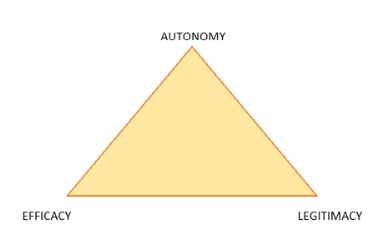
Figure 1 shows that there is more than one model of defence cooperation that can be legitimate and effective, given the diverse nature of the cooperation phenomenon to begin with. The initial dilemma between legitimacy and efficacy for all cooperation efforts seems to echo the definition of cooperation given by the neofunctionalist current which we have discussed above.
However, in our search for an ideal model of security and defence cooperation in the 21st century, we ask ourselves in this article whether it is possible to reconcile these two objectives under a single heading. In order to do so, we need to question the very foundation of the legitimacy sought after by states as well as the means to obtain it. Legitimacy, aside for those who view it as being a potential characteristic of the policy-making process, can be seen as a consequence of effective public policies (output legitimacy). (x) In this sense, the legitimacy of any political action no longer rests exclusively on the implication of citizens in the decision-making process (input legitimacy); it also depends on how that action meets their expectations, i.e. the degree to which that action is effective. When considered to be an output, legitimacy becomes one of the policy results, as opposed to being a simple input. This output legitimacy is acquired when the objectives of the action are met, and/or when their technical performance is acknowledged. (x) This approach – which is illustrated in Figure 2 – has been developed by Bastian Giegerich and Eva Gross in 2006 to analyse defence cooperation schemes within the EU. (x)
Figure 2
Legitimate because effective?
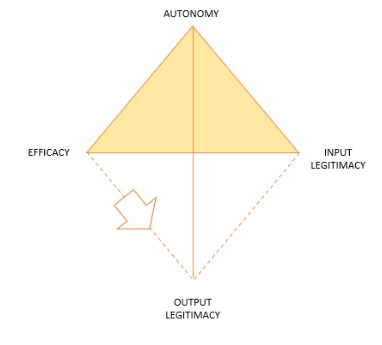
As a result, all forms of defence cooperation can become legitimate because of their effective results and because governments and citizens look for this efficacy. By adopting such an understanding of legitimacy, the theoretical reconciliation between the efficacy and legitimacy of a defence cooperation then seems possible.
Towards a typology of defence cooperation in the 21st century
In the 21st century, security and defence cooperation can be transient or permanent, formal or informal, institutionalised or not; it can be established within or outside of any official framework (x); it can subsist during peacetime or be limited to periods of crisis (x); and it can follow a very diverse set of objectives that relate to the legitimacy and/or the efficacy of military action. Given this diversification in the forms that defence cooperation can take, it seems necessary to propose a typology of agreements in the 21st century. This conceptual effort does not only serve to categorise the different forms of cooperation; it also allows us to have a guiding thread (x) for further exploring the conditions under which a state or an international organisation would no longer have to mediate between two of the three initial variables, namely those of efficacy and legitimacy.
To this day, only few studies have offered a typology of defence cooperation. The latter date back to the 1950s, 1960s, and 1970s, and limit themselves to the cases of military alliances. Hans-Joachim Morgenthau thus proposes a classification in which he distinguishes alliances from one another according to whether they are: i) mutual or unilateral, ii) transient or permanent, iii) operational or inoperative (concerning their capacity to coordinate the policies of their members), iv) general or limited in their distribution of benefits, and v) complementary, identical or ideological in their scope of interest. (x) In his typology of alliances, Kalevi J. Holsti later identifies four distinguishing factors that are worth considering: i) the situation in which commitments become operational, ii) the type of commitments that have been made, iii) the degree of military cooperation or integration, and iv) the geographical scope of the agreement. (x) Edwin H. Fedder, for whom an alliance consists of a coalition, proposes another typology which is inter alia based on i) the number of states involved, ii) its geographical limitations, iii) its duration, iv) the distribution of power amongst members, v) whether it adopts an active or passive outlook, vi) whether it is based uponunilateral or mutual commitment, and vii) its security mechanisms. (x) As for Bruce M. Russett, he underlines similar distinguishing factors to those of Fedder: i) the relation of the alliance to the international system, ii) the nature of the commitment, iii) its intended duration, iv) the relation between alliance members, and v) the links members had before they started to cooperate. (x)
Although these typologies have a set of factors in common, i.e. they think of defence cooperation as a military commitment of a certain number of states for a certain period of time, they do not reflect the diverse forms of cooperation in present times. Hence, we propose a novel typology that is both descriptive (x) and empirical, (x) and that reflects the forms of cooperation which characterise the 21st century (see Figure 3). Being deduced from the observation of past and present forms of cooperation, (x) our typology allows us to pinpoint and describe an object of study (x) – here the diversification of cooperation models. We categorise the different forms of defence cooperation in the 21st century according to i) their level of cooperation (if “bi”, “mini” or “multi”) ii) their objectives (if specific or general), iii) their length in time (if transient or permanent), iv) their domain (if related to operational aspects or investments), and v) their framework (if institutionalised or not).
Figure 3
Typology of defence cooperation in the 21st Century
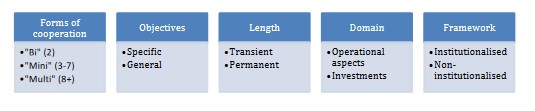
Our typology insists on the nuances that exist between the different levels of cooperation – with 2, 3-7 or over 8 partners – while providing some leeway with regard to the objectives, the length, the domain, and the framework of the cooperation at hand. States indeed will not opt for a single mode of cooperation in a firm and irrevocable manner. On the contrary, these different forms of cooperation quite often tend to be interwoven in practice. In this regard, the 2017 French Strategic Review of National Defence and Security underlines that ‘cooperation is already a lived reality for the French armed forces’. (x) As a matter of fact, France does contribute to numerous arrangements with one or more partners, some of which are based on dedicated institutions, while others are more informal and intermittent. At the European level, in particular, France ‘supports an optimal combination of different cooperation formats’. (x) First of all, it closely cooperates with Germany and the United Kingdom on a bilateral level on operational, industrial and equipment-related matters. In addition to these two bilateral relationships, France also cooperates with other European partners. At the mininational level, we can mention the Weimar triangle that groups France, Germany and Poland in an informal manner, and that aims for a general rapprochement in politico-military affairs. As for the minilateral level, we can highlight a series of specific, structural initiatives in the domain of the MALE drones that France has undertaken in cooperation with Germany, Italy and Spain via the Organisation for Joint Armament Cooperation (OCCAR) and the European Defence Agency. In addition, the2017 Strategic Review highlights the indispensable role of France’s strategic partnerships – with Australia, Brazil, India, Japan, Kuwait, Malaysia, Qatar, Singapore, and a number of African partners such as Tunisia, Morocco and Egypt, among others – as well as the importance of a strengthened multilateral framework comprising the United Nations, NATO, the African Union (AU), the EU, etc.
The French case illustrates the appeal of a tiered or multi-level approach to cooperation. Indeed, the simultaneous use of these different modes of cooperation, also referred to as ‘flexilateralism’, is what can allow for a gain in efficacy. Developed by Samuel B. H. Faure, the concept of flexilateralism captures the policies of a ‘state (that) simultaneously mobilises different forms of international cooperation in response to a policy problem’. (x) Given the diversification of areas in which defence cooperation takes place, are there any fields which are more likely to generate both legitimacy and efficacy? And are there certain forms of cooperation that can better reconcile these two characteristics?
Being both legitimate and effective: a challenge for all forms of cooperation in the 21st century
In light of the preceding elements, this study sets out to explore the compromises that can – and in certain cases have to – be made between legitimacy and efficacy when it comes to defence cooperation in the 21st century. The articles presented in this publication cover different forms of cooperation – between states, within or outside international bodies, and within regional or international organisations – but also various geographical areas. This empirical diversity strengthens the validity of our typology, even as we take into account the regional specificities of the case studies. The articles will show that different models of defence cooperation can generate both legitimacy and efficacy, even if these questions do not always arise at the same time or in the same way. More specifically, the cases analysed in this publication highlight what could be called “multi-layered” forms of cooperation. (x) The latter are made of a hard core, which corresponds to a key cooperation for a given state or geographical area (say bilateralism with the United States for Japan, or cooperation with the EU for France) to which can be added diverse forms of cooperation that are more informal or restricted, depending on the aims and needs at hand. For the sake of analytical clarity, the authors have adopted the following two definitions:
• A defence cooperation is deemed legitimate when established with one or more partners that possess a certain recognition on the international scene; or when the actions that the cooperation aims to undertake are deemed sufficiently righteous in qualitative terms – in particular when the population lends its support – or in quantitative ones – when a sufficient number of partners approve it –, or else when the cooperation is considered to be effective a posteriori.
• A defence cooperation is effective if it allows participating states to reach their political objectives and/or if the gain from the partnership is greater than if the state had proceeded unilaterally.
To begin with, Béatrice Hainaut analyses the bilateral forms of cooperation that are established amidst existing multilateral partnerships. More specifically, she looks into the bilateral defence cooperation between France and the United States in the area of outer space: while the United States publicises a multilateral approach, it draws in parallel on an informal practice in small groups. Taking the example of bilateral forms of transatlantic defence cooperation, Hainaut demonstrates that the aim of these technical and specific cooperation schemes is to promote norms of behaviour in outer space at an international scale. But while this instance of cooperation appears politically legitimate, its juridical legitimacy has yet to be obtained. As a result, she concludes that nothing else but the adoption of shared norms at the international level will grant juridical legitimacy to the Franco-American discussions, thus making their cooperation on this matter more effective.
Delphine Deschaux-Dutard then focuses on the strengthening of bilateral forms of cooperation, using the European case as her particular subject of analysis. She examines the Franco-German initiatives since 2016 which favour a European defence project and notes that the Franco-German couple is witnessing a revival. But while the current political context seems to provide a unique window of opportunity for advancing the EU’s defence policies, the Franco-German couple – considered to be the legitimate driving force behind this dynamic – cannot be its sole bearer, at the risk of becoming ineffective in the long run. As a result, Deschaux-Dutard finds that France and Germany have to ensure that their partners in the South (Italy, Spain) and in the East (in particular the Baltic states and Poland) are convinced of the need to reignite the European defence project for it to become a common cause and to gain in both legitimacy and efficacy.
Last but not least, Céline Pajon points out how Japan has adopted a “multi-layered” approach to defence cooperation since the end of the Cold War. Around the cornerstone that is its alliance with the United States, Japan has opted for establishing and strengthening a set of strategic partnerships without much institutionalisation on bilateral and minilateral levels, and for participating in various instances of multilateral cooperation. The legitimacy of Japanese cooperation initiatives is founded on shared liberal values and a commitment to defend the existing rule-based world order. However, Pajon stresses that the efficacy of these cooperation initiatives should be measured in light of their principal objective: Tokyo’s strive for military normalisation. She therefore demonstrates how Japan now constitutes a legitimate politico-military actor endowed with a large network of partners.
Franco-American defence cooperation in outer space
Béatrice Hainaut
Abstract
France and the United States (US) share the vision of a congested, contested and competitive outer space. Thanks to the technical progress made by France, the two space powers have initiated cooperation in the area of space surveillance. The ‘political convergence’ was also the result of normative, political, cognitive and functional factors. Thus, the bilateral cooperation has been institutionalised and its scope extended over time by defining norms of behaviour in the outer space. While the political and legal legitimacy of Franco-American cooperation is questioned in the article, its efficacy still has to be demonstrated.
Introduction
The United States considers outer space to be a ‘congested, contested and competitive’ place. (x) France shares in on these views, with its official papers defining outer space as a ‘battleground’ (x), a ‘field of confrontation’ (x), or a ‘new front’ (x). Historically, the two states have cooperated on this matter since the start of the space conquest, whether it be in the area of space launches under the heading of scientific cooperation, or more recently in the area of space surveillance. Cooperation between the two states has since been reaffirmed on numerous occasions, most recently as part of France’s Space Defence Strategy report published in 2019: ‘Cooperation with the US [regarding Space Situational Awareness] must continue even as technological advances enable Europe to develop its own capabilities, making it a credible partner’. Moreover, France considers the United States to form a ‘key ally’ when it comes to military space operations, a notion it introduced for the first time in this report. (x) Indeed, the ability to monitor space objects can allow for the development of certain modes of action which could fend-off the threats that weigh on national space assets. And yet, the outer space landscape is undergoing changes that are generating a heightened need for space surveillance. On this basis, the United States and France have drawn nearer to each other following the progress that France has made in terms of its capabilities. Indeed, the latter acquired a military-grade radar system in 2005 that has allowed it to run partial surveillance activities in outer space, thus becoming the European forerunner on the matter. But technical capacities are not the sole reason that has led the two states to extend their cooperation in the domain of outer space. Political, normative, cognitive and functional factors have all favoured cooperation by making French and American space policies converge, whereupon a bottom-up form of cooperation was rendered possible. Founded on a shared technical expertise, their cooperation has since grown into a broader and more institutionalised form that deals with the definition of the norms of behaviour in outer space.
The stakes of their cooperation on this subject matter are manifold. For France, it is about perfecting its situational awareness in outer space and gaining a competitive edge when elaborating the norms of behaviour, whilst preserving its strategic autonomy. Whereas for the United States, it is about expanding its network of space surveillance, ensuring its resilience, and promoting its own operational standards in outer space.
As such, how can the dynamics of this Franco-American convergence be singled out through which cooperation is rendered possible? Can this specific instance of bilateral cooperation be considered legitimate, in both political and juridical terms? And thereafter, how can the efficacy of this asymmetrical cooperation be evaluated in light of their respective technological capabilities? In this regard, the first part of the article traces back the origins of Franco-American space cooperation. The second part then explores in more detail the factors that have led to a political convergence in their respective space policies. This part, moreover, draws on the work of Katharina Holzinger and Christoph Knill (x) in order to examine the factors that have enabled cooperation between the two states in the area of space surveillance. Finally, the last part attempts to evaluate the legitimacy and efficacy of this specific instance of bilateral cooperation between the two states.
The historical Franco-American space cooperation and its recent developments
During the Cold War, outer space was monopolised by the two superpowers of the time: the United States and the Soviet Union. The two states, given the heightened competition between them, evidently did not cooperate with each other. Nevertheless, a handful of symbolic events still managed to bring them together, as with the Apollo-Soyouz Test Project (ASTP) on July 17, 1975. (x) Other states followed in their footsteps by sending their own satellites into orbit. France led the charge with its first launch in 1965, followed by China and Japan in 1970, the United Kingdom in 1971, India in 1975, Israel in 1988, and since the Cold War, North Korea in 1998 (though its launch into orbit remains contested), and Iran in 2009. Often, satellite capabilities have been linked to the development of ballistic or even nuclear capabilities on the part of a state. The launches into orbit that took place during the Cold War were thus of minor concern in comparison to the ideological conflict that brought fears of a nuclear war. However, the technological progress which these states made set the post-Cold War scene in outer space. Indeed, right after the Cold War drew to an end, access to outer space began to democratise itself. As of today, there are no fewer than seventy states which have invested the useful part of outer space, that is, the part in orbit spanning from 200 km to 36,000 km. Most of the time, the first satellite which a state acquires is one of observation in order to monitor its territory and borders. It therefore tends to be a mark of prestige as much as a technological tool.
The French space conquest and its autonomous access to outer space
Before it became a space power in 1965, France had relied on cooperation. To begin with, it had benefited from the skills of German engineers in the aftermath of the Second World War. These engineers allowed for rapid progress on the French studies in rocket engines that were already in motion. (x) These technological developments were a military affair, given the historic context under which they took place. Though it had been initiated under the Fourth Republic, the French nuclear and space programme witnessed a new impulse after General Charles de Gaulle came to power in 1958. On December 19, 1961, the National Centre for Space Studies was created (CNES) – which constitutes the symbolic date of birth for French space policy. At the time, France still possessed a launching pad in the Algerian Sahara which it had built in the early 1950s, though it decided to vacate the area when the Évian Accords were signed on March 8, 1962, that set Algeria on its path to independence. Before this, however, it launched the Diamant space rocket on November 25, 1965, which put the Astérix satellite into orbit and converted France into the third space power of that time. The French departure then became effective in 1967. (x) At that point, France was left without a launching pad and had to rely on the United States for its satellite launches, until it built the Guiana Space Centre (CSG) in 1968. This arrangement was motivated in particular the reluctance of the Americans to allow commercial use of French satellites. As such, the former refused to send out all satellites that France could potentially trade-off with third-parties. In March 1964, the French government thus decided to build a launchpad at Kourou, in French Guyana, in order to be able to launch its own vectors. France’s general quest for strategic autonomy is therefore captured here in the idea of obtaining a free and open access to outer space.
Franco-American scientific cooperation
The scientific domain is illustrative of Franco-American space cooperation. Projects in this domain are carried out by each national space agency, namely the National Aeronautics and Space Administration (NASA) and the Centre National des Études Spatiales (CNES). Partnerships and exchange programmes here are numerous and long-lasting. One can cite the Jason programme, (x) the discussions surrounding the issue of space debris in orbit, (x) and their joint initiative dubbed mission Curiosity that allowed them to send a rover to Mars on August 6, 2012. Civil cooperation is made possible by the pursuit of common scientific interests, and the strong trust relationship that scientists have established on both sides of the Atlantic through countless exchanges. Their shared missions and joint programmes provide clear testimonies in this regard. Hence, scientific cooperation seems quite simple to establish, even during periods of suspicion between the two states.
Conversely, space cooperation in the military domain is scarce because of how difficult it is to establish. Indeed, this particular subset of space cooperation touches upon national sovereignty by definition. Trust is therefore limited, even amongst allies, with military cooperation being used now more than ever as a bargaining chip. The dual civilian-military function of space surveillance is therefore of interest, since “non-sensitive” cooperation around shared databases can first be established before the states choose to scale their cooperation with the exchange of classified intel.
Dual function in cooperation: the political issue at stake for space surveillance
Since the Cold War, the “democratised” access to space technologies has enabled an ever-growing number of countries to conquer space. The amount of space objects, in this respect, has increased significantly. Currently, some 30,000 objects of at least 10 cm – including 1,400 active satellites – are floating in space, along with millions of small debris starting at 1 mm. (x) Active satellites represent an entire cohort of their own in need of regulation, known as space traffic management, while the corollary effect of this rise in orbital objects is the mathematical increase of the risk of collision. The exponential rise of space debris has been studied as far back as the 1970s by NASA engineers, and Donald Kessler in particular. In fact, the latter published an article back in 1978 (x) that marked a turning point for American policymakers in their recognition of the problem. What is more, the collisional cascading which he theorised was eventually named after him as the Kessler syndrome. The theory accounts for the proliferation of space debris in lay terms by explaining how these could reach a threshold after which space debris might begin to produce more debris on its own, thus causing a chain reaction that would put an end to human activity in outer space. This simplified take on the problem that resulted from a scientific theorisation has proven crucial for its widespread diffusion. (x) And yet the issue of space debris proliferation is not liable to disappear given the future projects that aim for a mega-constellation of satellites, as with the private initiative from One Web. (x) Private corporations behind the “New Space” (x) phenomenon now have a massive presence in outer space, even though such corporations give little consideration to the space debris that they generate. Beyond these risks, the users of outer space also face different threat models. The French Minister of the Armed Forces, Florence Parly, mentioned one of them in her address to the CNES on September 7, 2018. (x) According to her account, a Russian satellite seemingly came into close contact with a Franco-Italian military satellite that was in geostationary orbit. This apparent espionage attempt (x) illustrates what she refers to as a ‘miniature star wars’. (x)
The rest of her demonstration focused on the need to conduct operations in outer space. For this to be the case, space surveillance must be turned into a real issue, so as to pinpoint hostile action and provide an adequate response. She also noted that France still partially relies on American databases, though it aims to become autonomous, and that the GRAVES system (x) has allowed France to reach ‘a more balanced cooperation’ with its American counterpart. All of these reflections, one should note, were formalised in France’s Space Defence Strategy of 2019.
If space surveillance is slowly becoming a political issue at stake, it is because the usage of space services has become essential for the French society to properly function, and western societies in general. And yet, the means that have been put into place so far to protect these space services have not matched the degree of dependence that societies have on them. Such dependence proves a source of vulnerability as it exposes satellites to the existing risks and threats of outer space, which have risen these past couple years. While it constitutes the leading space power, the United States is the most dependent and for that matter the most vulnerable of all states in outer space. As such, it has been looking to strengthen its resilience by all means. (x) In this regard, the American willingness to further cooperate on space surveillance stems from its aim to raise its total number of sensors across the world. In this regard, the American strategist James Clay Moltz goes as far as to speak of a true ‘allied space network’. (x) To this end, their constantly-changing space surveillance network receives data from the French sensors of the GRAVES system and the SATAM (x) tracking radars. Aside for resilience, their goal is therefore to dissuade a potential assailant from taking action, since the latter would undoubtedly be detected.
While the two protagonists perceive the benefits of scientific cooperation as a positive-sum game, the benefits of security and defence cooperation are rather seen as a zero-sum game (x) – one loses what the other gains. As such, the transferred data does in fact reveal the solid technical capabilities of the French sensors. In this sense, the ‘more balanced cooperation’ which the French Minister evoked results from the progress that France has made in terms of its capabilities. Technological assets have thus become a diplomatic asset that fosters exchanges between the two nations. Though France is not a member of the Five Eyes, (x) its GRAVES system has come to reshape Franco-American relations in the area of space surveillance.
The GRAVES system, delivered to the French Air Force in December 2005, is capable of detecting all objects as little as 1 m² that pass over French territory bellow 3,330,000 feet. The procurement of these capabilities – at first meant for demonstration purposes – has allowed France to detect unreferenced flying objects. In this respect, the system has beaten all expectations, with its directory containing no less than 3,000 objects at the present time. This operational military asset thus became a diplomatic asset from the moment it proved capable of detecting unknown military satellites. Once a satellite is identified, it puts France in a position to initiate talks and strike deals with the relevant actor. Acquiring these technological surveillance capabilities has therefore reaffirmed France’s credentials as a space power. What is more, it has served as a bargaining chip that turns France into a credible partner with whom states do well to cooperate, at least to know what it is capable of detecting. This whole episode, in fact, constitutes the prelude to Franco-American space cooperation. Indeed, after two years of informal existence, the Franco-American Military Forum on Space Cooperation is unveiled on May 14, 2009. Thereafter, a declaration of principles is signed on February 8, 2011, between the French Minister of Foreign Affairs Alain Juppé and the American Secretary of Defence Robert Gates – the goal being to foster Franco-American cooperation in the area of space surveillance. In 2015, an accord on the exchange of confidential data is concluded. The French Minister of Defence, Jean-Yves Le Drian, follows up in 2016 by signing a common declaration of intent with his American counterpart, Ashton Carter, on military cooperation in general and space cooperation in particular. A final important step is taken in early 2020 when France becomes an integral member of the Combined Space Operations (CspO) initiative, which is meant to coordinate the efforts undertaken by each of the seven participating states in the field of space defence. Alongside these agreements, France has also been invited to partake in a number of exercises at the behest of the United States, despite these being initially restricted to the Five Eyes and Germany. The first one took place in 2014, named the Space Situational Awareness Table Top Exercise. The latest one to date was held in 2019, dubbed Global Sentinel, and gathered Germany, France, Japan, Italy, Spain, and Republic of Korea in addition to the Five Eyes except for New Zealand. Here, one might suspect that these exercises are pushing France to adopt international standards in the specific area of space surveillance. The simulated space events that are enacted during these exercises most likely put an emphasis on coordinated responses and interstate cooperation. As such, one can imagine that these exercises are meant to favour interoperability amongst the allies of the United States, to which France will have to abide by if it wishes to preserve its potential to cooperate with the United States and its partners.
The factors of political convergence enabling Franco-American cooperation
Such technical cooperation, however, does not explain the political convergence between the two states. Quite the opposite, in fact, for it comes downstream from this convergence, which is the result of four factors: normative, political, cognitive, and functional ones. Rather, it is when these factors intersect, or when the planets align so to speak, that political convergence occurs and in fine cooperation.
The normative factor
The normative factor refers to the international harmonisation of juridical norms (see annex). It takes place when certain state actors encourage a group of states to adopt certain norms, sometimes with binding effects. Per Holzinger and Knill, international harmonisation comes about either when actors share interdependencies with each other, as is the case for France vis-à-vis the United States even if the reverse situation is less true; or when actors face common problems that are prioritised over some measure of independence for a greater good, as with the risks and especially the threats in outer space. (x) Concerning the security norms of outer space activities, multiple initiatives are being pursued at the international level. Two that aim for an international harmonisation in this domain are considered here: the European initiative, that is, a code of conduct regulating outer space activities, and the NATO initiative. In both cases, France has partaken in the discussions, with its closeness to the United States and the numerous exchanges generated by these initiatives contributing to Franco-American converge in terms of their space policies, and in fine to Franco-American cooperation.
In addition to this, the steady rise of the overall population in outer space makes it that a certain group of states – for the most part comprised of space powers – seek to establish a new set of norms. With France at the helm, the European states thus came up with a proposal in 2008 to formulate a code of good conduct in outer space. However, this proposal stood at odds with the draft treaty that Russia and China had been pressing for, titled the Prevention of the Placement of Weapons in Outer Space and of the Threat or Use of Force against Outer Space Objects (abbreviated as PWPT). (x) Still, the Obama Administration chose to endorse the European proposal in 2012. But while the European states saw in the code of conduct a means to curb the proliferation of space debris, the United States rather saw in it a means to preserve a favourable and strategic status quo. The proposal was finally scrapped in 2015, however, as collateral damage to the worsening relations between the United States and Russia following the Russian interventions in Ukraine (2014) and Syria (2015). At this point, the United States feared the propagation of the Russian “anti-access” strategy, (x) with their diplomatic breakdown spilling over into the forums of the United Nations. Throughout his presidency, Donald Trump did not seem to favour the adoption of those international norms for outer space sought after by his French and European counterparts. However, in spite of being critical of NATO, Trump could have seen in it the ideal place to promote security norms for outer space activities, which could then have been imposed on other states as international norms. In this last respect, the Biden Administration might give a new momentum to the promotion of behaviour norms in outer space.
NATO is a multilateral institution restricted to the historic allies of the United States. Cooperation therein takes on an institutionalised form, and procedures have been put in place for the benefit of shared objectives. But even though it is an instance of multilateralism, NATO proves rather cost-efficient for the United States, since it implies deliberation among no more than 28 out of the world’s 200-odd states. These two dozen states, moreover, are not in stark opposition to the strategic concepts which are defined at each summit, as these are quite imbued with the American conceptual influence on these fluid environments. (x) Furthermore, smaller groups of NATO members can meet to form a common position before conveying it to all member states. One is then tempted to see in it a form of minilateralism (x) amidst a multilateral organisation, which might prove an effective method to propagate certain security norms for outer space activities.
If so, then the full reinstatement of France inside NATO’s military branch in 2009 – the corollary effect being the nomination of a general from the French Air Force to the position of Supreme Allied Commander Transformation (SACT) – can be seen as a real opportunity. To begin with, it constitutes one of the two highest positions in the organisation, alongside the Allied Command Operation (ACO) which is currently held by an American. The Allied Command Transformation (ACT), in simple terms, is the place where norms are defined, which means France is assured to exert influence. Though such an influence remains difficult to measure, even if Hubert Vedrine did write a report on this (x) back in 2012 at the behest of President François Hollande. Hence, in the context of NATO’s Space Policy adopted by Allies in 2019 and the recognition of space as a new operational domain, it is vital for France to adopt a firm stance when it comes to the defining the norms of behaviour in outer space, because of how important this objective is and the American tendency to monopolise it.
The political factor
The political factor takes the form of an imposition: a state or an international institution imposes its political viewpoint on another state. This situation of dependence and/or domination is the result of a power asymmetry, for the submissive state most of the time finds itself dependent on the resources of the dominant state or the international institution. (x) American superiority in the present domain partially reflects this situation. Having said this, the political factor also comes into play when new actors enter the scene, as the latter reshape existing power relations and incite political convergence.
Franco-American political convergence therefore draws on these two dynamics. Power asymmetry between France and the United States is real. What is more, the words of the French Minister of the Armed Forces point to this fact when she mentions in her 2018 address how the relation of cooperation in this domain has been rebalanced due to French technological progress. In fact, a report from the Parliamentary Office for the Evaluation of Scientific and Technological Choices (OPECST) had already reflected on these concerns back in 1991. (x) French legislators around then had been reflecting on the general stance of the United States towards Europe and France – one question being ‘vis-à-vis the United States, how should we turn a hegemonic situation into a partner status?’. (x) At the time, the authors of the report recommended efforts to encourage Franco-American cooperation as a whole. More specifically, they suggested that France cautiously get involved in the Strategic Defense Initiative (SDI) of the United States, (x) in exchange for its inclusion in the development of the Global Position System (GPS). (x) Nowadays, however, France and the United States no longer cooperate on those terms, especially given the emphasis that France places on cooperation with Germany and the European Union (EU) in order to strengthen its space surveillance. (x)
The United States therefore does not impose its political views on France in any strict sense, no more than it does on its other European allies. Having said this, French reliance on American support for its proposed code of conduct – given its status as the leading space power – does show how the latter nevertheless exerts influence on France. Furthermore, Franco-American convergence is undoubtedly linked to the emergence of new actors in the space environment, and certain state actors in particular.
The cognitive factor
The cognitive factor refers to both the nature of the problems that states are confronted with, and the manner in which those states confront them. Defining the problem and coming up with one or more solutions is eminently tied to how the actor perceives the situation and its causal links, along with the available options and their expected results. In the first part, I have shown that the United States and France share the same views of outer space as a congested, contested and competitive place, and come to think of it as a ‘field of confrontation’. (x) Russia, on the other hand, does not corroborate these views. It even calls the American view – that considers outer space to have become a ‘field of confrontation’ – a ‘dangerous’ one. (x)
Actors therefore arrange their perceptions of the problem in reference to these co-constructed cognitive images (x), before discussing possible solutions and formulating concrete proposals. Communication plays a key role in these processes of definition. (x) For one, it presupposes both an exchange of information and an act of communication between states, which Holzinger and Knill refer to as ‘transnational communication’. (x) The latter also note that communication is more easily established between states who share cultural, religious, linguistic, an/or historical ties. In this sense, the French and the Americans have “naturally” come closer to each other with their shared views of outer space as a place of confrontation. Thereafter, the two states have taken their views a step further by proposing a normative solution which includes formulating a code of conduct applicable to all space actors. This rapprochement has gained traction since the firing of a Chinese anti-satellite missile in January 2007 (x) and an orbital space collision in 2009, since both incidents produced a great deal of space debris and served as catalysts. Faced with this threat, but also with the problem of space traffic that is becoming more and more dense as well as competitive, the “old” space powers are progressively coming together.
Accordingly, the exchanges between France and the United States have grown in numbers, especially in the lead-up to American support for the code of conduct in 2012. Thereafter, the exchanges were carried on inside the French Ministry of Foreign Affairs and the American State Department. Franck A. Rose, as Deputy Assistant Secretary for the Bureau of Arms Control, Verification and Compliance, was the one in charge back then of these issues pertaining to security in outer space. A number of informal meetings were even held amongst the partisans of a space code – which included France and the United Kingdom, but also Australia, Japan, India, South Korea, and Canada – in order to establish a strong common position before sharing it on the international scene. The Americans, however, ended up pursuing a form of ‘multilateralism à la carte’ in order to push forward their own agenda, while the Europeans played ‘the multilateralism card to make themselves heard’. (x)
The functional factor
The functional factor consists of promoting an international solution in the shape of a policy or a normative text (see annex). As I have previously shown, there are two solutions that oppose each other on the international scene. In schematic terms, there is the solution of the occidental camp, a code of conduct to secure outer space activities, and the Sino-Russian solution, the so-called PPWT treaty. The latter is still under negotiation in the Disarmament and International Security Committee (DISEC), though it remains at a standstill because of how the committee functions. As for the code of conduct, it has benefited from a work of promotion or better said of socialisation across the world. Socialisation here refers to a process by which states are incited to alter their behaviour as they adopt the ‘preferred’ norms of an international society of states. (x) This approach has been adopted by national and international institutions, such as the EU via the European External Action Service and the particular efforts of a French diplomat at the United Nations, but also by non-governmental organisations, such as the Secure World Foundation.
The United States on its end has applied a form of ‘networked multilateralism’. (x) It consists of a series of ‘partnerships that the American government establishes with its allies, but also with non-state actors including civil societies and individuals, in order to better communicate the foreign actions of the United States in the broadest possible manner, and to encourage bottom-up support for its policies. [Multilateralism is then taken care of] by public diplomacy and communication’. (x) The numerous trips to India, Singapore, Indonesia, South Korea, Argentina, Chile, the United Arab Emirates, and even China, by the State Department representative during the Obama Administration illustrate this communicative diplomacy. Since then, the shelving of the code of conduct proposal and the arrival of Donald Trump at the White House in 2016 have put a halt to this momentum. In this respect, the new American presidency might inaugurate a change of course. As for China and Russia, the two states continue to promote their idea of a treaty, though without French support. (x)
The normative, political, functional and cognitive factors have therefore laid the grounds for political convergence between the two states and encouraged Franco-American cooperation. The latter is illustrated by their technical cooperation in the area of space surveillance, and their normative cooperation in promoting a non-binding text that defines the norms of behaviour in outer space. In fact, the proper application of these norms will require a space surveillance network to ensure compliance, meaning the two forms of cooperation complement each other. Let us now evaluate them in terms of their legitimacy and efficacy.
The legitimacy and efficacy of Franco-American cooperation
Political convergence between these two states that are ‘friends and allies, but not aligned’, (x) what is more on a domain which is deemed strategic, leads us to question the political and juridical legitimacy of their cooperation, and to evaluate its efficacy in spite of its recent character.
Political and juridical legitimacy
In accordance with the definition that has been laid out in the introduction of this study, I understand political legitimacy as something that stems from the support of the citizenry. There are three different ways, as such, that Franco-American cooperation can become legitimate. First, the popular view that ‘space is expensive’ (x) allows states to justify the need to share costs. At this point, it can appear legitimate for France to maximise its space surveillance capabilities not through the purchase of new sensors, but instead through the intake of American data. Second, the popularisation of the space debris problem – amplified by the recent cinematography (x) – is making the monitoring of outer space seem indispensable in order to palliate certain risks. And third, the recent disclosure of a suspected espionage attempt on a Franco-Italian military satellite by a Russian satellite (x) highlights the threats that weight on space systems, thus allowing states to turn space surveillance into a real political issue at stake. (x)
Such factors must also take into account the fact that the average French citizen is not much involved in the debates pertaining to outer space, and even less so in the ones that relate to military concerns in outer space. (x) In 2012, the general public was in fact deemed to show little interest on the topic, (x) in spite of the initiatives taken by the French Parliament and the Parliamentary Group for Outer Space (GPE) in particular. It is an understandable outcome, to some extent, given that the topic is deemed technical, (x) and that the ‘space culture’ remains paradoxically limited in France. Even those citizens who are familiar with Franco-American cooperation in outer space come to see it as something ‘natural’. (x) Indeed, this specific instance of cooperation is but an offshoot of the long-standing relations between the two states in light of their historic alliance.
As for juridical legitimacy, which is also discussed in the introduction of this publication, it stems from the evaluation of defence cooperation according to the accepted norms of the international community. The stakes of Franco-American cooperation here are the elaboration of norms that the international community is willing to accept. Some states, however, caution against defining outer space as a field of confrontation due to the normative consequences that it entails – such as the invocation of legitimate defence in outer space. (x) This reverts back in schematic terms to the “two sides” that I have previously described, namely the United States and its allies versus China and Russia. In addition, it has been shown how the code of conduct has benefited from an active promotion on the international scene. Juridical legitimacy, therefore, is taken to form the consequence of a learning process.
Besides this quest for legitimacy, however, French and American state actors also wish to pursue useful hence effective forms of cooperation. So what about the forms of cooperation dealt with here?
The efficacy of Franco-American cooperation
Even partial access to the American surveillance network of outer space has allowed France to gain additional information on the events taking place in orbit. Otherwise, France might have had no knowledge of these events whatsoever, or in some cases less precise and/or posterior knowledge. Regardless, effective cooperation is being achieved progressively: the accords require technical adjustments for the exchange of data on space surveillance. An evaluation of the efficacy to these accords is therefore conditioned by progress on the latter.
When it comes to Franco-American cooperation on the promotion of norms of behaviour at an international scale, it has been a failure. The proposed code of conduct has been shelved and no similar alternative has come up until now. The sort of multilateralism that the French had sought to turn this code into a ‘regime’ (x) was reliant on American leadership. (x) The latter, indeed, was the sole actor to possess the necessary resources for creating and maintaining such a regime. And yet, the failure to create a code of conduct regulating space activities in spite of American support invalidates the hypothesis of hegemonic stability, for the United States’ hegemonic position in outer space was of no avail. Granted, Russia and China played a non-negligible role in discrediting the initiative, but American space hegemony was unable to surpass this power struggle and thereby create a space regime. In other words, the dominant state was unable to constrain the other states to endorse its code of conduct. It is difficult for us to determine whether the American hegemon really intended to put this space regime into place, or whether it entered the “support game” simply to avoid being accused of impeding space regulation efforts. The latter, in this regard, would corroborate the thesis that the United States favours a sort of multilateralism that is made of ad hoccoalitions, which in this case helps to enlarge its surveillance capabilities through the incorporation of allied sensors.
Conclusion
Franco-American bilateral military cooperation in outer space is illustrated by two distinct forms of cooperation: technical cooperation on matters pertaining to space surveillance with the exchange of data and information, and normative cooperation with the promotion of international norms of behaviour in outer space. As a whole, four factors have made this bottom-up cooperation between the two states possible: political, normative, cognitive and functional factors.
These two forms of cooperation seem politically legitimate given outer space constitutes a specific environment wherein American predominance is acknowledged. Moreover, there is nothing unnatural to this cooperation in the eyes of French citizens, insofar the United States constitutes one of their historic allies.
Juridically, however, the legitimacy of their cooperation has yet to be acquired. Indeed, the norms promoted by the Franco-American couple do not garner unanimous support amongst the wider international community. Other norms, in particular those that are promoted by China and Russia, constitute an alternative with strong backing on the international stage, including the Group of 77 within the United Nations. Until the election of Joe Biden, it had remained improbable that a new instance of Franco-American cooperation would elaborate another non-binding text to spell out the norms of behaviour for outer space. Indeed, Donald Trump viewed cooperation as nothing but an adjustment variable, while his secretary of State went as far as to posit the ‘end of multilateralism’ altogether (x). Under his presidency, cooperation in outer space was illegitimate unless it met the “America First” credo, which in the present context translated to “America First in Space” (x).
In terms of efficacy, one can thus consider the input of space data as a surplus for French space surveillance. However, no official paper has evaluated this exchange thus far. (x) And when it comes to norms, only the future adoption of shared norms of behaviour at the international scale could make Franco-American discussions on the matter seem effective. Progress on this matter has been made, in fact, with the recent adoption of certain resolutions within the United Nations.
Beyond its bilateral cooperation with the United States, however, France now places its main emphasis on European cooperation in order to promote the idea of European strategic autonomy. France is involved along with certain members of the EU in a surveillance project for outer space (EU SST). Other European initiatives are also in the making, (x) even though France is not always the one to launch them. This flexilateralism, (x) – whether willed or imposed – provides enough legroom for France to not lock itself in an exclusive space relation with the United states, and to preserve its freedom of appreciation, access, and action in outer space. (x) Its quest for strategic autonomy must indeed be balanced with all the necessary forms of cooperation, whatever these might be.
Annex: Mechanisms of policy convergence
Katharina Holzinger, Christoph Knill, « Causes and Conditions of Cross-national Policy Convergence », Journal of European Public Policy, 12:5, 2005, p. 6.
Franco-German military cooperation and European defence after Brexit
Delphine Deschaux-Dutard
Abstract
European military cooperation, designed as the Common Security and Defence Policy (CSDP) in the EU, has experienced an important phase of revival in the last couple years. Franco-German military cooperation played an important role as kingpin for this relaunch. This article analyses the role of this bilateral cooperation in EU military cooperation relying on two criteria: its legitimacy and its effectiveness. After exploring the historical, operational and symbolic foundations of Franco-German military cooperation, the articles focuses on the effectiveness of this bilateral military cooperation in the framework of CSDP, by also raising its recurring limits.
Introduction
European military cooperation, embedded in the framework of the Common Security and Defence Policy (CSDP), has witnessed a strong regain of interest in these last couple years. Brexit, followed by the accession of Donald Trump to the White House in January 2017 and the election of Emmanuel Macron in France in May 2017, has opened a unique window of opportunity (x) to revive the defence policy of the European Union (EU). More specifically, when looking into the details of CSDP, it is striking to note that such a revival rests for the most part on French and German political activism – to the point where one can again speak of a Franco-German couple, after a period of exhaustion or at least trivialisation that had lasted since the early 2000s. Faced with a changing geopolitical environment and a set of heightened threats including terrorism, Russian actions in Crimea and on the Eastern borders of the EU, and the migration crisis, France and Germany have once more embraced their role as the engine of a much needed common European defence.
Faced with these increasing security challenges, the EU no longer seems to have a choice but to become more effective in terms of security and defence. Such a complex international situation opens up a world of possibilities, and has contributed to reviving the work-in-progress that is EU’s defence policy. In fact, a number of initiatives aimed at strengthening the credibility of the EU on a military level have flourished since June 2016 under a strong Franco-German impulse. In this regard, a poll conducted between April and June 2016 on French and German members of parliament has shown that defence constitutes the domain of action with the strongest potential for consensus, far ahead of economic questions on the governance of the euro zone or the harmonisation of labour markets. (x) Thereafter, the Franco-German couple has presented itself as the engine of this revival. The latter has multiplied its bilateral initiatives, which are then meant to be “Europeanised” in order to make CSDP more effective. This emerging Franco-German leadership since Brexit on those matters related to European defence stems from their bilateral military cooperation, which is rooted in the history of the two states and the European integration process at large. Their cooperation, at first based on the Élysée Treaty that was signed on January 22, 1963, and that marked the political reconciliation between Paris and Berlin, started its institutionalization during the 1980s. In present times, it provides a privileged framework for launching military-driven cooperation initiatives destined to be extended at the European level, but also for experimenting on a bilateral scale with projects tied to military cooperation, such as the Tiger helicopter.
The case of Franco-German military cooperation is therefore a good fit for the problématique raised in this publication, as it mingles material factors – in particular the preponderant economic and demographic weight of these two states in the EU – with cognitive and normative factors, especially the usage of political symbols that aim to foster a specific identity. Furthermore, this bilateral military cooperation constitutes the strongest link inside the “multi-layered” European network of defence cooperation. Compared to other instances of bilateral military cooperation, the specificity of this partnership resides in its top-down construction. Indeed, the defence partnership between Paris and Berlin rests on strong political and symbolic grounds prior to all concerns of operability. The partnership between Paris and London, on the other hand, focuses on operational efficiency more so than political harmonisation. This appears to be even more the case when considering the fact that the French and German armies are still based for the most part on divergent models – as opposed to the Franco-British case where the two armies share the same field experience and similar doctrines. What is more, the crux of foreign and security policy is quite dissimilar between Paris and Berlin. While France places strategic autonomy at the centre of its preoccupations, Germany continues to rely primarily on its partnership with the North Atlantic Treaty Organisation (NATO) instead when meeting its international security commitments. (x) In the end, the EU’s multilateral framework is what constitutes the common denominator of Franco-German military cooperation. Having said this, an analysis of Franco-German military cooperation must not blur the fundamentally political vocation of this cooperation that is entrenched in the history of European reconciliation. (x)
More specifically, the point is to question the legitimacy as well as the efficacy of this bilateral cooperation, both in itself and in the wider context of European military cooperation. How is it distinct from other instances of bilateral and multilateral cooperation pursued by the two states? What are the grounds of its legitimacy? Is this cooperation designed from the beginning as the heart of European military cooperation truly effective, or does it belong to a more symbolic register? And when this Franco-German military cooperation is analysed according to the double criteria of legitimacy and efficacy, to what extent can it present itself today as a basis for the revival of CSDP?
The article will focus on the politico-military dimension of this Franco-German military cooperation. To begin with, I will analyse the cooperation in terms of its legitimacy, which comprises a historical-symbolic and an operational facet. Then, I will question the efficacy of this Franco-German cooperation amidst the wider context of European military cooperation and CSDP in particular, whilst also taking note of its recurring limits.
A legitimacy based on a historical, symbolic and an operational facet
To restate the typology proposed in the introduction of this publication, Franco-German cooperation is rather specific for several reasons. First, it consists of a bilateral cooperation that is embedded in a multilateral framework – NATO and the EU – and that, in spite of its particularities, relates to a broader form of political cooperation between Paris and Berlin that is founded on the Elysée Treaty (1963). Second, it is a heavily institutionalised form of military cooperation that rests on dedicated institutions, which is what insulates it from political fluctuations between the two states. And third, the symbolic dimension plays a crucial role in legitimising this military cooperation. The political origins of this Franco-German military cooperation thus explain the search for operational tools that sustain on a concrete level the political objectives which it is first meant to fulfil.
The historical core of the European defence construction
The Franco-German partnership is often thought of as the engine of European integration, and this is also the case for the domain of defence. (x) The legitimacy of this bilateral cooperation in the eyes of the political elites and operational practitioners of the two countries, and even those of their European and Atlantic partners, lies first and foremost in its historical roots. A ‘basic entente’ between the two states – in contraposition to an enmity that is supposedly hereditary (x) – has thus been woven ever since the partnership that was established between Charles de Gaulle and Konrad Adenauer at the start of the 1960s, and that was spurred throughout the 1980s and 1990s due to the strong personal ties between François Mitterrand and Helmut Kohl.
In the aftermath of the Second World War, France and Germany were both in a bankrupt state and began to renew with the old dream of Aristide Briand: a Franco-German reconciliation that would end up uniting the peoples of Europe. Robert Schuman, under the influence of Briand, was the first to evoke the idea of a European army that would bring together French and German soldiers. The idea of a “community of fate” (Schicksalsgemeinschaft) between the two banks of the Rhine thus came to light. Marked with the European seal from the onset, it was inaugurated by the Elysée Treaty that Adenauer and de Gaulle signed. This treaty defined precise rules of cooperation on matters of foreign policy, defence, and culture. Concerning defence, the Elysée Treaty institutionalised a cooperation programme that was based on three central points: i) shared reflections on a strategic and tactical level, ii) personnel exchanges between the two armed forces, with a particular emphasis on student exchanges between the military schools of both countries, and iii) advanced cooperation on matters related to armament. (x)
The text provided for regular visits between the two heads of state, the ministers of defence, and the chiefs of staff – these summits being prepared for at the national level by an inter-ministerial commission – in order to develop ‘shared conceptions’ and pursue ‘identical actions’. In fact, it was amidst this framework that the Franco-German encounter on July 13, 2017, took place, after which President Macron and Chancellor Merkel announced their intention to build a joint combat aircraft amidst the wider framework of the Future Combat Air System (FCAS).
Nonetheless, the basis for agreement between these two states rests on divergent points of view, especially when it comes to the sort of relation that must be maintained with the United States regarding security and defence. Such differences were the reason for the additional preamble of the Elysée Treaty which the Bundestag appended to the initial draft on May 16, 1963. The preamble, amongst other things, served to remind the primacy of both NATO and the United States for German defence. From then onwards, defence cooperation between the two states – instituted through the Elysée Treaty – entered a phase of lethargy, punctuated by doctrinal and strategic differences on the two banks of the Rhine. One had to wait until 1982-1983 for the Franco-German couple to revive their bilateral military cooperation, given the accession to power of two key figures: François Mitterrand and Helmut Kohl.
Throughout the 1980s and 1990s, numerous common military initiatives were undertaken to give substance to the Franco-German couple. It was about erecting a solid base for the long-term construction of a common European defence. This bilateral cooperation was sustained on symbolic, institutional, and operational levels.
Starting on the political and symbolic level, the idea of a “community of fate” was reinvested by François Mitterrand during his address to the Bundestag on January 22, 1983, which marked the 20th anniversary of the Elysée Treaty. To this end, he gave public support to the German security demands towards NATO in the context of the Euro-Missile Crisis. (x)
Moving on to the institutional level, a Franco-German Committee was created on October 22, 1982, in order to coordinate their defence policies, to oversee their military cooperation on matters concerning armament, and to prepare their bilateral encounters on a semestrial basis in either France or Germany. The 25th anniversary of the Elysée Treaty, January 22, 1988, then served as an opportune moment to create the Franco-German Council on Defence and Security (CFADS), which became the cornerstone of Franco-German military cooperation at the institutional level. In the spirit of the Elysée Treaty, an exchange programme for officers and diplomats was established in the military headquarters as well as the ministries of foreign affairs and defence in order to further substantiate their institutional cooperation. (x) These exchanges and regular visits have culminated since then in the creation of stable bilateral networks between the executive advisors of the French president and those of the German chancellor, but also between the diplomats and senior military officials of both states.
In much respect, the premises of the European defence policy outlined in Maastricht (1991) came about from these bilateral cooperation practices. The European Security and Defence Policy (ESDP) – renamed Common Security and Defence Policy (CSDP) in the Lisbon Treaty (2007) – was officially launched in Cologne in June 1999, after the United Kingdom announced its participation during the Franco-British Summit of Saint-Malo in December 1998. The United Kingdom indeed played a fundamental role in the launch of ESDP in 1998-1999, even if it kept a more ambiguous posture thereafter towards each attempt to deepen ESDP/CSDP. For one, it stalled the initiatives that were most susceptible to further European strategic autonomy, such as that of a permanent military headquarters which could plan military operations from Brussels. (x)
Finally, on the operational level, Franco-German military cooperation began to hold multiple joint exercises and to form binational and multinational military units near the end of the Cold War. On September 24, 1987, common manoeuvres dubbed “Bold Sparrow” took place in Bavaria, which gathered 20,000 French soldiers and 55,000 German soldiers. The Franco-German Brigade (FGB) was then unveiled on October 2, 1989, and was intended at first to provide the bulk of the European Corps. In this brigade, French and German soldiers are made to coexist inside a single armed unit, even during times of peace. As for the European Corps, it was created on May 22, 1992, and symbolises the European aspirations of Franco-German military cooperation. As a multinational military unit headquartered in Strasbourg, it now forms a High Readiness Force (HRF) in the words of NATO that remains at its disposal but also at the disposal of the EU. (x) The European Corps has notably been deployed in Bosnia, Kosovo, and Afghanistan, in the context of European military operations. To this, one can add the Franco-German Naval Force – a temporary force of variable composition – that has been reactivated each year since 1992 for the conduct of training exercises but also a series of operational missions. For instance, it was activated in the second semester of 2008 during the French mandate of the EU presidency in order to be showcased as a role model of bilateral military cooperation.
Aside for all of this, the two states have also established personnel-exchange and training programmes. For instance, the mixed school of Luc-en-Provence inaugurated in 2005 serves to train French and German pilots for the joint-venture Tiger helicopter. Overall, these numerous relations, exercises, and manoeuvres are all meant to furnish a laboratory for European defence policy.
The joint role of France and Germany as the engine of a common European defence is therefore anything but new for it rests on historical grounds – even if these have been dampened by different viewpoints which form a liability that must be dealt with. This is what has given President Macron and Chancellor Merkel the possibility to legitimise the role of their military cooperation as part of a common European defence. Such heritage is also what has allowed them to seize the opportunity to revive CSDP – provided for as much by the risk of American disengagement in European security following Trump’s election than by the British departure from the EU – and to present it as a cornerstone of the European integration process.
A new post-Brexit legitimacy, founded on technical-symbolic grounds
France and Germany have seized the moment provided for by Brexit to multiply their high-level bilateral initiatives. They have focused on two fundamental aspects to make CSDP more effective: i) military capacities, especially material ones, and ii) budgetary questions. These technical aspects help to revive the defence policy of the EU while setting aside thorn-ridden political questions on its true purpose. And coupled with these operational initiatives, there are a number of symbolic gestures that aim to disseminate the image of the Franco-German couple as the European powerhouse, in line with the practices that took place towards the beginning of the 1990s.
To begin with the Franco-German initiatives surrounding capabilities, these have flourished since 2016 in order to provide the EU with credible military means, and to set it on the path towards strategic autonomy, as prescribed by the European Union Global Strategy (EUGS) report of June 2016. (x) In this regard, the joint proposition from the foreign ministers Jean-Marc Ayrault and Frank-Walter Steinmeier on the June 28, 2016, entitled “A Stronger Europe in a World of Insecurity”, aims to exhort the European partners of France and Germany to implement a European security agenda in order to prevent against internal as well as external threats. The document also refers to the long tradition of Franco-German cooperation in terms of security and defence, and reiterates the “community of fate” between the two states, which ends up making them the necessary powerhouse of the EU for security and defence. (x)
A second joint initiative, stemming from the two ministers of defence Jean-Yves Le Drian and Ursula von der Leyen, titled “For a Common Defence Inside a Global, Realist and Credible European Union” (x), was addressed to Federica Mogherini and the other members states of the EU in September 2016. This initiative puts emphasis on the idea of establishing a European Union of Security and Defence, a proposal which had already been floating in the 2000s. It stresses the importance for the EU to acquire its own capabilities in order to become an international security actor, whilst highlighting the need for a European command that would allow it to deploy military operations without relying on the capabilities of NATO (via the Berlin Plus accords) or those of its own member states. In fact, the idea of a European Military Headquarters dates back to the proposal that France, Germany, Belgium and the Netherlands formulated in 2003 at the Tervuren Summit, amidst the war in Iraq. At the time, the United Kingdom had opposed the proposal because it was concerned with limiting the EU’s ability to take military action outside the NATO framework. Brexit, henceforth, has made the revival of this idea possible. The bilateral proposition has thus begun to bear fruit with the decision of the European Council on March 6, 2017, to establish a Military Planning and Conduct Capability (MPCC). This enables the EU states to establish non-executive military operations – as opposed to high-intensity or combat missions – such as the European Union Training Mission in Mali (EUTM Mali), which constitute the premise of a European Military Headquarters. (x) Up until now, this embryonic structure of command, created during the European Council meeting that was held on June 8, 2017, has been tasked with managing the military training operations of the EU in Mali, Somalia, and the Central African Republic. (x)
In the air domain as well, a Franco-German letter of intention was published on October 4, 2016, by the ministers of defence Le Drian and von der Leyen in order to outline the possibilities to create a common fleet of C130J (Hercules) transport aircrafts. As such, France and Germany each acquired four C130J aircrafts in 2016. Likewise, President Macron and Chancellor Merkel expressed their commitment to build a joint combat aircraft on July 13, 2017, which could serve as a baseline for the development of a European aircraft as it falls under the broader framework of the Future Combat Air System (FCAS). This has led the chiefs of staff of the two air forces to sign a common technical sheet on the April 26, 2018, indicating the needs that this future combat aircraft would have to meet. (x) Here as well, the goal extends further than bilateral cooperation as it aims to feed into a common European defence in the longer run. Though in the aerial domain, France and Germany had already initiated the European Air Transport Command (EATC) back in 2006, which five other European partners have joined since. More recently, France and Germany proposed in September 2016 to develop a European logistics platform for strategic military transport based on three key aspects of CSDP: i) to develop a permanent medical command that would foster interoperability between European member states, ii) to develop European strategic transport on the ground, at sea, and in the air, and iii) to diminish European reliance on the Antonov aircrafts by making the A400M the leading aircraft for military transport in Europe.
All of these initiatives – which I have cited in a non-exhaustive manner – show how much France and Germany are building their bilateral military cooperation as the core of defence cooperation within the EU.
The issue of military spending constitutes the other central issue that France and Germany have tackled to revitalise CSDP. It constitutes one of the most thorn-ridden subjects when it comes to a common European defence, even for the Franco-German couple. On the one hand, France has tried throughout these last two decades to near the standard NATO defence budget equivalent to 2% of GDP, with its defence spending averaging 1.8% in these last few years. On the other hand, Germany has figured amongst the “bad students” until 2016 with defence spending averaging 1.2%. However, in light of the terrorist attacks on its own soil in 2016, the German government has announced an unprecedented increase in the defence budget and even its intention to meet the 2% NATO target in the years to come. Although the latter, in spite of this announcement, remains a strong point of contention in German politics. From then onwards, however, and starting with the European Council summit of December 2016, France and Germany have pleaded conjointly in favour of an increase in the defence spending of European member states.
Another fundamental aspect of these budgetary questions concerns the financing of European operations. While the civilian operations of the EU are taken care of under the communal budget allocated to CSDP, the military operations of the EU have until now relied on direct state funding. Indeed, the lion’s share of the costs related to these operations are taken up by the participant states according to the same principle of individual costs sharing followed in NATO. A small part of the shared expenses of these operations (around 10%) are pooled together and taken care of by a specific funding scheme created in 2004. Named the Athena Mechanism, it avoids the need to create ad hoc funding structures for every single operation. (x) Hence why France and Germany have proposed – as part of their joint initiative presented before the European ministers of defence on September 16, 2016, during an informal summit in Bratislava – to implement more communal funding for EU missions within CSDP. Two ideas were therefore reiterated during the European Council summit of December 2016: the idea of a European Defence Fund, and the need for member states to raise their defence budgets to the fiscal target of 2% of GDP in the years to come.
More specifically, the European Defence Fund initiative stems from a double Franco-German and European Commission impulse (in a communiqué released on November 30, 2016). Thierry Breton, the former French Minister of Finance, was one of the first to formulate this proposal back in January 2016, the goal being to create a common fund that would pool together part of the military expenses incurred by euro zone countries using Franco-German military cooperation as a baseline. (x) The European Council then approved the project on March 6, 2017, and the European Commission went on to launch the European Defence Fund in June 2017. This fund, which should be endowed with an annual 5.5 billion euros by 2020, is meant to favour the pooling of military capabilities but also the pooling of research and development in the military industry. (x)
Finally, the technical dimension of this post-Brexit legitimacy to Franco-German military cooperation is coupled with the French president and the German chancellor’s strong appeal to its symbolic dimension. Indeed, Franco-German cooperation bears an additional specificity compared to other instances of bilateral military cooperation that are less historical and political in character, namely the frequent appeals to its symbolic dimension. (x) The 2016-2018 period is no exception here, with a marked use of symbols in order to legitimise Franco-German cooperation in the military domain but also its role as the engine of European military cooperation.
Allow me to mention but a handful of examples. One of the most spectacular political symbols remains the French military parade across the Champs-Élysées on July 14, 1994. Therein, French and German soldiers of the European Corps marched side-by-side, in direct contrast to the march of German troops throughout Paris in June 1940 upon French capitulation. This inclusion of German soldiers from the European Corps and the Franco-German Brigade to the annual military parade that is held on France’s national day has been reiterated since, notably in 2014. Likewise, with the Charlemagne Prize – considered to be the Rex pater Europae – bestowed upon Emmanuel Macron by Chancellor Merkel, or with the address of Emmanuel Macron to the Bundestag in November 2018 during the centennial celebrations of the Armistice in 1918 alongside Angela Merkel, one can see the political importance that both countries still give to historical symbols.
The symbolic legitimisation of Franco-German military cooperation is also performed through rhetoric; it thrusts forward the Franco-German couple at the heart of the European project, and it emphasises the historical grounds of their relationship, as with the address of Emmanuel Macron at the Sorbonne in September 2017. During his address, Macron underlined his commitment to act in concert with Germany in order to develop ‘an autonomous military capacity for Europe that would complement NATO’. The wording is of particular interest, for it echoes the Franco-British accords that Jacques Chirac and Tony Blair concluded on December 4, 1998, in Saint-Malo after which CSDP was launched (x) – all while taking into account the German attachment to NATO. In a similar fashion, the French president and the German chancellor both reasserted their shared commitment towards Europe in November 2018, (x) and called for the creation of a European army. The latter would constitute a strong symbol that could shed light on European military cooperation, though it remains quite non-operational for the time being. (x) Likewise, the signing of the Aachen Treaty on January 22, 2019, falls under this symbolic legitimisation of the political role that Franco-German cooperation holds inside Europe. (x) There is no ground-breaking provision in the new treaty on defence-related matters (chapter 2), although it does put a symbolic emphasis on the importance of military cooperation between Paris and Berlin. In broad terms, the treaty reaffirms the shared commitment of the two states in terms of operational and strategic cooperation, with the fitting title “Treaty of Cooperation and Integration”. Furthermore, the treaty institutionalises some of the existing cooperation practices which date back to the end of the Cold War, such as joint troop deployments and joint military exercises. It also brings to the fore a clause of mutual assistance between the two countries, thus reappropriating the existing clause at the European level that is provided in the Lisbon Treaty (article 42 § 7), and the importance of bilateral cooperation in the defence industry. (x)
What is more, this symbolic dimension goes hand in hand with a high level of support from the general public towards CSDP. The Eurobarometer poll 461 which came out in April 2017 indicates that CSDP is backed by 77% of French citizens and 81% of German citizens surveyed. (x) However, one should note that the level of support for CSDP is quite high in all EU countries, with some 75% of citizens on average holding a favourable view. Having said this, a poll conducted on the fiftieth anniversary of the Elysée Treaty in January 2013 indicates that the military dimension of Franco-German military cooperation remains largely unknown to the general public: only 3% of French and Germans surveyed mention the Franco-German Brigade for example as one of the symbols of this political cooperation. (x) Likewise, the last presidential campaign of 2017 and the signing of the Aachen Treaty in January 2019 both revealed a latent anti-Germanism, in particular amongst the political groups on the far-left and the far-right.
As such, while the historical, political, and symbolic legitimacy of the institutionalised defence cooperation between Paris and Berlin is no longer questioned by its actors or partners, does this legitimacy constitute for that matter a guarantee of efficacy? More specifically, the aim is to shed some light on the real as opposed to the supposed efficacy of this military cooperation amidst the revival of a common European defence.
Is Franco-German military cooperation effective amidst European military cooperation?
The efficacy criteria can be applied to military cooperation on the basis of whether such cooperation allows the relevant actors to reach their intended political and operational goals. To put it simply, military cooperation can be deemed effective if the actors gain more from it than from unilateral military action in a given situation, as mentioned in the introduction of this publication. Defined as such, the notion of efficacy allows me to scrutinise the Franco-German case. In this sense, one can wonder whether bilateral military cooperation in this particular instance allows the actors involved – especially the political ones – to reach their goals and to benefit from such cooperation? And what are the factors that limit its efficacy in the present case?
Half-hearted implementations complicated by tense domestic politics
The bundle of Franco-German propositions and initiatives formulated in the aftermath of the British referendum on Brexit might give the impression of a well-greased machine whose efficacy is not worth questioning. Though one should have a closer look at some of these initiatives that have ended up being raised at the European level. In numerous cases, the final decision that is adopted by the European Council or enacted by the member states incurs at least a set of compromises that barely mask the sizeable differences between Paris and Berlin. Here, I shall avoid discussing the recurrent problems of efficacy that Franco-German military cooperation came across in the late 1990s and early 2000s. If anything, a number of these problems have already been pointed out, such as the juridical issues when applying labour laws to the Franco-German Brigade, or the lukewarm success of the Tiger helicopter. (x) Hence, the concrete results of Franco-German military cooperation, as much on the operational level than on the industrial one, can fall short of the optimum that is meant to be achieved.
In the industrial domain, especially, the differing viewpoints on the question of arms export complicate the cooperation process to a significant extent. (x) The previously mentioned embryonic European Military Headquarters (MPCC) is also quite revealing in this regard. While its creation makes the pre-eminent role of the Franco-German couple in CSDP more tangible, one cannot overlook the existing differences on this matter amongst European states. Though France initially sought to turn it into a permanent military command that could plan autonomous European missions, neither Germany nor any other state for that matter has expressed a similar ambition until now. As such, the “Europeanisation” of the initial Franco-German proposal is based more so on a small common denominator than on the strong willingness of European partners. And yet for Paris, it was about moving towards a military command that could plan executive military operations, such as the one that it spearheaded in the Central African Republic in 2014 (EUFOR Tchad/RCA) which posed a sizeable challenge concerning the renewal of armed forces. (x)
In a similar manner, multiple Franco-German political initiatives that are tied to CSDP have shown the need to make full use of existing tools since 2016. This includes the EU Battlegroups that have never been deployed to this day, (x) as well as the mechanism of Permanent Structured Cooperation (PESCO). The latter, provided for in the Lisbon Treaty, allows those willing countries to cooperate more closely on matters pertaining to defence. With this in mind, the European Council activated a new instance of PESCO during a meeting held on June 22, 2017, following a list of shared criteria that member states had been encouraged to define throughout that summer. (x) Officially launched in December 2017 with twenty-five participating states, it is built around two successive waves of seventeen projects as of 2021 – though none of these specifically deal with questions related to military expeditions. (x) France and Germany, with backing from Italy and Spain, have thus managed to revive the PESCO mechanism by exhorting their European partners to make use of the existing tools provided for in the EU treaties. However, the two states do not hold the same views of the content attributed to this new instance of PESCO. (x) For France, the ideal PESCO initiative would be restricted in numbers and ambitious in character, thus allowing for the conduct of European military operations. Whereas for Germany, the ideal PESCO initiative would be inclusive in numbers and practical in character, thus focusing to a larger extent on the industrial and logistical aspects of non-expeditionary projects.
The European Intervention Initiative (EII) stemming from Macron’s proposal that was launched on June 26, 2018, also illustrates these differences between France and Germany. While the latter considers the natural framework of the EII to be PESCO, the same is not true for the French viewpoint. The goal of the EII seems to be a dual one for France: to maintain a robust operational cooperation with the United Kingdom even after Brexit, and to further develop the capacities of the EU in order to intervene in armed conflicts – which means acquiring a stronger autonomy vis-à-vis NATO. Because of this, President Macron opted to place the EII outside all the established frameworks of the EU treaties. The aim, as such, is to constitute a strong core of states that are both capable and willing to pursue rapid military interventions in the advent of crises that threaten European stability. In the end, however, Chancellor Merkel subscribed to the EII after a prolonged period of doubt. (x)
This handful of recent examples serves to nuance the efficacy of Franco-German military cooperation, but also to restate its more symbolic and political dimension. At heart, the differences between the two states are entrenched in the original text of their reconciliation treaty. Indeed, the wording differs significantly depending on the linguistic version of the text: in the French version, it exhorts the two states to ‘bring their doctrines closer in order to end up with common conceptions’, while in the German version, the word ‘doctrine’ is replaced with ‘conceptions’. (x) This being said, the wording is conversely quite similar in the two languages for the Aachen Treaty, which underlines a political commitment towards convergence.
In a similar fashion, while the two heads of state seem to have embraced the idea of a European army since November 2018, this does not mitigate the fact that such a proposal stems from two differing viewpoints. The European army is a project that has long been sought after by German political elites, as it figures amongst the long-term objectives of the coalition contract signed in 2018. From the German perspective, the army would constitute an important step towards a European Union of Security and Defence – it had witnessed a brief resurgence throughout the 2000s, but it seems to have been left aside in Berlin throughout these last couple years, as the address of the Federal Minister of Defence in November suggests. (x) Whereas from the French perspective, the European army is a subject that has long been shelved. In a sense, the French political class feels like a ‘spurned lover of CSDP’ throughout these past few years, given it has no longer proven capable of raising the spirits of its European partners to meet its expectations. (x)
In addition to all of this, there is another reason for prudence when it comes to the real potential of these proposals that have been made in the past couple years: the respective political contexts in France and Germany. Although military cooperation between the two countries rests on a strong degree of institutionalisation which insulates it from an abrupt rupture, it nevertheless remains exposed to the sway of domestic politics. (x) On the German side, first of all, it took no less than five months of political bargaining after the general elections of September 2017 for a new government to be formed. The German Chancellor, as such, has found herself in a weak position since then, which is what led to her announcement – in the wake of the regional elections held in October 2018 – that she would definitively withdraw from the chancellery once her mandate expires in 2021. This poses the question of her successor, and complicates the future realisation of her government’s stated ambitions, in particular when it comes to raising the defence budget up to NATO standards. What is more, a harsh report from the German Armed Forces Commissioner Hans-Peter Bartels published in February 2018 has poured cold water on most of the pledges that have been made since 2016, including the defence budget increase (1.15% in 2020, which amounts to 44 billion euros). Bartels’ report also evokes the alarming obsolescence of German military equipment, and the glaring absence of leadership in the Bundeswehr with almost 21,000 officer and sub-officer positions still vacant. His report goes as far as to shed doubt on the operational readiness of the Bundeswehr in its current state. (x) Finally, the coalition agreement that underpins the federal government contains a set of restrictions for arm exports, which could hinder the sales of arms produced as joint ventures. The agreement indeed is meant to limit arms sales to countries outside of the EU and NATO, and to those that do not have similar standards. Furthermore, it plans on ceasing all exports to countries ‘directly implicated in the Yemeni Civil War’, notably Saudi Arabia. And to finish on a side note, France and Germany also disagree on the future European drone; the German Grand Coalition intends on using it for surveillance purposes only, whereas the French government wishes to use it for combat purposes as well. (x)
Turning to the French side, President Macron has seen his approval rates dwindle during his time in office – reaching an all-time low of 24% in December 2018 – amidst a profound social crisis surrounding the yellow vests movement which the Covid-19 pandemic has all but exacerbated. Although Macron does not seem to be at odds with his own government or French political elites when it comes to defence-related issues, his successor might not share his strong pro-European stance. What is more, the divisions on the left along with the electoral gains on the far-left and especially the far-right – couched in a vindicated anti-Europeanism – could foreclose some of the Franco-German projects that aim to substantiate European defence. Moreover, outside the realm of European defence, it is striking to note the persistent disagreements on both sides of the Rhine regarding a diverse set of issues such as the governance of the euro zone or the fight against terrorism (along with the role of military action in that fight). In light of these issues, the address of Emmanuel Macron at Aachen on the May 10, 2018, exhorted the chancellor to move past ‘budgetary fetishism’ towards European sovereignty in all domains. Though the Covid-19 health crisis has aggravated all of these internal factors since spring 2020, which could have an impact on defence budgets in the medium to long term. (x)
Significant factors of disagreement that limit operational efficacy
Important disagreements still divide the two states, as with strategic priorities or the use of force. In turn, these come to have an impact on the operational character of their bilateral troops as well as the Franco-German contributions to European defence.
It is but a truism to state that the French and German strategic cultures are different. A comparative reading of the German white paper on defence published in 2016 and the French Strategic Review of National Defence and Security published in 2017 suffices to notice it. Here as well, it is striking to note that the strategic doctrines of the two states are in fact quite dissimilar from one another aside for questions related to European defence. (x) Not that the disagreements between France and Germany on defence-related matters are anything new, but these have resurfaced with the revival of European defence policy and the changing strategic context at the European and global level since 2016.
To begin with, the French and German politico-military establishments do not quite coincide in their representations of European defence policy. (x) From a semantic point of view, France adopts a rather maximalist position when speaking of a “Europe of Defence” (x), for none of the other European states adopt this term and prefer to refer directly to CSDP. From a schematic point of view, CSDP is then seen by French diplomats and military officials as a means to counterbalance American unilateralism and to create a European locus for leadership on defence-related matters. The goal is not so much to become a rival of NATO, but rather to consolidate a European strategic locus precisely where the alliance does not intend on doing so. This notion of a Euro-power on the French side of the equation thus pleads in favour of inter-governmentalism. Though an approach that guarantees the respect of national sovereignty, it also permits the more involved states to make quicker progress on certain issues. Such efficacy, in fact, is what underlies the French perspective on PESCO – a strong core of proactive member states – which differs from the more inclusive formula that the European Council ended up adopting in December 2017. The notion of a Euro-power, moreover, transpired in the address of the French president on May 10, 2018, at Aachen, upon receiving the Charlemagne Prize. (x)
On the German side of the equation, however, political, military, and diplomatic officials perceive CSDP as a means to deepen European integration, to normalise German foreign policy, and to shed light on the civilian capabilities of the EU. Another aim of theirs is to create economies of scale through extensive cooperation, although differences in the economic models of armament production render cooperation more difficult once projects become more concrete. One examples here proves particularly striking: the construction of the Franco-German future combat aircraft, which is destined for exports more so than for personal usage by the two states. (x) Aside for all of this, Germany focuses on compliance with NATO rules – an ever-present concern in all its official publications on the matter, including the more recent white paper on defence. In this regard, Berlin promotes the strengthening of CSDP in order to demonstrate the reliability of the European allies towards their NATO counterparts. However, Donald Trump’s presence at the White House has also made it essential for German political elites to ensure that the country itself can fall back on its European allies. To this end, Germany had put itself at the forefront of the efforts to promote the concept of a supervisor-state inside NATO back in 2013-2014. This, in turn, brought Germany to spearhead a NATO battalion in Lithuania as part of the alliance’s effort to reaffirm of its defence commitments towards the Baltic states.
In spite of all these differences, the French position on NATO has somewhat evolved these past few years concerning the importance of a strengthened cooperation between NATO and the EU. During the July 2016 NATO summit in Warsaw, President Hollande indeed made a point of rebuffing the idea of a European defence separate from NATO as something that would not make sense. This marked a clear move towards a more pragmatic French position vis-à-vis the Atlantic Alliance and its role in European security.
Having said this, Paris and Berlin still continue to differ on the use of military force and its political oversight, due to their markedly different politico-military systems which are the product of their respective histories. Granted, the German position has evolved significantly with the Munich consensus and Berlin’s acknowledgement of the need for Germany to increase its involvement on the international stage – the intense diplomatic efforts it has pursued in the context of the Ukrainian War since 2014 is a good example of this. However, the German parliament keeps on playing a fundamental role when it comes to deploying German troops abroad or sending them on a mission. Whereas in the French case, the executive weighs in heavily on the decision, leaving but a small congruous role for the French parliament. Even if the latter has been given more constitutional oversight since 2008, the Fundamental Law still puts far more constraints on the German executive. (x) Such differences, amongst others, are what have contributed to the non-usage of the EU Battlegroups. (x)
Furthermore, some discrepancy between the two states remains on the notion of ‘European strategic autonomy’ – the recent disagreement between Emmanuel Macron and Annegret Kramp-Karrenbauer on the matter in November 2020 being the latest case in point. The same is true for their perceptions of the fundamental threats that weigh on the EU, and their views on the role that the EU should have across the world. A telling example is the proposal made by the former French Minister of Defence Le Drian in Summer 2016 to send EU battleships to the South China Sea – the goal being to ensure freedom of navigation on the maritime routes under pressure from Chinese claims. The German government was reluctant to see this proposal through, holding the view that East-Asian affairs were far removed from Brussels and European interests. (x) However, the proposal from German Vice-Chancellor Olaf Scholz on November 28, 2018, to convert France’s permanent seat on the Security Council into a European seat might then come as a surprise, for it conversely supposes a more enlarged conception of European interests by definition. (x) And on this note, similar divergences came about last summer when handling the security tensions between Greece and Turkey in the Eastern Mediterranean Sea.
Conclusion
Franco-German military cooperation is an indispensable feature of the European defence cooperation landscape. Its legitimacy stems from its historical grounds and the major role that the Franco-German reconciliation has had in the European project – in its widest meaning. In more recent times, its legitimacy has also resulted from the activism of the two states starting in the 1990s to develop a tangible European defence policy that is autonomous from NATO. The Brexit announcement has also opened a unique window of opportunity for France and Germany, who have placed their bets on bilateral military proposals in order to revive European defence policy. But while it seems that Franco-German military cooperation does meet the legitimacy criteria, their cooperation is still lacking when it comes to the efficacy criteria. Granted, their cooperation has produced numerous concrete initiatives that fuelled CSDP. Nevertheless, a number of these initiatives are quite limited in terms of their scope and implementation, due to the persistent strategic differences between Paris and Berlin. Still, the efficacy criteria must not blur the original objective of this bilateral military cooperation, which is first and foremost political. Seen as such, their cooperation is thus fulfilling its objectives rather effectively.
Furthermore, while the Franco-German couple appears as the necessary stimulus for a more ambitious European defence policy, it cannot form the engine on its own and must therefore ensure to convince its partners as much to the South (Italy, Spain) than to the East (the Baltic states and Poland). Such a task, though, has become more complicated in light of the recent elections and crises that multiple European states have gone through. While military cooperation between France and Germany is considered legitimate by the political elites of both states, it is often viewed with caution if not suspicion by the elites of their neighbouring states, and those of Poland in particular. (x) In this sense, the countries that form the Visegrád Group, along with the Baltic states and Romania, continue to rely on American protection and to maintain thinly-veiled suspicion towards European defence – with the renaissance of a Russian threat at their border since the Ukrainian conflict no doubt contributing to this. Thus, it will be up to France and Germany – through their bilateral military cooperation and their multilateral commitments at the European level – more so than the other EU members to build a pragmatic European defence policy. (x)
The diversification of Japanese security partnerships: legitimate andeffective cooperation?
Céline Pajon
Abstract
Japan has adopted a "multi-layered" approach to its strategic partnerships, which are organised in a rather flexible and non-institutionalised manner around its core alliance with Washington. The legitimacy of these cooperation schemes rests on the sharing and the upholding of a liberal order and liberal values, but also on an effort to counterbalance China and to keep the United States engaged in Asia. The effectiveness of these cooperation schemes should be measured according to their main objective: to further Japan’s military normalisation and to advance its interests in the Asian-Pacific region. At present, Japan enjoys a wide network of partners, and its defence cooperation schemes appear to a great extent as both legitimate and effective.
Introduction
Japan is currently involved in some thirty-odd instances of defence cooperation. At one end of the spectrum, there are some modest schemes that fall under a general framework. Whereas at the other end, there are specific cooperation schemes that can entail shared intelligence, logistic exchanges known as Acquisition and Cross-Servicing Agreements (ACSA), joint ventures in the defence industry, and joint military exercises that foster strategic convergence (see Charts 1 and 2 in the annex). A number of these bilateral instances of cooperation have morphed into a trilateral format (with the United States and Australia; the United States and India; Australia and India; and the United States and South Korea) and even a quadrilateral format (between Japan, the United States, Australia, and India). At the same time, Tokyo continues to engage with regional security institutions such as the ASEAN Regional Forum (ARF), the East Asia Forum, and the ASEAN Defence Ministers Meeting+ (ADMM+), and with its South-East Asian partners, especially for non-conventional security issues such as maritime security and piracy as well as counter-terrorism.
Yet the alliance with the United States – formed in 1952 and revised in 1960 – has long constituted the sole defence agreement of Japan, even if the end of the Cold War has pushed Tokyo to take part in regional minilateral and multilateral cooperation schemes (x) to a limited extent. The diversification of its defence cooperation schemes is therefore a recent phenomenon, and one that is gaining traction. How can Japan’s shift to these new forms of cooperation since the mid-2000s be explained? What is Japan looking for in them? As opposed to the defence cooperation schemes that have emerged in Europe and the Trans-Atlantic space, (x) Japanese bilateral or minilateral instances of cooperation do not result prima facie from the inefficacy of multilateral security institutions. Instead, these cooperation schemes are an extension of and a supplement to its foundational partnership, that is, its alliance with the United States. (x)
And with good reason, for there is no solid regional defence cooperation system equivalent to the North Atlantic Treaty Organisation (NATO) in Asia. The Asia-Pacific region is arranged around the American system of alliances, which are bilateral and asymmetrical. (x) Accordingly, the security-related multilateral organisations that have been established in the Post-Cold War era, namely the ARF in 1994, the East Asia Forum in 2005, and the ADMM+ in 2010, take the shape of forums based on consensus and non-binding decisions.
What is more, Japan is a rather singular actor for its security posture is highly constrained by legal and political norms that have limited its defence capabilities since 1945. (x) In this regard, the form that its defence cooperation schemes can take is directly contingent on the evolution of these internal norms. For this reason, defence cooperation includes non-traditional security issues, development aid, and civilian cooperation as with coastguards. The establishment of a strategic and legal framework under the second government of Shinzo Abe in 2012 that allows for the international expansion of Japanese security policy thus explains in part the multiplication and consolidation of these new security partnerships.
This article looks into the main instances of Japanese defence cooperation on a bilateral level (with Australia, India, South Korea, France, the United Kingdom, Indonesia, the Philippines, and Vietnam), on a trilateral level (between Japan, the United States, and Australia; between Japan, the United States, and South Korea; between Japan, the United States, and India; and between Japan, Australia, and India), and on a quadrilateral level (between Japan, India, Australia, and the United States). These seem to prove both legitimate and effective (x) in light of Japan’s constrained defence policy, its national security priorities, and the geostrategic environment in the Asian-Pacific region.
Indeed, Japan’s defence cooperation schemes in the 21st century have emerged amidst a regional security context that is threatening, fluid, and highly uncertain. As such, Japan has adopted a plural, ‘multi-layered’, and pragmatic approach by establishing a number of flexible and informal strategic partnerships around its core alliance with Washington, and by increasing its participation in multilateral instances of cooperation.
To begin with, the legitimacy of these cooperation schemes rests on shared liberal values and interests as well as a shared commitment to defend a rule-based world order (the rule of law, freedom of navigation). Beyond this normative framework, there are two realistic concerns that underpin the establishment of these partnerships: i) to counterbalance China, and ii) to preserve American engagement in Asia. Both of these pillars, moreover, reflect a broad consensus in Japanese politics. And last but not least, these cooperation schemes allow Tokyo to pursue its military normalisation.
The efficacy of these cooperation schemes must be measured first and foremost according to their main objective, which is of a political nature. Indeed, Japan now appears as a legitimate and capable politico-military actor who benefits from a large network of partners. In addition to this, Tokyo is strengthening the maritime capabilities of South-East Asian countries, expanding its partnerships outside Asia, and raising the bar for its operational cooperation schemes. However, debates on the adequacy and future of the quadrilateral dialogue with India, the United States and Australia do raise the question of the best cooperation format that could prove both legitimate and effective.
The emergence and dynamics of Japanese defence cooperation schemes
Japan has instituted a ‘multi-layered’ system of defence cooperation that allows it to adjust its security stance amidst a strategic environment marked by uncertainty.
A fluid and uncertain regional context that fuels defence cooperation
Since the 2000s, the concomitant rise of China and the relative withdrawal of the United States are the two factors that structure international relations in Asia. The evolving Sino-American relations have produced strong uncertainties to the point where most scenarios – from the creation of a G2 all the way to the breakdown into a cold war if not an open conflict – at once seemed plausible. This instability causes regional actors to adjust their stance in order to both minimise risks and strengthen their position regardless of the prospective scenario, a practice known as hedging. The multiplication of defence cooperation agreements is one aspect of this practice.
Under American impulse, the allies of Washington have been encouraged to be more in charge of their own defence and to come closer to one another in order to develop bilateral or trilateral forms of cooperation around the United States. Since the mandates of Barack Obama, the United States has sought to rely more on its regional partners, in spite of its professed rebalancing towards Asia. (x) South-East Asian countries – who constitute a vital region for Sino-American rivalry – are thus actively courted by the two powers, and profit from this competition in order to develop their own defence capabilities without having to take sides.
As such, this patchwork made of diverse forms of defence cooperation reflects the fluidity of the power relations at work, and does not constitute an architecture nor an order for now. (x) At best, this period can be seen as one of transition towards a more organised regional system, be it a unipolar or bipolar one, or even a multipolar one with a concert of nations if not a coalition of middle powers. (x)
The defence cooperation schemes of Japan: a multi-layered approach
Right after the end of the Cold War, the security stance of Japan began to evolve from one of strict reliance on its alliance with the United States to a marked engagement in Asian multilateral institutions (x) and the establishment of Security Dialogues and Defence Exchanges (x).
Throughout the 1990s, Japanese diplomacy started to adopt a ‘multi-tiered’ or ‘multi-layered’ approach (jûsô-teki or tasô-teki) in order to justify its engagement in different forms of defence cooperation. (x) Mentioned in all the main official publications related to diplomacy and defence, this approach is still current practice. (x)
Japan organises its cooperation around its Japanese-American alliance that forms the bedrock of its defence, which includes the other allies and partners of the United States as well as regional multilateral security institutions (see Figure 1 in the annex).
This approach allows Japan to widen its options in order to better defend its territory, to prevent the emergence of new threats, and to contribute to international regional stability, all in spite of its limited means and while preserving the centrality and predominance of its alliance with Washington. (x)
For the most part, then, Japanese defence cooperation schemes derive from and supplement its alliance with the United States. Japanese-Australian cooperation can thus be considered a product of the Trilateral Security Dialogue (TSD) launched by the United States in 2002. (x) The same can be said for defence cooperation with South Korea, since the trilateral agreement on intelligence sharing that was signed in 2014 came two years before their bilateral cooperation agreement. (x) Finally, the thawing of relations between the United States and India in 2006 was the main factor that enabled the announcement of a strategic and global partnership between Tokyo and New Delhi in 2007. Conversely, defence cooperation with South-East Asian countries, or in recent times with France and the United Kingdom, are established on a more independent basis. Nevertheless, these cooperation schemes are still compatible with American interests.
As for the subject matter of these cooperation schemes, it spans from traditional to non-traditional security issues. Defence cooperation with Australia began through UN peacekeeping missions, especially the fight against terrorism in Iraq. Nowadays, it includes things such as joint anti-submarine military exercises alongside the United States. Japan has also conducted maritime exercises with India. Their coastguards have been performing joint exercises since 2008; the Japan Maritime Self-Defence Force (JMSDF) and the Indian Navy since 2012. Depending on the capabilities of each partner, and the degree of trust and experience that is reached, these cooperation schemes can include more complex and sensitive domains.
Another feature of these defence cooperation schemes is that they take place inside the framework of ‘strategic partnerships’. Such partnerships are defined as ‘structured collaboration between states (or other ‘actors’) to take joint advantage of economic opportunities, or to respond to security challenges more effectively than could be achieved in isolation’. (x) As a matter of fact, economic complementarity and convergence play an important part in Japanese relations with Australia, as the signing of an economic partnership agreement in 2014 suggests, but also with India (x) and South-East Asian countries. Strategic partnerships are founded on common interests and values, but do not require a mutual defence clause unlike alliances. Moreover, these are quite informal, flexible, and unprovocative, which allows states to pursue a diverse set of objectives at bilateral, regional, and global levels. (x) In this sense, the length of these partnerships is solely conditioned by the worth that the states confer upon them. This format therefore seems particularly well-adapted to the fluid strategic context of the Asia-Pacific region.
Aside for these bilateral or minilateral instances of cooperation, Japan also engages in multilateral institutions in order to advance regional coordination, as with post-natural disaster rescue missions or international operations such as the anti-piracy patrols in the Gulf of Aden since 2009.
In December 2013, Japan issued its first National Security Strategy (NSS) which explicated a decade old remark: Japan’s security is indissociable from the international scene, hence ‘the active contribution to peace, based on international cooperation’, must become a fundamental strategic principle for Japan. (x) Significant political and normative changes were instituted as a result, thus paving the way for more substantial defence cooperation schemes.
Three pillars for the legitimacy of defence cooperation schemes
The legitimacy of Japan’s defence cooperation schemes is based on three fundamental pillars: i) the sharing and upholding of liberal values, ii) the concomitant effort to counterbalance China and to maintain American engagement in Asia, and iii) the normalisation of the Japanese armed forces.
The normative framework: sharing common values, upholding the liberal order
The recurrent mention of universal values in Japanese diplomacy traces back to the aftermath of the Cold War. These values are first meant to strengthen the legitimacy of the Japanese-American alliance following the collapse of the Soviet Union, and then to justify the establishment of new security partnerships. (x)
This ‘values-based diplomacy’, (x) first promoted by former Prime Minister Shinzo Abe during his initial mandate (2006-2007), has become a new pillar of Japanese diplomacy. From this point onwards, Japan confers upon itself the mission to build ‘an arch of liberty and prosperity’ (x) around the edges of the Asian continent to counterbalance China and Russia.
Even though the ‘Arc of freedom and prosperity’ has proved a lasting initiative, the sharing and upholding of liberal values has turned into the indispensable normative prerequisite for strategic partnerships that are presented as “natural”, and that include a security and military dimension – as with the agreements that were signed with India and Australia around 2006-2007. (x)
However, its references to liberal principles are not without geopolitical after-thoughts (x) that implicitly aim for Beijing. In this regard, the National Security Strategy of 2013 deems the latter’s attempts to forcefully change the status quo in the South China Sea to be ‘incompatible with the existing world order in terms of international law’. (x) The emphasis is thus placed on the rule of law, (x) freedom of navigation, and maritime security. All of these principles are crucial for Japan, and form the smallest common denominator with its partners in the Asian-Pacific region. In a globalised and for the most part interdependent world in economic terms, this effort to become an ‘institutional balancer’ (x) is rather pertinent. Indeed, it is adapted to the systematic and normative challenges that China poses, and it supplements the military dimension to cooperation without the additional provocation. Japan’s strategic partnerships – and defence cooperation schemes – therefore contain an essential normative and political reach. (x)
Having said this, it seems the rhetoric surrounding the defence of liberal values has little currency amongst Japanese citizens. A poll conducted in December 2018 indicates that only 34% of the respondents believe the role of Japan should be to promote and strengthen universal values (based on multiple-choice answers). (x) As such, it is mostly an outwards-looking discourse to ensure the external legitimacy of its defence cooperation schemes.
Realistic objectives: to counterbalance China, and to engage the United States
Since the 2000s, mitigating the rise of China has become Japan’s main strategic objective, and has thus conditioned its overall diplomatic and defence policies. Indeed, China’s maritime expansion constitutes a direct threat to Japanese interests in the East China Sea – causing friction around the Senkaku Islands (x). Likewise, the militarisation of small islands in the South China Sea is considered a barrier to freedom of navigation. Last but not least, China is presented as a power that seeks to questions the post-1945 world order through its institutional activism, and to impose its own norms, in particular through its Belt and Road initiative.
In response, Japan has adopted a hedging approach with an emphasis on the balancing dimension. This is both an internal approach through the strengthening of its defence capabilities, and an external one through the establishment of cooperation schemes with friendly countries. First, the diversification of strategic partnerships allows Japan to consolidate its global position vis-à-vis China. Second, it helps preserve a multipolar Asian order, that is, it maintains a balance of power preventing Chinese hegemony. Indeed, such diversification favours coordination between those partners that share similar values and interests, such as India or Australia. Furthermore, it contributes to strengthening the naval capabilities of South-East Asian countries in logistical and operational terms with respect to China. While these are not a direct response to the rise of China in an explicit sense, Japan’s defence cooperation schemes are widely seen as advancing the counterweight effort that is actively being sought by all of its partners. (x)
Alongside this, Japan’s second key strategic objective has been to encourage and facilitate a permanent American military presence in Asia. Indeed, the consolidation of its alliance with the United States – in order to deter China – and the preservation of the international liberal order – in order to shape or constraint Chinese attitudes – are considered the only options that can ensure Japan’s strategic autonomy on the medium term. (x)
Two problems emerge, with the perception of a relative American decline, and the persistence of doubts regarding American military commitments in Asia and towards Japanese defence in particular – doubts which the Trump administration exacerbated. Together, these issues have pushed Tokyo to durably anchor the United States inside Asia by inserting its bilateral alliance in an enlarged network of strategic partners that span the Asian-Pacific region. The annual strategic report from the think tank associated to the Japanese Ministry of Defence, the National Institute for Defense Studies (NIDS), thus notes in 2018 that Japan must serve as a ‘bridge connecting the United States to the other countries of the Asian-Pacific region’. (x) Guaranteeing American engagement is also an objective that some of Tokyo’s partners share, notably Canberra for whom it likely constitutes the main reason for cooperating with Japan. (x) The diversification of its partnerships thus allows Japan to protect itself against an eventual American strategic withdrawal, and provides it with the means to put pressure on American decisions if it comes down to it. (x) In the longer term, these partnerships also offer Japan the possibility to cut-off its reliance on the United States. (x)
While the external legitimacy of these realistic cooperation objectives appears rather secure thanks to the adherence of Japan’s partners, their internal legitimacy on the other hand seems rather contrasted. Both the pursuit of the Japanese-American alliance and a hedging/balancing strategy towards China draw on a large cross-partisan consensus amongst the Japanese political elites. Public opinion also subscribes to these aims with a 94% approval rate regarding the importance of the Japanese-American alliance in the Asian-Pacific context, (x) and a 77% approval rate regarding its usefulness for national security. (x) Furthermore, the vast majority of the Japanese population (80%) have a negative view of China, (x) and endorse the maintenance (at 60%) if not the increase (at 33%) of its self-defence capabilities. (x) Nonetheless, its appreciation of defence cooperation schemes differs from that which the government promotes.
According to a poll (x) conducted in January 2018, Japanese public opinion is quite univocal (80%) in considering the diversification of defence cooperation schemes to be useful for Japan’s security. However, it first mentions China (44%), then South-East Asian countries (42%) and South Korea (41%), as the partners that should be prioritised. Hence, it appears cooperation is considered first and foremost as a means to build trust and level out differences with China and South Korea on the one hand, and to help develop the capabilities of the South-East Asian countries on the other hand.
Conversely, the European countries are only mentioned by 34% of the surveyed individuals, Australia by 30%, and India by 24%. This seems to corroborate the hypothesis that the general public is not receptive towards the government discourse on the defence of liberal values, and also underlines a deficit in public communication when it comes to strengthening the internal legitimacy of these cooperation schemes.
To participate in the normalisation and legitimisation of the Japanese military
In light of the Chinese discourse that has denounced the re-militarisation of Japan in recent years, Tokyo has been searching for understanding and support from the international community in order to strengthen the external legitimacy of its actions. This was a particularly important objective back in 2014-2015 when it reinterpreted its constitution and adopted a set of laws that, amongst other things, allowed for a limited use of its right to legitimate collective self-defence. The Japanese public was very torn on the subject, while the actual piece of legislation had to be forced through in parliament. (x) This lack of internal legitimacy thus needed to be compensated with the avowal of its international partners. (x)
Aside for this, the defence cooperation schemes have established a politico-legal framework since 2014 (x) that allows for the joint development of defence technologies and equipment as well as the sale and purchase of arms amongst partners. The Japanese entrance on the international arms market thus feeds into these strategic partnerships, all while preserving its own industrial base and defence technologies. Previously confined to the domestic and American markets, its involvement in the international arms trade thus ensures an external legitimacy that mitigates the lukewarm internal legitimacy. (x)
The interoperability of Japanese armed forces with those of third-party states is also an advantage that is actively being sought after, even though Japan is still not used to working inside coalitions aside for providing logistical support or humanitarian aid. In this regard, Japan’s involvement in the anti-piracy patrols along the Gulf of Aden since 2009, and its establishment of a logistics base in Djibouti around 2011, are meant to provide experience for its self-defence forces and to make them “socialise” with their counterparts. Bilateral and trilateral forms of cooperation are therefore meant to foster a qualitative increase in these sorts of interactions and the consolidation of operational capabilities.
Efficacy: satisfactory results with limited means
To a large extent, Japan’s defence cooperation schemes seem rather effective, for there has been a sizeable increase in their power despite their modest character. Above all, these cooperation schemes allow Japan to strengthen its strategic coordination with numerous partners, and resultantly to gain more influence. However, the shortcomings that Japan has encountered in its quadrilateral cooperation with India, the United States and Australia has called into question, for some time, the legitimacy of that particular format.
Defence partnerships: an important lever of influence for Japan
The first merit of these partnerships is none other than their actual existence: the mere fact that Japan finds itself at the heart of a considerable number of strategic partnerships which contain a security dimension strengthens its diplomatic position in the region and its legitimacy as a normalised military actor. (x)
On a political level, strategic convergence has been reiterated during several joint statements with its partners. In turn, this gives weight to Japan’s arguments and initiatives, such as that of an ‘Free and Open Indo-Pacific’ (FOIP) which extends beyond defence cooperation. In much respect, this strategic initiative is seen as an alternative to the Chinese Belt and Road Initiative. Unveiled in 2016, it aims to finance infrastructure connectivity in the region and to establish maritime security cooperation, in order to favour regional integration on the basis of liberal values. (x) This initiative has helped to federate the partners of Japan (x) and to ignite concrete instances of cooperation beyond security-related questions, though in accordance with the original objective of strategic convergence and coordination. To this end, India and Japan announced their Asia Africa Growth Corridor in 2017, which aimed to codevelop infrastructure projects, especially in Africa. (x) And in 2018, Tokyo, Washington, and Canberra set up a trilateral partnership for investments in Asian infrastructure. (x)
The support coming from its partners has also consolidated Japan’s legitimacy as a security actor in the region. In this respect, Tokyo has been deploying more and more sophisticated military assets these last few years. In 2017, the Izumo helicopter carrier – the largest destroyer of Japan’s naval fleet – made a stopover at the ports of Cam Ranh Bay in Vietnam and Subic Bay in the Philippines before partaking in the “Malabar” exercises with India and the United States, and routine manoeuvres in Sri Lanka. The following year, in 2018, its twin carrier, the JS Kaga, was the one to be mobilised. Other exercises have also been performed alongside Malaysia, Indonesia, and Sri Lanka, by making good use of the rotation system for its destroyers stationed at the Djibouti base. Furthermore, Japanese forces take part in multilateral exercises organised by Indonesia (“Komodo”), the United States (“RIMPAC”), and Australia (“Kakadu”). Though it used to be quite timid concerning political and military initiatives in the region, Tokyo now owns up to its role as a security provider and a political leader. What is more, Japan is even become a desirable partner, as Vietnam and Malaysia have shown their interest in acquiring second-hand P3-C maritime patrol aircrafts in order to benefit from the high-level training dispensed by the Japan Air Self-Defense Force (JASDF). (x)
Differentiated forms of cooperation with mostly positive results
The efficacy of Japan’s defence cooperation schemes needs to be measured according to their objectives: i) to broaden strategic coordination, and ii) to strengthen the operational capabilities of the most competent partners. (x)
Assistance with the strengthening of maritime capabilities mainly targets those South-East Asian countries concerned with the Chinese advances in the South China Sea. Through a ‘strategic use’ of its development aid, Japan has played an important role by offering training courses and ship equipment to Indonesian, Filipino, and Vietnamese coastguards. (x) In virtue of the new legal dispositions at hand, Japan has also been able to provide five second-hand TC-90 patrol aircrafts to the Philippines, who has used them to monitor Scarborough Shoal – an area of intense friction with China. (x) Referral to the capability-reinforcement assistance programme established by the Ministry of Defence in 2012 finally allows Japan to get the JMSDF involved alongside its civilian coastguards. (x)
Cooperation is expanding in this domain, and the countries of the region seem quite receptive. To a certain extent, therefore, Japan’s cooperation schemes are meeting their objective: to help these countries better monitor their territorial waters. The next step for Japan is to coordinate its assistance with the one coming from its partners, especially the United States and Australia, in order to increase their overall efficacy. Cooperation among these partners remains quite modest, however, given the main aim is to avoid duplications. (x) For the time being, as such, their cooperation has led to no more than a couple of training courses in East Timor and Vietnam. (x) Hence, Japan’s strategic initiative for a Free and Open Indo-Pacific is also meant to provide a broad framework under which all these types of cooperation are organised.
With Australia and India, but also European countries such as France and the United Kingdom, the aim is to multiply interactions on all levels in order to reaffirm the strategic convergence with these actors and to substantiate this convergence through increased tactical, operational, and industrial cooperation. In this regard, establishing cooperation schemes in areas that pertain to military superiority, such as cybersecurity and space, also becomes central.
The exchange of information and the improvement of interoperability between armed forces – through more sophisticated trilateral military exercises – constitute two other advantages that Japan is seeking to press, not least because the Japan Self-Defence Forces (JSDF) are unaccustomed to working with other partners beyond the United States.
Amongst all of these defence cooperation schemes, Japan’s most extensive one is with Australia, which it refers to as a “quasi-alliance” (x). The two countries have gradually reinforced their cooperation over the years, especially through bilateral and trilateral maritime exercises with the United States – the “Trident”, “Pacific Bond”, “Cope North Guam”, and “Southern Jackaroo” exercises – that focus on anti-submarine operations. These joint manoeuvres now include air, land, and sea forces, and the partners have agreed to develop their cooperation on an operational as well as a strategic and tactical level. (x) With New Delhi, Japan’s bilateral and trilateral maritime exercises alongside the United States have been ramped up to include cooperation for land, air, space, and cybersecurity operations, while an ACSA agreement is under negotiation. (x) In this regard, the bilateral exercises dubbed “JIMEX” were staged for the third time in October 2018. These exercises included the Izumo helicopter carrier and the Inazuma anti-missile destroyer amongst others, with the manoeuvres focusing on coordinated operations in anti-submarine and anti-aerial scenarios. (x) With France, the signing of an ACSA agreement in July 2018 is meant to foster more ambitious military exercises that aim to improve interoperability between their armed forces. (x) Furthermore, cooperation with Paris has enabled Japan to better apprehend the African terrain. (x) Finally, when it comes to the United Kingdom, Japan has conducted joint maritime exercises, and for the first time in a trilateral manner with the American naval forces in December 2018 as part of anti-submarine exercises. (x)
In spite of this positive balance, however, a number of different shortcomings persist. To begin with, this overall dynamic approach to defence cooperation – quite remarkable given the constraints that weigh on Japan – is progressing at a moderate pace. This is probably due to the persistence of drawbacks on the Japanese end, for in spite of the “voluntarist” discourses, Japan still tends to strictly favour its own territorial defence prior to all issues pertaining to international cooperation. Albeit, Japan is able to make a limited used (x) of its right to collective self-defence since 2015, which includes the possibility for the JSDF to come to the rescue of those states with whom Japan maintains ‘close relations’. However, such an eventuality seems rather theoretical at the moment. For one, this disposition is meant first and foremost to strengthen its alliance with Washington in order to guarantee American support. (x) On top of this, Japan remains focused on the urgent need to protect and defend its territory in case of an attack. But this is an objective that cannot be met if its strategic partnerships do not include a mutual defence clause (and the lack of such a clause means that Tokyo is not currently obliged to rescue say the Australian forces). (x) Furthermore, while its constitutional reinterpretation is meant to facilitate the staging of military exercises that advance operational cooperation, other agreements are needed in order to determine the juridical status of foreign armed forces on its soil during joint exercises. If anything, the Japanese judicial system renders them particularly complex to define. As such, the negotiations between Japan and Australia for a mutual access agreement have been ongoing for more than six years before it was signed in November 2020, (x) and this comes after two years spent to implement their ACSA agreement following its signature in 2010.
Finally, defence-related industrial cooperation remains below expectations. To give an example, the sale of US-2 Shinmaywa amphibious aircrafts that are meant for maritime surveillance to the Indian Navy is under negotiation since 2016. The same year, Australia had chosen the French-made DCNS to renew its submarine fleet over the Japanese-made MHI, despite the pledge made to Tokyo under the previous Australian government of Tony Abbott (although a great disappointment, it did not obstruct the deepening of the strategic partnership between Australia and Japan). Likewise, its joint ventures for defence equipment – such as an underwater drone capable of detecting mines which is being co-produced with France – move at a moderate pace. This once again points to the challenges that Japan is facing as a novice on the international market with little experience regarding international cooperation except with the United States.
When the efficacy and legitimacy questions collide: the dilemma of the quadrilateral format
Japan has played a central role in the establishment of this quadrilateral strategic dialogue. During his address to the Indian parliament in August 2007, (x) Shinzo Abe had already evoked the emergence of a concert of democracies between the United States, Australia, India, and Japan. It appears their shared experience in 2004, when the four states ended up forming the brunt of the international rescue operations following the Tsunami in the India Ocean, is what ignited this idea. The quadrilateral dialogue (Quad) met for the first time in May 2007, which gave rise to the joint naval exercises dubbed “Malabar 07-2” that brought together some 20,000 soldiers, 28 ships, 150 aircrafts, and three aircraft carriers, in the Bay of Bengal around October 2007. (x) Chinese authorities then expressed their preoccupation with what looked to them like the steppingstones of an “Asian NATO” alliance. Following their criticism, the Australian government of Kevin Rudd pulled back from the Quad, while the Indian communists put pressure on the Singh government to distance itself from it. The quadrilateral initiative was dissolved as a result, until it resurfaced ten years later at the behest of Shinzo Abe.
The Quad revival in November 2017 stems from a shared acknowledgement concerning the failure of the engagement policy towards China, given the regime’s sustained authoritarian turn and its militarisation of multiple islands in the South China Sea. (x) The increasing risks of an American withdrawal under the Trump administration also served to encourage New Delhi and Canberra to take on more risks and to coordinate further. Finally, the strategic dialogue was able to benefit from improvement in the politico-military bilateral and trilateral ties amongst these four actors throughout the last decade.
Having said this, the Quad renaissance has been the subject matter of important debates concerning its legitimacy, its future prospects, and its objectives. In China, some critics have readopted the “Asian NATO” qualifier, while others have deemed the Quad to be nothing but “sea foam”. (x) Although the interests of all four countries converge when it comes to their values, maritime security, their vision of a liberal world order, and the development of connectivity, real divergences persist. The latter are related to their respective positions of economic dependence and strategic vulnerability vis-à-vis China, and to internal political factors that fluctuate considerably in their democracies. These differences explain the absence of a joint declaration until the Quad Leaders’ Summit in March 2021. (x) Likewise, the lack of quadrilateral exercises until 2020 (x) demonstrates their concern to avoid provoking Beijing, but also their lack of internal trust as India had refused to invite Australia to its “Malabar” exercises. Beyond the “China gap” that separates the four countries, different visions of the international order can also infringe on a more extensive form of cooperation. While Australia and Japan resolutely support an international order centred around the United States and its alliance system, India prefers a multipolar order and therefore limits itself to establishing partnerships. (x) Finally, the geographical priorities and spheres of influence of each actor remain quite different, which can also complicate a move towards quadrilateral cooperation. Quad’s prime merit – to send a political message to China – therefore constitutes, at some point, its prime weakness as well: if the backlash towards China is too strong, it could lead to the dismantling of the initiative. (x)
Nonetheless, the development of this quadrilateral cooperation format can still be facilitated via sustained dialogue, coordination for investments in infrastructure, (x) maritime domain awareness (MDA), and punctual material cooperation as with joint military exercises or humanitarian and rescue operations following catastrophes. (x)
In fact, the year 2020 witnessed the empowerment of the Quad. The COVID-19 pandemics has provided a new impetus for expanding the quadrilateral cooperation to new domains (health governance and crisis management) as well as new partners (a so-called “Quad-Plus” dialogue was set up in March 2020) (x). In addition, the Chinese assertiveness has pushed India to raise its engagement to the Quad and to hold the second Malabar exercises with its three partners. Finally, the election of Joe Biden, in November 2020 also allowed for a renewed US commitment to its allies and partners and allowed for the first ever (virtual) Summit of the Quad Heads of States in March 2021.
Conclusion
Japan’s defence cooperation schemes therefore serve multiple objectives. First and foremost, they are founded on shared values and are used as springboards to defend liberal principles. They also contribute to Japan’s counterweight stance vis-à-vis China, whose rise brings concrete risks for Japanese security. In addition to this, its defence cooperation schemes aim to strengthen the system of American alliances and to maintain an American presence in the region. These last two aims result from the relative decline and strategic withdrawal of the United States that has begun under the Obama administration. Finally, these defence cooperation schemes contribute to the normalisation of the Japanese defence posture, to the socialisation of its armed forces abroad, and to the preservation of its defence-related industrial and technological base. In any case, the point for Tokyo is to increase its margin of manoeuvre and its options by diversifying its security partners.
These flexible and rather non-institutionalised defence cooperation schemes seem like a good fit for such a fluid and uncertain security environment, and for the internal political and legal constraints that Japan is faced with. For these reasons, Japan’s cooperation schemes appear both legitimate and effective to a large extent. One should note, however, that while their external legitimacy is well founded, their internal legitimacy essentially rests on Japan’s political elites, given the general public is quite insensitive to the true nature and objectives of these cooperation schemes.
And yet, according to some authors, (x) the fundamental problem with Japan’s approach to defence cooperation is that it does not leave room for association or engagement with China. According to Victor Cha, the security dilemma will remain unresolved until Japan develops a more complex and multi-level security architecture that is capable of integrating all critical actors including China through a functionalist as opposed to an ideological approach. (x) The 2017 report of the National Institute for Defense Studies (NIDS) – the strategic think tank linked to the Japanese Ministry of Defence – partially echoes these thoughts. In its conclusion, the report states that ‘it would be more realistic for Japan to steadily build functional cooperation in non-traditional security fields with other countries in the region, including China, while deepening coordination with countries with which it shares values’. (x)
Annexes
The main instances of defence cooperation for Japan and their level of integration
Chart 1
Bilateral Cooperation
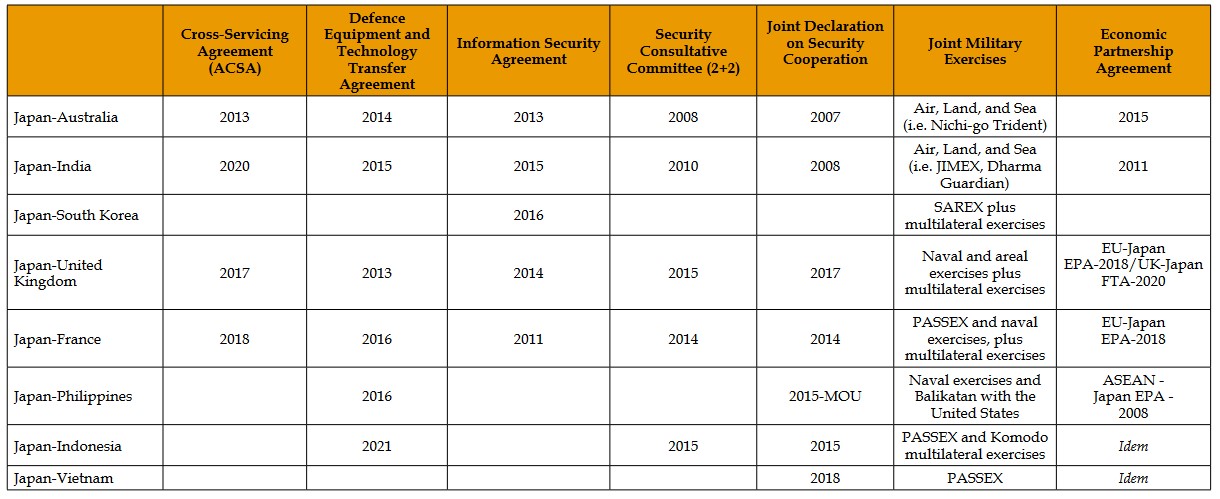
Chart 2
Trilateral Cooperation and Quadrilateral Dialogue
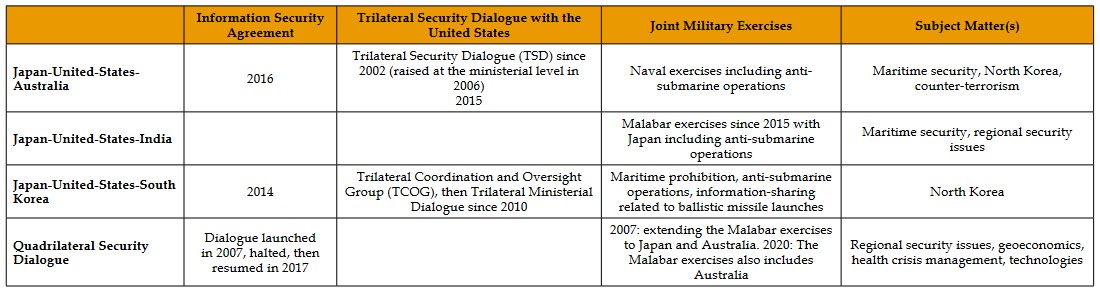
Figure 1
Japan’s security cooperation schemes: a “multi-layered” system
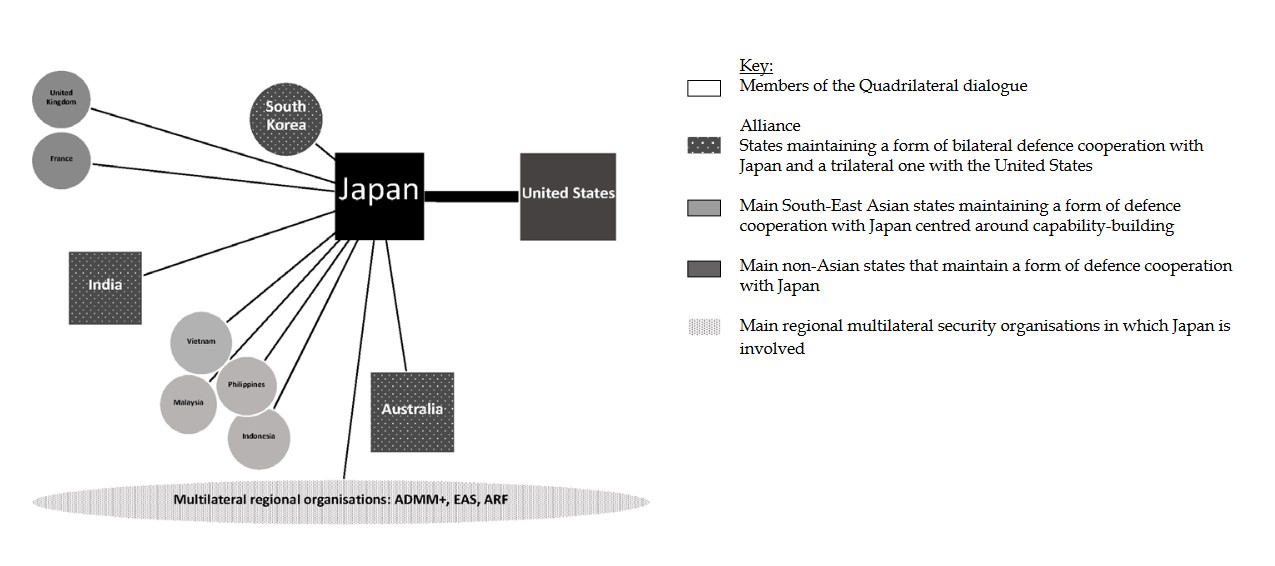
Authors
Delphine Deschaux-Dutard is an associate professor in political science at the University Grenoble Alpes (France) and the vice-dean for international relations of the Faculty of Law at this university. She holds a Ph.D. from Sciences Po Grenoble (2008) dedicated to the role of French and German diplomatic and military actors in the development of European Defence Policy since the 1990s. She has published several articles, books and chapters on security and defence issues. Her latest publications include: “EU Cyber Defence Governance: Facing the Fragmentation Challenge”, in C. Lavallée, R. Csernatoni, A. Calcara (eds.), The European Governance of Emerging Security Technologies, Routledge, 2020; Methods in defence studies, Routledge, 2020.
Béatrice Hainaut holds a Ph.D. in political science, international relations from the University of Paris 2 Panthéon-Assas. The subject of her thesis was “Emergence and promotion of the norm on space security”. She currently works at the French Space Command.
Camille Morel is a research fellow at the Centre for International Security and Defence Studies (University of Lyon) and a lecturer at the Paris School of International Affairs (Sciences Po, Paris). She holds a Ph.D. in Law from the Jean Moulin Lyon III University. Her research mainly focuses on the geopolitics of submarine communication cables and the role of technologies in changes occurring on the international scene. Previously, Camille worked as an expert for the French Prime Minister’s services (2018-2020) and was an associate Ph.D. Candidate at the Institute for Strategic Research (IRSEM) (2016-2019). She was also an associate researcher at the French Navy Centre for Strategic Studies (2015-2019).
Celine Pajon is head of Japan Research at the Center for Asian Studies of the French Institute of International Relations (IFRI), Paris, where she has been a research fellow since 2008. In October 2020, she joined the Japan Programme at VUB as a senior researcher. Céline is also an international research fellow with the Canon Institute for Global Studies (CIGS) in Tokyo and was a visiting fellow with the Japan Institute for International Affairs (JIIA), Tokyo, back in 2016. Her area of expertise is Japan’s foreign and defence policy, as well as geostrategic dynamics of the Indo-Pacific area, including the position of France and Europe in the region.
Friederike Richter is a research associate at the Universität der Bundeswehr München, and a Ph.D. candidate in Political Science at the Centre de recherches politiques de Sciences Po (CEVIPOF). She is also a Teaching Assistant at the Paris School of International Affairs (Sciences Po, Paris), and a research fellow at the Chaire Économie de Défense. Her research focuses on policy agendas. She is particularly interested in how security and defence issues become and remain a government priority in Europe. Before starting her Ph.D., she worked for the European Commission and a public affairs consultancy in Brussels.